
I. Event Recap
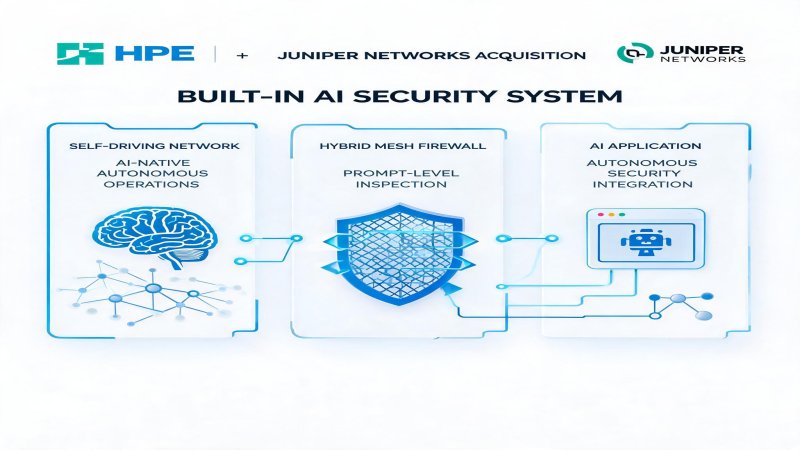
After completing the Juniper Networks acquisition in 2024, HPE (Hewlett Packard Enterprise) rapidly consolidated its networking and security capabilities into a unified strategic framework during 2025-2026. Facing AI-driven cyberattacks, HPE unveiled a series of security enhancements at the 2026 RSA Conference: the Juniper Networking SRX400 series firewalls extend carrier-grade security capabilities to edge sites; the Hybrid Mesh Firewall gained AI application visibility, prompt-level inspection, and centralized identity protection; and the Self-Driving Network deeply integrates AI-native operations with built-in zero trust.
Financial data reveals the explosive power of this integration. HPE's Q2 FY2026 earnings showed quarterly revenue of $10.7 billion, up 40% year-over-year, a new record. Networking revenue reached $2.7 billion, surging 151.5% with a 23.7% operating profit margin. Campus and branch networking revenue was $1.2 billion, up 42%. Management raised full-year networking revenue growth guidance to 65%-70%, implying approximately $11 billion in networking revenue—nearly equivalent to a standalone networking giant.
The core driver of HPE's networking revenue explosion is the post-Juniper integration synergy. Data center networking performance is particularly strong, with high-end firewalls like the SRX4300 and SRX4700 gaining strong traction in enterprise and carrier markets. HPE claims its networking-security convergence solution's market traction far exceeds expectations, with overall performance running approximately two years ahead of plan.
II. Technical Depth
2.1 Self-Driving Network: From "Managed Network" to "Autonomous Network"
HPE's Self-Driving Network is its most differentiated technical vision. Unlike traditional network management requiring extensive manual configuration and troubleshooting, the Self-Driving Network combines autonomous AI-native operations with built-in zero trust, shared visibility, and end-to-end policy enforcement, enabling networks to automatically optimize, self-heal, and self-protect at machine speed.
This vision's technical implementation relies on three layers:
- Experience-First Intelligence: AI-driven network insights focus not just on device status but on user experience quality, achieving the leap from "network available" to "experience excellent"
- Agentic AI: AI agents within the network can autonomously execute complex tasks such as fault diagnosis, capacity planning, and security response, reducing human intervention
- Integrated Security: Security is no longer an add-on to the network but a gene built into the network architecture—zero trust policies are enforced from the access layer, covering users, devices, and workloads
2.2 Hybrid Mesh Firewall: Unified Policy Enforcement for the AI Era
The Hybrid Mesh Firewall is HPE's core product for addressing distributed AI workload security needs. The 2026 major update endowed it with three major AI governance capabilities:
| Capability | Function Description | Technical Implementation |
|---|---|---|
| AI Application Visibility | Comprehensive view of AI application usage across the organization | Automatically identifies approved and unauthorized AI tools, distinguishing Shadow AI from compliant applications |
| Prompt-Level Inspection | Prevents data leakage through AI interactions | Filters keywords, manages file uploads, protects IP and customer data while allowing efficient access |
| Centralized Identity Protection | Unified security policies across environments | Policy consistency across physical, virtual, and containerized environments, ensuring policies follow users and workloads rather than just devices |
2.3 SRX400 Series: Carrier-Grade Standards for Edge Security
The SRX400 series is HPE's key product for下沉 carrier-grade security to the edge. Taking the SRX4300 as an example, its technical specifications reflect high-end firewall performance standards:
- Trio ASIC Architecture: Distributed architecture using Network Processing Units (NPUs) and Services Processing Units (SPUs) for scalable packet processing
- Built-in Zero Trust: Supports EVPN-VXLAN fabric integration and AI predictive threat prevention
- Centralized Management: Unified policy management through Juniper Security Director Cloud
- Performance Benchmark: According to Techzine, the SRX400 series' threat blocking performance is comparable to the SRX5800, but with significantly reduced size and power consumption
The SRX4700 achieves 1.4 Tbps throughput using flow-based processing, separating control plane, security processing, and high-speed data forwarding. This distributed architecture design enables it to handle massive east-west traffic in AI data centers without sacrificing performance.
2.4 Confidential Compute and Data Resilience
HPE's 2026 security enhancements particularly emphasized confidential compute integration. Alletra Storage MP X10000 extends AI-ready object storage into modern data protection, providing ultra-high-speed backup and recovery capabilities. The partnership with CrowdStrike enhances incident response capabilities through the Zerto integration hub, enabling enterprises to recover quickly from incidents.
III. Financial Logic
3.1 Financial Explosion of Juniper Integration
HPE's Q2 FY2026 revenue of $10.7 billion (up 40% YoY) far exceeded Wall Street consensus of $9.74 billion. Networking revenue of $2.7 billion (up 151.5% YoY) was the brightest highlight, though this primarily reflects the Juniper consolidation effect. On a pro forma basis, networking revenue's mid-single-digit growth remains solid.
Key financial indicators show:
- Full-year networking revenue guidance: 65-70% growth, approximately $11 billion
- Operating profit margin: 23.7% for networking, down from 29.7% last year, reflecting integration-period investment costs
- AI infrastructure demand: Strong demand driving enterprise and data center network modernization
3.2 Synergy Value of Security Business
HPE's security strategy is not about independently selling security products, but enhancing overall solution value through network-security convergence. When enterprises buy HPE's network equipment, built-in security capabilities (such as SRX firewall hardware root protection, Hybrid Mesh Firewall unified policies) reduce the need for independent security purchases. This bundled model increases average deal size and customer stickiness.
3.3 Uncertainty in Investment Returns
Despite impressive revenue figures, networking operating profit margins declined from 29.7% to 23.7%, indicating the Juniper integration remains in the investment phase. R&D integration, product line streamlining, and channel consolidation require sustained capital and human investment. Management expects margins to gradually recover post-integration, but timelines carry uncertainty.
IV. Strategic Depth
4.1 "Built-in" vs "Bolted-on" Strategic Choice
HPE's "built-in, not bolted on" philosophy forms an interesting competitive counterpoint to Cisco's Hypershield. Both pursue built-in security, but with different technical paths and emphases:
| Dimension | HPE (Self-Driving Network) | Cisco (Hypershield) |
|---|---|---|
| Core Differentiation | Network "autonomy"—AI-native autonomous operations | Security "distributed execution"—DPU-embedded protection |
| Technical Foundation | Juniper carrier-grade routing + AI operations | Cisco network devices + eBPF/DPU security agents |
| Edge Strategy | SRX400 series下沉 carrier-grade security | Catalyst C9000 + Secure Firewall 200 |
| Data Center | SRX4700 (1.4 Tbps) + EVPN-VXLAN | Nexus 9300 + Silicon One G200 |
| Management Plane | Security Director Cloud | Cisco Security Cloud |
4.2 Positioning in Competitive Landscape
In the global cybersecurity market, HPE gained 2% market share through the Juniper acquisition (tied with Fortinet). While the share is modest, the HPE-Juniper combination holds unique advantages in carrier markets and large enterprises:
- Carrier-grade routing capabilities: Juniper's MX and PTX series hold important positions in carrier core networks, providing natural sales channels for security products
- End-to-end coverage from campus to data center: From Aruba's campus networks to Juniper's data center networks, HPE provides unified management and security policies
- AI workload-native support: SRX series' AI predictive threat prevention and Self-Driving Network's AI operations capabilities directly address AI-era network management needs
4.3 Ecosystem Partnership Strategy
HPE's ecosystem strategy is relatively focused but sufficiently deep. Partnership with CrowdStrike enhances endpoint security capabilities; integration with Zerto improves disaster recovery. Compared to Palo Alto Networks' deep binding with Google Cloud, HPE emphasizes openness and multi-vendor compatibility—an advantage in reducing vendor lock-in, but a disadvantage in lacking exclusive technical barriers.
V. Challenges and Concerns
5.1 Juniper Integration Complexity
Post-acquisition product integration and cultural alignment are HPE's biggest challenges. Management plane unification between Junos OS and HPE's existing networking products, channel consolidation, and sales team integration all require time. The decline in networking operating profit margins (29.7% -> 23.7%) is a direct manifestation of integration costs. Management claims to be approximately two years ahead of plan, but the market still needs to observe integration quality.
5.2 Market Acceptance of Advanced AI Security Features
Advanced features like Prompt-Level Inspection, while technologically advanced, carry high market education costs. Enterprise awareness of AI-specific threats is insufficient, and they may be unwilling to pay premiums for these "novel" features. HPE needs to demonstrate ROI for these features, not just technical advancement.
5.3 Competitive Pressure
In the AI data center security domain, Cisco's alliance with NVIDIA forms a powerful competitive barrier; Palo Alto Networks' Prisma AIRS covers the full AI lifecycle security; Fortinet's ASIC acceleration has irreplaceable advantages in high-throughput scenarios. HPE needs to find clear differentiated positioning to avoid falling into homogeneous competition.
5.4 Supply Chain and Delivery Capacity
Futurum Group analysis notes HPE faces supply constraint challenges. With strong AI infrastructure demand, ensuring timely delivery of SRX series firewalls and networking equipment is key to maintaining revenue growth.
VI. Conclusion
HPE has gained a strong networking foundation through the Juniper Networks acquisition and built a unique "Self-Driving Network Security" vision on this basis. Its strategic core lies in deeply integrating AI-native operations, zero trust architecture, and hybrid mesh security, making the network itself an active defense system.
For enterprise users, HPE's AI security layout provides three key values:
- Operational Simplification: Self-Driving Networks reduce reliance on manual security operations, with AI-native automation lowering complexity. Security Director Cloud's unified management enables enterprises to manage security policies across the entire network from campus to data center through a single console.
- Consistent Protection: Unified security policies from core data centers to edge branch offices eliminate security blind spots. SRX400 series hardware root protection ensures edge devices cannot be tampered with, while Hybrid Mesh Firewall's prompt-level inspection prevents AI applications from becoming new channels for data leakage.
- Business Resilience: Integrating network security with data protection into unified business resilience capabilities. Alletra Storage's ultra-high-speed backup and Zerto's disaster recovery capabilities enable enterprises to recover quickly after AI attacks.
From an investment perspective, HPE's Q2 FY2026 results demonstrate the short-term synergy effects of Juniper integration, but the decline in operating profit margins indicates integration remains in the investment phase. If the full-year $11 billion networking revenue target is achieved, it will consolidate HPE's position as a global top-tier networking-security vendor. However, integration quality, supply chain capacity, and market acceptance of advanced security features will be the key variables determining long-term success.
Why it Matters
HPE's "built-in security" philosophy forms direct competition with Cisco's Hypershield, but HPE emphasizes network "autonomy." The Self-Driving Network is not just a security product but a "network that thinks"—capable of autonomously sensing threats, adjusting policies, and optimizing performance. This vision holds special appeal for large carriers and enterprises requiring highly automated network management. Q2 FY2026 networking revenue of $2.7 billion (up 151.5% YoY) proves Juniper integration is releasing synergy, but operating profit margins declining from 29.7% to 23.7% indicate integration remains in the investment phase. With the global AI cybersecurity market projected to reach $133 billion by 2030 (29% CAGR), HPE's network-security convergence strategy enables it to capture dual growth dividends from both network infrastructure and AI security.
DECISION
- Enterprises with existing Juniper network infrastructure should prioritize evaluating SRX400 upgrades and Hybrid Mesh Firewall integration paths, leveraging Security Director Cloud for unified management.
- Enterprises concerned about AI application data leakage risks should deploy Hybrid Mesh Firewall's prompt-level inspection and AI application visibility features to distinguish Shadow AI from compliant applications.
- Large carriers and enterprises pursuing autonomous network operations should focus on evaluating the Self-Driving Network solution, paying attention to its AI-native operations and built-in zero trust security capabilities.
- Investors should focus on the recovery progress of HPE's networking operating profit margins and Juniper product integration quality, not just revenue growth rates.
PREDICT
- Within 12 months, prompt-level inspection will become standard configuration for enterprise AI security governance, with HPE Hybrid Mesh Firewall expected to cover 300+ large enterprise customers.
- Within 2 years, Self-Driving Networks will achieve large-scale deployment in major carriers and data centers, with Junos OS and HPE management plane completing deep integration.
- Within 3 years, HPE-Juniper product consolidation will be complete, networking operating profit margins will recover to 28%+, forming a unified network-security-storage data resilience platform.
Get 3-5 key AI infrastructure signals weekly →
💬 Comments (0)