
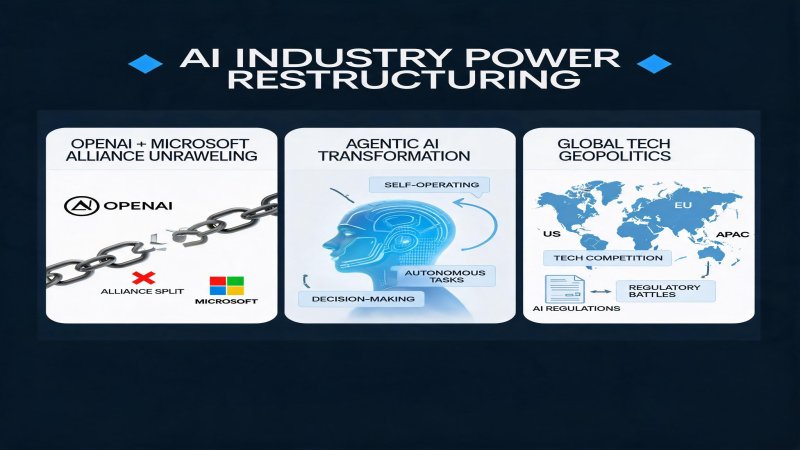
I. Event Recap: The Violent Shaking of AI Industry Power Structures
July 2026 witnessed multiple landmark events in the global AI industry, all pointing to a deep trend: the centralized AI power structure is fracturing, replaced by a more fragmented, multipolar new order.
On July 1, OpenAI and Microsoft formally implemented their revised partnership agreement from April 27. Under new terms, Microsoft's exclusive license to OpenAI models ended, giving OpenAI freedom to serve customers on any cloud platform while Microsoft retained only a "right of first refusal." This meant the capacity-commitment structure that had tightly bound OpenAI to Azure since 2019 was formally dissolved.
Almost simultaneously, Cloudflare announced global layoffs exceeding 1,100 people, roughly 20% of its workforce. CEO Matthew Prince stated in a memo that internal AI usage had surged over 600% in three months, requiring fundamental reorganization for the "Agentic AI era."
On July 5, news broke of Microsoft Azure cutting 200-400 roles in China, with some employees offered relocation to Canada. This was not cloud business contraction but strategic restructuring under geopolitical risk.
Additionally, Meta formally implemented 2-5% global ad location fees on July 1, passing digital services tax costs to advertisers. OpenAI announced it would gradually shut down its fine-tuning API, with existing customers unable to create new fine-tuning jobs by January 6, 2027.
Key Timeline and Data
- April 27, 2026: OpenAI and Microsoft revise partnership agreement
- July 1, 2026: New agreement takes effect; Cloudflare announces 20% layoffs; Meta implements location fees
- July 2, 2026: OpenAI fine-tuning API shutdown roadmap published
- July 5, 2026: Microsoft Azure China layoffs confirmed; Microsoft reportedly holds 27% of OpenAI
- Cloudflare Q1 2026 revenue: $639.8M, up 34% YoY
- Microsoft Azure Q3 FY2026 growth: 40% YoY; Intelligent Cloud quarterly revenue ~$34.7B
II. Technical Depth: The Structural Shift from Closed Alliances to Open Ecosystems
The OpenAI-Microsoft unbundling represents the inevitable result of AI industry technical architecture evolution, not merely a commercial dispute.
Capacity Bottleneck: The 3 Exaflops Gap
Background documents on the agreement revision reveal OpenAI's internal projections showed a need for nearly 3 exaflops of dedicated inference compute by mid-2026 to handle GPT-5.1 and its advanced reasoning agent ecosystem. Even with rapid expansion of NVIDIA GB200 and AMD Instinct MI400 clusters, Azure could not guarantee this capacity within rigid contractual frameworks. Meanwhile, Oracle OCI and CoreWeave both offered substantially lower per-GPU-hour pricing.
This reveals a technical-economic reality: no single cloud provider can satisfy a frontier AI company's full compute needs. AI model scaling (10x annually) outpaces any single data center buildout.
Multi-Cloud Architecture: From Exception to Norm
Four core changes in the new agreement fundamentally alter AI infrastructure rules:
- Exclusive license eliminated: OpenAI can license directly to any enterprise; Microsoft retains non-exclusive rights
- Capacity agreement unbundled: Old 95% Azure routing commitment replaced by "right of first refusal"
- Competitive notice period: OpenAI must provide 90 days' notice before signing with alternative clouds
- Revenue-sharing adjusted: Microsoft's 20% share applies only to traffic on its own platforms
For OpenAI, this is the beginning of an "any cloud, any customer" strategy. For Microsoft, losing exclusive API revenue share could create a $4-6 billion annual profit gap, though it retains deep Copilot ecosystem integration rights.
Agentic AI: The Organizational Technology Earthquake
Cloudflare's layoffs provide a window into how Agentic AI impacts organizational structure. The company's internal AI usage surged 600% in three months, with thousands of employees across engineering, HR, finance, and marketing running numerous AI agent sessions daily. This forced the company to "reimagine every internal process, team, and role."
Cloudflare categorized AI crawlers into Search, Agent, and Training types, announcing default blocking of mixed-use AI crawlers starting September 15. This "first systematic legislation at the internet infrastructure layer" signals that network gatekeepers are transforming from "security guards" into "rule-makers plus market participants."
Four-Vendor Competitive Matrix
| Dimension | Microsoft | OpenAI | Cloudflare | Meta |
|---|---|---|---|---|
| Core AI Strategy | Copilot ecosystem + Azure AI | Model platformization + multi-cloud | AI security + agent management + edge | AI advertising + social agents |
| Latest 2026 Move | Ended OpenAI exclusive license | Unbundled from Azure; shut fine-tuning API | 20% layoffs reorg; blocked AI crawlers | Implemented ad location fees |
| AI-Related Revenue | Azure AI growing 40% | Diversifying API revenue | Q1 revenue $639.8M | Ad revenue +2-5% location fees |
| Primary Risk | $4-6B annual profit gap | Rising compute costs | Service continuity + valuation pressure | Advertiser churn risk |
| Geopolitical Exposure | Azure China layoffs | U.S. government security review | Global infrastructure regulation | EU digital tax compliance |
| Agentic AI Positioning | Copilot Runtime | GPT-5.1 reasoning agents | AI agent discovery and governance | Social AI agents |
III. Financial Logic: The Economics of Alliance Dissolution and AI ROI Restructuring
The OpenAI-Microsoft unbinding is not merely a strategic partnership adjustment but involves the redistribution of billions of dollars in value.
Microsoft's Financial Shock and Response
Goldman Sachs analysts estimate that removing the exclusive API revenue share could create a $4-6 billion annual gap in Microsoft's AI services profit. Previously, Microsoft collected 20% on all OpenAI API calls regardless of hosting cloud. Under new terms, this applies only to traffic flowing through Microsoft platforms.
To compensate, Microsoft is accelerating monetization of proprietary AI models (Phi family and upcoming MARS reasoning model), which run entirely on Azure with no partner revenue split. The company also announced a $15 billion expansion of AI-optimized datacenters, targeting 30% per-teraflop cost reduction before 2027.
OpenAI's Platformization Gamble
For OpenAI, unbundling is a necessary step to become a "platform company." Previously, OpenAI functioned as an advanced Azure feature module; now it can pursue an "any cloud, any customer" strategy. Oracle and CoreWeave issued statements within hours welcoming opportunities to bid for OpenAI workloads.
OpenAI also plans to offer dedicated "Sovereign AI" instances for highly regulated industries like defense, finance, and healthcare. Previously available only through Azure Government Secret clouds, these can now deploy on any compliant infrastructure, potentially unlocking hundreds of millions in new contract revenue.
The Agentic AI Efficiency Revolution
Cloudflare's case shows Agentic AI is redefining tech company cost structures. When internal AI usage surges 600% in three months, traditional human resource structures appear redundant. The company offered industry-leading severance (full base pay through end of 2026, healthcare through year-end, equity vesting through August 15), but this cannot obscure a fundamental fact: AI is systematically displacing white-collar work.
If Cloudflare's 20% reduction can be attributed to AI efficiency gains, the tech industry may see 10-20% similar "AI-driven organizational optimization" over the next three years. This will profoundly change tech stock valuation logic: revenue growth may slow, but margins could structurally improve.
IV. Strategic Depth: How Geopolitics and Digital Sovereignty Reshape the Tech Landscape
AI industry power restructuring occurs not only at the commercial level but is deeply shaped by geopolitics and digital sovereignty.
U.S.-China Tech Competition: From Trade to Operations
Microsoft Azure's China layoffs represent the latest example of geopolitical risk penetrating tech company operations. This is not cloud business slowdown (Azure growing 40% globally) but "a map being redrawn around sovereignty, compliance, and geopolitical risk."
Layoff details show adjustments primarily affecting Azure operations roles, with other Microsoft units in Shanghai and Suzhou untouched. Some employees were offered relocation to Canada, suggesting Microsoft wants certain work performed in jurisdictions less exposed to China-specific constraints.
For U.S. tech companies, China is transforming from a "complicated but necessary market" into "the front line of strategic competition." Washington increasingly focuses on where advanced cloud and AI capabilities may be accessed, trained, supported, or exported. Beijing intensifies data localization, security reviews, and limits on foreign influence over sensitive digital infrastructure. The result is a narrowing corridor for multinational cloud teams working across borders.
Digital Tax and Regulation: The New Cost Structure for Global Tech Platforms
Meta's July 1 implementation of 2-5% ad location fees represents the microcosm of tightening global digital regulation. Rates of 2% in the UK, 3% in France/Italy/Spain, and 5% in Austria/Turkey shift digital services tax costs from platforms to advertisers. Google and Amazon have taken similar measures.
This represents a global trend: tech platforms can no longer internalize regulatory costs but must transmit them through pricing mechanisms to ecosystem participants. For Meta, this means stable profit protection; for advertisers, increased complexity and uncertainty in global marketing budgets.
Content Sovereignty: Cloudflare's "AI Toll Station"
Cloudflare's default AI crawler blocking represents the first systematic regulation of AI data harvesting at the internet infrastructure layer. The company categorized AI crawlers into Search, Agent, and Training types, allowing website owners to set permissions independently.
More ambitiously, its "Pay Per Use" model pays publishers when their content genuinely generates value in AI systems (e.g., appearing in AI search results). Cloudflare is building an "AI content toll station" with itself as the hub, simultaneously playing rule-maker, rule-enforcer, and market participant.
V. Challenges and Concerns: Risks and Uncertainties in Power Restructuring
The AI industry's power restructuring brings opportunities alongside multiple risks and uncertainties.
Technology Fragmentation Risk
The OpenAI-Microsoft unbundling means AI model deployment enters a fragmented era. Enterprise customers may need to manage multiple API endpoints, authentication systems, and compliance policies across Azure, AWS, Google Cloud, and OpenAI's own platform. This fragmentation increases operational costs and complicates security boundaries.
Microsoft's product team has promised six-month deprecation notices and open-source migration tools for any API divergence, but real-world migration costs remain significant.
Antitrust and Regulatory Uncertainty
The U.S. FTC opened an inquiry in late 2025 into the OpenAI-Microsoft partnership structure, questioning whether exclusive licensing and fixed capacity arrangements constituted an unregistered merger. While unbundling is a preemptive step, the FTC's final ruling could still impose binding requirements on both parties.
In the EU, the Digital Markets Act (DMA) constraints on large platforms are strengthening. Google has proposed search ranking adjustments to address EU concerns about news rankings. The regulatory environment facing global tech platforms grows increasingly complex.
Agentic AI Employment Impact
Cloudflare's 20% reduction may be just the beginning. When AI agents can replace white-collar work spanning code writing, customer service, and financial analysis, the tech industry and broader service sectors face structural employment shocks.
The critical question is transition speed. If AI capability improvement is gradual, labor markets can adapt through retraining and education. But if it is abrupt (as Cloudflare's case shows with 600% usage surge in three months), social adjustment mechanisms may not react in time.
Geopolitical Chain Reactions
Microsoft Azure China layoffs may trigger chain reactions. Other U.S. cloud providers (AWS, Google Cloud) could face similar geopolitical pressure to adjust China operations. This will accelerate the "camping" split of global cloud infrastructure into U.S.-led and China-autonomous systems.
For enterprise customers, this means multi-cloud strategy is not merely a technical choice but a geopolitical risk management tool. Global unified architectures dependent on single cloud providers may suddenly become unworkable in specific regions.
VI. Conclusion: Investment Perspective and Forward-Looking Judgments
AI industry power restructuring is accelerating, with more alliance dissolutions, organizational restructurings, and geopolitical contests expected over the next 12-24 months.
Recommendations for CIOs/CTOs
First, elevate multi-cloud AI strategy from optional to mandatory. For OpenAI model deployment, actively explore AWS Bedrock, Google Vertex AI, and Oracle OCI alternatives to avoid over-dependence on Azure. Establish cross-cloud unified AI governance frameworks managing API consistency, cost, and security.
Second, launch Agentic AI pilot projects with accompanying workforce transition plans. Prioritize high-ROI scenarios like customer service, code generation, and data analytics, while providing retraining opportunities for affected employees. Cloudflare's case shows that Agentic AI deployment without workforce transition planning can trigger organizational turmoil.
Third, re-examine cloud provider geographic distribution. Ensure critical workloads deploy in compliant and geopolitically stable regions, with emergency plans for potential cross-border service interruptions.
Recommendations for Investors
First, watch Microsoft AI services margin changes. OpenAI unbundling effects may become visible in H2 2026 financials. Azure AI growth figures need careful decomposition between proprietary model revenue and third-party model share revenue.
Second, position in Agentic AI infrastructure. AI agent proliferation will create massive demand for agent security, orchestration, monitoring, and edge inference. Cybersecurity companies like Cloudflare and Zscaler, plus data platforms like Databricks and Snowflake, may benefit.
Third, beware geopolitical risk valuation discounts for tech stocks. Against intensifying U.S.-China tech competition, U.S. tech companies with significant China revenue exposure may face persistent valuation pressure.
Forward-Looking Judgment
By 2027, the AI industry will exhibit three structural characteristics: First, top-tier AI models will universally adopt "multi-cloud + self-hosted" hybrid deployment architectures, making single-cloud lock-in history. Second, Agentic AI will drive 10-15% average layoffs at tech companies, but margins will structurally improve 200-300 basis points. Third, the global cloud market will split into U.S.-led, China-autonomous, and Europe-neutral camps, requiring multinational enterprise IT architectures to adapt to this new reality of "fragmented globalization."
Why it Matters
The OpenAI-Microsoft unbundling marks a structural inflection point as the AI industry shifts from single-cloud dependency to multi-cloud freedom. This could reduce Microsoft's AI services profit by $4-6 billion annually while forcing AWS, Google Cloud, and Oracle to compete directly for OpenAI compute contracts. Meanwhile, Agentic AI is fundamentally changing tech company organization—Cloudflare's internal AI usage surged 600% in three months, directly triggering 20% layoffs. Geopolitically, Microsoft Azure's China cuts reflect strategic retreat amid U.S.-China rivalry, a derisking repositioning that will reshape global cloud infrastructure geography over the next three years. For CIOs and investors, multi-cloud strategy moves from optional to mandatory, while AI Agent deployment will profoundly reshape enterprise workforce structures and IT spending patterns.
DECISION
[CIO/CTO] 1. Immediately evaluate multi-cloud AI strategies to avoid over-dependence on a single cloud provider; explore AWS Bedrock and Google Vertex AI alternatives for OpenAI model deployment. 2. Launch Agentic AI pilot projects, prioritizing high-ROI scenarios like customer service, code generation, and data analytics, while developing corresponding workforce transition plans. 3. Re-examine cloud provider geographic distribution to ensure critical workloads run in compliant and geopolitically stable regions. [Investors] 4. Monitor Microsoft AI services margin changes; OpenAI unbundling effects may become visible in H2 2026 financials. 5. Position in Agentic AI infrastructure, including AI security, agent orchestration, and edge inference segments.
PREDICT
- By end of 2026, at least 30% of OpenAI inference workloads will run on non-Azure clouds, with Oracle and CoreWeave as primary beneficiaries. 2. Within 12 months, at least 5 Fortune 500 companies will announce 10%+ layoffs attributed to Agentic AI deployment, with Cloudflare's cuts seen as industry precedent. 3. Before 2027, U.S.-China tech decoupling will force at least 3 U.S. cloud providers to exit or drastically reduce China operations, splitting the global cloud market into U.S.-led and China-autonomous camps. 4. OpenAI's fine-tuning API shutdown will spawn a $5B+ open-source model fine-tuning services market, with Hugging Face, Together AI, and similar startups as primary beneficiaries.
Get 3-5 key AI infrastructure signals weekly →
💬 Comments (0)