
I. Event Recap
In early July 2026, the global AI infrastructure supply chain witnessed multiple major events with cascading effects. On July 1, Bloomberg reported that Meta is developing a cloud infrastructure business plan to sell AI compute and model access to external customers, directly competing with AWS, Microsoft Azure, and Google Cloud. The strategic pivot had immediate market impact: Meta shares surged over 10% intraday on July 1, closing up 8.81%; but fell 4.9% on July 2 after Zuckerberg admitted at an all-hands meeting that AI agent development had not accelerated as expected.
During the same period, NVIDIA unveiled an AI compute partnership program, transforming from a pure GPU seller into an AI cloud ecosystem participant. The program combines revenue sharing with credit support for emerging GPU cloud providers—if partners fail to lease all GPU capacity, NVIDIA will repurchase excess capacity at agreed prices; in exchange, NVIDIA receives a percentage of partners' cloud service revenue.
Microsoft also announced on July 2 the formation of Microsoft Frontier Company, investing $2.5 billion and deploying 6,000 industry experts and engineers to deliver effective AI deployment projects for enterprise customers. Meanwhile, Jefferies' latest Q2 CIO survey revealed that Microsoft Azure's lead over AWS in preferred cloud provider status had widened from 7 percentage points in December 2025 to 27 points (55% vs 28%), while AWS declined from 38% to 28%.
On the semiconductor equipment side, ASML announced on July 2 that it was raising its 2026 revenue guidance from EUR 34-39 billion to EUR 36-40 billion. Samsung Electronics is negotiating to raise Q3 2026 general-purpose DRAM ASP by 20% sequentially, following a 90% increase in Q1. Amazon successfully launched 29 Kuiper low-earth orbit satellites on July 2, accelerating its satellite internet deployment.
Key Timeline:
- July 1: Meta reported planning to sell AI compute; NVIDIA launched AI compute partnership program
- July 2: Zuckerberg's internal admission; Microsoft Frontier formation; ASML guidance raise; Jefferies CIO survey
- July 2: Amazon Kuiper launch; Samsung DRAM pricing negotiations revealed
Financial Data:
- Meta 2026 AI infrastructure spending: up to $145 billion
- NVIDIA H2 FY2027 datacenter revenue expected 20% above Wall Street consensus
- ASML 2026 revenue guidance raised 5-8% to EUR 36-40 billion
- Global top 9 cloud providers' 2026 capex estimated at $830 billion, 79% YoY growth
- Q1 2026 global cloud infrastructure spending: $128.6 billion, up 35% YoY
II. Technical Depth
Meta's technical foundation for selling AI compute stems from its massive AI infrastructure buildout over the past two years. Meta's 2026 AI infrastructure spending will reach up to $145 billion, representing a significant portion of the over $700 billion in combined AI investment by major tech companies. Meta is considering two routes: first, selling access to AI models hosted on its own infrastructure, including its self-developed Muse Spark model, similar to AWS Bedrock; second, selling raw compute power directly, competing with emerging GPU cloud providers like CoreWeave.
NVIDIA's AI compute partnership program represents a fundamentally new business model for chip vendors. Traditionally, NVIDIA generated revenue through GPU hardware sales, but as AI compute supply gradually loosens, NVIDIA is using revenue-sharing to deeply bind downstream cloud providers. This "leaseback + revenue share" mechanism both lowers financing barriers for emerging cloud providers and ensures NVIDIA maintains stable cash flow even when compute demand fluctuates.
On the semiconductor manufacturing side, ASML's EUV lithography machines are essential for 3nm and below advanced processes. ASML plans to increase annual EUV capacity to 60 units in 2026 and 80 in 2027. TSMC's 2nm expansion involves four fabs targeting 60,000 wafers per month. Samsung plans to increase its 3nm process capacity to 100,000 wafers per month.
Four-Vendor Competitive Matrix:
| Dimension | Meta | NVIDIA | Microsoft Azure | Amazon AWS |
|---|---|---|---|---|
| AI Compute Strategy | Sell excess capacity + model APIs | Revenue share + leaseback | Enterprise AI deployment services | Kuiper satellites + GovCloud |
| 2026 Capex | $145 billion | $40 billion investment | Not separately disclosed | Not separately disclosed |
| Core Advantage | Social data + self-developed models | GPU monopoly + CUDA ecosystem | Enterprise integration + Office ecosystem | Market share leader (28%) |
| Primary Risk | Slow self-developed model commercialization | Compute glut causing price declines | China business contraction | Azure competitive pressure |
| Target Market | External enterprise customers | Emerging GPU cloud providers | Global enterprise customers | Government + enterprise |
III. Financial Logic
Meta's financial motivation for transforming from AI compute mega-buyer to potential seller is clear: convert massive capital expenditures into revenue streams. Institutional estimates suggest that if Meta's cloud business fully scales, annualized revenue could reach up to $264 billion by 2028. However, the market questions whether Meta truly has sufficient idle capacity to sell. Meta previously signed a $60 billion multi-year chip supply agreement with AMD, over $21 billion in six-year compute contracts with CoreWeave, and nearly $27 billion in compute procurement with Nebius. The transformation of one of the largest buyers into a seller directly undermined market confidence in the "compute scarcity" narrative.
NVIDIA's financial driver is defensive positioning. SemiAnalysis' supply chain research indicates NVIDIA's H2 FY2027 datacenter compute revenue will be 20% above Wall Street consensus. However, as AMD and Intel accelerate their追赶, and with cloud providers' custom chips (Google TPU, Amazon Trainium) gaining traction, NVIDIA needs business model innovation to maintain high margins. Revenue sharing may dilute near-term revenue but locks in long-term customer relationships.
ASML's guidance raise is driven by surging demand for advanced lithography equipment for AI chip manufacturing. Leading foundries TSMC and Samsung are accelerating High-NA EUV adoption. ASML's Q1 memory-related equipment sales accounted for 51% of total, logic for 49%. SK Hynix recently placed a record $8 billion EUV equipment order with ASML.
Samsung's DRAM price increases reflect demand structural changes from AI inference workload growth. General-purpose DRAM ASP rose 90% QoQ in Q1 2026 and 50-60% in Q2. As AI inference workloads expand, general-purpose DRAM is returning to center stage, especially LPDDR, whose energy efficiency advantages make it increasingly chosen as off-chip cache by AI chips.
IV. Strategic Depth
From a competitive landscape perspective, the global AI infrastructure market is shifting from "oligopoly" to "multi-polar competition." Traditionally dominated by AWS, Azure, and Google Cloud, the market structure is changing with the rise of emerging GPU cloud providers like CoreWeave, Lambda, and Nebius. Meta's entry will further intensify competition, though its business model faces significant uncertainties.
Microsoft Azure's rapidly expanding lead deserves special attention. In the "preferred cloud provider" metric, Azure leads AWS 55% to 28%, driven by Microsoft's deep enterprise market accumulation and successful Copilot integration. However, AWS still holds approximately 28% of global cloud infrastructure market share, followed by Microsoft at 21%.
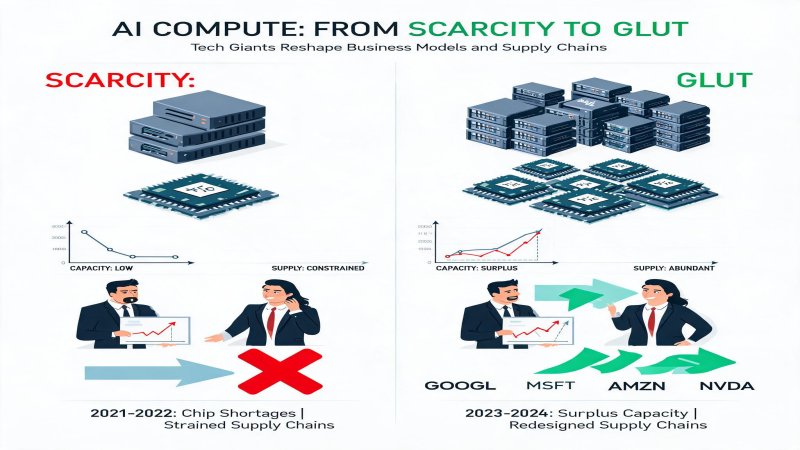
From a supply chain perspective, there is a clear "scissors gap" in the AI compute market: upstream semiconductor equipment (ASML) and chip design (NVIDIA) maintain high prosperity, while downstream cloud providers face increasing ROI pressure. Goldman Sachs' 1-Delta trading desk head Rich Privorotsky warned that the market's core premise has been compute scarcity; once supply increases and lease prices decline, the shortage narrative will be directly undermined.
Vendor Strategy Matrix:
| Strategic Position | Representative Vendors | Core Strategy | Risk Factors |
|---|---|---|---|
| Compute Seller Transformation | Meta, NVIDIA | Shift from procurement to sales/sharing | Insufficient demand, price wars |
| Platform Ecosystem Expansion | Microsoft, Google | Enterprise AI integration, Office ecosystem | Regulatory risk, China contraction |
| Infrastructure Expansion | Amazon, ASML | Satellite networks, lithography capacity | Capital intensive, long cycles |
| Storage/DRAM | Samsung, SK Hynix | Price increases, capacity restructuring | Demand volatility, intensified competition |
V. Challenges and Concerns
Meta's biggest risk in exploring compute sales lies in its slow self-developed AI commercialization progress. Meta's Muse Spark model, launched in April 2026, remains closed to developers, with no clear external launch timeline according to The Wall Street Journal. Unlike Google and OpenAI, Meta's self-developed AI models and supporting services have relatively weak external market demand. If Meta cannot offer competitive AI models, selling raw compute alone will plunge it into price wars with CoreWeave and similar providers.
NVIDIA's revenue-sharing model, while innovative, carries hidden risks. If the compute market experiences serious oversupply, NVIDIA's leaseback commitments could become a heavy burden. Additionally, this model may attract antitrust scrutiny, as NVIDIA both provides hardware and participates in downstream operations, creating potential conflicts of interest.
Semiconductor equipment concerns center on geopolitical risk. Although ASML raised its guidance, CEO Christophe Fouquet warned that macro uncertainties could disrupt growth momentum. Under the US-China tech decoupling trend, ASML's export restrictions to mainland China are affecting its revenue structure.
DRAM market price increases may also face macroeconomic constraints. If AI inference demand growth falls short of expectations, or if global economic slowdown causes enterprise IT spending contraction, memory vendors like Samsung could face inventory accumulation risks.
VI. Conclusion
From an investment perspective, the AI infrastructure supply chain is at a critical transition from "crazy construction phase" to "rational returns phase." Meta's compute sales exploration, NVIDIA's revenue-sharing model, and intensifying competition among cloud providers all indicate the industry is reassessing the commercial logic of AI investment.
In the near term, semiconductor equipment (ASML) and high-end DRAM (Samsung, SK Hynix) will continue benefiting from AI chip capacity expansion, offering relatively high earnings certainty. Microsoft Azure, with its enterprise ecosystem advantages, is well-positioned to continue gaining share in cloud competition.
Over the medium term, the AI compute market may face supply-demand rebalancing. If new business models from Meta, NVIDIA, and others succeed, they will accelerate compute普及 and lower prices—positive for downstream application developers but pressuring hardware vendor margins.
Forward-looking judgment: Over the next 6-12 months, the investment theme in AI infrastructure will shift from "compute scarcity" to "compute efficiency." Vendors achieving breakthroughs in model optimization, inference acceleration, and energy efficiency will generate excess returns. Meanwhile, platform vendors offering one-stop AI solutions (rather than raw compute alone), such as Microsoft, will occupy increasingly favorable competitive positions.
Why it Matters
ROI anxiety over AI infrastructure investment is reshaping the entire technology supply chain. Global top 9 cloud providers' 2026 capex is estimated at $830 billion (79% YoY growth), but Meta's transformation from compute mega-buyer to seller indicates waning market confidence in the 'compute scarcity' narrative. This shift will directly impact valuation logic for semiconductor equipment (ASML), memory chips (Samsung, SK Hynix), GPUs (NVIDIA, AMD), and cloud computing (Microsoft Azure, AWS). For CIOs and technology decision-makers, increased compute supply means potential cloud price declines, but lower barriers for AI application development and deployment.
DECISION
For CIOs/CTOs: 1) Re-evaluate multi-cloud strategy—Azure's enterprise integration advantage is expanding, but watch for vendor lock-in risks; 2) Monitor compute price decline trends—2027 may be favorable for cloud contract renegotiation; 3) Prioritize AI inference optimization over pure training compute expansion. For investors: 1) Near-term bullish on ASML and high-end DRAM capacity expansion dividends; 2) Medium-term cautious on NVIDIA margin pressure and Meta compute sales uncertainty; 3) Long-term position in platform vendors offering one-stop AI solutions (Microsoft). For security decision-makers: 1) AI infrastructure expansion creates new attack surfaces—simultaneously strengthen cloud security and AI model security investments.
PREDICT
Next 3-6 months: Meta will announce more cloud business details, potentially triggering a new round of cloud provider price wars; NVIDIA's Q2 earnings (August 26) will be a key milestone for validating market acceptance of the revenue-sharing model. Next 6-12 months: AI compute market will face supply-demand rebalancing, with cloud service prices potentially declining 10-15%; Microsoft Azure is expected to continue expanding enterprise market share. Next 12-24 months: ASICs and custom chips (Google TPU, Amazon Trainium) will exert greater competitive pressure on NVIDIA GPUs; edge AI inference demand explosion will drive rapid growth in LPDDR and low-power memory markets.
Get 3-5 key AI infrastructure signals weekly →
💬 Comments (0)