
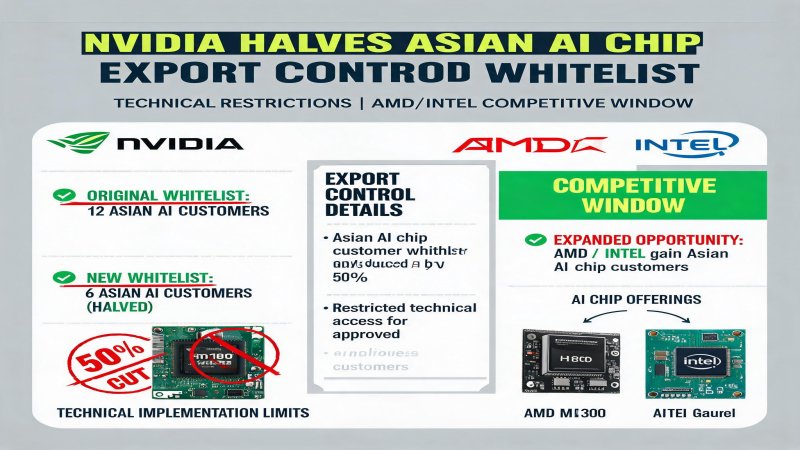
I. Event Recap: NVIDIA's Asian Whitelist System and Background
On July 14, 2026, NVIDIA, the global AI chip leader, announced a decision that shook the industry: drastically reducing the number of authorized AI chip customers in Asia by more than half. The company established a completely new whitelist system in key markets including Singapore, Malaysia, and Japan, where only buyers passing strict compliance reviews can qualify to purchase high-end AI chips such as H100, H200, and B100.
The direct catalyst for this intensified due diligence was the US government's recent escalation of efforts to prevent advanced AI chips from illegally flowing to China. According to Reuters and other media reports, large quantities of NVIDIA AI chips had previously been transshipped to China through intermediaries in Southeast Asian countries, circumventing US export controls. The US Commerce and Treasury Departments launched multiple investigations and exerted enormous compliance pressure on NVIDIA.
NVIDIA's new review process includes three core components:
- Customer Ownership Review: Penetrating examination of corporate equity structures for applicants, identifying indirect Chinese entity holdings (including VIE structures and offshore companies).
- End-Use Verification: Requiring customers to submit detailed AI chip usage plans, including data center locations, application scenarios (training/inference), and expected deployment scale.
- Deployment Monitoring: NVIDIA uses hardware-level remote monitoring technology (including GPS modules in GPU firmware and network traffic analysis) to track the actual deployment locations and usage patterns of sold chips.
On the same day, NVIDIA also announced a strategic partnership with Mitsubishi Heavy Industries to jointly build AI data centers in Japan. This collaboration is viewed as NVIDIA's compliance showcase in the Japanese market—by partnering with local industrial giants to establish transparent, controllable AI computing infrastructure, the company aims to allay regulator concerns.
Key Event Timeline:
- Q4 2025: US Commerce Department begins investigating clues of NVIDIA chips transshipped to China through Southeast Asia
- Q1 2026: NVIDIA discovers multiple suspicious orders in Singapore and Malaysia, proactively halting some shipments
- June 2026: US Congressional hearing demands NVIDIA strengthen export compliance
- July 14, 2026: NVIDIA officially announces Asian whitelist system, cutting customer base by over 50%
II. Technical Deep Dive: Whitelist Compliance System Architecture
NVIDIA's whitelist system is not merely an administrative process but a complex technical system integrating hardware, software, and data analytics.
Hardware Layer: GPU-Built-in Geofencing and Authentication
Starting with the Hopper architecture (H100), NVIDIA embedded hardware-level security modules in GPUs. These modules contain immutable device unique identifiers (Device IDs) and geolocation capabilities (via GPS modules or IP address inference). When GPUs boot, they send heartbeat signals to NVIDIA's authentication servers, reporting their geographic location and network environment. If a device is detected in unauthorized regions (such as mainland China), the GPU automatically degrades to limited-functionality mode, with computing performance dropping over 80%.
Software Layer: CUDA Licensing and Driver Control
NVIDIA further strengthens compliance through CUDA toolkit licensing mechanisms. Whitelist customers receive CUDA license keys bound to their corporate identity when purchasing GPUs. These keys activate during driver installation and periodically (weekly) validate online with NVIDIA's license servers. If a key's corresponding enterprise is found violating end-use agreements, NVIDIA can remotely revoke the key, rendering the GPU unable to run CUDA programs—effectively bricking the device for AI applications dependent on the CUDA ecosystem.
Data Layer: Supply Chain Tracking and Anomaly Detection
NVIDIA established a blockchain-based supply chain tracking system, recording data from wafer fabrication (TSMC) to packaging testing (ASE), through distributors to end customers, on an immutable distributed ledger. Through machine learning algorithms, NVIDIA can identify abnormal procurement patterns, such as: a customer's historical purchase volume suddenly surging, purchased GPU models mismatching their public business, or multiple GPUs' heartbeat signals originating from the same IP address range.
Review Process Technical Details
The whitelist application process typically includes:
- Enterprise Qualification Pre-screening (2 weeks): Submit business licenses, equity structure diagrams, and ultimate beneficiary declarations
- Business Scenario Assessment (2 weeks): NVIDIA technical team reviews AI workload types, expected frameworks (PyTorch/TensorFlow/JAX), and model scale
- On-site Due Diligence (1-2 weeks): For large orders, NVIDIA dispatches compliance teams for physical data center inspections
- Continuous Monitoring (ongoing): Quarterly usage reports submitted, with NVIDIA retaining right to spot inspections
Competitive Comparison Matrix:
| Dimension | NVIDIA | AMD | Intel |
|---|---|---|---|
| Hardware Geofencing | Yes (Hopper+) | No | No |
| Driver Remote Control | Yes (CUDA License) | Limited (ROCm) | Limited (oneAPI) |
| Supply Chain Blockchain | Yes | No | No |
| Compliance Team Size | 500+ | ~100 | ~80 |
| Export Control Response | Fastest (Whitelist) | Slower | Slower |
III. Financial Logic: Impact of Asian Market Contraction
NVIDIA's Asian whitelist system will significantly impact its financial performance in the short term, but long-term effects depend on overall global AI chip demand trends.
Asian Market Revenue Analysis
According to NVIDIA's FY2026 financial reports, approximately 35-40% of total revenue came from the Asia-Pacific region (excluding direct sales to mainland China). Singapore, Malaysia, Japan, South Korea, and Taiwan were major markets. After excluding indirect sales to mainland China, compliant revenue from Asia-Pacific represented roughly 25-30% of global total revenue.
The whitelist system cuts customer numbers by over 50%, but remaining customers are primarily large data centers and cloud providers (such as Singapore's Singtel, Japan's SoftBank, South Korea's Naver), whose purchasing volume accounts for over 70% of Asia-Pacific total demand. Therefore, actual revenue impact may be smaller than the customer cut ratio. Analyst estimates suggest:
- Short-term (Q3-Q4 2026): Asia-Pacific compliant revenue declines 8-12%, approximately US$1.5-2 billion
- Medium-term (2027): If whitelist system stabilizes, Asia-Pacific revenue recovers to within 5% year-over-year decline
- Black market substitution effect: An estimated 20-30% of original customer demand will be met through black markets or alternatives, not convertible to NVIDIA revenue
Cost Impact
Establishing and maintaining the whitelist compliance system requires substantial investment. NVIDIA's compliance team now exceeds 500 people, with annual operating costs (including technology development, personnel compensation, third-party audits) exceeding US$300 million. Additionally, extended sales cycles due to compliance review (from average 4 weeks to 10 weeks) may cause some customers to switch to competitors.
Stock and Market Reaction
On July 14, NVIDIA's stock fell 3.2% to US$204.12 in pre-market trading, but still outperformed the broader semiconductor sector (PHLX Semiconductor Index fell 4.8%). Market reaction was relatively measured because:
- US cloud providers (Microsoft, Google, Amazon, Meta) are accelerating AI capital expenditure, sufficient to offset short-term Asian market decline
- NVIDIA's global pricing power allows partial compensation for Asian losses through price increases to US customers
- Whitelist system is viewed as worst-case scenario priced in—eliminating uncertainty about future harsher sanctions
IV. Strategic Depth: AMD and Intel's Competitive Window
NVIDIA's contraction in Asian markets creates rare strategic opportunities for long-suppressed competitors AMD and Intel.
AMD's Counterattack: Instinct MI350X and ROCm Ecosystem
AMD's core AI chip product line is the Instinct series GPUs. The latest MI350X, based on CDNA 4 architecture and TSMC 3nm process, delivers approximately 2.5 PFLOPS in FP8 precision, approaching NVIDIA H200 levels. More importantly, AMD's pricing strategy is 20-30% lower than NVIDIA's, making it highly attractive for budget-sensitive Asian SMEs.
AMD's weakness lies in software ecosystem. The ROCm (Radeon Open Compute) platform, while CUDA-compatible (via HIP conversion tools), still significantly lags behind CUDA in performance optimization, developer community scale, and third-party library support. However, AMD is increasing investment:
- ROCm 6.2 (2026) substantially improved PyTorch and TensorFlow performance, reaching over 90% CUDA efficiency for some workloads
- AMD partners with mainstream model vendors like Hugging Face and Meta Llama, providing pre-optimized inference solutions
- AMD established dedicated developer support teams in Asia (especially India and Singapore)
Intel's Differentiated Path: Gaudi 3 and oneAPI
Intel's AI chip strategy centers on the Gaudi accelerator series. Gaudi 3 uses TSMC 5nm process and achieves high cost-performance in training workloads through unique Tensor Processing Core (TPC) architecture. Intel's core selling point is the complete platform solution of CPU + GPU + AI accelerator—for data centers already using Intel Xeon CPUs, Gaudi integrates seamlessly, reducing system complexity and total cost of ownership (TCO).
Intel's Asian market strategy focuses more on government-enterprise customers and sovereign AI projects. For example, in India, Indonesia, and Vietnam, Intel partners with local governments to build National AI Clouds, providing full-stack solutions from chips to software. This bundled sales model somewhat avoids head-to-head competition with NVIDIA on pure performance.
V. Challenges and Risks: Potential Loopholes and Backlash
Despite being technically rigorous, NVIDIA's whitelist system still faces multiple challenges and potential backlash.
Technical Circumvention Risk
Historically, NVIDIA's geofencing technology has been cracked multiple times. In 2024, a hacker team successfully restored full performance operation of restricted-region H100 GPUs by modifying regional codes in GPU firmware. While NVIDIA patched this vulnerability, the cat-and-mouse game continues. More covert circumvention methods involve VPNs and proxy servers, making GPU heartbeat signals appear to originate from whitelist countries while actual computing tasks execute in China.
Black Market Expansion Risk
The most direct side effect of the whitelist system is AI chip black market expansion. Industry estimates place H100 black market prices at 2-3 times official pricing (approximately US$60,000-90,000 per unit), with extremely limited supply. High profits attract large numbers of smuggling groups who transport chips to China through disassembly, forged documentation, and free trade zone loopholes. This not only damages NVIDIA's legitimate revenue but may also associate the company's brand reputation with illegal activities.
Customer Relationship Deterioration
The whitelist system has made many long-term Asian partners feel betrayed. Some mid-sized data center operators complain that NVIDIA's compliance reviews are overly intrusive, requiring large amounts of sensitive business information. This distrust is accelerating the search for alternatives—not just AMD and Intel hardware, but also self-developed chips and open-source software ecosystems. Long-term, this may weaken NVIDIA's central position in the global AI ecosystem.
Regulatory Arbitrage Risk
NVIDIA's whitelist system is essentially nationality-based market discrimination, potentially triggering countermeasures from other countries. The EU is discussing a Chip Sovereignty Act that would give European enterprises unfairly treated under US export control frameworks the right to sue in European courts. China has already enacted the Anti-Foreign Sanctions Law, placing multinational companies cooperating with US export controls on an unreliable entity list. NVIDIA must walk a tightrope between compliance and global market access.
VI. Conclusion and Recommendations
NVIDIA's Asian whitelist system represents a key inflection point in reshaping global AI chip trade patterns.
For NVIDIA:
- Short-term: Accelerate cooperation with compliance showcase customers like Mitsubishi Heavy Industries, demonstrating whitelist system effectiveness to regulators. Simultaneously increase capacity deployment in the US and Europe to compensate for short-term Asian losses.
- Medium-term: Develop Compliance Cloud services, building managed data centers in the US or allied countries to provide remote AI computing power to Asian customers, bypassing some export restrictions.
- Long-term: Invest in decentralized federated learning technologies, reducing dependence on single-region data centers to fundamentally alleviate geopolitical risks.
For AMD and Intel:
- Immediate action: Establish dedicated AI chip sales and technical support centers in Asia (Singapore, Tokyo, Seoul, Bangalore), with multilingual teams covering Chinese, Japanese, Korean, and more.
- Product strategy: Target lost customers from NVIDIA's whitelist system with customized AI inference solutions, emphasizing cost-performance and supply chain flexibility.
- Ecosystem building: Establish deep partnerships with Asian native AI frameworks (such as Baidu's PaddlePaddle, Alibaba's PAI) and communities to break CUDA's ecosystem monopoly.
For Asian Data Centers and Cloud Providers:
- Compliance path: Immediately initiate NVIDIA whitelist applications, preparing comprehensive corporate qualification documents and business plans, with the entire process expected to take 4-8 weeks.
- Alternative path: Evaluate AMD Instinct MI350X applicability for inference workloads and Intel Gaudi performance for training specific models.
- Hybrid path: Adopt a NVIDIA + AMD dual-supplier strategy, retaining training tasks on NVIDIA platforms while migrating inference tasks to AMD platforms to reduce costs.
For Chinese AI Enterprises:
- Hardware autonomy: Accelerate large-scale deployment of self-developed chips like Huawei Ascend 910C and Cambricon MLU590, targeting over 50% share in internal data centers by end of 2027.
- Software decoupling: Increase investment in domestic AI frameworks like MindSpore and PaddlePaddle, reducing dependence on PyTorch and CUDA.
- International cooperation: Through Belt and Road digital infrastructure projects, build AI data centers in Southeast Asia, the Middle East, and Africa to indirectly access advanced computing power.
NVIDIA's whitelist system marks the end of the AI chip globalization era and the beginning of an era of regionalization and camp-based division. In this war without gunpowder, technology leaders, policymakers, and market participants are all recalibrating their coordinates. Over the next three years, the global AI chip industry landscape will be completely redrawn.
Why it Matters
NVIDIA's Asian whitelist system marks the upgrade of US AI chip export controls on China from rule-based constraints to technical enforcement. As the dominant player commanding over 80% of the AI training chip market, NVIDIA's sales channel controls directly determine the difficulty for China's AI industry to access advanced computing power. Halving the customer base means numerous small-to-medium Asian data centers, cloud providers, and AI enterprises will no longer legally procure high-end AI chips like H100 and H200. The deeper impact is that NVIDIA's whitelist review technical system may become an industry benchmark for US tech export controls, emulated by AMD, Intel, and others. For AMD and Intel, NVIDIA's contraction in Asian markets creates a rare competitive window, especially in non-China emerging markets like the Middle East and Southeast Asia.
DECISION
For Asian data centers and cloud providers: Immediately initiate NVIDIA whitelist application processes, preparing detailed business proofs, end-user declarations, and data center deployment plans, with estimated review cycles of 4-8 weeks. For chip purchasers: Evaluate AMD Instinct MI350X and Intel Gaudi 3 as alternatives, particularly for inference workloads where AMD's cost-performance advantage is expanding. For investors: NVIDIA's Asian revenue may decline 8-12% short-term (Q3-Q4), but global AI chip demand remains strong; maintain Buy rating with target price support at $200. For AMD and Intel: Accelerate sales team expansion in Asian markets, offering 15-20% discounts and more flexible licensing terms to capture NVIDIA's lost customers. For Chinese AI enterprises: Accelerate self-developed chip (Huawei Ascend, Cambricon) and software ecosystem development to reduce dependence on NVIDIA CUDA.
PREDICT
Short-term (Q3-Q4 2026): NVIDIA Asian revenue declines 8-12%, but global revenue maintains 20%+ growth driven by strong US cloud provider demand. Whitelist system causes Asian AI chip black market prices to surge 30-50%. Medium-term (H1-H2 2027): AMD's Asian AI chip market share rises from current 8% to 15-18%, Intel Gaudi gains 2-3 major Asian customers. NVIDIA launches compliance cloud services, bypassing some export restrictions through managed data center models. Long-term (2027-2028): Chinese self-developed AI chips (Huawei Ascend 910C, Cambricon MLU590) capture over 40% share in domestic data centers, but remain 1-2 generations behind NVIDIA in training workloads. Global AI chip market evolves from NVIDIA dominance to a tripolar structure of NVIDIA leading + AMD catching up + China self-sufficient system.
Get 3-5 key AI infrastructure signals weekly →
💬 Comments (0)