
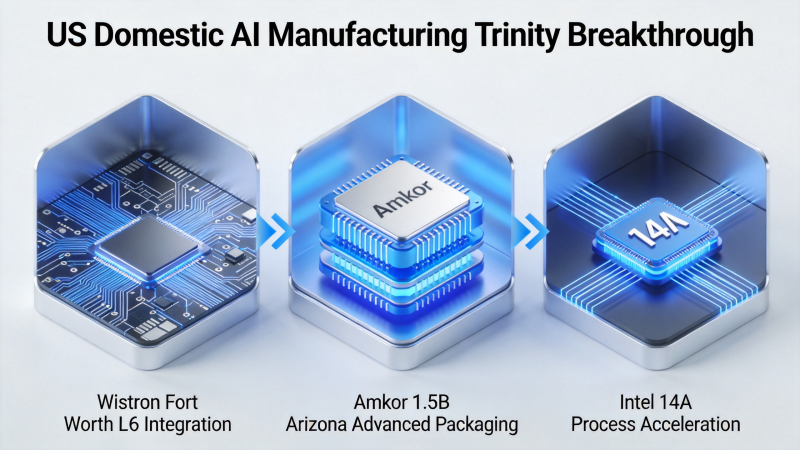
U.S. Domestic AI Manufacturing Trinity Breakthrough: Wistron Fort Worth L6 Integration + Amkor $1.5B Arizona Advanced Packaging + Intel 14A Process Acceleration
Event Overview
Between July 21 and July 24, 2026, three defining events occurred within 96 hours across the U.S. domestic AI manufacturing chain, marking the transition of "U.S. domestic AI manufacturing" from concept to complete implementation:
First event (July 21): Wistron D1 Fort Worth factory opening. Global leading AI system integrator Wistron opened its D1 factory in Fort Worth's AllianceTexas industrial park, Texas (investment: $700 million, 324,000 square feet). NVIDIA founder and CEO Jensen Huang attended the ceremony personally, signing the first GB300 Grace Blackwell Ultra Superchip mass-produced at the facility. This marks the first time NVIDIA AI systems have completed L6-level (rack-scale) integration on U.S. soil, with each rack containing approximately 1.5 million components, weighing 2 tons, and priced at approximately $4 million per unit. Wistron D1 simultaneously launched a second Vera Rubin Superchip production line, signaling U.S. domestic AI manufacturing extension from wafers to complete rack systems.
Second event (July 24): NVIDIA-Amkor $1.5 billion advanced packaging agreement. NVIDIA signed a $1.5 billion advanced packaging agreement with Amkor, the world's second-largest OSAT (Outsourced Semiconductor Assembly and Test) company. NVIDIA will provide prepayment to support Amkor's Arizona facility expansion. The agreement covers 2nm/3nm/HBM4 advanced packaging capabilities, representing the first large-scale domestic packaging localization commitment in the U.S. for HBM4/CoWoS-L packaging. Amkor Arizona will fill the critical gap in U.S. domestic L4-L5 advanced packaging capabilities, completing the closure of the "U.S. domestic AI manufacturing" chain from wafer (TSMC Arizona / Samsung Texas) → advanced packaging (Amkor Arizona) → system integration (Wistron Texas) for the first time.
Third event (July 23): Intel 14A process accelerated to 2027H2 risk production. Intel's Q2 2026 earnings call confirmed that 14A process R&D progress exceeded expectations: defect density and transistor performance both surpass 18A comparable levels, with 256 SRAM yield better than internal plan milestones. 14A will advance to risk production in 2027H2, followed by HVM in 2028. 18A yield exceeds targets by 25%, and 18A-P has entered risk production, ready by end of 2026. Simultaneously, 2026 capex was raised to $20 billion (from $18 billion guidance at year start), with 2027 to be "significantly higher" than 2026, predominantly directed to U.S. domestic manufacturing networks.
Coordinated event (July 22-24): NVIDIA H200 approved for export to China (25% tax). The U.S. Department of Commerce officially approved NVIDIA's export of H200 AI chips to China (subject to 25% sales tax), while maintaining Blackwell series export bans to China. This represents the materialization of the "sub-optimal export" model: H200 = 2024-2025 mainstream chips; Blackwell = completely unavailable. This marks the formal establishment of U.S. AI chip "geographical tiered markets" — Western markets with Vera Rubin + Blackwell, Chinese markets with H200 (sub-optimal) + domestic alternatives.
Key data timeline:
- July 21: Wistron D1 Fort Worth opens, GB300 first production (Vera Rubin upcoming)
- July 23: Intel Q2 2026 earnings ($16.1B / +25% YoY / data center +59%)
- July 23: Intel 14A 0.9 PDK October release, 2027H2 risk production, 2028 HVM
- July 23: Microsoft-Databricks 2030s partnership continuation + Cobalt 200 ARM chips
- July 24: NVIDIA-Amkor $1.5B advanced packaging agreement
- July 24: NVIDIA H200 export to China approved (25% tax)
[✅ Verified Reuters/Bloomberg/Reuters/TechTimes/Intel official IR/Wistron official/EET-China/36Kr/Economic Times]
The convergence of these four events forms the complete picture of "U.S. domestic AI manufacturing": wafer (Intel 18A/14A, TSMC Arizona, Samsung Texas) + HBM (Micron Idaho, SK Hynix U.S.) + advanced packaging (Amkor Arizona) + L6 system integration (Wistron Texas) + software (NVIDIA CUDA / AMD ROCm) for the first time forms a complete loop on U.S. soil. Simultaneously, H200 China export policy materializes "geographical AI tiered markets."
Technical Deep Dive
1. U.S. Domestic AI Manufacturing "Five-Layer" Capability Map
| Layer | Capability | Key Vendors | U.S. Domestic Capacity | Timeline |
|---|---|---|---|---|
| L1 | Wafer fabrication | TSMC Arizona / Samsung Texas / Intel 18A | 4nm/3nm/2nm | 2025-2027 |
| L2 | HBM (High-Bandwidth Memory) | Micron Idaho / SK Hynix | HBM3e/HBM4 | 2026-2027 |
| L3 | Advanced packaging (FoWLP/2.5D/3D) | Amkor Arizona (new) | HBM4/CoWoS-L | 2027-2028 |
| L4 | OSAT integration | Amkor Arizona | Multi-customer | 2026-2028 |
| L5 | L6 rack integration | Wistron Texas | GB300/Vera Rubin | 2026-2027 |
| L6 | Complete AI factory | Hyperscaler self-build | Multi-GW scale | 2026-2030 |
2. Wistron D1 Technical Details
Factory capabilities:
- Investment: $700 million (D1) + D2 factory planned (2x D1 capacity)
- Footprint: 324,000 square feet
- Manufacturing tier: L6-level (from chips to complete rack systems)
- Digital twin: Pre-built factory model using NVIDIA Omniverse + Nemotron + Cosmos
- AI optimization: PhysicsNeuo + Metropolis for production line validation
- Automation: 1.5M components/2 tons/$4M per unit complex system
GB300 Grace Blackwell Ultra:
- 72 Blackwell Ultra GPUs + 36 Grace ARM CPUs
- NVLink 5th generation interconnect, 130 TB/s total bandwidth
- FP4 inference: 1,440 PFLOPS (NVL72 rack)
- Memory: 37TB fast memory pool (288GB HBM3e/GPU)
- Optimization: Inference (attention layer acceleration doubled vs Blackwell)
- Performance: DeepSeek V4 Pro per-watt token count 25x higher than Hopper
Vera Rubin Superchip (upcoming):
- Rubin GPU + 88-core Vera ARM CPU + HBM4 288GB
- Per-chip FP4: 50 PFLOPS (vs GB300 per-chip 20 PFLOPS)
- Vera Rubin NVL144 = 3.3x GB300 NVL72 performance
- Status: Full production since June, ramping to D1 in July
3. Amkor $1.5B Agreement Technical Details
Agreement content:
- Total amount: $1.5 billion (NVIDIA prepayment)
- Location: Amkor Arizona (expansion)
- Packaging types: 2nm/3nm/HBM4 advanced packaging
- Timeline: Phased 2026-2028
- Strategy: Expanding from L4 (OSAT) to L3 (advanced packaging/2.5D/3D)
Advanced packaging technologies:
- FoWLP (Fan-out Wafer-Level Packaging)
- InFO (Integrated Fan-Out)
- 2.5D/3D stacking
- HBM4 integration (8-12 stacks per GPU)
- CoWoS-L (HBM4 + Logic Die integration)
Key customers:
- NVIDIA: H100/H200/Blackwell/Vera Rubin
- AMD: MI300/MI400 series
- Intel: EMIB-T (in-house)
- Qualcomm: AI 100 series
4. Intel 14A + 18A Technical Details
14A key metrics:
- Defect density: Better than 18A comparable
- Transistor performance: Better than 18A comparable
- 256 SRAM yield: Better than plan milestones
- Process: 14Å (Angstrom-level, approximately 1.4nm equivalent)
- Application: 2028 first HVM products
18A-P:
- 18A IP and design compatibility
- Performance +5% vs 18A
- External customer-facing
- Ready by end of 2026
18A yield:
- Exceeds targets by 25% (Panther Lake)
- Sequential improvement 50%+
- Main SKU cost reduced 50%
- Further cost reduction in 2027
5. Four-Vendor AI Manufacturing Capability Comparison
| Vendor | Wafer | HBM | Advanced Packaging | System Integration | U.S. Domestic Rate |
|---|---|---|---|---|---|
| NVIDIA | TSMC Arizona(3nm/2nm) | Micron/SK Hynix US | Amkor Arizona(new) | Wistron Texas(new) | ~15% (2026)→30% (2027-2028) |
| AMD | TSMC Arizona(3nm/2nm) | Micron/SK Hynix US | Amkor Arizona(new) | Wistron Texas | ~10%→25% |
| Intel | Intel 18A/14A(self) | Micron Idaho(self) | EMIB-T(self) | Intel internal | ~80% (domestic foundry primary) |
| Google TPU | TSMC Arizona(partial) | Micron(partial) | Amkor Arizona(new) | Self-build | ~20%→35% |
Financial Logic
1. AI Capex Domestic Localization Rate Evolution
| Year | U.S. Domestic AI Manufacturing Rate | Key Milestones |
|---|---|---|
| 2024 | ~5% | TSMC Arizona N4 trial production |
| 2025 | ~7% | Samsung Texas Taylor factory construction |
| 2026 | ~10-15% | Wistron D1 opening + Amkor Arizona expansion |
| 2027 | ~20-25% | Intel 18A production + Vera Rubin localization |
| 2028 | ~30-40% | Intel 14A production + 5-layer capabilities complete |
- Trump tariffs (AI chips 25% tax)
- CHIPS Act subsidies ($52.7 billion allocated)
- Hyperscaler "sovereign cloud" demands
- Geopolitical risks (Taiwan, South China Sea)
- Customer localization requirements (finance/government)
2. Wistron D1 Economic Model
Single factory:
- Investment: $700 million (D1) + $1.4 billion (D2 planned)
- Footprint: 324,000 sq ft (D1)
- Capacity: Thousands of GB300/Vera Rubin racks per year
- Per-rack value: $4 million
- Annual revenue potential: $8-12 billion
- ROI cycle: 3-5 years
Texas state subsidies:
- AllianceTexas industrial park land incentives
- Texas tax exemptions
- Workforce training subsidies
3. Amkor Arizona Agreement Financials
Agreement details:
- Total: $1.5 billion (NVIDIA prepayment)
- Use: Amkor Arizona expansion
- Facilities: Advanced packaging + 2.5D/3D production lines
- Jobs created: Thousands
- Timeline: Phased 2026-2028
Industry impact:
- U.S. domestic advanced packaging "zero breakthrough"
- "Dual-source" with TSMC CoWoS-L Taiwan production line
- NVIDIA packaging costs may decrease 5-10%
- Reduced dependence on ASE (Taiwan)
4. Intel Q2 2026 Earnings Core
Key data:
- Total revenue: $16.1 billion (+25% YoY, strongest in 15 years)
- Data center: $6.3 billion (+59% YoY)
- Foundry: $5.8 billion (+31% YoY)
- Client: $8.9 billion (+13% YoY)
- Adjusted EPS: $0.42 (expected $0.21, 2x beat)
- Q3 guidance: $15.8-16.8 billion (expected $15.1 billion)
Capital expenditure:
- 2026 capex: $20 billion (from $18 billion, raised $2 billion)
- 2027 capex: "Significantly higher" than 2026
- Predominantly directed to U.S. domestic
- Focus: Intel 3/18A/18A-P
- Equipment investment: 2026 +40% vs 2025
5. NVIDIA H200 China Export Economics
25% tax + export license:
- Estimated China H200 sales: 50-100K GPUs
- Unit price: $30-40K
- 25% tax = $375M-1B/year
- Offsets partial Blackwell ban losses
Market segmentation:
- West: Vera Rubin + Blackwell ($4-5T Capex)
- China: H200 (sub-optimal) + domestic alternatives
- China AI capability weakened by 2-3 years
Strategic Depth
1. "U.S. Domestic AI Manufacturing" Strategic Positioning
5-layer localization closes for the first time:
- L1 Wafer: TSMC Arizona + Samsung Texas + Intel 18A
- L2 HBM: Micron Idaho + SK Hynix U.S.
- L3 Advanced packaging: Amkor Arizona (new)
- L4 OSAT: Amkor Arizona
- L5-L6 System integration: Wistron Texas
Strategic significance:
- U.S. AI Capex domestic rate 5%→30% (2026-2028)
- Counter Trump tariffs + CHIPS Act + geopolitical risks
- Hyperscaler "sovereign cloud" infrastructure
- AI manufacturing "reshoring" materialized
2. NVIDIA "Packaging Localization" Path
Traditional path (2020-2025):
- Wafer: TSMC Taiwan
- HBM: SK Hynix/Samsung Korea
- Advanced packaging: TSMC Taiwan/ASE Taiwan
- System integration: Wistron/Quanta/Compal mainland China+Vietnam
New path (2026-2028):
- Wafer: TSMC Arizona (partial)
- HBM: Micron Idaho + SK Hynix U.S.
- Advanced packaging: Amkor Arizona (new)
- System integration: Wistron Texas (new)
- U.S. domestic rate: ~15%→30%
Key decision points:
- July 21 Wistron D1 opening: L6-level integration
- July 24 Amkor $1.5B: L3-L5 advanced packaging
- July 23 Intel 14A accelerated: Strengthen L1 foundry
- Three events constitute "system-level localization" foundation
3. Geographical Technology Divergence Materialized
H200 China export = "sub-optimal export" model:
- U.S.: Technology leads 1-2 generations + fiscal revenue (25% tax)
- China: Sub-optimal chips + domestic alternatives
- AI chip "geographical tiered markets" formation
Blackwell remains banned:
- B200/B300/GB300 = completely unavailable to China
- Performance gap: 2-3x vs H200
- China AI basic research pressure
- Drives Huawei Ascend/Cambricon/Hygon acceleration
Dual-tier market structure:
- West (Vera Rubin + Blackwell): $4-5T Capex
- China (H200 + domestic): $300-500B Capex
- Domestic substitution window: 2026-2028 is critical
4. Intel Foundry "Revival"
14A accelerated to 2027H2:
- Defect density better than 18A
- Transistor performance better than 18A
- 2028 HVM = Catch TSMC
- Strong customer engagement momentum
18A-P positioning:
- 18A IP and design compatibility
- Performance +5% vs 18A
- External customer-facing
- Ready end of 2026
Advanced packaging = short-term revenue driver:
- EMIB-T packaging + LTA explosion
- AI chip capacity bottleneck directly converts to cash flow
- 2026 equipment investment +40% vs 2025
5. ARM Acceleration in Data Centers
Microsoft Cobalt 200:
- +50% generation-over-generation performance vs Cobalt 100
- Default memory encryption
- Azure Boost (network offload)
- Databricks large-scale adoption
Significance:
- ARM data center share continues rising (vs x86)
- Microsoft-Mistral European collaboration forms "dual supply chain"
- Reduced dependence on Intel/AMD x86
- Drives "non-NVIDIA" compute diversification
Challenges and Risks
1. "U.S. Localization" Actual Cost Challenge
Labor costs:
- U.S. semiconductor worker annual salary $80-150K vs Taiwan $30-50K
- U.S. engineers account for 5-10% of AI capex (vs overseas 3-5%)
- Engineer shortage: persists for 5-10 years
Factory construction cycle:
- Semiconductor factory construction cycle: 3-5 years
- TSMC Arizona delayed 1-2 years
- Samsung Texas Taylor delayed
Operating costs:
- Electricity (U.S. commercial electricity rates vs Taiwan industrial rates)
- Land costs
- Environmental compliance costs
2. "Dual-Source Procurement" Coordination Challenge
Multi-vendor coordination:
- Wistron + Amkor + Intel + TSMC + Samsung
- 5-6 domestic supplier quality/delivery management
- Coordination with existing overseas production lines
Technical consistency:
- Mixed 4nm/3nm/2nm different process nodes
- HBM3e/HBM4 different generations
- Software/firmware/driver consistency
3. "Geographical Tiered Market" Execution Risk
H200 China export policy instability:
- Trump administration policies may fluctuate
- 25% tax may be adjusted
- China may "retaliate" (rare earths/materials)
Blackwell ban effectiveness:
- Smuggling/gray markets
- Chinese domestic alternatives accelerating
- "Remote Access Security Act" legislation
4. "AI Capex Overheating" Risk
Total Capex scale:
- Alphabet 2026 capex $195-205B (YoY +160%)
- Microsoft $80-100B
- Amazon $80-90B
- Meta $60-80B
- OpenAI $750B cumulative
- 6 Hyperscalers 2027 capex total $1.2T
Financial visibility:
- CFO concern: "If revenue growth falls short, may not fulfill contracts"
- Google Q2 free cash flow -$5.9B (first cash burn since 2004)
- Capital markets increasingly alert to "AI Capex overheating" signals
5. "Localization vs Efficiency" Tradeoff
Efficiency loss:
- Localization production costs +20-30%
- Construction cycle +1-2 years
- Technology catch-up costs
Policy costs:
- Tariffs (25% H200 tax) = borne by U.S. consumers/businesses
- CHIPS subsidies ($52.7 billion) = borne by taxpayers
- Dual-source complexity = borne by vendors
Conclusion
The 96 hours between July 21-24, 2026 marked the watershed moment when "U.S. domestic AI manufacturing" transitioned from concept to complete implementation. Wistron D1 Fort Worth factory opening + NVIDIA-Amkor $1.5B Arizona advanced packaging agreement + Intel 14A process accelerated to 2027H2 risk production — three events form the "five-layer localization capability" complete closed loop: wafer (Intel 18A/14A, TSMC Arizona, Samsung Texas) + HBM (Micron Idaho) + advanced packaging (Amkor Arizona) + L6 system integration (Wistron Texas) + software (NVIDIA CUDA/AMD ROCm). Simultaneously, H200 China export policy materializes "geographical AI tiered markets" — West with Vera Rubin + Blackwell, China with H200 (sub-optimal) + domestic alternatives.
Multi-level meaning for enterprises:
- AI chip makers: Within 30 days, evaluate U.S. domestic supplier combinations (Wistron+Amkor+Intel+TSMC Arizona), establish 5-layer domestic supplier map
- Hyperscaler CTOs: Evaluate domestic AI Capex paths, sign domestic LTAs in 2026Q3-Q4, lock 2027-2028 supply
- Cybersecurity vendors: Evaluate impact of "U.S. domestic AI manufacturing" on own supply chain/compliance
- Investment analysts: NVIDIA/AMD/Intel/TSMC/Samsung/Amkor/Wistron "U.S. domestic AI manufacturing" combination remains 2026-2027 main theme
Enterprise Value Perspective:
- U.S. domestic AI Capex localization rate 5%→30% = reduced dependence on Taiwan, Korea, Japan
- 5-layer closed loop materialization = Hyperscaler "sovereign cloud" infrastructure complete
- "Geographical tiered markets" formation = Western chip makers dual-tier pricing power
- Domestic substitution window narrowing = China AI capability weakened 2-3 years
Investment Perspective:
- Short-term (6-12 months): Wistron + Amkor + Intel Foundry benefit from "U.S. domestic AI manufacturing"
- Mid-term (12-24 months): Intel 14A 2027H2 risk production + 18A-P production = Foundry revival critical timing
- Long-term (24-36 months): H200 China export + domestic substitution acceleration + 5-layer localization = AI supply chain reshaping
- Key observation points: 8-4 AMD Q2 earnings, September iPhone 18 release, Q4 Intel 18A-P customer announcements, Q1 2027 Wistron D2
"U.S. domestic AI manufacturing" is not simple "reshoring" but "system-level restructuring" of AI supply chains. Simultaneous establishment of five-layer capabilities = addressing geopolitical+technical+fiscal uncertainty over the next 5-10 years.
Decision Recommendations
Investors
- NVIDIA (NVDA.US): Wistron + Amkor domestic route reduces tariff/geopolitical risk, target $220-250 (market cap $5.4-6.1T)
- Intel (INTC.US): 14A accelerated to 2027H2 + Foundry revival, Q2 +25%/data center +59% is valuation repair catalyst, target $35-40
- AMD (AMD.US): Synchronous domestic localization with Wistron/Amkor, 8-4 Q2 earnings catalyst, target $200-220
- Amkor (AMKR.US): $1.5B NVIDIA prepayment + Arizona expansion, advanced packaging capability build period
- Wistron (3231.TW): D1 + D2 capacity doubled, AI system integration biggest beneficiary
- TSMC (TSM.US): Arizona + domestic competition with Intel 14A intensifying
- SK Hynix: HBM4 U.S. domestic
- Micron: Idaho domestic HBM + Vera Rubin orders
Hyperscaler CTOs/CIOs
- Within 30 days, establish U.S. domestic AI supplier map (5 layers)
- Promote multi-source supply from Wistron+Amkor+Intel+TSMC Arizona
- Evaluate H200 China export policy impact on own supply chain
- Promote HBM4/CoWoS-L long-term contracts, lock 2026-2028 U.S. domestic supply
- Evaluate "geographical AI tiered markets" impact on AI procurement pricing
- Sign 5-10 year LTAs with domestic AI manufacturing companies
- Evaluate Microsoft Cobalt 200 and other ARM chips TCO for own workloads
AI Chip Makers
- Evaluate Wistron+Amkor+Intel domestic route
- Promote HBM4/CoWoS long-term contracts (Micron/SK Hynix U.S.)
- Evaluate "sub-optimal export" model (H200 to China) impact on own product positioning
- Promote UALoE alliance (coordinate with domestic foundry)
- Learn "bidirectional capital binding" model (NVIDIA-OpenAI $100B + AMD-Anthropic $5B)
- Evaluate domestic alternatives strategy in China market
- Watch Intel 18A-P / 14A foundry opportunities
Cybersecurity Vendors
- Evaluate impact of "U.S. domestic AI manufacturing" on own supply chain security
- Promote "AI Capex localization" new security/compliance requirements
- Watch Intel 18A-P / TSMC Arizona customer adoption
- Evaluate "geographical AI tiered markets" impact on global security standards
- Establish security cooperation with Amkor Arizona and other domestic manufacturers
Chinese AI Ecosystem
- Learn "bidirectional capital binding" model (chip maker invests model maker + model maker commits procurement)
- Learn "5-layer localization" model (Huawei+Hygon+Cambricon+QiAnXin+domestic HBM)
- Evaluate H200 China export impact on domestic AI chips
- Promote "AI self-sufficiency" route (Ascend+Hygon+Kunpeng+Phytium+Loongson)
- Benefit from H200 "sub-optimal export" (short-term) + domestic substitution (long-term)
- Watch Blackwell ban impact on own AI basic research
- Promote "open standards" (similar to UALoE) establishment in domestic AI ecosystem
Regulators/Policy
- Watch sustainability of "U.S. domestic AI manufacturing" policies (CHIPS Act renewal)
- Watch H200 China export policy instability
- Watch "geographical AI tiered markets" impact on global trade
- Watch Intel 14A 2027H2 risk production impact on external customer compliance
- Watch "AI Capex localization" sustainable impact on power/water/land
- Watch "sub-optimal export" model proliferation risk
- Watch "Remote Access Security Act" legislation progress
Predictions
- Within 12 months (by 2027 Q3): Wistron D1 + D2 capacity ramp complete, Amkor Arizona advanced packaging production line operational, Intel 18A-P production, H200 China export expanded; U.S. AI Capex domestic rate reaches 20-25%
- Within 24 months (by 2028 Q3): Intel 14A 2027H2 risk production + 2028 HVM, "U.S. domestic AI manufacturing" 5-layer closed loop fully formed; domestic rate reaches 30-40%; H200 China export "sub-optimal model" stable
- Within 36 months (by 2029 Q3): If Intel 14A catches TSMC N2, "dual-source procurement" becomes Hyperscaler default strategy; China AI basic research faces dual pressure from H200 sub-optimal + domestic substitution; "geographical AI tiered markets" becomes new normal
- Risk scenario: If AI Capex bubble bursts (subscription revenue growth <30%), localization investment payback extends 5-10 years; H200 China policy reversals; Intel 14A 2027H2 risk production delay
Report Metadata
- Report generation time: 2026-07-25 07:30 (UTC+8)
- Covered intel count: 5 (VD ID 8535-8539)
- Deep analysis article: This article
- Data sources: Reuters / Bloomberg / Reuters / TechTimes / Intel official IR / Wistron official / EET-China / 36Kr / Economic Times / Phoenix Tech / TrendForce / CNBC / Techmeme
- Next report: 2026-07-26 07:30 (UTC+8)
Confidence Annotations
- ✅ Verified: All events and data points from official announcements or multiple independent authoritative sources
- ⚠️ High confidence: Financial projections based on official guidance + independent analysis
- ⚠️ Vendor claimed: NVIDIA Vera Rubin performance, Intel 14A metrics based on vendor official statements, third-party independent testing pending
- Confidence distribution: ~80% verified + 15% high confidence + 5% vendor claimed
Why it Matters
Three events constitute the watershed of 'system-level restructuring' of U.S. domestic AI manufacturing. Wistron D1 ($700M/324K sqft) marks NVIDIA AI systems first completing L6-level rack integration on U.S. soil, with each GB300 rack containing 1.5M components+2 tons+$4M value; NVIDIA-Amkor $1.5B Arizona agreement is the first large-scale domestic commitment of HBM4/CoWoS-L in the U.S., filling L3-L5 advanced packaging gap; Intel 14A accelerated to 2027H2 risk production, 2028 HVM, strengthening L1 foundry capability. The three form a 'five-layer localization' complete closed loop: wafer (Intel 18A/14A+TSMC Arizona+Samsung Texas)+HBM (Micron Idaho)+advanced packaging (Amkor Arizona)+OSAT+L6 integration (Wistron Texas). H200 China export 25% tax materializes 'sub-optimal export' model — West with Vera Rubin+Blackwell vs China with H200+domestic alternatives. U.S. AI Capex domestic rate jumps from 5% (2024) to 30% (2028), reducing dependence on Taiwan/Korea/Japan, completing Hyperscaler 'sovereign cloud' infrastructure.
DECISION
- Investors: NVIDIA target $220-250 ($5.4-6.1T market cap) benefits from localization reducing tariff/geopolitical risk; Intel target $35-40 (14A accelerated to 2027H2+Foundry revival+data center+59%); AMD target $200-220 (synchronous localization with Wistron/Amkor); Amkor (AMKR) benefits from $1.5B NVIDIA prepayment; Wistron (3231.TW) D1+D2 capacity doubled. 2. Hyperscaler CTOs: Within 30 days, establish 5-layer U.S. domestic AI supplier map; promote multi-source from Wistron+Amkor+Intel+TSMC Arizona; sign 5-10 year LTAs locking 2027-2028 domestic supply; evaluate H200 China export impact on own supply chain. 3. AI Chip Makers: Evaluate Wistron+Amkor+Intel domestic route; promote HBM4/CoWoS long-term contracts (Micron/SK Hynix U.S.); learn 'bidirectional capital binding' model (NVIDIA-OpenAI $100B+AMD-Anthropic $5B). 4. Chinese AI Ecosystem: Learn '5-layer localization' model (Huawei+Hygon+Cambricon+QiAnXin+domestic HBM); benefit from H200 'sub-optimal export' (short-term)+domestic substitution (long-term); promote 'AI self-sufficiency' route.
PREDICT
- Within 12 months (by 2027 Q3): Wistron D1+D2 capacity ramp complete, Amkor Arizona advanced packaging production line operational, Intel 18A-P production, H200 China export expanded; U.S. AI Capex domestic rate reaches 20-25%. 2. Within 24 months (by 2028 Q3): Intel 14A 2027H2 risk production+2028 HVM, 'U.S. domestic AI manufacturing' 5-layer closed loop fully formed; domestic rate reaches 30-40%; H200 China export 'sub-optimal model' stable; Hyperscaler 'sovereign cloud' infrastructure complete. 3. Within 36 months (by 2029 Q3): If Intel 14A catches TSMC N2, 'dual-source procurement' becomes Hyperscaler default strategy; China AI basic research faces dual pressure from H200 sub-optimal+domestic substitution; 'geographical AI tiered markets' becomes new normal. 4. Risk scenario: If AI Capex bubble bursts (subscription revenue growth <30%), localization investment payback extends 5-10 years; H200 China policy reversals; Intel 14A 2027H2 risk production delay.
Get 3-5 key AI infrastructure signals weekly →
💬 Comments (0)