
I. Event Recap: TSMC Revenue Hits Record High Alongside Price Hike Notice
On July 14, 2026, TSMC's June revenue report sent shockwaves through the global semiconductor industry. The company reported consolidated revenue of NT$442.68 billion (approximately US$13.7 billion), representing 6.2% month-over-month growth and 67.9% year-over-year growth, setting a new all-time monthly record. This figure not only far exceeded market expectations but also underscored TSMC's absolute dominance during the AI chip demand boom cycle.
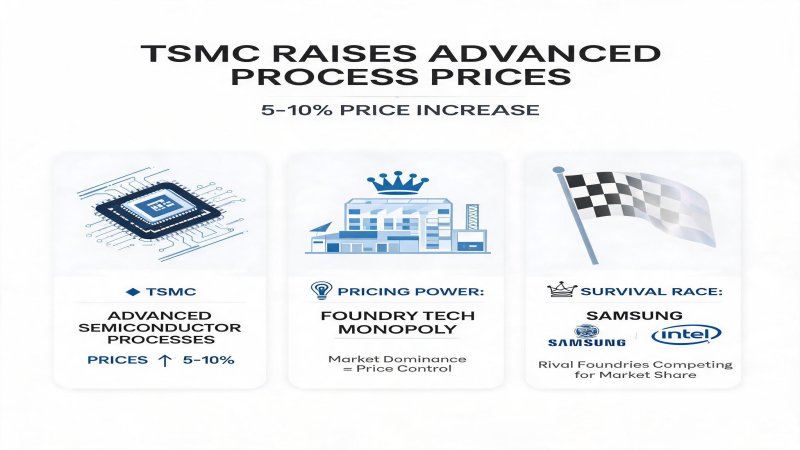
More critically, TSMC simultaneously notified core customers including NVIDIA, Apple, and AMD of planned price increases of 5-10% for 3nm, 5nm, and 7nm process nodes. Industry analysts estimate this price hike will cover over 70% of TSMC's foundry revenue, meaning the vast majority of advanced process customers will be directly affected. Wall Street analysts widely predict TSMC's Q3 2026 revenue will exceed NT$1.3 trillion, another record high, with full-year revenue growth remaining above 30%.
TSMC will announce Q2 FY2026 earnings on July 16 (Thursday). S&P analysts expect Q2 revenue of NT$1.26 trillion, up 35.31% year-over-year, with net profit surging 57% year-over-year. The market's focus will center on gross margin guidance—if margins break above 60% or even approach 70%, it will validate that TSMC's pricing power in advanced processes has reached unprecedented levels.
Key Financial Data:
- June 2026 Revenue: NT$442.68 billion (+67.9% YoY)
- Q2 Expected Revenue: NT$1.26 trillion (+35.31% YoY)
- Price Increase Range: 5-10% for 3nm/5nm/7nm
- Revenue Coverage: Over 70%
- Full-Year Growth Forecast: 30%+
II. Technical Deep Dive: Process Technology Monopoly and Capacity Bottlenecks
TSMC's pricing power stems from its undisputed technological leadership in advanced processes. Understanding this requires deep analysis of its 3nm and 5nm process architectures, yield advantages, and capacity deployment.
3nm Process (N3/N3E/N3P Family)
TSMC's 3nm family represents the final evolution of FinFET transistor structure. Compared to 5nm, logic density improves by approximately 60%, with 15% performance improvement at the same power, or 30% power reduction at the same performance. The currently mass-produced N3E version reduces EUV lithography layers from 25 to 21, significantly improving yield and throughput while maintaining performance. Industry estimates place TSMC's N3E overall yield at a stable 75-80%, while competitor Samsung's 3nm GAA process fluctuates around 60% yield.
5nm Process (N5/N4/N4P Family)
As the mainstream process node for current AI chips, TSMC's 5nm family is highly mature. Core products including NVIDIA H100/H200, AMD EPYC Genoa, and Apple M3 series are based on this node. Through continuous process optimization (N4P version), TSMC achieved 6% performance improvement at the same power consumption. Capacity is primarily concentrated at Hsinchu Fab 12 and Tainan Fab 18, with combined monthly capacity exceeding 150,000 wafers.
2nm Process (N2, Risk Production Expected Late 2025)
TSMC's 2nm process will adopt Gate-All-Around (GAA) transistor structure, marking a historic transition from FinFET to GAA. According to TSMC disclosures, N2 delivers 10-15% performance improvement at the same power, or 25-30% power reduction at the same performance. Risk production is expected in late 2025, with mass production in 2027. Apple has been confirmed as N2's launch customer, with M5/A19 chips being first to adopt this process.
Technical Roots of Capacity Scarcity
TSMC's advanced process bottleneck is not simply a matter of fab count, but the absolute scarcity of EUV lithography machines. ASML's EUV lithography systems (NXE:3600D/3800E) cost over €150 million each, with annual production of only about 50-55 units. TSMC commands over 60% of ASML's EUV shipments, with Samsung and Intel dividing the remainder. More importantly, EUV machine installation, calibration, and ramp-up require 12-18 months, meaning even orders placed today won't yield effective capacity until late 2027.
Competitive Comparison Matrix:
| Dimension | TSMC | Samsung | Intel Foundry |
|---|---|---|---|
| 3nm Mass Production Status | N3E Mass Production | 3nm GAA Limited Production | 18A Expected Late 2026 |
| 3nm Yield | 75-80% | ~60% | Not Disclosed |
| 2nm Mass Production Timeline | 2027 | 2027 | 18A: Late 2026 |
| EUV Lithography Count | 80+ | 30+ | 15+ |
| Core AI Chip Customers | NVIDIA, Apple, AMD, Qualcomm | Internal, Partial Qualcomm | Internal, Limited External |
| Advanced Process Market Share | >90% | <10% | <1% |
III. Financial Logic: Cost Structure and Profit Transmission
TSMC's pricing decision is not simply opportunistic exploitation, but a rational choice based on complex cost structures and supply-demand dynamics.
Cost Analysis
Advanced process costs consist primarily of three components: equipment depreciation, raw materials, and labor. Equipment depreciation accounts for 40-50% of total costs. For a 3nm line with 30,000 wafers per month capacity, equipment investment exceeds US$20 billion, with depreciation cycles typically spanning 5-7 years. The high cost and limited lifespan (~10 years) of EUV lithography machines further elevate per-unit costs. Additionally, surging demand for advanced packaging technologies (CoWoS, SoIC) has created bottlenecks, with packaging costs now representing 15-20% of total chip costs.
Revenue Analysis
TSMC's pricing strategy follows 'value-based pricing,' meaning prices reflect the value created for customers rather than pure manufacturing costs. In AI chips, NVIDIA H100 sells for over US$30,000, with foundry costs representing roughly 15-20% of the selling price. Even with a 10% TSMC price increase, the impact on NVIDIA's gross margin is only 1-2 percentage points, entirely within acceptable range. For Apple, the self-developed M-series chip strategy makes it less sensitive to foundry pricing than pure chip design houses.
Profit Transmission Chain
TSMC's price hike will transmit along the following chain:
- TSMC gross margin improvement (expected from current 56% to 60-65%)
- NVIDIA/Apple/AMD chip cost increase (5-10%)
- Cloud provider (AWS/Azure/GCP) AI computing procurement cost increase
- End-enterprise AI application cost increase
IV. Strategic Depth: Samsung and Intel's Catch-Up Roadmaps
TSMC's price hike is not merely a commercial decision but strategic pressure on competitors Samsung and Intel. Competition among the three giants in advanced processes has reached fever pitch.
Samsung's Counterattack: GAA First-Mover and HBM Synergy
Samsung adopted GAA transistor structure first at the 3nm node, technically possessing certain first-mover advantages. However, its 3nm yield has long hovered around 60%, resulting in slow customer adoption. Currently, Samsung 3nm's main customers remain limited to internal (Exynos) and partial Qualcomm orders.
Samsung's strategic advantage lies in its vertical integration of 'memory + foundry.' In HBM (High Bandwidth Memory), the most critical component for AI chips, Samsung competes with SK Hynix and Micron in a tripartite standoff. By combining advanced foundry with HBM packaging, Samsung aims to offer AI chip customers 'one-stop' solutions. Additionally, Samsung's over US$25 billion investment in its Taylor, Texas fab targets 4nm/3nm mass production in 2026, directly competing with TSMC's Arizona facility.
Intel's Last Stand: 18A Node and IDM 2.0
Intel's foundry business (Intel Foundry) is at a critical moment of life and death. CEO Pat Gelsinger's bet on the 18A node (equivalent to 1.8nm) represents Intel's final opportunity to return to advanced process leadership. Intel claims 18A will be first to adopt High-NA EUV lithography and RibbonFET (GAA) technology, with performance surpassing TSMC's N2.
However, Intel Foundry remains deeply mired in losses, with over US$7 billion in foundry losses in 2025 alone. The company is heavily dependent on internal customers (Intel Products), with extremely slow external customer adoption. While Microsoft and Amazon have expressed interest in Intel 18A, specific order scales remain unclear. More critically, Intel's financial difficulties have forced the company to consider spinning off its foundry business, further undermining customer confidence.
V. Challenges and Risks: TSMC's Vulnerabilities
Despite TSMC's price hike demonstrating formidable market position, the company faces multiple risks and uncertainties.
Geopolitical Risk: Taiwan Strait Tensions and Supply Chain Security
TSMC's greatest risk is geopolitical. Over 90% of the company's advanced process capacity is concentrated on Taiwan's main island. Any Taiwan Strait tensions would catastrophically disrupt global semiconductor supply chains. Although TSMC is actively pushing overseas expansion (Arizona, USA; Kumamoto, Japan; Dresden, Germany), overseas fabs cost 20-30% more than Taiwan, with insufficient technical talent reserves. The Arizona facility, already delayed to 2027 mass production, faces uncertainty about whether its N4 process capacity and yield can match Taiwan levels.
Customer Concentration Risk: Top 5 Customers Contribute Nearly 90% Revenue
TSMC's customer concentration is extremely high, with Apple, NVIDIA, AMD, Qualcomm, and MediaTek contributing nearly 90% of revenue. This heavy dependence creates potential pricing risks—if major customers accelerate shifts to Samsung or Intel due to cost pressure, TSMC's capacity utilization would rapidly decline. Apple has begun exploring allocation of partial M-series chip orders to Intel 18A, though limited in scale, the signal is significant.
Technology Transition Risk: GAA Migration and High-NA EUV
TSMC's transition from FinFET to GAA transistors at the 2nm node represents a major technological architecture shift. Historically, Samsung encountered severe yield problems when pioneering GAA at 3nm. Whether TSMC can avoid similar setbacks at the N2 node will directly determine its competitiveness in 2027-2028. Additionally, ASML's High-NA EUV lithography system (EXE:5000), expected in 2027, may bring new process challenges due to its higher resolution and complexity.
AI Demand Cyclicality Risk: Is the Supercycle Peaking?
TSMC's current full capacity utilization heavily depends on AI chip demand explosion. However, markets have begun worrying about AI investment returns. If AI application commercialization progress falls short of expectations, cloud providers may reduce AI computing capital expenditure, leading to declining TSMC advanced process orders. Samsung Electronics' Q2 profit plunge of 95% has already signaled weakening memory chip demand—whether AI chip demand will follow suit warrants vigilance.
VI. Conclusion: Investment and Strategic Procurement Recommendations
TSMC's price hike represents a microcosm of global semiconductor industry power restructuring. For different stakeholders, we offer the following recommendations:
For Investors:
TSMC remains the most certain core asset in the semiconductor sector. Based on price hike effects and capacity scarcity, we recommend raising TSMC's target price by 15-20%, with 2026 EPS expectations revised upward from NT$35 to above NT$40. In the July 16 Q2 earnings report, gross margin guidance breaking above 60% would be a strong buy signal. Simultaneously, we recommend reducing positions in price-sensitive mid-to-low-end chip design companies.
For Chip Design Enterprises:
- NVIDIA/Apple/AMD: Leverage volume advantages to negotiate long-term capacity contracts with TSMC, locking in N3E and N2 capacity for 2026-2027. Simultaneously initiate 'dual-sourcing strategies,' shifting 10-15% of mature process orders to Samsung to balance costs and supply chain risks.
- Small-to-medium chip design companies: Evaluate product roadmaps, prioritizing high-margin products for advanced processes while retreating low-margin products to mature processes or seeking alternatives.
For Cloud Service Providers and AI Enterprises:
- AWS/Azure/GCP: Assess AI computing cost impacts on gross margins, recommending per-FLOPS pricing increases of 8-12% to pass through chip costs. Simultaneously increase investment in self-developed chips to reduce dependence on NVIDIA GPUs.
- Small-to-medium AI enterprises: Consider AMD Instinct or Intel Gaudi-based alternatives to avoid cost pressures from NVIDIA chip price increases.
For Samsung and Intel:
- Samsung: Use 15-20% price discounts as competitive leverage, focusing on capturing mature process and packaging orders while accelerating 3nm GAA yield improvement above 70%.
- Intel: Concentrate resources to ensure 18A node delivery on schedule, prioritizing onboarding 1-2 heavyweight external customers to prove foundry capabilities.
TSMC's price hike is not the endpoint but the beginning of a new round of global semiconductor industry reshuffling. With AI chip demand continuing to surge, enterprises mastering advanced process technology will continue enjoying excess profits, while laggards face marginalization. For the entire technology industry, finding balance between rising costs and accelerating innovation will be the most critical strategic proposition for the next three years.
Why it Matters
TSMC's price hike signals further concentration of power in the global semiconductor industry. As the dominant player with over 90% market share in advanced processes (7nm and below), TSMC's pricing power directly determines the cost curve of the entire AI chip supply chain. The 5-10% increase will affect gross margins of core AI chips including NVIDIA H200/B100, Apple M-series, and AMD MI-series, subsequently impacting cloud providers' AI computing pricing. For Samsung (3nm GAA yield ~60%) and Intel (18A node delay risks) who are racing to catch up, TSMC's pricing confidence highlights the depth of its technology moat. More broadly, under the US CHIPS Act subsidies, TSMC's Arizona fab coming online in 2027 will directly link its global pricing strategy to the pace of US-China semiconductor decoupling.
DECISION
For chip designers: Lock in long-term capacity contracts before TSMC's price hike takes effect (expected Q3), and prioritize product roadmap adjustments for N3E and N2 nodes. For cloud providers and AI enterprises: Assess the impact of rising AI computing costs on gross margins, and consider raising per-FLOPS pricing by 8-12% to pass through costs. For investors: Raise TSMC target price range by 15%, watch whether Q2 earnings guidance on July 16 shows gross margin breaking above 60%; simultaneously reduce positions in price-sensitive mid-to-low-end chip designers. For Samsung and Intel: Accelerate 2nm/18A node customer adoption, offering 15-20% price discounts as competitive leverage.
PREDICT
Short-term (Q3 2026): TSMC Q3 revenue will exceed NT$1.3 trillion, with gross margin approaching 70%, as price hike effects fully materialize. Medium-term (Q4 2026-H1 2027): NVIDIA and Apple will shift some mature process orders to Samsung to balance costs, but 3nm and below core AI chips will remain heavily dependent on TSMC. Long-term (2027-2028): After TSMC Arizona fab's N2 capacity comes online, US-based AI chip manufacturing costs will be 20-30% higher than Taiwan, potentially pushing second-tier cloud providers toward more AMD and Intel alternative solutions.
Get 3-5 key AI infrastructure signals weekly →
💬 Comments (0)