
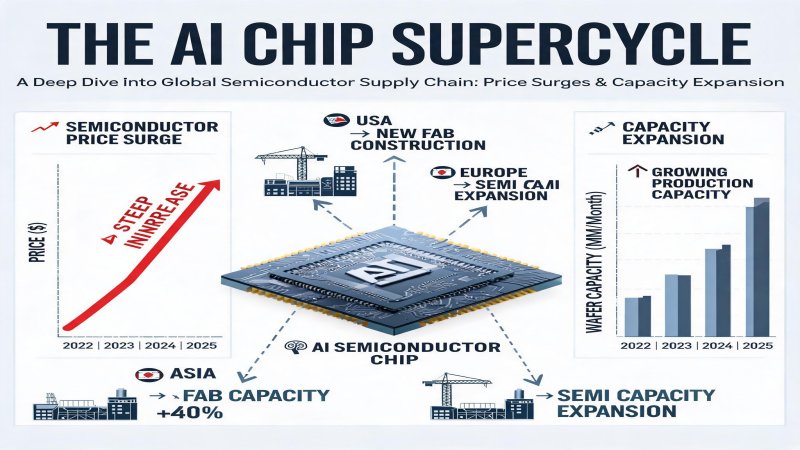
I. Event Recap: The AI-Driven Global Semiconductor Price Surge
In early July 2026, the global semiconductor supply chain experienced a rare wave of synchronized price increases, both in breadth and depth exceeding market expectations. On July 3, Samsung Electronics notified customers of plans to raise Q3 DRAM average selling prices by 20% quarter-over-quarter. The same day, Intel confirmed price increases for select consumer and server CPUs, with consumer products rising approximately $30-50 and server products by hundreds to over a thousand dollars. By July 5, Qualcomm shares surged 15% to hit 52-week highs, while Arm Holdings received multiple analyst price target upgrades, bringing year-to-date gains to 117%.
Upstream, Dutch lithography giant ASML announced on July 2 that it raised its 2026 total net sales guidance from €34-39 billion to €36-40 billion, maintaining gross margins at 51-53%. This adjustment signals continued upward momentum in the semiconductor equipment sector, with AI chip manufacturing demand as the core driver.
Notably, AI application layer companies are also moving upstream. In early July, Anthropic was reported to have initiated plans to develop its own AI chips, with Samsung as the foundry. Even top-tier AI software companies are now seeking vertical integration at the chip level.
This price surge did not erupt suddenly but resulted from accumulated factors throughout H1 2026. Server CPU prices rose 10-20% starting in March; Intel adjusted server CPU prices again in April; Samsung began negotiating DRAM price increases with customers in June. The entire supply chain shows comprehensive tension from upstream equipment through midstream chips to downstream applications.
Key Financial Data
- ASML Q1 2026: €8.8B net sales, 53.0% gross margin, €2.8B net income
- Samsung Electronics market cap: Surpassed $1 trillion on July 5, becoming Asia's second trillion-dollar tech company
- Qualcomm stock: Rose 15% intraday on July 5, trading volume reached 17.9M shares, double the 20-day average
- Arm Holdings: 117% YTD gain, P/E ratio of 317x
- Intel Q1 2026 revenue: $13.6B, up 7% YoY; Data Center and AI revenue $5.1B, up 22% YoY
II. Technical Depth: Capacity Bottlenecks from EUV Lithography to HBM Memory
The fundamental driver of this semiconductor price surge is the exponential growth in AI compute demand, with capacity expansion far lagging behind. Technically, bottlenecks concentrate in advanced lithography equipment and high-end memory.
EUV Lithography: Structural Bottleneck of a Single Supplier
ASML, the world's sole EUV lithography equipment supplier, holds 100% market share. Its products are essential for manufacturing chips at 7nm and below. According to SEMI, the 2026 global semiconductor manufacturing equipment market will reach $145 billion, with lithography accounting for over 30%, and ASML capturing roughly 80% of the high-end segment.
ASML's 5-8% guidance raise validates the AI-driven supercycle. Technically, ASML demonstrated 1000-watt EUV light source verification at the 2026 SPIE conference, planning to increase annual EUV capacity to 60 units in 2026 and 80 in 2027. Yet even this expansion cannot fully satisfy orders from TSMC, Samsung, and Intel. TSMC's Arizona 5nm fab alone requires over 20 EUV systems; Samsung aims to ramp 3nm capacity to 100,000 wafers per month.
HBM Memory: The "Oil" of AI Servers
High Bandwidth Memory (HBM) is the scarcest resource in this price surge. Samsung, SK Hynix, and Micron have all shifted investment from commodity DRAM to higher-margin HBM. TrendForce data shows DRAM prices already trending upward in Q2 2026, with HBM supply gaps even more severe.
SK Hynix recently placed a record $8 billion EUV equipment order with ASML, underscoring memory makers' expansion resolve. However, HBM manufacturing complexity far exceeds standard DRAM, and yield improvements require time. Analysts expect the DRAM market to remain supply-constrained through H2 2026, with prices continuing to rise.
Four-Vendor Competitive Matrix
| Dimension | Samsung | Intel | Qualcomm | ASML |
|---|---|---|---|---|
| Core Products | HBM, DRAM, 3nm foundry | Xeon CPU, GPU | Mobile SoC, AI datacenter chips | EUV lithography systems |
| Q1 2026 Revenue | Profit up 8x YoY | $13.6B | $10.6B | €8.8B |
| AI-Related Growth | HBM demand explosion | DCAI up 22% YoY | Datacenter chips shipping early | Guidance raised to €40B |
| Market Share | DRAM ~40-45% | Server CPU 66.8% | #1 mobile chips globally | 100% EUV monopoly |
| Key Challenge | SK Hynix competition | AMD share erosion | Overvaluation (RSI 80) | Capacity constraints |
| Price Increase | DRAM +20% in Q3 | CPUs up $30-50 to $1000+ | Stable chip pricing | Stable equipment pricing |
III. Financial Logic: Supply-Demand Games and Profit Restructuring
Financially, this price surge results from severe supply-demand imbalance while reflecting profit restructuring across the supply chain.
Demand Side: AI Capex Explosion
AI large model training and inference have driven exponential compute demand. Gartner forecasts the 2026 global AI chip market at $120 billion, up 45% YoY, exceeding $300 billion by 2030. This directly pulls demand for advanced process chips, HBM memory, and high-end server CPUs.
Intel linked CPU demand growth to AI inference and Agentic AI expansion, noting datacenter CPU-to-GPU ratios are tightening from roughly 1:8 historically toward 1:4, with some Agentic AI scenarios potentially approaching 1:1. Even as NVIDIA dominates GPUs, CPU importance in AI infrastructure is systemically rising.
Supply Side: Capacity Shifts and Structural Shortages
The three memory giants have shifted investment focus from commodity DRAM to HBM, limiting standard DRAM capacity growth. Intel's CPU price hikes were not across-the-board but targeted at high-demand, higher-negotiation-margin models. Toms' Hardware noted this reflects profit maximization strategy rather than simple cost pass-through.
From a margin perspective, ASML's gross margin stands at 53%, Intel's datacenter margins are improving, and Samsung's HBM margins far exceed traditional DRAM. The price surge effectively represents profit redistribution from downstream OEMs to upstream chip and equipment makers.
Cost Pass-Through and End-Market Impact
Upstream component inflation will transmit to end-system pricing. PC and gaming console makers face the earliest impact, while datacenter customers with stronger bargaining power are relatively shielded. Analysts expect server system prices to rise 8-10% in H2 2026, with PC and consumer electronics seeing roughly 5% increases.
IV. Strategic Depth: Competitive Evolution and Vendor Strategy Matrix
This price surge reflects not just supply-demand imbalance but profound shifts in global semiconductor competitive dynamics.
x86 Server CPUs: Intel Defending, AMD Attacking
Mercury Research data shows Intel's Q1 2026 server CPU shipment share at 66.8%, weakening both quarterly and annually, while AMD rose to 33.2% from 27.2% a year prior. More critically on revenue share: AMD commands roughly one-third of server CPU shipments but 46.2% of revenue, nearly half the total x86 server CPU market.
Intel's pricing strategy helps near-term average selling prices but faces persistent AMD pressure in high-end client, enterprise notebook, cloud, and AI/HPC server segments. Intel's 18A process progress will determine whether it can maintain above 60% server share.
Mobile Chips and AI Datacenter: Qualcomm's Transformation Bet
Qualcomm is transforming from a smartphone chip company into a diversified AI compute platform provider. It expects to begin shipping datacenter chips to a major hyperscaler in 2026, earlier than the previously expected FY2027 timeline. Its AI roadmap is expanding into CPUs, inference accelerators, and custom ASICs.
However, Qualcomm's massive YTD gains and high valuation, with RSI at 80.10 signaling short-term overheating, mean investors must watch actual datacenter chip shipment volumes and customer validation to confirm the transformation strategy.
Chip Design: Arm's Datacenter Ambition
Arm Holdings is another winner in this cycle. Management predicts Arm will hold the largest CPU market share by 2030. AGI CPU product demand doubled from $1B to $2B in just two months. Datacenter is overtaking smartphones as Arm's largest revenue source.
Yet challenges remain. Morgan Stanley downgraded Arm to Equalweight, citing near-term risks from its chip manufacturing transition. AMD, Intel, and NVIDIA are all aggressively positioning in AI CPUs, requiring Arm to sustain investment in performance, efficiency, and ecosystem.
V. Challenges and Concerns: Risks in the Supercycle
Despite the bright prospects, multiple risks and uncertainties warrant caution.
Geopolitical Risk
U.S.-China tech competition continues intensifying, creating major semiconductor supply chain uncertainty. U.S. export controls on advanced chips and equipment to China may tighten further, affecting China revenue for Intel, Qualcomm, and others. Meanwhile, Microsoft Azure's cutting of 200-400 China-based roles shows geopolitical risk penetrating from trade into operations.
Overcapacity Risk
History shows semiconductors are highly cyclical. Current massive capacity expansion could lead to oversupply in 2027-2028. If Samsung, SK Hynix, and Micron's HBM expansion plans release capacity simultaneously, price wars could erupt. While ASML raised 2026 guidance, CEO Christophe Fouquet acknowledged macro uncertainty and geopolitical factors prevent full confirmation of 2026 growth.
Technology Path Risk
AI chip technology paths continue evolving rapidly. NVIDIA GPUs dominate training, but inference may see more fragmented competition. Intel, AMD, Qualcomm, and numerous custom AI chip efforts are vying for this market. A major technology shift (e.g., neuromorphic or photonic chips) could strand current CMOS-based capacity investments.
Downstream Demand Volatility
If AI application commercialization progresses slower than expected, or macroeconomic recession compresses enterprise IT spending, semiconductor demand could cool quickly. Current high inventory and high prices could become liabilities. Intel's CFO has already warned that gaming product demand may drop over 20% in H2 due to component and memory price increases.
VI. Conclusion: Investment Perspective and Forward-Looking Judgments
This AI-driven semiconductor supercycle is in acceleration mode, with supply chain pricing trends likely continuing for the next 12-18 months. Strategy should differ by investor type.
For Industry Investors (CIOs/CTOs)
Accelerate H2 2026 procurement of servers, storage, and networking equipment to lock in current prices. Actively evaluate AMD EPYC alternatives to Intel Xeon on TCO, and Arm-based servers for specific workloads. Long-term supply agreements with key vendors, especially for HBM and high-capacity DDR5, will be critical for supply chain stability.
For Financial Investors
Semiconductor equipment (ASML, Applied Materials, Lam Research) offers the strongest earnings certainty because equipment investment is required regardless of which technology path wins. Memory (Samsung, SK Hynix, Micron) benefits most from HBM growth but carries the highest volatility. CPU/GPU design (Intel, AMD, Qualcomm, Arm) features the fastest competitive shifts, requiring close tracking of technology progress and market share.
Forward-Looking Judgment
By 2027, the global semiconductor market will see two structural shifts: first, significant HBM capacity additions, but standard DRAM supply-demand tightness may persist; second, the custom AI chip wave will spread from software companies to internet giants and automakers, reshaping the AI accelerator competitive landscape. Long-term, industry value will migrate from "manufacturing capability" toward "design + ecosystem," with companies owning proprietary architectures and software ecosystems commanding higher valuation premiums.
Why it Matters
This semiconductor price surge is not cyclical but a structural supercycle driven by AI compute demand. ASML's monopoly on EUV lithography and raised guidance confirm advanced node expansion has entered substantive procurement. Memory giants Samsung, SK Hynix, and Micron are shifting capacity from commodity DRAM to higher-margin HBM, creating standard DRAM shortages. Intel and AMD's server CPU market share shifts make price hikes both a supply-demand outcome and a strategic margin battle. For CIOs and investors, this means server, storage, and networking equipment procurement costs will rise systematically by 8-15% over the next 12-18 months.
DECISION
[CIO/CTO] 1. Accelerate H2 2026 server and storage procurement to lock in current prices. 2. Evaluate AMD EPYC vs Intel Xeon TCO advantages to optimize purchasing strategy amid shifting competition. 3. Negotiate long-term supply agreements with memory vendors for HBM and high-capacity DDR5 stability. [Investors] 4. Focus on semiconductor equipment stocks (ASML, Applied Materials, Lam Research) for earnings certainty. 5. Watch for pullback risks in overvalued names like Qualcomm, where RSI above 80 signals short-term overheating.
PREDICT
- DRAM prices will rise another 10-15% in Q3-Q4 2026, with HBM capacity shortages persisting until mid-2027. 2. Intel will implement further 8-10% price hikes in H2 2026 but may see server market share erode below 60% to AMD. 3. ASML will deliver 60 EUV systems in 2026 and 80 in 2027, driving TSMC and Samsung 3nm capacity ramps. 4. By 2027, at least three top AI companies (OpenAI, Anthropic, Meta) will have launched custom chip programs, reshaping the AI accelerator market.
Get 3-5 key AI infrastructure signals weekly →
💬 Comments (0)