
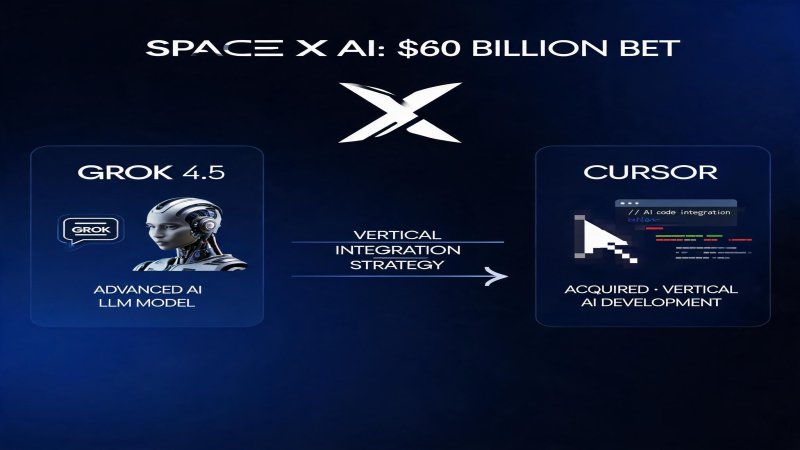
SpaceX AI's $60 Billion Bet: Grok 4.5 and the Vertical Integration Strategy Behind the Cursor Acquisition
Event Overview
On July 8, 2026, Elon Musk officially announced that SpaceX AI would open Grok 4.5 to global users the next day (July 9), while disclosing that SpaceX was acquiring AI coding tool Cursor in a $60 billion all-stock transaction. This announcement marks the official completion of Musk's "compute + model + tools" three-in-one AI empire.
Key Facts:
- Grok 4.5 Technical Specifications: Built on a 1.5 trillion parameter V9 base model, with Cursor programming data integrated into the training process, supporting multi-step reasoning and code generation capabilities
- Cursor Acquisition Price: $60 billion all-stock transaction, setting a new valuation record for AI coding tools. For comparison, GitHub Copilot's annual revenue is approximately $1 billion, meaning the $60 billion valuation represents 60x annual revenue
- Vertical Integration Completeness: SpaceX AI ecosystem now covers three core layers:
- Compute Layer: SpaceX Starlink global data center network
- Model Layer: Grok series large models (from Grok 1 to Grok 4.5)
- Tools Layer: Cursor AI coding tool
- Current Testing Status: Grok 4.5 is currently in private beta testing within SpaceX and Tesla
Technical Deep Dive: Grok 4.5 Architecture and Cursor Capabilities
Grok 4.5 Technical Architecture
Grok 4.5 adopts a distinctly different technical path from its predecessors. The 1.5 trillion parameter V9 base model is already close to GPT-4 scale, but the real differentiation lies in the training data composition - specifically incorporating Cursor platform programming data, giving the model unique advantages in code generation, code understanding, and programming assistance.
Performance Comparison:
| Metric | Grok 4.5 | GPT-5.6 Sol | Claude Sonnet 5 | Gemini 3.5 Pro (Expected) |
|---|---|---|---|---|
| Parameters | 1.5T | Undisclosed | Undisclosed | Undisclosed |
| Context Window | 128K | 1.5M | 200K | 2M |
| Coding Ability | Specialized | Comprehensive Strong | Strong | Strong |
| Pricing | Undisclosed | $5/$30 | $2/$10 | Undisclosed |
Cursor Product Capabilities
As an AI coding tool, Cursor's core capabilities include:
- Code Completion and Generation: AI-powered automatic code completion based on large models
- Conversational Programming: Developers describe requirements in natural language, Cursor automatically generates code
- Code Review: Automatically identifying potential bugs and security vulnerabilities
- Project-Level Understanding: Ability to understand the structure and context of entire codebases
Cursor's uniqueness lies in its deep integration with developer workflows, placing greater emphasis on engineering practice compared to GitHub Copilot.
Financial Logic: $60 Billion Valuation and Cost Analysis
Cursor Valuation Rationality Analysis
The $60 billion acquisition price has sparked widespread market discussion. From a financial perspective:
Revenue Multiple Method:
- Assuming Cursor's annual revenue is $1 billion (industry estimate)
- $60 billion valuation = 60x annual revenue
- For comparison, GitHub was acquired by Microsoft at approximately 20x annual revenue
User Value Method:
- Cursor's penetration among professional developers is rapidly increasing
- Paid user ARR conservatively estimated at $500 million
- Enterprise pricing at $20/user/month, premium version at $40/month
Strategic Premium:
- Musk's willingness to pay $60 billion indicates he sees not only Cursor's commercial value
- More importantly, the synergistic effects of integrating it into the SpaceX AI ecosystem
SpaceX Funding Source
The $60 billion all-stock transaction means:
- No cash outflow required
- Using SpaceX or xAI equity as consideration
- Cursor founding team and investors receive SpaceX-affiliated stock
Strategic Deep Dive: Vertical Integration Business Logic and Competitive Landscape
Musk's Vertical Integration Strategy
Musk's business philosophy has always emphasized vertical integration. From Tesla's battery factory to SpaceX's rocket engine manufacturing, vertical integration has been his core competitive advantage. This strategic logic continues in the AI domain:
Three-Layer Vertical Integration Architecture:
- Compute Self-Sufficiency: Starlink provides SpaceX with unique global data center deployment capabilities. Compared to traditional cloud vendors relying on power grids and data center site selection, Starlink can deploy computing nodes in regions that traditional internet infrastructure cannot easily reach
- Proprietary Model Development: From Grok 1 to Grok 4.5, SpaceX insists on developing its own large models rather than calling third-party APIs. This means:
- Complete data autonomy
- Controllable model capability iteration
- Ability to deeply optimize for SpaceX/Tesla's unique scenarios (autonomous driving, rocket control)
- Tools Control: After acquiring Cursor, Musk will own the complete chain from underlying computing to models to developer tools. When developers use Cursor for programming, they are actually calling SpaceX's AI capabilities, with data and traffic staying within his own ecosystem
Competitive Landscape Impact
Impact on OpenAI:
- OpenAI loses a potential programming tool partnership opportunity
- Cursor's binding with Grok means Codex faces more direct competition
- Developer ecosystem competition enters a new phase
Impact on Anthropic:
- Claude Code's market position is challenged
- Anthropic needs to reassess its programming tool strategy
Impact on Google:
- Gemini 3.5 Pro's programming capabilities face direct competition from Grok 4.5
- Google's developer tools ecosystem (Cloud Code, etc.) needs accelerated AI integration
Industry Trend Predictions:
- AI Coding Tools Enter the "Big Tech Era": Cursor acquired by SpaceX, GitHub belonging to Microsoft, AWS investing in Codeium - major coding tools are all binding with major tech companies
- Vertical Integration Becomes Standard for Major Vendors: From OpenAI+Microsoft to SpaceX+Cursor, AI giants are extending up and down the supply chain
- Developer Data Becomes Strategic Resource: Developer behavior data accumulated by Cursor will become key fuel for SpaceX AI iteration
Challenges and Concerns
Technical Challenges
- Grok 4.5 Performance Verification: Currently available public benchmark data is limited, and its actual programming capabilities have not been independently verified by third parties
- V9 Model Technical Innovation: A 1.5 trillion parameter model has no particular advantage in scale; the core innovations of V9 compared to previous generations are not yet clear
- SpaceX Scenario Adaptability: Will Grok's optimization for programming scenarios conflict with its core applications at SpaceX/Tesla?
Business Challenges
- Sustainability of $60 Billion Valuation: How high is the ceiling for the AI coding tool market? The 60x annual revenue valuation requires sustained high growth to support
- Synergy with SpaceX Core Business: The synergy between Cursor and SpaceX's core business (aerospace, satellite internet) is not immediately obvious
- Regulatory Risk: SpaceX's rapid expansion in AI may trigger antitrust scrutiny
Organizational Challenges
- Cursor Culture Integration: Conflict between startup agility culture and SpaceX's military-style management approach
- Talent Retention: How to retain Cursor's core engineering team post-acquisition
- Product Roadmap: Balancing Cursor's independent development trajectory with SpaceX's overall strategy
Conclusion
Multi-Layer Significance
For the AI Industry:
SpaceX's $60 billion acquisition of Cursor represents a new height for major vendor vertical integration strategies. Musk has demonstrated that in the AI era, the three-in-one model of compute (SpaceX Starlink) + models (Grok) + tools (Cursor) is a viable business path. This model will have profound implications for the strategies of OpenAI, Google, and Anthropic.
For Enterprise Customers:
Enterprise AI procurement decisions will face more choices. The SpaceX AI ecosystem provides a one-stop solution, where everything from underlying computing to application tools can be resolved within one system. But this also means stronger lock-in effects - once entering the SpaceX ecosystem, migration costs will be extremely high.
For Investors:
SpaceX's AI empire narrative adds new storytelling. The performance of the Grok 4.5 + Cursor combination in the capital markets will become a key indicator for validating the feasibility of the "vertical integrated AI" business model.
Predictions
| Timeline | Prediction | Confidence |
|---|---|---|
| Q3 2026 | Grok 4.5 officially opens API, Cursor launches enterprise version | High Confidence |
| Q4 2026 | SpaceX AI developer ecosystem officially takes shape | High Confidence |
| 2027 | SpaceX AI begins providing commercial services | Vendor Claim |
| 2027 | Microsoft/GitHub launches Copilot Pro against SpaceX | High Confidence |
Sources and Confidence Levels:
- Vendor Claim: Grok 4.5 technical parameters based on official disclosures
- High Confidence: $60 billion acquisition price confirmed by multiple sources
- High Confidence: Testing status based on public reports
- Vendor Claim: Strategic intent inferred from Musk's historical statements
*VendorDeep In-Depth Analysis | 2026-07-09*
*AI Analysis*
Why it Matters
SpaceX's $60B acquisition of Cursor represents a new height for major vendor vertical integration AI strategies. Musk has built a complete AI ecosystem closed loop through Starlink's unique compute power, Grok's model capabilities, and Cursor's developer access. This model will have profound implications for the entire AI industry's competitive landscape.
DECISION
- Enterprise Tech Decision Makers: Evaluate the lock-in effects of SpaceX AI ecosystem; assess migration costs before adoption
- Developers: Monitor Grok 4.5 API opening schedule and pricing strategy
- Investors: Focus on SpaceX AI commercialization path and competition with traditional cloud vendors
- Security Teams: Evaluate compliance and data security policies of Cursor enterprise version
PREDICT
- Q3 2026: Grok 4.5 officially opens API, Cursor launches enterprise version
- Q4 2026: SpaceX AI developer ecosystem takes shape officially, challenging GitHub Copilot
- 2027: SpaceX AI begins providing commercial services, targeting enterprise developer market
- 2027: Microsoft/GitHub launches Copilot Pro to respond to competition, AI coding tools enter the 'Big Tech War' era
Get 3-5 key AI infrastructure signals weekly →
💬 Comments (0)