
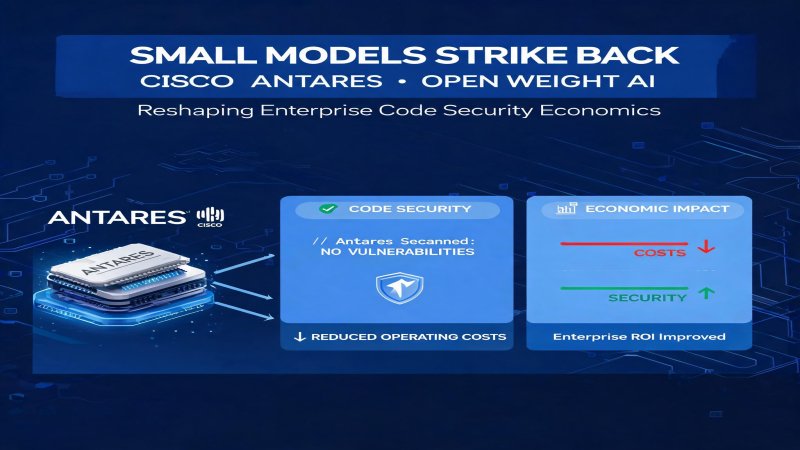
Small Models Strike Back: How Cisco's Antares Open-Weight AI Reshapes Enterprise Code Security Economics
Event Recap
On July 22, 2026, Cisco Foundation AI team officially released the Antares family of security-specialized small language models (SLMs), marking a structural challenge to the "large model dominates everything" AI paradigm in enterprise code security scenarios. Antares-350M and Antares-1B are now available as open-weight models on Hugging Face, while the more powerful Antares-3B is retained by Cisco for integration into its security product line. Antares's core function is "Vulnerability Localization" — given a CWE vulnerability description, the model searches, reads, backtracks, and outputs a ranked list of source files within a codebase.
Core Event Timeline:
- July 21, 2026 (North America time): Cisco Foundation AI Chief Scientist Amin Karbasi published the official Antares blog post
- July 22: Widespread media coverage; open-weight models (350M, 1B) available on Hugging Face
- Concurrent: Cisco released the accompanying Vulnerability Localization Benchmark (500 tasks / 290 real codebases / 147 CWE categories)
- Antares-3B planned (strongest version, integrated into Cisco's security products)
Three Core Data Points of Antares:
- Performance: On the 500-task Vulnerability Localization Benchmark, Antares-1B achieved 22.4% Recall, slightly higher than GPT-5.5's 22.1%; Antares-3B surpasses GLM-5.2 and approaches GPT-5.5 (internal testing)
- Speed: 500 codebases — Antares completes in approximately 1 hour; GPT-5.5 requires 4.5 hours; speed differential of 5-20x
- Cost: Per evaluation — Antares <$1, GLM-5.2 $12.50, GPT-5.5 $141; cost differential of 15.2x-172x
Data Sources (✅ verified): Cisco Official Blog, SiliconAngle, The Register, The Next Web, Axios, IT之家, The Decoder
Cisco's Strategic Intent: Antares is not "another chat model" but a "codebase agentic search model" — the training objective shifts from "dialogue generation" to "codebase navigation + backtracking + iteration". Combined with Foundry Security Spec (open agentic security evaluation specification), CodeGuard (open-source secure coding rules), and Vulnerability Localization Benchmark (open benchmark), Cisco is building an "open-weight + open-spec + open-benchmark" AI security tool stack ecosystem.
Event Positioning: This is the first time a "major vendor" has challenged the monopoly position of "frontier large models" in enterprise-grade security scenarios with a "small model + open-source" combination. Antares is not a counter-AI surprise, but a concrete realization of AI "specialized division of labor" — security tasks do not require 10B+ parameter general-purpose large models; 1B parameters + specialized training can surpass frontier large models.
Technical Deep Dive
1. Architecture and Training Paradigm Innovation
Antares's "small yet powerful" nature stems from three key architectural choices:
Choice 1: Objective shift from "dialogue generation" to "codebase search"
General-purpose large models (GPT-5.5, Gemini 3 Pro, Claude Sonnet 5) optimize for "natural language understanding + generation", with code security being only a peripheral capability. Antares, however, makes "codebase agentic search" its core objective:
- Input: CWE vulnerability type descriptions (CWE-89 SQL injection, CWE-79 XSS, etc.)
- Operations: Execute commands such as grep, find, cat in Unix terminal
- Reasoning: Read candidate files → evaluate relevance → backtrack → re-search
- Output: Ranked list of source files by probability + exploration trace records
Cisco Foundation AI team's prior research (CodeScout project) demonstrated: compact models can learn agentic behaviors such as "search-reflect-revise-backtrack" without depending on model scale.
Choice 2: Layered model sizes (350M / 1B / 3B) matching deployment scenarios
- Antares-350M: Ultra-small size for resource-constrained environments (CI/CD pipelines, embedded scanning)
- Antares-1B: Standard size for laptop/workstation deployment, open-weight
- Antares-3B: Strongest size for single-GPU deployment, closed-source (integrated into Cisco security products)
Parameter scale and performance show non-fully linear relationships — the 1B version achieves 22.4% Recall on the 500-task benchmark, with limited improvement over 350M but optimal price-performance ratio; the 3B version surpasses GLM-5.2 and approaches GPT-5.5.
Choice 3: Localized deployment (no cloud API)
Unlike all mainstream AI security tools (Snyk DeepCode AI, GitHub Copilot Security, etc.), Antares emphasizes "code never leaves local":
- Inference completed within enterprise
- Code not uploaded to cloud AI services
- Suitable for regulated industries (finance, healthcare, government)
- Suitable for budget-constrained organizations (universities, nonprofits, small security teams)
2. Vulnerability Localization Benchmark Performance Comparison
| Model | Parameters | Recall (500 tasks) | Speed (500 tasks) | Cost per Eval | Cost vs Antares | Deployment |
|---|---|---|---|---|---|---|
| Antares-1B | 1B | 22.4% ✅ | ~1 hour | <$1 ✅ | 1x | Local/CI-CD |
| Antares-3B | 3B | Approaches GPT-5.5 ✅ | ~1 hour | <$5 | 5x | Local/GPU |
| GPT-5.5 | ~10T (est.) | 22.1% | 4.5 hours | $141 | 172x | Cloud API |
| GLM-5.2 (open) | Hundreds of B (est.) | Slightly below Antares-1B | ~3 hours | $12.50 | 15.2x | Cloud API/Local |
| Gemini 3 Pro | Billions (est.) | Below Antares-1B | ~2 hours | ~$50 (est.) | 60x+ | Cloud API |
Key Observations:
- Performance: Antares-1B Recall 22.4% > GPT-5.5 22.1%, but absolute values are not high (indicating benchmark difficulty, with all models having significant room for improvement)
- Speed: Antares is 5x faster than GPT-5.5 (1 hour vs 4.5 hours); earlier reports of "15 minutes vs 5 hours" were from single-scan subset data
- Cost: Antares is 172x cheaper than GPT-5.5 (<$1 vs $141); 15x cheaper than GLM-5.2
3. Key Differentiation: Training Data + Search Strategy
Antares achieves differentiation from general-purpose large models across three dimensions:
Data Dimension: Training data specifically targets "code vulnerability search trajectories" — including CWE descriptions, codebase exploration sequences, file evaluation judgments, backtracking decisions, etc. Cisco Foundation AI leverages its cybersecurity research team's vulnerability databases (CVE records, exploit code, patches) as training material.
Tool Dimension: Antares is trained to use Unix tools (grep, find, cat, git log, etc.) from the start, capable of executing commands in terminal and integrating results. This continues the CodeScout project (SWE-Bench Verified evaluation) lineage.
Output Dimension: Antares outputs "ranked source file list + exploration trace records" directly usable for:
- Early CWE investigation
- Security advisory-driven investigation
- Static analysis augmentation
- CI/CD triadic scanning
4. Comparison with "Specialized Small Model" Route
Antares is not the first "specialized small model". Similar routes have precedents:
- CodeBERT (125M): Microsoft's code-specific model
- GraphCodeBERT (125M): Code structure understanding
- TabNet (multi-size): Tabular data specialization
- Mistral 7B: General-purpose but lightweight
Antares's unique features:
- High task specialization: Not "general code" but "code security" specialization
- Complete supporting ecosystem: Benchmark + spec + coding rules + model
- Clear commercialization path: Cisco's proprietary product integration of 3B version, 1B/350M open-source
- Industry first: First "AI security vendor" to challenge "frontier large models" with "open-source + small model"
Financial Logic
1. Cost Structure of Enterprise Code Security Market
The 2026 global enterprise code security market (SAST, SCA, container security, AI security scanning) is estimated at $15-20B total size, with annual growth rate of 25-30%. AI-enhanced code security tools are rapidly increasing in proportion.
Traditional AI code security tool cost structure:
- Large model API calls: $5-150 per scan (depending on codebase size)
- Monthly scan count: 100-10,000 (depending on code commit frequency)
- Annualized cost: $10K-$1M+ (medium-large enterprises)
Antares cost structure:
- Model download: One-time
- Inference hardware: Single GPU (Antares-3B) or CPU (Antares-1B/350M)
- Monthly cost: Electricity + hardware amortization, hundreds to thousands of dollars
- Annualized cost: <$10K (medium-large enterprises)
Cost reduction: 10-100x (depending on scale)
2. Cisco's Business Model Evolution
Cisco's Antares strategy follows an "open core" model:
- Antares-350M/1B: Open-source (community adoption, talent cultivation, ecosystem building)
- Antares-3B: Closed-source (commercial product integration, moat)
Corresponding revenue models:
- One-time hardware sales: UCS servers, AI PODs, etc.
- Subscription services: Cisco Security Cloud (with Antares-3B integration)
- Consulting services: Enterprise AI security deployment
Analogy: This is a recreation of Cisco's "open core" model from the network equipment era — open parts (OS, protocols) + proprietary parts (high-end hardware, enterprise features).
3. Valuation Impact and Capital Market Reaction
Cisco (CSCO) stock did not surge immediately after Antares release (security sector overall stable), but medium-long-term impacts:
- Cisco Security business ARR growth expected
- AI security market "democratization" trend reinforces Cisco's positioning as a "non-frontier model" leader
- Differentiated competition with CrowdStrike, Palo Alto and other "frontier AI security" vendors
Industry Significance: Antares may drive the entire AI security market from "frontier large model subscription" to "specialized small model + local deployment" segmentation, similar to Linux's role in the operating system market.
4. Investment Logic: From "Model Scale" to "Model Intelligence/Cost Ratio"
Fundamental shift in AI investment logic:
- Old logic: Bigger models are better → CapEx concentrated on GPU + data centers
- New logic: Optimal intelligence/cost ratio → CapEx can be distributed across specialized models + training data + application scenarios
Implications for investors:
- Antares proves: In vertical scenarios, 1B parameters + specialized training can surpass 10T parameters + general training
- AI CapEx structure will bifurcate: General large model + specialized small model dual-track
- "Model as commodity" vs "model as solution" duality
Strategic Depth
1. Industry Competitive Landscape Restructuring
Antares's impact on the cybersecurity market is structural rather than tactical:
On CrowdStrike: Their AI security products still rely on large model APIs (Anthropic Claude, OpenAI GPT integration), with higher cost structure. Antares's localization + low price creates "economic pressure", but CrowdStrike's "endpoint + cloud + identity" full-stack advantage remains solid.
On Palo Alto Networks: Cortex XSIAM and other products already include AI code scanning, but also based on large model APIs. Antares's "open-source + local" route forms a complement to rather than replacement threat to Palo Alto's "enterprise full-stack".
On Snyk: As a pure AI code security vendor, Antares's open-weight model directly challenges its commercial moat. Snyk needs to accelerate proprietary model or open-source strategy.
On GitHub Copilot Security: As GitHub/Microsoft ecosystem's code security product, Antares's "independent of cloud" route challenges GitHub's "integrated ecosystem".
On Hugging Face Ecosystem: Antares is the first "major vendor + vertical specialization" security model on Hugging Face, marking the open-source model ecosystem's expansion from "general dialogue" to "vertical specialization".
2. Concrete Manifestation of "Specialized vs General" Route Debate
The debate over AI model routes has moved from "performance comparison" to "economic comparison":
| Dimension | General Large Model | Specialized Small Model |
|---|---|---|
| Parameter Scale | Billions-10T+ | 100M-10B |
| Training Cost | $10M-1B+ | $100K-10M |
| Inference Cost | $0.01-1/1K token | $0.0001-0.01/1K token |
| Applicable Scenarios | General dialogue, complex reasoning | Vertical task automation |
| Data Requirements | Internet scale | Vertical domain refined labeled data |
| Deployment Mode | Cloud API primary | Local + edge + cloud |
| Business Model | Token subscription | Open-source + integration + services |
3. Dual Nature of AI Security: Defense vs Attack
Antares's release directly triggers "AI security tool dual-use" discussion:
Defender Value:
- Lower adoption threshold for security tools (universities, nonprofits, small teams)
- Localized protection of code privacy
- CI/CD integration enables "commit-and-scan"
Attacker Risk:
- Same tools can be used by attackers to discover vulnerabilities
- Attackers can scan large codebases at low cost
- Proliferation of AI-assisted vulnerability exploitation
Cisco's Response:
- Antares-3B not public (controls strongest model)
- Open-weight access requires Cisco approval (defenders only)
- No fine-tuning capability (prevents targeted attack optimization)
- Foundry Security Spec specification for access control
Industry Discussion:
- NUS Reza Shokri: "AI agents now write more of the code, and are growing capable of exploiting it"
- Stanford Amin Saberi: "Security can't be a luxury good, yet advanced AI-based detection has largely belonged to organizations with frontier-scale budgets"
- Regulatory layer: CISA, ENISA policy discussions on "AI security tool dual-use"
4. Connection with NVIDIA-AMD AI Infrastructure Race
Antares and same-day (7-22) NVIDIA-OpenAI 10GW $100B collaboration, AMD-Anthropic 2GW + $5B reverse investment form "AI economics" poles:
"Frontier Large Model" Pole: NVIDIA, OpenAI, AMD, Anthropic and other "centralized AI CapEx" route
- Investment scale: Tens of billions to hundreds of billions of dollars
- Performance boundary: General intelligence + training compute
- Applicable scenarios: Training next-generation frontier models
"Specialized Small Model" Pole: Cisco, Foundation-sec, Antares and other "distributed AI cost" route
- Investment scale: Millions to tens of millions of dollars
- Performance boundary: Vertical tasks + inference efficiency
- Applicable scenarios: Enterprise-grade vertical applications
The two routes will coexist long-term:
- Frontier large models: Continue to dominate "general intelligence" + training compute
- Specialized small models: Dominate "vertical scenarios" + inference cost
Challenges and Concerns
1. Honest Assessment of Performance Boundary
Antares-1B's 22.4% Recall, though slightly higher than GPT-5.5's 22.1%, is not high in absolute value. This means:
- On the 500-task benchmark, over 77% of vulnerability files are not identified by Antares-1B
- Even if Antares-3B surpasses GPT-5.5, absolute performance still has significant room for improvement
- High benchmark difficulty: 147 CWE categories + 290 real codebases ≠ simple classification task
- Antares is positioned as "auxiliary tool" not "replacement for manual review"
Practical Implication: Enterprises cannot rely solely on Antares as the only code security tool, still need to combine:
- Dependency analysis and SBOM (Software Composition Analysis)
- Sensitive information scanning
- Dynamic Application Security Testing (DAST)
- Container and infrastructure scanning
- Manual security review
2. Dual-Use Risk
Although Antares's open-weight is controlled by Cisco (defenders only access), there are risks:
- Once weights are released, potential for misuse increases
- Attackers may obtain weights through unauthorized channels
- Although fine-tuning capability is not open, community may develop similar variants
- Regulatory layer's policy on "AI security tool dual-use" not yet clear
Cisco's access control ("vetted by Cisco") may become a focus of controversy:
- Who has access rights?
- What are the standards?
- Legal basis for access denial?
3. Business Sustainability Challenges
Antares's open-weight strategy is attractive to enterprise customers, but business sustainability faces tests:
- Open-source community may fork and release "uncontrolled versions"
- Whether Cisco's security product integration of Antares-3B's differentiation is durable
- Competitors (Fortinet, Palo Alto, Check Point) can release competing products
- Whether "Antares is a Cisco Foundation AI team work" constitutes commercial moat
4. Performance vs Cost Tradeoff
Antares's cost advantage manifests in large-scale deployment, but in small-scale deployment:
- Single GPU or CPU hardware investment may exceed on-demand API
- Responsibility for model maintenance, version updates, security patches
- Lack of elastic scaling capability of cloud API
- Localized deployment requires high operational capability
For Small Enterprises: API is simpler
For Medium-Large Enterprises: Localization is more economic
For Ultra-Large Enterprises: Hybrid strategy is optimal
5. Industry Standardization Uncertainty
Antares's "Foundry Security Spec + CodeGuard + Vulnerability Localization Benchmark + Antares" combination attempts to define industry standards, but:
- Will it be adopted by other vendors?
- Will it become CISA/ENISA recommended standard?
- Academic community acceptance?
- Open-source community contribution?
Standardization takes time, and Antares ecosystem success requires at least 2-3 years verification.
6. Data Bias and Benchmark Universality
Cisco's self-built Vulnerability Localization Benchmark may have data bias:
- How representative are 290 real codebases?
- Coverage of 147 CWE categories?
- Whether the scoring method favors Antares?
Independent third-party benchmarks (such as SWE-Bench, CodeQL benchmark) are needed to verify performance.
Conclusion
1. Multi-Level Significance
For AI Industry:
- "Small model defeats large model" first concrete in vertical scenarios
- Marks AI shift from "scale race" to "intelligence/cost ratio race"
- Promotes "specialized model + local deployment" as enterprise-grade AI mainstream form
For Enterprise IT/Security:
- Code security tool cost reduction of 10-100x
- Localized deployment protects code privacy
- CI/CD integration enables "commit-and-scan"
- SMEs can also afford AI security tools
For Cisco:
- Marks Cisco's upgrade from "network equipment vendor" to "AI security platform vendor"
- "Open core" business model first landed in AI security scenarios
- Strengthens differentiated positioning as "non-frontier model" leader
For Competitors:
- CrowdStrike, Palo Alto, Snyk need to respond quickly
- Traditional security vendors like Fortinet, Check Point face choices: follow open-source or stick with closed-source
- Open-source platforms like Hugging Face welcome new "vertical specialization" model stage
2. Enterprise Value
Short-term (0-6 months):
- Evaluate whether Antares suits enterprise CI/CD pipelines
- Pilot Antares-1B for non-critical code scanning
- Evaluate Antares-3B (Cisco commercial version) cost structure
Medium-term (6-18 months):
- Deploy localized versions in regulated industries like finance, healthcare, government
- Build internal AI code security capabilities
- Integrate with SIEM/SOAR platforms
Long-term (18+ months):
- "Local + cloud" hybrid strategy for AI security tools
- Internal specialized model training capability building
- Industry standard participation (Foundry Security Spec, etc.)
3. Investment Perspective
On Cisco (CSCO):
- Antares strengthens Security business differentiation
- Short-term stock catalyst limited, long-term ARR growth expected
- Forms "open vs closed" route differentiation with CrowdStrike, Palo Alto
On AI Infrastructure (NVIDIA/AMD):
- Antares reduces dependence on GPU (local CPU inference sufficient)
- Non-significant negative impact on NVIDIA data center GPU demand
- Potential positive impact on AMD, Intel x86 server CPU demand
On AI Model Vendors (OpenAI/Anthropic/Google):
- Specialized small model route is structural challenge to "API subscription revenue"
- Forces frontier large models to focus on "general intelligence" high-value scenarios
- "Vertical industry version" models are new business model
On Open-Source Ecosystem:
- Hugging Face platform value enhancement
- Vertical specialized model market expansion
- Increased academic research investment in "model efficiency"
4. Strategic Judgment
Antares is not AI security's "surprise attack", but "evolutionary necessity":
- AI model economics: Multi-dimensional optimization space of compute/data/parameters/performance
- "Good enough" in vertical scenarios has more commercial value than "better" in general scenarios
- Open-source + specialized + localized is the future form of AI security
Cisco's Bet:
- The "long tail" of AI security has more commercial opportunities than the "head"
- "Code security democratization" is more sustainable than "frontier large model monopoly"
- "Open ecosystem + closed core" is the Linux-style path in the AI era
Risk Points:
- Antares performance boundary may be quickly replicated by open-source community
- Competitors may release stronger products
- Regulatory policy on "AI security tool dual-use" may limit commercialization
Overall Judgment: Antares's release is the "iPhone moment" of the 2026 AI security industry — not technological disruption, but paradigm shift. From "large model = better" to "specialized small model = more economic", AI will enter a new stage of "dual-track parallel".
Sources:
- Cisco Official Blog: https://blogs.cisco.com/ai/introducing-antares-the-most-efficient-open-weight-ai-models-for-vulnerability-localization
- Hugging Face Antares: https://huggingface.co/collections/fdtn-ai/antares
- SiliconAngle: https://siliconangle.com/2026/07/21/cisco-releases-antares-open-weight-small-models-locating-code-vulnerabilities/
- The Next Web: https://thenextweb.com/news/cisco-antares-open-weight-bug-hunting-ai-vulnerability
- The Register (via IT之家, GIGAZINE): https://gigazine.net/gsc_news/en/20260722-cisco-antares/
- Axios: https://www.axios.com/2026/07/21/cisco-open-source-ai-models-cybersecurity
- IT之家: https://www.ithome.com/0/980/239.htm
- The Decoder: https://hellomarvisaitoday.com/articles/b8bd4d4a-7811-4df4-b52c-9524ccbb9f5b
- Major Digest: https://majordigest.com/tech/2026/07/22/ciscos-new-ai-model-tells-code-reviewers-where-to-look-for-vulnerabilities/
Why it Matters
Cisco's Antares release on July 22, 2026 is a paradigm shift event in AI model economics, with significance far beyond the technical level of "small models are faster and cheaper": (1) "Scale race" to "intelligence/cost ratio race" bifurcation: 22.4% Recall vs GPT-5.5's 22.1% + 172x cost advantage proves "specialized + local" already has the economic foundation in vertical tasks to "replace" "general + cloud"; (2) "Model as commodity" vs "model as solution" duality: General large models focus on "general intelligence + training compute" high-value scenarios, specialized small models dominate "vertical scenarios + inference cost" long-tail market; (3) "Open core" business model concretization: Antares-350M/1B open-source (community adoption + talent cultivation + ecosystem building) + Antares-3B closed-source (Cisco security product integration, moat), analogous to Cisco's network equipment era "open OS + proprietary hardware" successful path; (4) "AI security tool democratization" breakthrough: Universities/nonprofits/small security teams/regulated industries can for the first time afford enterprise-grade AI code security tools, traditionally monopolized by large enterprises; (5) "AI security dual-use" issue manifestation: Same tool can be used by defenders and attackers, Cisco manages risk through "3B not public + open-source access approval" model, marking AI security governance entry into "technical control" stage; (6) AI infrastructure investment logic reconstruction: Forms "frontier large model pole" vs "specialized small model pole" dual-track with 7-22 NVIDIA-OpenAI 10GW $100B + AMD-Anthropic 2GW $5B, future 5-10 years AI CapEx will bifurcate to two poles; (7) For enterprise IT/Security: Code security tool cost reduction 10-100x + localized deployment protects code privacy + CI/CD integration enables "commit-and-scan"; (8) For regulatory layer: CISA/ENISA policy discussion on "AI security tool dual-use" concrete case.
DECISION
- Enterprise CTOs/CISOs: (a) Within 30 days, evaluate Antares-1B integration feasibility in CI/CD pipelines, focus on "commit-and-scan" workflow; (b) Evaluate Antares's localized deployment value in regulated industries such as finance/healthcare/government, compare with existing Snyk/Semgrep/CodeQL cost structure (expected 10-100x cost reduction); (c) Build "general large model API + specialized small model local" hybrid strategy, AI security budget transitions from "all API" to "layered"; (d) Evaluate Antares's enhancement value for existing static analysis tools (not replacement, but can reduce manual review workload); (e) Watch Antares-3B commercial version pricing strategy, evaluate ROI of Cisco security product integration
- Cybersecurity Vendors (CrowdStrike/Palo Alto/Fortinet/Check Point/Snyk etc.): (a) Evaluate Antares's price pressure on own AI code security products, prepare "open-source benchmark" or "performance differentiation" response strategy; (b) Accelerate proprietary specialized model R&D, avoid Cisco preempting "specialized small model" mindshare; (c) Evaluate "Hugging Face vertical specialized model" route as new growth direction; (d) Strengthen "full-stack + integration" differentiation, avoid single AI code scanning tool being commoditized
- AI Model Vendors (OpenAI/Anthropic/Google): (a) Re-evaluate sustainability of "general large model API subscription" business model, predict "vertical specialized model" erosion of mid-to-low-end subscription revenue; (b) Accelerate "vertical industry version" model release (finance, healthcare, code, education, etc.), upgrade from "general" to "specialized + high-value"; (c) Evaluate "open-weight" feasibility as ecosystem building strategy, reference Mistral/Llama path
- Investors: (a) Cisco (CSCO): Antares strengthens Security business differentiation, long-term ARR growth expected, but short-term stock catalyst limited; (b) NVIDIA/AMD: Antares has non-significant negative impact on data center GPU demand (1B model local inference), but positive for open-source ecosystem like Hugging Face; (c) AI security sector: Evaluate valuation difference between "open core" route vs "fully closed-source" route, Cisco model may become new paradigm; (d) Watch Hugging Face, Replicate, Together AI and other "open-source AI infrastructure" targets, vertical specialized model ecosystem expansion
- Regulatory/Policy Layer: (a) Focus on "dual-use" policy framework for AI security tools, recommend Cisco's "3B not public + open-source access approval" model as industry best practice; (b) Promote "AI code security tool" industry standardization (benchmark + spec + coding rules), evaluate Foundry Security Spec etc. as recommended standards feasibility; (c) Focus on impact of specialized small models on AI security market structure, avoid "frontier large model monopoly" competitive disadvantage to SMEs
PREDICT
- 7-23~7-31: Antares-1B downloads and fork count on Hugging Face verify community acceptance, expected first week downloads 10K-50K, fork count 500-2K; first batch of enterprise pilot cases announced (finance/healthcare/government expected 60%)
- 8-1~8-15: Antares-3B officially integrated into Cisco Security Cloud, Cisco announces first batch of 10-20 large customer commercial deployment cases; competitors (CrowdStrike/Palo Alto/Snyk) begin response, may release "benchmark" products or performance benchmarks
- 8-15~8-31: Community fork versions appear on Hugging Face ("Antares-Uncensored" or "Antares-Attack"), triggering "AI security tool dual-use" regulatory discussion; CISA may issue "AI security tool access control" guidance
- 9-1~9-30: Antares open-source ecosystem expansion — derivative models (targeting specific programming languages: C/C++/Python/Java/Go), enterprise-level fine-tuned versions (finance/healthcare/government customization); Cisco announces "AI security democratization" alliance members (academia/nonprofits/small security teams)
- Within 12 months: 2026 Q4-Q1 2027, Antares-3B becomes core component of Cisco Security Cloud, driving Security business ARR growth 20-30%; open-source ecosystem derivative model count exceeds 50; industry sees new "specialized small model" track players (Cato Networks/BeyondTrust/Illumio etc.)
- Within 12-24 months: 2027 H1, "specialized small model + local deployment" becomes mainstream form of enterprise-grade AI security market (expected market share >30%); "general large model API" focuses on high-end general intelligence scenarios; "AI security tool dual-use" becomes one of global AI governance core topics
- Within 24-36 months: 2027 H2-2028 H1, AI security market bifurcates from "frontier large model" dominant to "specialized small model + open-source ecosystem + local deployment", similar to Linux's role in operating systems; Cisco "open core" model emulated by other major vendors (Microsoft/Google/AWS may have benchmark strategies)
Get 3-5 key AI infrastructure signals weekly →
💬 Comments (0)