
I. Event Recap
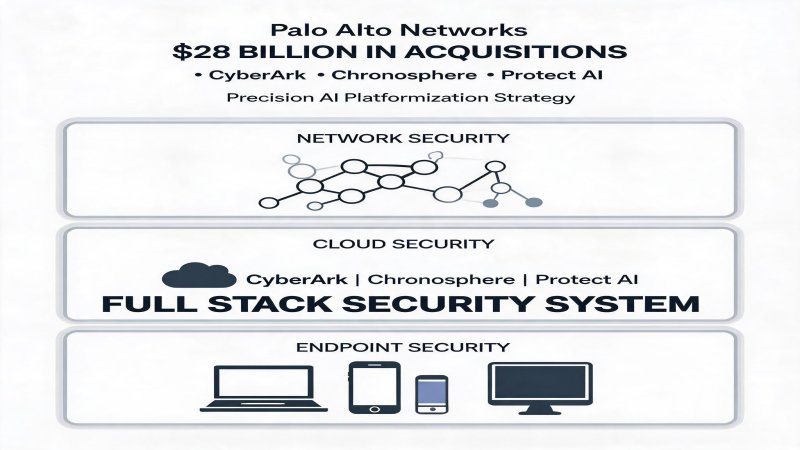
Palo Alto Networks, the highest-market-value cybersecurity vendor globally, demonstrated extremely aggressive expansion during 2025-2026. In 2025, the company completed a series of acquisitions totaling over $28 billion (CyberArk $25 billion, Chronosphere $3.35 billion, Protect AI $500 million+), rapidly filling gaps in identity security, observability, and AI model security. In August 2025, it released PAN-OS 12.1 Orion, the industry's first quantum-ready NGFW. Its strategic partnership with Google Cloud has generated over $2 billion in sales revenue, with 75+ joint integrations building deep technical fusion.
Financial figures are equally impressive. Palo Alto Networks' Q4 2025 earnings showed GAAP net income of $1.1 billion; next-generation security ARR reached $5.6 billion, up 32% year-over-year; net new NGS ARR in the quarter was $490 million, up 12% from a year ago. AI ARR was approximately $545 million—while the absolute value is modest, growth is rapid. In the global IT and telecom cybersecurity market, Palo Alto Networks leads with 5% share, ahead of CrowdStrike (3%), Cisco (2%), and Fortinet (2%).
More strategically significant is CEO Nikesh Arora's Platformization strategy. Arora stated on the Q4 2025 earnings call: "Enterprise browsers will become the new battlefield for AI security." This insight reveals Palo Alto Networks' profound understanding of AI security evolution—as AI applications are increasingly accessed through browsers, the browser itself becomes a critical enforcement point for security policies.
II. Technical Depth
2.1 Prisma AIRS: The Only Full AI Lifecycle Coverage
Prisma AIRS is Palo Alto Networks' comprehensive AI security platform. Its uniqueness lies in covering the full AI lifecycle from development to production—the most comprehensive AI security product portfolio currently on the market:
| Capability Layer | Function Description | Technical Depth |
|-----------------|---------------------|-----------------
| AI Posture Management | AI asset risk visibility, identifying weak or missing security controls | Auto-deployment and traffic redirection to optimal network and AI security |
| AI Runtime Security | Real-time defense against threats in AI workloads | Inline detection and blocking of prompt injection, data leakage; March 2026 added custom error responses and auto-scaling |
| AI Agent Security | Protection for autonomous AI agent systems | Prisma AIRS 3.0 uses In-Flight Reason Analysis to monitor agent behavior, detecting anomalous drift |
| AI Red Teaming | Proactive testing of AI system security resilience | OAuth Token Refresh supports long-duration scans, leveraging huntr ethical hacker community and Advanced WildFire intelligence |
| AI Model Security | AI model vulnerability scanning | Analyzes 35+ model file types (PyTorch, ONNX, TensorFlow, etc.) for 25+ threat categories |
The March 2026 major update added four key capabilities to Prisma AIRS' AI Runtime Firewall:
- Custom Error Response: When the firewall detects AI threats, it sends a uniquely identified custom response (rather than a generic TCP reset), preventing applications from making unnecessary retries because they cannot distinguish between security blocks and network failures
- Auto-Scaling: Software firewalls automatically scale up and down based on traffic demand, optimizing resource utilization and cost efficiency
- Microperimeter: Deploys lightweight panredirect agents on Linux workloads, redirecting all traffic through GENEVE tunnels to NGFW for L7 deep inspection
- Enhanced L7 Micro-Segmentation: Provides application-layer granular inspection for east-west traffic, strengthening workload defense against exploitation and lateral movement
2.2 PAN-OS 12.1 Orion: Dual Readiness for Quantum and Multi-Cloud
PAN-OS 12.1 Orion is Palo Alto Networks' flagship operating system for future cybersecurity. Its two core innovations are industry-firsts:
Quantum-Ready Security:
- Quantum Readiness Assessment: Comprehensive inventory of enterprise cryptography usage, identifying post-quantum cryptography (PQC) compliance gaps
- Cryptographic Transformation: Industry-first cryptographic transformation capability, able to instantly upgrade any application to quantum security without modifying application code
- Fifth-Generation Quantum-Optimized NGFW: Purpose-built for large-scale decryption and inspection of PQC-encrypted traffic, ensuring enterprises don't sacrifice network performance when migrating to quantum security
Unified Multi-Cloud Security:
- Continuously assesses risk for every cloud and AI asset
- Automatically deploys and redirects traffic to optimal network and AI security
- Builds complete multi-cloud security structures, applying micro-segmentation and least-privilege access
2.3 Device Security: From IoT/OT to Unified Device Governance
Device Security is Palo Alto Networks' comprehensive upgrade of IoT/OT security. Its technical depth lies in:
- 2000+ Attribute Dimensions: Covering static device attributes, real-time network traffic, and firewall policy coverage, combined with generative AI extracting key device information from vendor datasheets and websites
- Multi-Factor Risk Scoring: Analyzing CVE, CVSS/EPSS scores and in-the-wild exploitation, assessing coverage of existing controls against known threats, identifying vulnerable devices accessible to attackers
- Proactive Mitigation: Linked with NGFW policy engine for automatic isolation of high-risk devices, recommending specific remediation measures
III. Financial Logic
3.1 Platformization Strategy Revenue Engine
Palo Alto Networks' financial performance proves the effectiveness of the Platformization strategy. Q4 2025 NGS ARR reached $5.6 billion (up 32% YoY), with $490 million net new in the quarter. Although GAAP net income fell approximately 60% year-over-year to $1.1 billion, this primarily reflects large acquisition amortization costs and integration investments.
The Platformization strategy's financial logic lies in:
- Cross-Sell Effects: After customers purchase network firewalls, upsell conversion rates for cloud security (Prisma), endpoint security (Cortex), and AI security (AIRS) are significantly higher than independent sales
- ARR Growth Quality: NGS ARR's 32% year-over-year growth indicates customers not only buy products but continuously renew and expand, directly reflecting platform stickiness
- AI ARR Potential: Current AI ARR of $545 million is modest, but against a backdrop of the AI security market projected to reach $133 billion by 2030 (29% CAGR), growth space is enormous
3.2 $28 Billion Acquisition Capital Logic
Palo Alto Networks' acquisition spree appears aggressive, but each acquisition has clear strategic intent:
| Acquisition Target | Amount | Strategic Purpose | Integration Progress |
|---|---|---|---|
| CyberArk | $25 billion | Enter identity security market, unify human and machine identity management | Expected 12-18 months for core integration |
| Chronosphere | $3.35 billion | Acquire next-generation observability capabilities, integrate into Cortex Agenti X | Technical integration in progress |
| Protect AI | $500 million+ | Acquire AI model scanning and runtime protection core technology | Already integrated into Prisma AIRS |
3.3 Google Cloud Partnership Ecosystem Value
The strategic partnership with Google Cloud is not just technical integration but a revenue engine. Over $2 billion in sales revenue and 75+ joint integrations enable Palo Alto Networks to deeply bind with one of the world's fastest-growing cloud vendors. This binding's strategic value lies in:
- Pre-Validated Joint Solutions: Eliminate enterprise customer integration challenges and operational friction
- Revenue Lock-In: Google Cloud customers tend to choose security solutions deeply integrated with their platform, providing Palo Alto Networks with a stable customer source
- Technology Leadership: Deep integration with Vertex AI, Agent Engine, and Agent Development Kit (ADK) keeps Prisma AIRS technologically leading in AI security
IV. Strategic Depth
4.1 Platformization: The Ultimate Answer to Fragmentation
Palo Alto Networks' Platformization strategy represents an answer to the fundamental problem of the cybersecurity industry: tool fragmentation. Enterprises deploy an average of 50+ security tools, which lack integration, leaving security teams overwhelmed. Platformization unifies network (Strata), cloud (Prisma), and endpoint (Cortex) security into a single data model and unified agent architecture through the Cortex platform.
This strategy holds special significance in the AI era. AI workloads span on-premises data centers, multi-cloud, and edge nodes, and fragmented security policies expose enterprises to enormous risk. Platformization ensures the same security policies are consistently enforced across all environments, whether AI models run on Google Cloud Vertex AI, AWS Bedrock, or on-premises GPU clusters.
4.2 Comprehensive Leadership in Competitive Landscape
In the global cybersecurity market, Palo Alto Networks leads with 5% share, but its true advantage lies in capability comprehensiveness:
| Dimension | Palo Alto Networks | Cisco | Fortinet | HPE |
|---|---|---|---|---|
| Market Share | 5% (First) | 2% | 2% | 2% (via Juniper) |
| AI Security Coverage | Full Lifecycle (Only) | Discover+Detect+Protect | Runtime+LLM Protection | Prompt-Level Inspection+Visibility |
| Identity Security | CyberArk (Acquiring) | Duo IAM | Weaker | Weaker |
| Quantum Security | PAN-OS 12.1 (Industry First) | Post-Quantum Ready | Quantum-Safe SASE | Not Major Focus |
| Cloud Ecosystem | Google Cloud (75+ Integrations) | Multi-Cloud Support | Moderate | Weaker |
| Hardware Performance | VM-Series/CN-Series | Nexus/Hypershield | ASIC 400GbE | SRX 1.4 Tbps |
4.3 Enterprise Browser: The New Battlefield for AI Security
Nikesh Arora's insight that "enterprise browsers will become the new battlefield for AI security" reveals Palo Alto Networks' profound understanding of AI security evolution. As AI applications are increasingly accessed through browsers (such as ChatGPT, Claude, enterprise self-built AI applications), the browser itself becomes a critical channel for data leakage. Palo Alto Networks' Prisma Access and Enterprise Browser strategy aims to establish first-mover advantage in this emerging battlefield.
V. Challenges and Concerns
5.1 Acquisition Integration Execution Risk
The massive $28 billion acquisition spree (especially CyberArk at $25 billion) brings significant integration challenges. Cultural alignment, product synergy, channel consolidation, and customer migration all require years. Historical experience shows large technology acquisitions have mixed success rates—SAP's acquisition of Sybase, Oracle's acquisition of Sun, and others experienced prolonged integration pain.
Specific risks include:
- CyberArk Integration: The identity security market already has strong competitors like Okta and Microsoft Entra ID; whether CyberArk's technical advantages can fully释放 on the Palo Alto Networks platform carries uncertainty
- Product Complexity: While Platformization's vision is grand, the technical difficulty of truly unifying network, cloud, endpoint, and AI security into a seamless experience is extremely high. Customers may abandon comprehensive adoption due to excessive complexity
- Talent Attrition: Post-acquisition key talent loss is a common issue, especially in highly competitive domains like identity security and observability
5.2 Price Pressure and Mid-Market Erosion
As a market leader, Palo Alto Networks' product pricing is higher. In a macro environment of tightening budgets, mid-market customers may shift to more cost-effective solutions like Fortinet. Gartner projects 2026 global information security spending at $244.2 billion (up 13.3% YoY), but enterprises increasingly focus on ROI, and high prices may become a growth bottleneck for Palo Alto Networks.
5.3 AI Security Standards Uncertainty
AI security domain standards are still rapidly evolving. MCP security specifications, Agentic AI security frameworks, and others are not yet finalized. Palo Alto Networks' massive investments may face technology route risks—if industry standards evolve in different directions, invested R&D and acquisitions may not generate expected returns.
5.4 Over-Dependence on Google Cloud
The $2 billion partnership with Google Cloud is impressive but also brings risk of over-dependence on a single cloud vendor. If Google Cloud's market share growth slows or the partnership changes, Palo Alto Networks' cloud security revenue will be directly impacted. In comparison, Cisco's multi-cloud strategy and Fortinet's neutral positioning provide greater flexibility.
VI. Conclusion
Palo Alto Networks is building a full-stack security empire covering network, cloud, endpoint, identity, and AI through three engines: "Precision AI + Platformization + Ecosystem Partnerships." Its strategic core is: fighting AI with AI, eliminating fragmentation through platformization, and building barriers through ecosystems.
For enterprise users, Palo Alto Networks' AI security layout provides three key values:
- Most Comprehensive AI Security Coverage: Prisma AIRS is the only security platform covering the full AI lifecycle (posture, runtime, agents, red teaming, models). As AI applications move from experimentation to production, enterprises need not fragmented security tools but end-to-end protection capabilities.
- Unified Security Experience: The Cortex platform unifies network, cloud, and endpoint security into a single data model, significantly reducing operational complexity. For security teams already suffering from "tool fatigue," Platformization is not just a technical choice but a liberation of working methods.
- Future-Proof: Quantum security, AI agent security, and multi-cloud unified architecture ensure investments are oriented toward the next 5-10 years. PAN-OS 12.1 Orion's quantum readiness enables enterprises to calmly address quantum computing threats without large-scale equipment replacement.
From an investment perspective, Palo Alto Networks' $5.6 billion NGS ARR (up 32%) and $2 billion partnership revenue with Google Cloud prove market acceptance of the Platformization strategy. However, the integration progress of $28 billion in acquisitions, management of product complexity, and dependence on Google Cloud will be key variables determining whether it can maintain industry leadership. If Palo Alto Networks can complete CyberArk's core integration within 12-18 months while maintaining Prisma AIRS' technology leadership, its "full-stack security empire" vision will accelerate toward reality.
Why it Matters
Palo Alto Networks' Platformization strategy represents the ultimate form of the cybersecurity industry—unifying network, cloud, endpoint, identity, and AI security into a single platform. Prisma AIRS is the only security platform covering the full AI lifecycle, from posture management to runtime protection, from agent security to model scanning, forming an end-to-end closed loop. With the global AI cybersecurity market projected to reach $133 billion by 2030 (29% CAGR), Palo Alto Networks' comprehensive capabilities enable it to capture the largest share of growth dividends. Its 75+ joint integrations with Google Cloud and over $2 billion in revenue build an ecosystem barrier that is difficult to replicate. However, the integration risk of $28 billion in acquisitions (especially CyberArk's $25 billion) and management of product complexity are major challenges it faces.
DECISION
- Enterprises seeking a "one-stop" security platform with sufficient budget and desire to reduce vendor counts should prioritize Palo Alto Networks' Platformization solution, focusing on evaluating Cortex platform's unified management capabilities.
- Enterprises deploying AI applications at scale should evaluate Prisma AIRS' full AI lifecycle protection capabilities, especially AI Agent Security's In-Flight Reason Analysis and automatic kill switch features.
- Enterprises concerned about quantum computing threats should proactively deploy PAN-OS 12.1 Orion's quantum-ready features, leveraging the industry's first cryptographic transformation capability for smooth migration.
- Investors should closely monitor CyberArk integration progress (expected 12-18 months) and NGS ARR growth rate as core indicators of Platformization strategy execution effectiveness.
PREDICT
- Within 12 months, CyberArk integration will be initially completed, and the identity-AI-network trinity architecture will begin deployment in 100+ large enterprises.
- Within 2 years, Prisma AIRS will become one of the de facto standards for cloud-native AI security, with AI ARR expected to exceed $2 billion.
- Within 3 years, the Platformization strategy will drive Palo Alto Networks to capture over 30% of enterprise security budgets, with enterprise browser security becoming a new revenue growth point.
Get 3-5 key AI infrastructure signals weekly →
💬 Comments (0)