
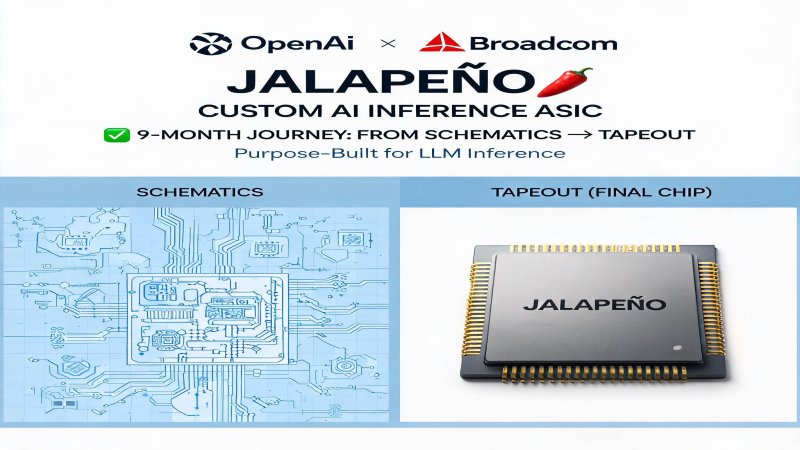
I. The Event: A Chip Named Jalapeño
On June 24, 2026, OpenAI and Broadcom jointly unveiled Jalapeño, OpenAI's first custom AI inference chip. The name itself is a statement—while semiconductor codenames tend toward technical sterility (Blackwell, Rubin, Gaudi), OpenAI chose a spicy Mexican pepper, signaling its intent to heat up the market.
Key Facts at a Glance:
| Dimension | Details |
|---|---|
| Chip Type | ASIC, purpose-built for LLM inference |
| Development Cycle | From early schematics to tape-out: only 9 months |
| Partners | Broadcom (silicon + Tomahawk networking), Celestica (board/rack integration) |
| Workloads | GPT-5.3, Codex, Spark, and future LLM inference |
| First Deployment | Active data centers by end of 2026 |
| Performance | Engineering samples at production-target clock/power; superior performance-per-watt expected |
II. Architecture: The Philosophy Behind Jalapeño
2.1 ASIC, Not GPU
Jalapeño strips away everything except LLM inference. Its design philosophy rests on three principles:
- Minimize unnecessary data movement — LLM inference bottlenecks are in data movement (HBM to SRAM to compute), not raw computation.
- Balanced compute-memory-network configuration — Matched precisely to OpenAI's actual inference load profiles, pushing real-world utilization toward theoretical peak.
- Full-stack software-hardware co-design — Hardware decisions optimized jointly with software from kernel to product experience.
2.2 Broadcom's Role
Broadcom is the world's dominant ASIC design house—Google's TPU series were designed with Broadcom's involvement. Here, Broadcom provides silicon implementation expertise and Tomahawk networking silicon for high-speed chip-to-chip and rack-to-rack interconnects.
III. Financial Logic
3.1 The Revenue-Loss Paradox
| Metric | 2025 | Q1 2026 |
|---|---|---|
| Total Revenue | $13.07B | Annualized >$25B |
| R&D Costs | $19.18B (56% of OpEx) | Growing |
| Total Operating Expenses | $34.0B | — |
| Operating Loss | ~$20.92B | — |
| Infrastructure payments to Microsoft | >$10.59B | — |
| Valuation | — | $852B (IPO filing) |
3.2 Inference Costs Have Overtaken Training
For mainstream LLM services, inference compute now exceeds training compute in aggregate cost. This is why Jalapeño targets inference exclusively—the workload is predictable, repeatable, and highly amenable to ASIC acceleration.
3.3 The IPO Imperative
OpenAI confidentially filed for IPO in 2026, targeting a valuation exceeding $1 trillion. A custom inference chip reducing per-query cost by even 10% generates structural savings in the billions.
IV. Strategic Depth
4.1 The Real De-NVIDIAlization
OpenAI's strategy is hedging, not replacement. NVIDIA retains training dominance; Jalapeño targets inference. AMD and Cerebras supplement. Every percentage point of self-supply is leverage in the next NVIDIA negotiation.
4.2 The Industry-Wide Custom Chip Race
| Company | Custom Chip | Latest |
|---|---|---|
| TPU v7/8i | Split training/inference lines | |
| Amazon | Trainium 3 | Powers Anthropic Claude |
| Microsoft | Maia 200 | 3nm, powers GPT-5.2 on Azure |
| Meta | MTIA 500 | Inference-focused |
| OpenAI | Jalapeño | LLM inference, June 2026 |
V. Risks and Challenges
ASIC Narrow-Gate Curse: Jalapeño is optimized for GPT-5.3-era architectures. Fundamental changes in GPT-6 could erode its efficiency advantage rapidly.
Manufacturing Viability: Yield ramp, thermal design, and supply chain execution remain unproven at scale. Volume deployment is targeted for end-2026—an aggressive timeline.
The Microsoft Triangle: Microsoft collects >$10.59B annually from OpenAI for infrastructure, while Jalapeño is designed specifically to reduce those payments.
Thin Software Ecosystem: NVIDIA's CUDA moat cannot be replicated overnight.
VI. Conclusion
Jalapeño's significance operates on three levels:
Commercial survival: Custom inference silicon directly addresses the largest cost driver in OpenAI's $34B annual spend.
Strategic independence: OpenAI transforms from compute buyer to compute maker, fundamentally shifting negotiating leverage with Microsoft and NVIDIA.
Industry paradigm shift: Every major AI company now has a custom chip story. When compute cost is the largest variable in a business model, no company with the scale to act will leave it entirely to third parties.
Jalapeño is not OpenAI's endpoint—it is the first step of a multi-generational hardware roadmap.
> "By designing more of the stack ourselves, we can serve more intelligence with greater efficiency." — Greg Brockman, President of OpenAI
Control the chip, control the price of intelligence. In this battle for AI-era compute pricing power, Jalapeño is OpenAI's first card—and its most daring one.
Why it Matters
DECISION
PREDICT
Get 3-5 key AI infrastructure signals weekly →
💬 Comments (0)