
I. Incident Review
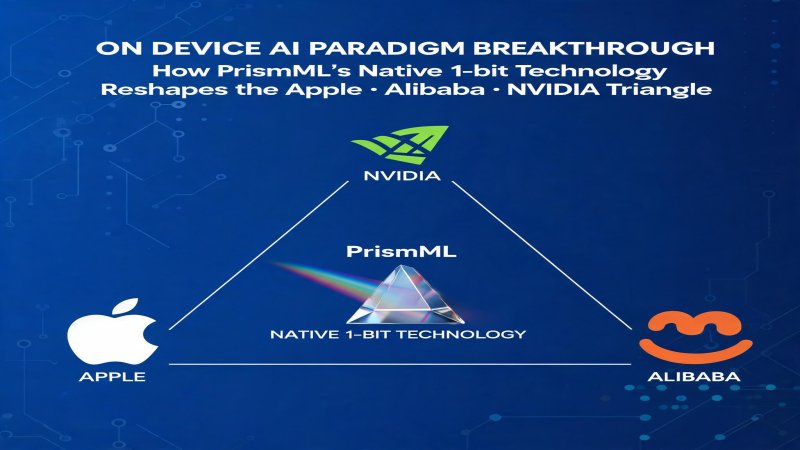
On July 10, 2026, multiple media outlets disclosed that PrismML has held technical talks with Apple. PrismML is a spinout company founded by Babak Hassibi, professor of electrical engineering at Caltech, whose core technology uses original mathematical methods licensed from Caltech to compress large language model weights from high-precision floating-point representation to a binary representation of {-1, +1}. This approach differs from traditional quantization (int8/int4) because it does not retain any "high-precision escape channels"—the entire model is built from 1-bit at the design source.
Specific Results: Alibaba Qwen 3.6 27-billion-parameter dense version compressed from approximately 54GB to under 4GB (compression ratio 13.5:1, model size reduced by 92%), successfully running completely on iPhone 17 Pro. PrismML claims 8x inference speed improvement, 75-80% energy reduction, and no degradation in model performance.
Key Architecture Difference: PrismML's approach keeps all 27 billion parameters active simultaneously. In contrast, Apple's current on-device model shipped in iOS 27 beta claims to have 20 billion parameters, but uses sparse architecture with only 1-4 billion parameters activated per inference. This full-activation vs sparse-activation difference determines the fundamental gap in actual usable model capabilities.
Commercial Progress: Khosla Ventures (OpenAI's first institutional investor) led PrismML's $16.25 million seed round in early 2026. The company plans to open-source the complete compressed model for independent verification on July 14, 2026. This means anyone can reproduce and test its performance claims, unlike traditional closed-source vendors who rely solely on official benchmarks.
On Apple's side, The Information previously reported that Apple's attempt to compress its internal AI model for iPhone adaptation last year encountered significant performance degradation. At WWDC 2026, Apple acknowledged that Siri's advanced features still need to call NVIDIA chips running on Google Cloud for compute support. PrismML's technology provides a key technical piece for Apple's "on-device AI first" strategy.
II. Technical Depth
2.1 Technical Essence of 1-bit Compression
The key difference between PrismML's "native 1-bit" technology and traditional quantization is: traditional quantization (such as GPTQ, AWQ, bitsandbytes) starts from a pre-trained FP16/BF16 model and uses weight quantization to reduce storage and computational overhead, but typically retains a small number of high-precision channels ("outlier features") to maintain performance. Although this approach is engineeringly simple, it is essentially lossy compression.
PrismML's reverse thinking: in the training phase, model weights are constrained to 1-bit, and each layer achieves expressiveness through {-1, +1} binary representation with group scaling factors. From an information theory perspective, each 1-bit weight carries only 1 bit of information, but by increasing the number of weights (27B) and deeper network layers, sufficient model capacity can still be maintained. This is similar to the principle that human brain synapses, though binary, can produce complex intelligence.
2.2 Full Activation vs Sparse Activation
Current mainstream on-device AI solutions use "sparse activation" (MoE/Mixture of Experts): although the model has a large total parameter count (such as Apple's 20B), only a small portion (such as 1B-4B) is activated per inference. This design has advantages in training efficiency (large total parameters but small per-computation cost), but the actual "effective knowledge capacity" of the model during inference is limited by the activated parameters.
PrismML's approach is "full activation" (Dense): all 27 billion parameters participate in computation per inference. The advantage is that the model's knowledge capacity is fully utilized, significantly improving accuracy for complex reasoning, Agent tasks, and code generation. The cost is larger computational load and higher energy consumption (although 1-bit representation significantly reduces actual energy consumption).
| Dimension | Apple Sparse Solution | PrismML Full Activation Solution |
|---|---|---|
| Total Parameters | 20B | 27B |
| Per-Activation | 1-4B | 27B |
| Actual Knowledge Capacity | Lower | Complete |
| Energy Consumption | Lower | Medium (80% reduction after 1-bit optimization) |
| Inference Speed | Medium | Fast (8x improvement) |
| Applicable Scenarios | Simple tasks | Complex reasoning/Agent/coding |
2.3 Four-Vendor Technology Comparison Matrix
| Vendor | Model | On-Device Parameters | On-Device Compression Solution | Core Hardware | Business Model |
|---|---|---|---|---|---|
| Apple (Apple Intelligence) | AFM-on-device | 20B (sparse 1-4B active) | Sparse architecture + Apple Silicon unified memory | M4/M5 chips + Neural Engine | Device premium + service subscription |
| Alibaba (Qwen on-device) | Qwen 3.6 (via PrismML) | 27B (full activation) | Native 1-bit (PrismML) | Third-party iPhone/Android | Open-source ecosystem + Cloud Qwen API |
| NVIDIA (TensorRT-LLM) | Multiple open-source models | 8-13B | int4/int8 quantization | RTX AI PC / Jetson Orin | Hardware sales + software licensing |
| Qualcomm (AI Hub) | Llama 3 / Phi-3 | 8-10B | int4 quantization | Snapdragon X Elite NPU | Chip sales + OEM cooperation |
2.4 Key Performance Metrics Comparison (Based on Public Benchmarks and Vendor Claims)
| Metric | PrismML + Qwen 3.6 | Apple AFM (iOS 27) | Llama 3 8B (int4) | Phi-3 14B (int4) |
|---|---|---|---|---|
| Model Size | <4GB | ~5GB (estimated) | ~4.5GB | ~7.5GB |
| Active Parameters | 27B | 1-4B | 8B | 14B |
| Inference Speed (tokens/s) | Not disclosed, pending 7.14 verification | Not disclosed | ~30 (iPhone 15 Pro) | ~18 (Snapdragon X Elite) |
| Energy Efficiency | -75%~-80% (official) | Baseline | -40% (int4 vs FP16) | -50% |
| Performance Claim | FP16-level precision | Not disclosed | ~95% FP16 | ~92% FP16 |
| Agent Capability | Strong (full activation) | Weak (sparse) | Medium | Medium |
III. Financial Logic
3.1 Apple Perspective: Hardware Premium vs Cloud Compute Costs
Apple's current AI strategy faces a dilemma: (1) complete cloud dependence (Siri uses Google Gemini + NVIDIA chips on Google Cloud) means high per-user inference costs and significant data sovereignty risk; (2) full on-device transformation is limited by model compression technology, with Apple's self-developed compression solution failing (The Information reports significant performance degradation).
PrismML's emergence provides Apple with a third path: on-device can handle complex tasks, only calling cloud when necessary. Financial impact:
- Assume Siri daily active users 500 million (conservative estimate), each cloud inference cost $0.001
- Assume PrismML technology can let 80% of tasks complete on-device
- Annual cloud compute cost savings: 500M × 0.8 × 1/day × 365 × $0.001 = $146M/year
- Plus iPhone 16 Pro users' hardware premium from on-device AI capability upgrade (~$100/device), based on 50 million unit upgrade estimate within 12 months of Siri AI complete version release in September 2026, hardware premium revenue approximately $5 billion
A more important financial impact is the "data sovereignty" value: on-device AI means user data never leaves the device, dramatically improving Apple's fulfillment of its "Privacy is a fundamental human right" marketing commitment, indirectly protecting Apple's brand premium capability.
3.2 Alibaba Perspective: Open-Source Ecosystem vs Commercialization Path
After Qwen is compressed to on-device via PrismML, it becomes the "preferred base for on-device AI technology verification." This has bidirectional impact on Alibaba:
Negative Impact: Scenarios that may have been charged through Qwen cloud APIs are replaced by on-device inference. Consider an extreme assumption: if 100 million Chinese users use Qwen to complete 1 on-device inference task per day (originally possibly completed in cloud), Alibaba will lose approximately $36.5 million/year in cloud revenue. But this number is limited in impact relative to Alibaba Cloud AI business's overall scale (estimated $5 billion+ in 2026).
Positive Impact: Qwen becomes the "de facto standard" open-source base in on-device AI, similar to Linux's position in the server field. Through the expansion of the open-source ecosystem, Qwen's developer community, tool chain, and enterprise deployment cases will form network effects. Subsequently, Alibaba can commercialize through Qwen's enterprise enhanced features, Qwen + Tongyi large model full-stack solution, Qwen + Alibaba Cloud inference optimization, etc.
Khosla Ventures' investment in PrismML also confirms this logic: they heavily invested in OpenAI's Transformer in 2018, and today in PrismML's 1-bit compression—both are "infrastructure building" thinking.
3.3 NVIDIA Perspective: Risk of On-Device Compute Replacing Cloud Compute
This is the deepest impact. If on-device AI capabilities improve rapidly, it will form a long-term challenge to NVIDIA data center GPU demand.
Short-term (1-2 years): Limited impact. Current AI inference demand is still primarily cloud-based, with on-device AI only handling partial lightweight tasks.
Medium-term (3-5 years): If PrismML's "27B full activation" becomes the new standard, cloud inference will concentrate on "complex Agent tasks, long-context tasks, professional knowledge bases." NVIDIA GPUs still have irreplaceability in these high-difficulty tasks.
Long-term (5+ years): If 1-bit technology continues to evolve, models can be compressed to trillion-parameter level running on-device, and cloud AI may degenerate into "distributed training + on-device model update" mode. NVIDIA's moat will shift from "hardware performance" to "software ecosystem (CUDA) + training-side compute advantage."
NVIDIA's response: launching AI Compute Partnership Program on July 1 (detailed in July 10 DailyShift report), locking in new cloud vendor customers through revenue sharing + credit support model, transforming "compute distribution" from one-time sales to recurring revenue, essentially pre-positioning for long-term edge-cloud compute redistribution.
3.4 Financial Impact Quantification Table
| Vendor | Short-term Financial Impact (1 year) | Medium-term Financial Impact (3 years) | Long-term Strategic Impact (5+ years) |
|---|---|---|---|
| Apple | -$0 (acquisition/licensing of PrismML ~$100-200M) | +$5B (iPhone hardware premium + cloud cost savings) | +$20B+ (AI subscription service + brand premium protection) |
| Alibaba | -$50M (cloud API revenue loss) | +$1B (Qwen enterprise edition/cloud inference optimization) | +$5B (Qwen ecosystem moat) |
| NVIDIA | $0 (no direct impact) | -$500M/year (partial cloud inference transitions to on-device) | -$2B/year (cloud inference demand structural decline) |
| PrismML | $0 (not yet commercialized) | +$500M (technology licensing + Apple cooperation) | +$2B (becoming on-device AI standard) |
IV. Strategic Depth
4.1 Apple: The "Impossible Triangle" of On-Device AI is Broken
Apple has long faced the "impossible triangle" of performance-privacy-energy efficiency in its AI strategy:
- Strong performance requires cloud compute → privacy risk
- On-device transformation limited by model size → performance bottleneck
- Energy efficiency optimization requires sparse architecture → actual capability decline
PrismML's "27B full activation" native 1-bit solution simultaneously satisfies three points:
- Performance: 27 billion parameters fully active, matching cloud mid-tier model capability
- Privacy: All inference completed locally on device, data never leaves
- Energy Efficiency: 8x inference speed improvement, 75-80% energy reduction
This breakthrough directly addresses the pain point Apple acknowledged at WWDC 2026 that "Siri advanced features still require cloud." Apple's current options include:
- Direct acquisition of PrismML (referencing previous acquisitions of Intel modem business, Tidal Music integration capabilities)
- Technology licensing (referencing Apple's patent licensing model with Qualcomm)
- Strategic investment + technical cooperation (referencing Apple's investment in Didi)
4.2 Alibaba: "De Facto Standard" Contest for On-Device AI Standards
The open-source large model track is currently in a "three-way battle" pattern: Meta Llama, Google Gemma, UAE Falcon, etc. PrismML's choice of Qwen 3.6 as the first verification target brings Alibaba Qwen three major strategic advantages:
- Technical Verification Endorsement: Qwen becomes the "open-source large model that can be on-device transformed" benchmark, more open than Llama (limited by Meta's open-source strategy) and Gemma (limited by Google's cloud-first strategy)
- Cross-Platform Potential: PrismML's technology theoretically applies to any open-source large model, with Qwen being the first beneficiary
- Edge-Cloud Collaboration Narrative: Alibaba can build a full-stack solution of "on-device Qwen (open-source) + cloud Qwen API + Alibaba Cloud AI infrastructure"
But risks are also obvious: if PrismML's open-source version is independently verified with underperforming results, Qwen's narrative as "on-device AI benchmark" will collapse. The July 14 open-source release will be a critical verification milestone.
4.3 NVIDIA: Fundamental Challenge of Edge-Cloud Compute Redistribution
NVIDIA's current business model is built on the assumption that "training + inference both require large-scale GPUs." PrismML's breakthrough may reshape this assumption:
- Training Side: Training of trillion-parameter models still requires large GPU quantities (no change in short term)
- Inference Side: From "all cloud inference" to "on-device inference primary + cloud complex tasks auxiliary"
NVIDIA's response is already underway:
- RTX AI PC: Bringing GPU capabilities to PC and laptops through DLSS, RTX Spark, etc.
- Jetson Series: Embedded AI computing platform covering edge devices
- AI Compute Partnership Program: Locking in cloud vendor compute demand through revenue sharing
- Hardware-Software Collaboration: CUDA + TensorRT + NIM building software ecosystem moat
But NVIDIA's core challenge is: if on-device AI capabilities improve rapidly, while the "volume" of the entire AI inference market is growing, the "price" is falling. Apple's reduction of dependence on Google Cloud through on-device transformation is essentially reducing NVIDIA's potential customers (NVIDIA chip usage on Google Cloud).
4.4 Industry Landscape: Four-Polar Competition
Edge-cloud AI competition has formed a four-polar pattern:
| Camp | On-Device Strategy | Cloud Strategy | Representative Vendors |
|---|---|---|---|
| Apple Camp | On-device AI priority (PrismML cooperation) | Cloud when necessary | Apple + PrismML |
| Google Camp | Android on-device Gemini Nano | Cloud Gemini Pro/Ultra | Google + Samsung |
| Domestic Camp | On-device Qwen/DeepSeek | Alibaba Cloud/Huawei Cloud | Alibaba + Huawei + SMIC |
| Open Camp | Local Ollama + open-source models | AWS/Azure/various clouds | Meta + Mistral + Ollama |
4.5 Strategy Matrix
| Dimension | Apple + PrismML | Alibaba Qwen Open-Source | NVIDIA CUDA Ecosystem | Domestic Chip Substitution |
|---|---|---|---|---|
| Time Window | 1-2 years | 2-3 years | 3-5 years | 5+ years |
| Moat Type | Software-Hardware Integration | Ecosystem Scale | Software Ecosystem | Autonomous Controllability |
| Main Risk | Acquisition failure/technology falls short of expectations | Commercialization lag | Edge-cloud demand structural decline | Advanced process constraints |
| Investment Logic | Short-term stock catalyst | Medium-term ecosystem dividend | Long-term cash flow | Long-term geopolitical premium |
V. Challenges and Concerns
5.1 Technical Verification Risk
PrismML officially commits to open-sourcing the complete model on July 14, 2026. Before independent verification, the following questions need to be answered:
- Is the "FP16-level precision" claim verified on standardized benchmarks?
- On which hardware platform was the 8x inference speed measured? What is the baseline?
- Is the 75-80% energy reduction peak or average?
- Does 27 billion parameter full activation on iPhone 17 Pro generate overheating? Long-time task stability?
Historically, multiple "on-device AI breakthroughs" have been falsified by independent testing after open-source release (such as multiple "on-device 70B model" claims in 2024-2025, with actual inference quality seriously declining).
5.2 Commercialization Path Risk
PrismML currently only has $16.25 million seed round financing, vastly smaller in scale compared to Apple, Alibaba, NVIDIA and other major manufacturers. Even if the technology breakthrough is verified, PrismML faces the "how to commercialize" challenge:
- Direct on-device AI products? No brand and sales channels
- Licensing technology to major manufacturers? Each major manufacturer may hope to self-develop or acquire
- Being acquired? Are the founding team willing to join a major manufacturer?
5.3 Internal Contradictions in Apple's AI Strategy
Even if PrismML's technology is fully adopted by Apple, Apple's AI strategy still faces internal contradictions:
- The stronger on-device AI becomes, the smaller the space for third-party AI applications on App Store (Apple may integrate directly into iOS through on-device AI)
- But Apple has always positioned itself as an "open platform," and mandatory pre-installation will trigger antitrust concerns
- The improvement in on-device AI capabilities also means user demand for "cloud AI" declines, conflicting with Apple's iCloud+ AI subscription business model
5.4 Parallel Evolution of Domestic On-Device AI
Alibaba Qwen being selected by PrismML as verification base is a positive for domestic on-device AI. But caution is needed:
- PrismML is a Caltech spinout, with technology patents and final interpretation rights held by Caltech
- Apple may "lock" Qwen's on-device transformation advantages into iOS ecosystem through PrismML cooperation
- Android-side Qwen on-device transformation needs other technology paths
- Domestic chips (Huawei HiSilicon, Unisoc, etc.) on-device AI capability improvement speed is equally critical
5.5 Medium-to-Long Term Geopolitical Impact
Edge-cloud AI compute redistribution also brings geopolitical impact:
- US: Maintaining AI leadership through NVIDIA + Apple edge-cloud collaboration
- China: Achieving autonomous controllability through Huawei + Alibaba edge-cloud collaboration + domestic chips
- Europe: May prefer "sovereign AI" (local + open-source)
PrismML is located at Caltech in the US, and technology licensing also has export control risks (although the sensitivity of 1-bit compression technology itself is relatively low).
VI. Conclusion
6.1 Multi-Layer Significance
Consumer AI Layer: iPhone users will for the first time obtain local AI capabilities truly comparable to cloud AI, without needing to network for daily complex tasks (programming, deep reasoning, Agent tasks). "On-device AI is no longer synonymous with simple assistants" becomes reality.
Enterprise AI Layer: Privacy-sensitive finance, healthcare, legal, government customers will have feasible solutions: data does not leave the device, model capabilities equivalent to mid-tier cloud models. This will break the perception of "cloud AI = strong capability, on-device AI = weak capability."
Domestic AI Layer: Alibaba Qwen, through PrismML's on-device transformation capability, becomes the "de facto standard" open-source base of on-device AI, forming a new competitive dimension against Meta Llama. Medium to long term, the "edge-cloud collaboration" narrative of domestic AI will be more complete.
6.2 Enterprise Value
- Apple Investors: Short-term acquisition catalyst (stock price boost), medium-term moat strengthening of AI subscription services, long-term consolidation of "on-device AI = Apple ecosystem" exclusive advantage
- Alibaba Investors: Qwen ecosystem value needs re-evaluation, financial return cycle of open-source strategy compressed
- NVIDIA Investors: Long-term substitution risk of on-device AI needs to be incorporated into valuation model, but training side + enterprise GPU still solid
- Domestic Chip Vendors: On-device AI capability improvement creates strong demand pull for domestic NPUs (Huawei HiSilicon, Cambricon, etc.)
6.3 Investment Perspective
Most Direct Beneficiaries: Apple (acquiring or cooperating with PrismML), Alibaba Qwen ecosystem partners (such as A-share Qianwen series concept stocks), PrismML and its investor Khosla Ventures
Medium-Term Beneficiaries: On-device NPU chip vendors (Apple Silicon, Qualcomm, Huawei HiSilicon, Unisoc), 1-bit computing related EDA/tool vendors
Long-Term Observation Required: NVIDIA's edge-cloud strategic adjustment capability, domestic on-device AI's independent technology path (not dependent on PrismML)
6.4 Key Timeline Milestones
- 2026-07-14: PrismML open-source release, independent verification begins
- 2026-09: iOS 27 official version release, Siri AI complete version goes live
- 2026 Q4: Apple WWDC follow-up moves, whether to officially announce PrismML acquisition/cooperation
- 2027 H1: Whether Alibaba Qwen enterprise edition edge-cloud collaboration solution is launched
- 2027 H2: Whether NVIDIA edge-cloud compute redistribution response strategy takes shape
6.5 Final Judgment
PrismML's 1-bit technology breakthrough is one of the most structurally significant technology events in the AI industry in 2026. Its impact is no less than the birth of the Transformer architecture in 2017—Transformer enabled AI to move from specialized to general, while 1-bit native compression enables AI to move from cloud to device. If the July 14 open-source verification confirms PrismML's claims, the entire AI industry value chain will undergo fundamental restructuring.
However, cautious optimism is needed: there is often a huge gap between technology claims and commercial reality, and PrismML's ultimate success or failure depends on the speed of industry integration in 2026-2027.
*This article is a VendorDeep AI analysis for decision-making reference only and does not constitute investment advice. All financial data is based on public information and industry analogy calculations, with key performance metrics awaiting July 14, 2026 open-source verification.
*VendorDeep 2026-07-11 On-Device AI Paradigm Breakthrough Analysis | Authored by: AI Analysis
Why it Matters
This is one of the most structurally significant technology events of 2026, with impact comparable to the birth of the Transformer architecture in 2017 — Transformer enabled AI to move from specialized to general, while 1-bit native compression enables AI to move from cloud to device. Three-way resonance: Apple can significantly reduce reliance on Google Gemini and strengthen on-device AI strategy; Alibaba Qwen can compete for the 'de facto standard' open-source foundation of on-device AI; NVIDIA's edge-cloud compute allocation logic faces fundamental challenge. If the July 14 open-source verification confirms the claims, the entire AI industry value chain will undergo fundamental restructuring.
DECISION
- CTO/CIO immediate assessment: Establish on-device AI capability assessment matrix, conduct real benchmark tests for 'full activation vs sparse activation'; plan on-device AI deployment paths for sensitive data scenarios (finance, healthcare, government); focus on July 14 PrismML open-source verification results
- Mobile AI developers: Assess PrismML technology's impact on iOS/Android application architecture; plan model selection transition from 'cloud API calls' to 'edge-cloud collaboration'; iPhone 17 Pro A19 Pro chip adaptation requires focused testing
- Enterprise AI procurement: Edge-cloud hybrid architecture (Argmax solution) vs full local architecture (PrismML solution) requires weighing across privacy, performance, and cost dimensions; budget structure's 'cloud inference cost' portion can be migrated to edge in phases
- Investment direction: Watch Apple (potential PrismML acquisition/partnership), Alibaba Qwen ecosystem partners, on-device NPU chip vendors (Apple/Qualcomm/HiSilicon); NVIDIA's edge-cloud strategic adjustment capability is a key observation indicator
PREDICT
- Within 12 months: If PrismML open-source verification meets claims, it will trigger an explosion in the '1-bit native compression' track; Google/Microsoft/Meta may urgently follow up; Apple to officially announce PrismML acquisition or exclusive licensing; on-device AI chip shipments expected to grow 200-300%
- Within 24 months: iPhone/iPad/Mac product lines to fully deploy 1-bit local models; Android camp accelerates catch-up driven by Qualcomm/MediaTek/HiSilicon; 'cloud AI = strong capability, on-device AI = weak capability' perception completely broken
- Within 36 months: Edge-cloud collaborative architecture becomes standard paradigm for AI infrastructure; pure cloud AI market share drops below 30%; NVIDIA launches products optimized for edge-cloud collaboration to address challenges; China's 'on-device AI + domestic chips + open-source models' path becomes independent technology branch
- Medium to long term: 1-bit computing may become new AI chip standard, FPGA/ASIC vendors face architectural restructuring; 'edge intelligence' concept extends from IoT to phone/PC/automotive full scenarios; on-device AI's security/privacy advantages will spawn new compliance frameworks
Get 3-5 key AI infrastructure signals weekly →
💬 Comments (0)