
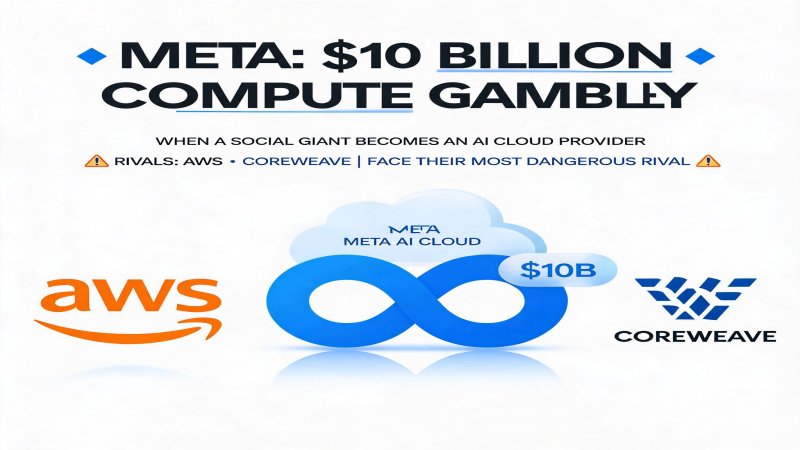
I. Event Recap
On July 18, 2026, the technology industry received news capable of rewriting the competitive landscape of AI infrastructure. Reuters exclusively reported that Meta is in deep negotiations with Anthropic for a compute leasing deal worth up to $10 billion. Spanning two years, this deal, if finalized, would become one of the largest single compute leasing agreements in AI industry history.
The core details of the transaction deserve close attention. According to informed sources, the deal was originally proposed by Anthropic in June 2026, adopting a flexible monthly payment structure rather than the lump-sum or annual contracts common in traditional cloud services. More strategically significant, both parties retained early termination rights. This means Anthropic could exit the agreement at any time if it found a more competitive compute solution, while Meta would not be burdened with long-term commitment costs if its compute demand patterns shifted. This bidirectional flexibility reflects the complexity of supply-demand dynamics in the current AI compute market -- buyers need training continuity but fear single-vendor lock-in; sellers pursue economies of scale but are unwilling to bear idle capacity risks.
On the same day as the Reuters report, Bloomberg published a corroborating piece. Citing multiple sources, Bloomberg reported that Meta is actively building an independent cloud services business, planning to commercialize its excess AI infrastructure capacity by selling it to external customers. The report made clear that Meta's cloud ambitions were not impulsive but a well-considered strategic initiative, targeting the rapidly growing enterprise AI training and inference market.
Extending the timeline further, Meta CEO Mark Zuckerberg had hinted at this strategic direction as early as May 2026. At a technology summit, Zuckerberg explicitly stated that “entering cloud computing is something we are considering,” and revealed a striking detail: “Almost every week, companies contact us asking if they can buy our compute.” At the time, this statement was interpreted as a tentative signal, but combined with the July reports, it is clear that Meta's cloud computing initiative had moved from the “consideration” phase into substantive commercial negotiations.
Notably, Anthropic has been pursuing a multi-vendor compute procurement strategy. Before approaching Meta, Anthropic had already reached a compute cooperation agreement with Elon Musk's SpaceX for the Colossus 1 data center. Colossus 1 is a hyperscale AI training data center built by SpaceX in Memphis, equipped with over 100,000 GPUs. Anthropic's partnership with SpaceX demonstrates that the AI safety company is actively diversifying away from its dependence on a single cloud provider -- particularly AWS -- seeking more diverse and flexible compute supply channels.
Viewed against a broader industry timeline, this deal is not an isolated event. The first half of 2026 saw several landmark developments in AI infrastructure: AWS's us-east-1 region suffered a severe three-hour outage, exposing the fragility of traditional cloud services under peak AI workloads; Google Cloud launched its Agentic Sandbox, attempting to build differentiation at the AI application development layer; TSMC reported record Q2 2026 earnings, confirming the continued explosion in AI chip foundry demand; and OpenAI struggled with internal turmoil and external pressures, facing talent attrition, commercialization challenges, and governance disputes. Against this backdrop, Meta's high-profile entry via a $10 billion compute deal represents both precise market timing and a forceful reshaping of the AI infrastructure competitive landscape.
II. Technical Depth
To understand why Meta has the confidence to participate in the compute leasing market at $10 billion scale, one must examine the technical foundation of its AI infrastructure. Unlike AWS and Google Cloud, which started from general-purpose computing, Meta's AI infrastructure grew organically from its own hyperscale AI training requirements, giving it unique technical advantages in AI-dedicated compute.
Meta's custom chip strategy has entered its second generation. Its in-house MTIA (Meta Training and Inference Accelerator) chips, after large-scale deployment in 2025, entered the MTIA v2 stage in 2026. While MTIA is currently used primarily for Meta's internal inference workloads, Meta simultaneously operates one of the world's largest clusters of NVIDIA H100 and B200 GPUs. Industry estimates suggest Meta has cumulatively purchased over 600,000 GPUs between 2025 and 2026, with total investment exceeding $30 billion. These GPU clusters are distributed across multiple hyperscale data centers in North America, equipped with customized high-speed network interconnect architectures and advanced liquid cooling systems.
From a technical architecture perspective, Meta's GPU clusters are deeply optimized for large language model training. Internally, the data centers employ RDMA over Converged Ethernet (RoCEv2) networking architecture with inter-node communication bandwidth reaching 400Gbps, with some new facilities already upgraded to 800Gbps. On the storage layer, Meta has deployed NVMe-based all-flash storage systems achieving throughput of multiple terabytes per second, satisfying the massive checkpoint read-write demands during large model training. For cooling, Meta's next-generation data centers have fully adopted liquid cooling technology, with power densities exceeding 100kW per rack, far surpassing the 15-30kW typical of traditional air-cooled facilities.
Anthropic Claude models' compute demand characteristics are highly compatible with Meta's infrastructure capabilities. The Claude model family employs large-parameter Transformer architecture training paradigms with extreme requirements for GPU cluster scale, interconnect bandwidth, and storage I/O. Anthropic had previously relied primarily on AWS compute resources, including the Rainier project -- a hyperscale AI training cluster announced by AWS in 2024, dedicated exclusively to Anthropic. However, the Rainier project's construction and delivery timeline was lengthy, and as a closed ecosystem within AWS, Anthropic faced constraints in usage flexibility and cost control. Meta's offering is significantly more flexible on this front: monthly payments with early termination rights mean Anthropic can dynamically adjust compute usage based on training progress and financial conditions.
Compute leasing as a business model imposes stringent requirements on service quality. First is the Service Level Agreement (SLA). AI training workloads are extremely sensitive to interruptions; a single unexpected cluster failure could result in millions of dollars in lost training progress. Meta must commit to at least 99.9% availability and establish rapid fault recovery mechanisms. Second is network bandwidth and latency. Gradient synchronization between GPUs in distributed training is acutely sensitive to network latency, and Meta must provide networking performance matching or exceeding AWS EC2 UltraClusters. Third is storage performance. Data loading, checkpoint saving, and recovery during large model training all demand extremely high IOPS and throughput. Fourth is software ecosystem compatibility. Meta's compute platform must support mainstream deep learning frameworks like PyTorch and JAX, as well as GPU programming ecosystems like CUDA and ROCm, ensuring Anthropic engineers can seamlessly migrate workloads. Fifth is security and compliance. Anthropic's customers include numerous enterprises whose training data involves sensitive business information, and Meta must provide enterprise-grade data isolation and encryption capabilities.
Notably, Meta has already accumulated extensive experience in AI infrastructure operations. The training of the Llama model family covers the complete workflow from pre-training to fine-tuning, and Meta's engineering teams possess deep understanding of the scheduling, monitoring, and fault handling of ten-thousand-GPU-scale clusters. This “eat your own dog food” experience is something traditional cloud providers lacked in their early stages -- AWS and Google Cloud's AI compute services are largely extensions of general-purpose computing platforms, whereas Meta's compute services have been forged from AI-native use cases.
III. Financial Logic
Understanding the strategic significance of this $10 billion deal requires placing it within the full picture of Meta's financials. Meta's current revenue structure is heavily concentrated in advertising. Full-year 2025 revenue exceeded $165 billion, with advertising accounting for over 96%, and the remainder from Reality Labs (metaverse-related hardware and software). This extreme revenue concentration is both a strength of Meta's business model -- advertising enjoys extremely high margins and cash flow generation -- and its greatest strategic risk. Any systemic shock to advertising revenue (tightening privacy regulations, slowing user growth, TikTok competition) could significantly impact Meta's valuation.
From this perspective, while the $10 billion compute leasing deal is enormous in absolute terms, its financial impact on Meta must be rationally assessed. Ten billion over two years implies $5 billion in annual revenue contribution. Assuming Meta's full-year 2026 revenue falls between $185-190 billion, the cloud computing business would contribute approximately 2.6-2.7% of incremental revenue. This proportion, while seemingly modest, carries strategic value far exceeding the financial numbers themselves: it signals Meta's first step toward building a second growth curve beyond advertising, providing the market with a new framework for valuing Meta.
Analyzing from a profitability perspective, the gross margin of compute leasing depends on multiple factors. Meta's GPU cluster construction costs are already sunk as capital expenditures, with additional operating costs primarily including electricity, cooling, network bandwidth, and operations personnel. Based on current data center operating cost structures, the gross margin of compute leasing could range between 40-55%, lower than Meta advertising's approximately 80% gross margin but significantly higher than hardware sales and Reality Labs profitability. More importantly, compute leasing can substantially improve the utilization rate of Meta's existing GPU assets, amortizing fixed costs and thereby indirectly improving overall profitability.
On Anthropic's side, the strategic and financial significance of this deal is even more direct. Anthropic's current valuation exceeds $60 billion, and the company is preparing for an IPO in 2027. For an AI company not yet profitable, securing stable and scalable compute supply is one of the most critical strategic preparations before going public. While $10 billion over two years is an enormous commitment, the monthly payment structure means Anthropic bears no one-time capital expenditure pressure, perfectly aligning with its asset-light, high-growth business model.
Comparing this deal against other valuation benchmarks in the AI infrastructure space reveals its rationality. CoreWeave's 2025 IPO valuation was approximately $35-40 billion, primarily based on its GPU cloud service revenue projections and long-term contracts with major customers like Microsoft. Nebius (formerly Yandex's cloud business), after separating from Russia in 2025, repositioned as an AI cloud provider with a valuation of approximately $8-12 billion. If Meta Cloud can use the Anthropic deal as a starting point to attract more AI company clients over the next two to three years, the standalone valuation of its cloud business could rapidly reach tens of billions of dollars, contributing a significant increment to Meta's overall market capitalization.
Furthermore, the financial structure of this deal reflects changing dynamics in AI industry financing. Between 2024 and 2025, financing costs for AI companies increased significantly due to rising interest rates, making the financial pressure of multi-year upfront compute commitments increasingly burdensome. Flexible models with monthly payments and early termination rights are becoming the new industry standard, which is particularly important for companies like Anthropic that are not yet profitable but growing rapidly. Meta accommodating this flexibility in its financial structure indicates that its primary goal is not short-term profit maximization but rapid establishment of market position and customer relationships.
IV. Strategic Depth
Meta's high-profile entry into the cloud computing market via a $10 billion compute deal carries strategic intentions far beyond a single commercial transaction. This is a pivotal step in Meta's strategic transformation from an advertising-driven social platform to an AI infrastructure service provider. To fully understand the depth and breadth of this transformation, we must position Meta Cloud through multi-dimensional competitive comparison.
The following is a competitive comparison matrix of major players in the AI cloud services market:
Dimension | Meta Cloud | AWS | CoreWeave | Nebius
Compute Scale | Global TOP3, 600K+ GPUs | Largest globally, 1M+ GPUs | Medium, ~100K GPUs | Smaller, ~30K GPUs
Business Model | Surplus reuse + new build | General cloud + AI | Pure GPU cloud | Pure GPU cloud
Key Customers | Anthropic and AI cos | All industries | AI companies | AI companies
AI-Dedicated Cap. | Native AI training opt. | Balanced gen. + AI | Deep AI optimize | Deep AI optimize
Pricing Compet. | Very strong (near-zero marg. cost) | Moderate (brand premium) | Strong | Strong
Network Arch. | Custom RoCEv2 400-800G | Proprietary EFA+optical | InfiniBand | Std Ethernet
Global Coverage | North America mainly | 30+ regions globally | NA + Europe | Europe mainly
Software Ecosystem | Native PyTorch | Most comprehensive | AI workflow focus | AI workflow focus
Compliance | Basic (needs strengthening) | Most comprehensive | Moderate | Weak
Lock-in Risk | Low (monthly flexibility) | High (deep ecosystem) | Moderate | Moderate
From the above matrix, Meta Cloud's strategic positioning becomes clear. Meta's greatest competitive advantage lies in its “extremely low marginal cost.” Unlike CoreWeave and Nebius, which need to build GPU clusters from scratch, most of Meta's GPU assets are already constructed and serving its own AI R&D. Leasing idle or off-peak compute capacity externally incurs marginal costs only for electricity, cooling, and network transmission -- far lower than competitors who must bear GPU depreciation and capital costs. This enables Meta to adopt an aggressively competitive pricing strategy, potentially pricing below cost to rapidly capture market share -- a playbook Meta has mastered in the advertising industry.
However, Meta Cloud's disadvantages are equally apparent. Compared to AWS's coverage of over 30 cloud regions and hundreds of availability zones globally, Meta's data centers are currently concentrated in North America, with severely inadequate global coverage. On the compliance certification front, AWS possesses a comprehensive certification portfolio from SOC 2 to FedRAMP High, while Meta has virtually no enterprise cloud service compliance track record. This means that in the short term, Meta Cloud's customer base will be primarily concentrated among AI-native companies with relatively relaxed compliance requirements, rather than regulated industries like finance, healthcare, or government.
At a higher strategic level, Meta's cloud computing initiative creates synergies with its AI open-source strategy (the Llama model family). Llama's open-source approach has lowered barriers to AI application development, spawning numerous Llama-based AI startups. If these companies need large-scale compute to fine-tune, deploy, and inference Llama models, Meta Cloud could offer an integrated “model + compute” solution, creating stickier ecosystem engagement than AWS. This “open-source model for traffic + cloud services for monetization” strategy echoes Google's “TensorFlow + GCP” approach, but Meta currently wields greater influence in the open-source model space.
More fundamentally, Meta's cloud computing strategy reflects the “infrastructure anxiety” among Silicon Valley tech giants in the AI era. As AI model training and deployment costs grow exponentially, controlling compute means controlling the voice of the AI value chain. Microsoft gained first-mover advantage through investing in OpenAI and building Azure AI supercomputers; Google established technical barriers through TPU and Gemini; Amazon built ecosystem moats through AWS Bedrock and Anthropic investment. Meta has achieved leadership in AI model R&D through Llama, but has been absent in infrastructure-as-a-service. The $10 billion Anthropic deal is the critical step for Meta to complete this strategic puzzle.
V. Challenges and Risks
Despite Meta's significant advantages in compute scale and cost structure, the multiple challenges of entering the cloud services market cannot be overlooked. These challenges concern not only whether Meta Cloud can successfully commercialize, but also whether Meta's organizational DNA can adapt to the complexities of the enterprise services market.
The most fundamental challenge is Meta's lack of cloud service operating experience. Cloud computing is not merely a technology problem -- it is a service problem. AWS, after nearly 20 years of building, has established a comprehensive cloud platform encompassing hundreds of services across compute, storage, networking, databases, security, and monitoring, along with a global enterprise customer service team numbering in the tens of thousands. Meta's engineering culture, known for “move fast and break things,” is an enormous advantage in developing consumer products but could become a fatal weakness in enterprise services. Enterprise customers expect not just compute itself, but stable technical support, comprehensive documentation, well-designed APIs, and 24/7 operational assurance. These “non-technical” capabilities require years of accumulation and cannot be bridged through financial investment in the short term.
Compliance and data isolation represent another major concern. AI training data often contains highly sensitive trade secrets and user privacy information. When Anthropic trains Claude models on Meta's cloud platform, it must be guaranteed that training data is completely isolated from Meta's own business data. This involves not only technical aspects like virtualization and encryption but also legal dimensions including data sovereignty, cross-border transfer, and audit compliance. AWS has won numerous enterprise customers largely because of the trust and certification framework it has built in compliance. As a company whose core business model revolves around collecting and using user data, Meta's “trust assets” in data isolation and privacy protection are far inferior to AWS's. Regulators and customers may be reserved about hosting sensitive AI training data on Meta's platform.
Compute resource conflict is Meta's third challenge. Meta is currently training next-generation Llama models, and its internal compute demand is already enormous. When Anthropic's Claude training tasks compete with Meta's Llama training tasks on the same GPU cluster, how can both be guaranteed sufficient and stable compute supply? If Anthropic's training is deprioritized or interrupted due to Meta's internal needs, Meta Cloud's commercial reputation would be severely damaged. This role conflict of “serving as both player and referee” is unprecedented in the cloud services industry, with no existing solutions to reference.
The AWS us-east-1 region's three-hour severe outage in 2026 perfectly illustrates the complexity and risk of cloud service operations. us-east-1 is one of AWS's most mature and heavily invested regions, yet a configuration error still caused a massive service disruption affecting numerous prominent customers including Netflix and Disney+. If even a veteran cloud provider like AWS cannot completely avoid major incidents, the technical risks facing Meta as a cloud newcomer are even more daunting. AI training workloads have even higher stability requirements than typical web applications -- a three-hour outage could mean weeks of training progress lost, with economic losses measured in tens of millions of dollars.
Additionally, the deal itself carries risks of falling through. According to Reuters, negotiations are still ongoing and no final agreement has been reached. The $10 billion scale implies enormous financial and operational commitments, and any changes in due diligence, contract terms, or strategic priorities on either side could collapse the negotiations. Especially considering the bilateral early termination clauses, even after signing, the actual execution of the deal could fall far short of the $10 billion maximum. For Meta, if this marquee deal fails to materialize as planned, market confidence in its cloud strategy would be severely impacted.
OpenAI's current internal and external struggles also offer a cautionary tale. OpenAI gradually discovered in its exclusive cloud partnership with Microsoft that over-reliance on a single compute supplier is strategically passive. Anthropic has clearly learned this lesson and is actively building a multi-vendor system. But this also means Anthropic's dependence on Meta will be limited and tactical rather than strategic. Meta cannot view Anthropic as a long-term stable “anchor customer” but must rapidly expand its customer base after signing.
VI. Conclusion
Meta's $10 billion compute deal with Anthropic, whether or not it ultimately signs at full value, has already become a milestone in the competitive landscape of AI infrastructure. It marks a critical moment in the transition of the AI compute market from “oligopolistic monopoly” to “diversified competition,” and signals a profound restructuring of value distribution in the AI industry chain.
For AI startups, Meta's entry is a significant positive development. Compute supplier diversification means richer choices, more flexible contract terms, and more competitive pricing. AI startups should act immediately to include Meta Cloud in their vendor evaluation shortlists, but maintain prudence -- until Meta Cloud's service maturity is validated by the market, it should not be adopted as the sole or primary compute provider. The optimal strategy is a “dual-vendor” or even “triple-vendor” approach: maintaining stability through AWS (or GCP) while leveraging Meta Cloud's (and CoreWeave's) pricing advantages to reduce overall compute costs. Simultaneously, data isolation clauses and SLA commitments in contracts should be closely monitored to ensure that affordable compute does not come at the expense of data security and training reliability.
For traditional cloud providers, Meta's entry is a clear warning signal. AWS needs to seriously consider: when customers can obtain equivalent technical performance at 20-30% lower cost from Meta, is ecosystem stickiness and brand trust alone sufficient to maintain customer loyalty? AWS's core advantage lies in its comprehensive service portfolio and global coverage, but for the specific use case of AI training, customers may simply need a “fast and cheap” GPU cluster. AWS should consider introducing more competitive pricing for AI training compute, even at the expense of some margin, to defend market share. For pure-play AI cloud providers like CoreWeave and Nebius, Meta's entry could be an existential threat. These companies need to build deeper moats in vertical domains (such as specific framework optimization, industry solutions, professional services) to avoid direct price competition with Meta on raw compute.
For investors, Meta's cloud computing initiative provides a window to reassess its valuation framework. If Meta Cloud can achieve $10-20 billion in annualized revenue by 2027-2028, this would significantly improve Meta's revenue diversification and growth expectations. However, investors should maintain clear awareness of risks: cloud service businesses require enormous capital expenditure, and Meta has no historical performance in this domain to reference. Key metrics to monitor include: the number and diversity of Meta Cloud customers, the actual executed value of the Anthropic deal, the proportion of Meta's capital expenditure allocated to cloud service infrastructure, and Meta's progress on compliance certifications.
From a broader perspective, Meta's cloud computing entry reflects a core trend in the AI industry: compute is transitioning from a “cost center” to a “profit center.” Companies with large-scale compute assets are no longer satisfied with using compute solely for their own product development but are actively seeking to commercialize it. This trend will further accelerate the commoditization of AI compute, ultimately benefiting the entire AI ecosystem -- cheaper compute means more innovation possibilities. But in this process, a cohort of companies unable to adapt to the new competitive landscape will inevitably be eliminated. Meta's $10 billion compute gamble is betting not only on its own transformation success but on the beginning of a new round of reshuffling in the AI infrastructure market.
Why it Matters
This marks Meta's first entry into the AI infrastructure market as a cloud provider, signaling a fundamental redefinition of its business model by the world's largest social platform. The $10 billion scale directly challenges AWS's dominance in AI training compute and threatens the viability of emerging AI cloud providers like CoreWeave and Nebius. For AI startups, compute supplier diversification will significantly reduce the risk of platform lock-in.
DECISION
- AI startups should immediately evaluate Meta Cloud's compute offerings and add them to their vendor shortlist to hedge against AWS and CoreWeave pricing and availability risks. 2. Traditional cloud customers should anticipate potential price wars triggered by Meta's entry and proactively negotiate long-term rate locks with existing providers. 3. Investors should reassess the valuation logic of pure-play AI cloud companies like CoreWeave and Nebius, as Meta's entry will significantly compress their market space and pricing power. 4. Chip manufacturers should actively engage with Meta's cloud infrastructure buildout to secure priority supplier status.
PREDICT
- By Q4 2026: Meta and Anthropic will formally sign the deal, with the transaction value between $8-10 billion, and Meta Cloud brand will be officially launched. 2. Q1-Q2 2027: Meta will announce its first batch of cloud customers, including 2-3 major AI companies beyond Anthropic, triggering a 10-15% market price reduction. 3. H2 2027: AWS will introduce competitive pricing packages in response to Meta Cloud, pushing the AI compute market into a price war phase. 4. By 2028: Meta's cloud business annualized revenue could exceed $20 billion, becoming its second-largest revenue pillar after advertising.
Get 3-5 key AI infrastructure signals weekly →
💬 Comments (0)