
Background and Overview
From March 19 to April 18, 2026, the cybersecurity market witnessed a wave of LLM-WAF product releases: Cloudflare launched its official version on April 2, Palo Alto Networks introduced an integrated module on March 28, and CrowdStrike disclosed its technical roadmap on March 21. This flurry of activity signifies that, as Large Language Model (LLM) APIs become widely adopted in enterprises, specialized protection solutions targeting their unique attack surfaces (e.g., Prompt Injection, Context Overflow) have entered the stage of commercial deployment. Traditional WAFs, reliant on static rule libraries, struggle with the dynamic semantic complexity of LLM attacks. The OWASP LLM API Security Top 10 standard, released in 2025, provided the core protection framework and directly catalyzed the evolution of LLM-WAF technology from rule-matching towards an AI-native architecture.Architectural Layers
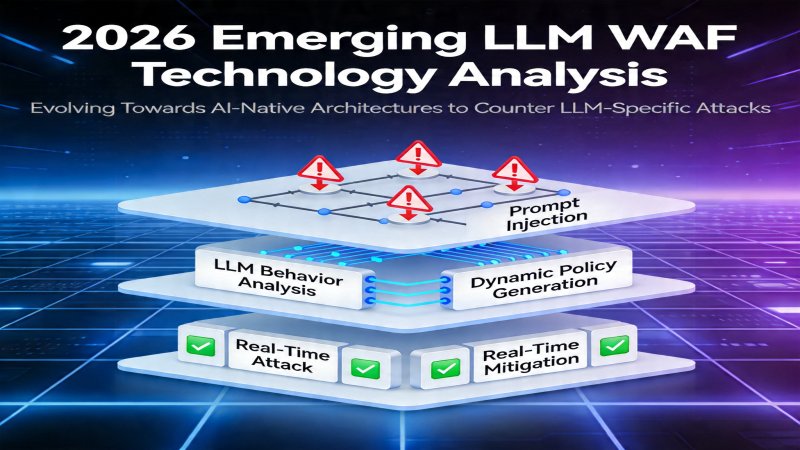
The modern AI-native architecture of an LLM-WAF is typically divided into three layers to achieve comprehensive protection from traffic capture to intelligent detection and precise response.- Traffic Ingestion & Parsing Layer: This layer is responsible for capturing and parsing API traffic from mainstream LLM service providers like OpenAI and Anthropic. Its core is the protocol parsing module, which identifies and extracts key fields from requests, such as prompt text, system instructions, and token parameters, and normalizes them into a unified internal format, providing consistent data input for subsequent detection.
- Security Detection Layer: This is the core of the LLM-WAF, employing a hybrid detection architecture. The rule engine rapidly matches known malicious patterns (e.g., specific keywords, abnormal token sequences) based on knowledge bases like the OWASP LLM API Top 10. Simultaneously, a lightweight, security-specialized LLM (e.g., a 7B parameter model) performs semantic analysis on the request in parallel to identify novel or mutated attacks (e.g., complex Prompt Injection) that are difficult for rule libraries to cover. The results from both are synthesized, producing a detection result with a risk level and confidence score.
- Response & Enforcement Layer: Executes predefined security policies based on detection results. Actions include directly blocking malicious requests, dynamically masking sensitive information in requests or responses, generating alerts, and logging detailed events. This layer emphasizes integration with existing security operations systems (e.g., SIEM, XDR platforms) to achieve rapid attack traceability and response closure.
Key Technologies
1. Lightweight Security LLM
- Problem Addressed: Using general-purpose large models for security detection traditionally suffers from high computational resource consumption and significant inference latency (often exceeding 100ms), failing to meet the stringent real-time requirements of WAFs.
- Core Principle: Techniques like model distillation, pruning, and quantization compress the parameter count to the order of billions (e.g., 7B), enabling efficient operation on edge servers or dedicated hardware. Model training is the key challenge, requiring fine-tuning on large-scale, high-quality labeled datasets. For example, using datasets containing tens of millions of samples labeled by security researchers (typically sourced from public vulnerability databases, honeypot-captured data, and adversarial samples generated from red team/blue team exercises), and employing Instruction Tuning or Reinforcement Learning from Human Feedback (RLHF) to optimize the model's decision boundary for malicious intent, enabling it to learn the semantic patterns of attacks rather than relying solely on keyword matching.
- Measured Performance: According to Cloudflare's whitepaper (2026-04-02), after deploying its 7B parameter model, the system's overall detection rate for Prompt Injection reached 99.2%, with added processing latency controlled under 20ms. However, the report does not mention the baseline latency (i.e., the latency of the rule engine itself). If the rule engine latency is 5ms, the total latency increase is 400%; if it is 50ms, the increase is 40%. The lack of a baseline makes the actual business impact of the 20ms promise unassessable. The 99.2% detection rate is based on their internal test set (reportedly containing OWASP benchmarks and known samples), a figure not independently verified and not covering real-time, evolving adversarial attacks. Academic research (arXiv:2602.05678, 2026-02-10) also validates the feasibility of lightweight models for edge deployment, with latency only about 15% higher than traditional rule engines.
2. Prompt Attack Semantic Feature Extraction Algorithm
- Problem Addressed: Attackers mutate malicious prompts through synonym replacement, structural reorganization, adding irrelevant characters, etc., rendering fixed-pattern rule engines ineffective.
- Core Principle: This algorithm extracts multi-level semantic features from attack inputs, including: 1) Intent Features: Identifying deep-seated intents to induce the model to overstep authority, leak data, or execute malicious code; 2) Structural Features: Analyzing abnormal prompt structures like nesting and delimiter abuse; 3) Context Violation Features: Detecting conflicts between user input and system instructions. These features are vectorized and fed into a machine learning classifier for judgment.
- Measured Performance: Related research (arXiv:2602.05678) indicates that methods based on semantic feature extraction can identify over 98% of mutated injection attacks while significantly reducing false positives—an outcome difficult for pure rule-based solutions to achieve.
3. Cloud-Edge Collaborative Detection Architecture
- Problem Addressed: In complex enterprise environments, a balance must be struck between detection accuracy, response latency, and system resource overhead. A pure edge solution may lack detection depth due to limited computing power, while a pure cloud solution may introduce unacceptable latency due to network round-trips.
- Core Principle: As adopted by CrowdStrike, this involves traffic preprocessing and lightweight, rapid detection (rules + lightweight model) at the endpoint or near-end edge nodes, filtering out most normal traffic and simple attacks. For highly suspicious or complex requests, their features or sanitized content are uploaded to the cloud for in-depth analysis using more powerful, comprehensive detection models, with the final decision sent back to the edge for enforcement.
- Measured Performance: This architecture aims to achieve the optimal balance between performance and precision. CrowdStrike claims that in their preset scenarios, the false positive rate for "suspicious traffic" uploaded to the cloud after edge preprocessing and judged by the deep model is below 0.3% (Blog, 2026-03-21). Note: This metric is not the "end-to-end false positive rate" for all original traffic, which may vary significantly depending on the edge preprocessing rules. The challenge of this architecture lies in the need to deploy endpoint agents, increasing management complexity, and the latency of cloud-side detection depends on network conditions.
Principle and Process
The typical processing flow of an LLM API request through an LLM-WAF is as follows:- Traffic Input & Parsing: The LLM-WAF intercepts the client's request to the LLM API, parses its specific protocol format, extracts key fields, and normalizes them.
- Parallel Security Detection: The normalized data is simultaneously fed to the rule engine and the lightweight security LLM. The rule engine performs rapid pattern matching, while the security LLM conducts deep semantic analysis. A hybrid decision module synthesizes both results to produce a final risk verdict (e.g., High Risk - Prompt Injection, Medium Risk - Context Overflow).
- Response & Execution: Actions are executed based on the risk verdict and preset policies: block high-risk requests and alert; allow medium-risk requests that might leak data after dynamic masking; directly allow low-risk/normal requests. All events are logged for auditing and traceability.
Competitive Landscape Analysis
The current market is dominated by leaders in cloud security, network firewalls, and endpoint security, each proposing different architectural approaches based on their strengths.| Vendor | Technical Approach | Core Advantages (Based on Recent Releases) | Potential Challenges |
|---|---|---|---|
| Cloudflare | Edge-Side Hybrid Architecture | 1. High Performance: Edge deployment, latency <20ms (Whitepaper, 2026-04-02) 2. High Detection Rate: 99.2% Prompt Injection detection rate based on internal test set 3. Native Adaptation: Deep parsing of mainstream LLM API protocols | 1. Limited computing resources on edge nodes make deploying larger models for future complex attacks difficult; model updates depend on central pushes, creating time lags. 2. Deep technical lock-in leads to extremely high switching costs: Its traffic parsing and threat models are deeply integrated with its proprietary edge infrastructure; customers cannot run the WAF logic independently. Once chosen, switching to another vendor would require architectural rework, creating de facto single-vendor dependency and weakening customer bargaining power. |
| Palo Alto Networks | Integrated LLM-WAF Module | 1. Ecosystem Integration: Seamless integration with Prisma Cloud and Next-Generation Firewalls, covering the full attack surface 2. Deployment Flexibility: Supports SaaS and on-premises deployment, adapting to complex enterprise networking (Press Release, 2026-03-28) 3. Customizability: Supports custom rules based on OWASP standards | 1. Detection capabilities may lean more on rule libraries, with relatively weaker agility in AI-based dynamic detection 2. Deployment and configuration complexity is influenced by existing enterprise network architecture |
| CrowdStrike | Cloud-Edge Collaborative Architecture | 1. High Precision: Claims false positive rate for suspicious traffic under 0.3% in specific scenarios (Blog, 2026-03-21) 2. Data Security: Built-in sensitive data masking module 3. Security Orchestration: Can integrate with EDR/XDR for attack chain traceability | 1. Requires deployment of endpoint agents, increasing deployment and management complexity 2. Cloud-side deep detection may introduce additional network latency, depending on request path |
Key Assessments
Based on current technological evolution and market competition, we derive the following actionable assessments:| Key Assessment | Confidence | Actionable Advice |
|---|---|---|
| Hybrid architecture (rule engine + lightweight security LLM) is expected to become the mainstream technical approach for LLM-WAFs. However, claims of "optimal balance of 99%+ detection rate and <0.5% false positive rate" currently only appear in select vendor marketing materials and depend on specific test environments. | High | Prioritize evaluating hybrid architecture products during technical selection. It is essential to require vendors to conduct a Proof of Concept (PoC) on a mirror of your own business traffic to obtain real performance data, rather than relying solely on standard vendor test reports. |
| Edge deployment is key to reducing latency and ensuring business performance, especially for LLM application scenarios with high real-time requirements. | Medium | For high-concurrency, low-latency scenarios (e.g., public Chatbots), when choosing an LLM-WAF supporting edge deployment (e.g., Cloudflare's solution), require and verify that their committed P99 latency is within an acceptable range (e.g., <50ms), and assess its actual impact on business performance. |
| The OWASP LLM API Security Top 10 standard will accelerate product standardization, but vendor differentiation will still be reflected in architectural innovation and ecosystem integration. | High | Pay attention to a vendor's adaptation to the OWASP standard, as it is the foundation for compliance. Simultaneously, it is essential to evaluate its extensibility and integration flexibility, particularly the maturity of API integration with existing security operations platforms (SIEM/SOAR/XDR), as well as the technical and cost risks associated with future vendor switching. |
Open Research Questions
- How will the standardization process of LLM-WAFs (e.g., OWASP extensions) influence vendor technical approaches and market competition? Standardization will drive convergence of basic functionalities but may prompt leading vendors to engage in more intense performance competition around advanced features like "adaptive evolution capability" and "detection model explainability" to build differentiation barriers.
- How can the explainability of lightweight security LLMs be improved to enhance security team trust? Technical means are needed, such as visualizing attack semantic features (e.g., intent heatmaps), providing detection confidence scores and key evidence snippets (e.g., the specific prompt part triggering the attack verdict), to transform the "black-box" decision process into information that security analysts can understand and verify.
- How can hybrid architectures achieve adaptive and evolutionary capabilities to counter emerging attacks like adaptive Prompt Injection? This requires building a continuous security data feedback loop: collecting real attack samples, automated labeling, and periodic model retraining. However, introducing online learning mechanisms may carry the risk of model "poisoning." Therefore, a more feasible path might be periodic model updates based on cloud-based threat intelligence, coupled with rigorous offline testing before deployment.
Why it Matters
Positioning: Ecosystem Expansion, Reason: Giants fortify existing ecosystems with AI security
Key Factor: Competitive Barrier: Ecosystem Lock-in and Data Closed Loop. The core barrier in the current LLM-WAF market is not a single technical metric, but vendors' ability to deeply embed AI security capabilities into their existing product ecosystems (e.g., Cloudflare's edge network, Palo Alto's firewall suite, CrowdStrike's XDR platform). This lock-in is achieved through proprietary protocol parsing, closed-loop model training data, and deep API integration, resulting in extremely high customer switching costs and de facto vendor lock-in. Comparisons of technical performance (e.g., detection rate, latency) must be based on unified baselines (e.g., end-to-end latency, independent test sets) to avoid being misled by marketing data.
Stage: Peak of Inflated Expectations
DECISION
For Vendor (Cloudflare)
- Publish more comprehensive performance benchmark data, including baseline rule engine latency versus end-to-end latency with AI model overhead.
- Enhance model interpretability with visualizations of attack features to build trust with enterprise security teams.
Strategic Moves: Bundle LLM-WAF as a core value-added service within its edge computing platform.
- During vendor selection, conduct a Proof of Concept (PoC) using mirrored production traffic to measure real-world end-to-end latency and false positive rates.
- Rigorously evaluate the product's integration capabilities with existing security operations tools (SIEM/SOAR) and assess future switching costs.
Action Guidance: Follow
For Investor
- Focus on security vendors with strong existing ecosystems (network, cloud, endpoint) capable of seamless LLM-WAF integration.
- Be wary of investment decisions overly reliant on single-vendor marketing claims (e.g., unverified 99.2% detection rates).
Key Risk: Rapid technology iteration may render early investments obsolete due to architectural lag or ecosystem isolation.
PREDICT
1 year (High confidence)
Basic LLM-WAF features based on OWASP standards will converge, shifting competition to threat intelligence update speed and model adaptive evolution.
2 years (Medium confidence)
Leading vendors will intensify ecosystem lock-in via closed data loops and proprietary models, potentially leading to market fragmentation along ecosystem lines.
3 years+ (Low confidence)
Regulatory pressure or industry consortia may push for partial standardization of detection model interfaces and log formats to mitigate vendor lock-in.
Get 3-5 key AI infrastructure signals weekly →
💬 Comments (0)