
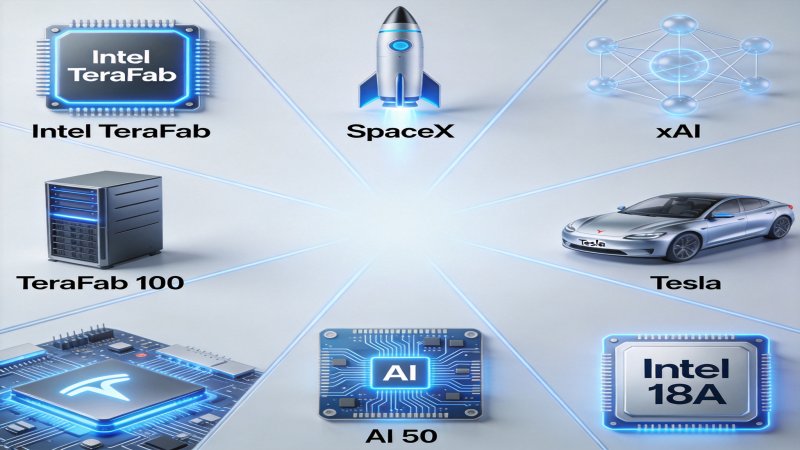
Intel TeraFab Alliance: Musk + Intel AI Chip Factory Reshapes Foundry Landscape
What is TeraFab: A Comprehensive Analysis of the SpaceX + xAI + Tesla + Intel AI Chip Manufacturing Alliance
On April 7, 2026, news sent shockwaves through the semiconductor industry: Intel officially announced its entry into the TeraFab project as the core foundry partner for Elon Musk's combined SpaceX, xAI, and Tesla chip manufacturing initiative. This is no ordinary foundry contract—it represents a strategic alliance that could reshape the global chip manufacturing landscape.
What is TeraFab? It is the most ambitious semiconductor project ever announced within U.S. borders: a vertically integrated semiconductor complex designed, lithographed, fabricated, packaged, and tested under one roof, built by SpaceX, xAI, and Tesla at the Giga Texas campus in Austin, Texas.
The core objective: producing 100 terawatts (TW) of AI compute annually. For context—current global AI chip annual production is approximately 20 gigawatts (GW); TeraFab's target represents 50 times existing global capacity.
On the investment side, TeraFab's initial investment is $20-25 billion. However, analyst estimates suggest achieving the long-term goal of one million wafer starts per month could require up to $5 trillion in total capital—Bernstein Research's calculations are even more striking, estimating the capital needed for 1 TW/year compute at approximately $5 trillion, exceeding 70% of the total annual U.S. federal budget.
Intel's participation fills TeraFab's most critical technology gap. Under the agreement, Intel will contribute its most advanced 18A process node (1.8nm class)—the only cutting-edge logic process currently manufactured entirely within the United States. Intel CEO Lip-Bu Tan personally oversees this collaboration, stating on X: "Elon has a proven track record of reimagining entire industries. This is exactly what is needed in semiconductor manufacturing today."
Why is Musk Building His Own Chips: Does Compute Demand Really Exceed TSMC's Supply?
Musk's choice to build a self-sufficient chip manufacturing system is driven by four words: compute anxiety.
During Tesla's Q1 earnings call, Musk presented a chart explaining TeraFab's necessity: "This chart explains why we need to build TeraFab—because all of the output from the rest of Earth is approximately 2% of what we need."
What lies behind that 2%? xAI's Grok large model training, Tesla FSD (Full Self-Driving) continuous iteration, SpaceX's AI satellite constellation—each is a bottomless pit of compute demand.
- xAI's Grok 3 training: Requires continuous consumption of massive H100/H200 compute, with next-generation models already in planning
- Tesla FSD v12 and beyond: End-to-end neural networks require enormous amounts of real-world driving data for training
- SpaceX AI Sat Mini: Musk revealed that 80% of TeraFab's output will go toward space-based AI infrastructure
This doesn't even account for Tesla's Optimus humanoid robot project—each robot requires high-performance AI chips for local inference.
"Procuring chips externally, we will never satisfy our own demand." This statement from Musk during the earnings call captures the fundamental logic behind vertical integration.
The more practical consideration is capacity availability. Industry analysis indicates TSMC and Samsung's advanced process capacity for the coming years is already committed to high-margin orders, with production schedules booked through 2028-2030. For a buyer like Musk needing rapid expansion and unwilling to be constrained, waiting for TSMC's capacity availability is not an option.
Intel Foundry's Comeback: Technical and Commercial Assessment of TeraFab's Success Probability
Intel's decision to partner with TeraFab represents the most significant external customer endorsement for its foundry strategy (Intel Foundry Services) since its inception.
What does this deal mean for Intel Foundry?
Throughout 2025, Intel Foundry generated only $307 million in external customer revenue—a staggering gap compared to TSMC's tens of billions in external revenue. Since taking over as CEO, Lip-Bu Tan has aggressively restructured Intel: mass layoffs, sharper focus on 18A and 14A nodes, positioning domestic manufacturing capability as a "geopolitical differentiator."
The TeraFab contract is direct validation of this strategic pivot. Following the announcement, Intel's stock rose approximately 4%, closing at $52.91. For the first time, markets see real possibility that Intel Foundry could win genuinely heavyweight external customers.
But challenges are equally severe:
Technical dimension: Intel 18A is still in production ramp, not yet achieving yield levels required for high-volume manufacturing. Moving from 18A to 14A requires crossing multiple technology nodes. NVIDIA CEO Jensen Huang bluntly stated that TeraFab "will almost certainly not achieve TSMC-level yields"—this is not alarmism but objective assessment based on manufacturing density.
Scale dimension: Analyst estimates show building a 100,000 wafer starts per month, 2nm-class fab costs approximately $25-35 billion. This means TeraFab's claimed $25 billion total budget is only enough to build a single fab operating at a fraction of the stated full-capacity scale.
Timeline dimension: The first pilot line targets 3,000 wafer starts per month, planned for production in 2029. Scaling from 3,000 to the claimed one million wafer starts per month represents engineering challenges of orders of magnitude.
Vertical Integration vs. Specialty Foundries: TCO Comparison of TeraFab and TSMC Models
TeraFab represents a fundamentally different model from TSMC: vertical integration.
TSMC's core logic: Specialty division of labor, economies of scale, continuous process iteration leadership. TSMC designs no chips—only manufacturing. This "neutrality" makes it the common choice for competitors like Apple, NVIDIA, AMD, and Qualcomm.
TeraFab's core logic: Internal demand-driven, supply chain autonomy, iteration speed priority. By placing design, manufacturing, packaging, and testing under one roof, Musk claims the ability to compress "the R&D-to-production iteration cycle from traditional 2-3 years to 9 months."
Both models have distinct advantages and disadvantages:
| Dimension | TSMC Model | TeraFab Model |
|---|---|---|
| Process Maturity | Mature and stable, high yield | 18A/14A still ramping |
| Scale Flexibility | Global footprint, ample capacity | Limited initial scale |
| Cost Structure | Economies of scale, low unit cost | Massive initial investment, high unit cost |
| Supply Chain Control | External dependencies, diversified customers | Highly autonomous, concentrated risk |
| Applicable Scenarios | Diverse, competitive demands | Large-scale single demand |
From a TCO (Total Cost of Ownership) perspective, before TeraFab achieves its capacity targets, TSMC's cost advantage is overwhelming. But for Musk, cost is not the only consideration—supply autonomy and iteration speed are equally core values.
Impact on AI Chip Foundry Landscape: What Does an Additional Supplier Mean?
The TeraFab + Intel combination's potential impact on the global AI chip foundry landscape can be analyzed across three dimensions:
1. Limited Direct Impact on TSMC, But Significant Signaling Effect
TSMC's advanced process leadership won't be shaken in the short term. More critically, TeraFab currently doesn't directly compete with TSMC—Tesla's AI5 chips are still co-produced by Samsung and TSMC; AI6.5 chips will use TSMC's Arizona 2nm technology. TeraFab is more Musk's "insurance strategy" than a frontal challenge to TSMC.
2. Injecting Credibility into Intel Foundry, Potentially Attracting More Customers
The TeraFab contract provides Intel 14A process with its first external major customer validation. If Intel demonstrates stable production capability in the TeraFab project, Apple, Google, and other enterprises may seriously evaluate Intel Foundry as an alternative supplier. Morgan Stanley analysis indicates Intel Foundry pricing could be 15-20% lower than TSMC's—a tangible cost attraction.
3. The "Self-Design + Manufacturing" Trend May Accelerate
Musk's actions fundamentally signal to the entire technology industry: "If we don't manufacture our own chips, we will hit bottlenecks in the future." If the TeraFab model proves viable, more tech giants may consider similar vertical integration paths. This represents long-term structural challenges for TSMC.
For enterprise procurement, the TeraFab narrative provides critical strategic perspective: the AI compute supply side is undergoing profound changes, exploration of diversified supply sources has begun, but TSMC's hub position won't waver in the short term. The window to lock in long-term compute contracts is closing—this is the core conclusion pointed to by both TSMC's Q1 earnings and the TeraFab alliance.
Why it Matters
The TeraFab + Intel combination marks the first substantive diversification signal in the AI chip foundry landscape. Intel's 18A process has secured its first major external customer validation—if volume production succeeds, companies like Apple and Google may evaluate Intel Foundry as an alternative supplier. For enterprise procurement, the AI compute supply side is undergoing profound changes with exploration of diversified supply sources underway, though TSMC's hub position won't waver in the short term.
DECISION
Decision Recommendations
For Vendor(Chip Manufacturers)
- TSMC: TeraFab poses no immediate direct competition, but monitor Intel foundry yield ramp progress and develop defensive customer lock-in strategies
- Intel: Use TeraFab as a training ground for 18A process, rapidly expand to other customers after gaining volume production experience
- Samsung Foundry: Facing dual pressure - accelerate 3nm/2nm process catch-up while preventing customer loss to TeraFab
For Enterprise(Enterprise Buyers)
- Closely monitor actual Intel 18A process yield data, evaluating its viability as an alternative supplier
- Even if TeraFab succeeds, initial capacity will prioritize Musk's own enterprises; external customers will face difficulty obtaining allocations
- TSMC remains the most reliable AI chip manufacturing partner in the mid-term; the window to lock long-term contracts is narrowing
For Investor(Investors)
- Intel: TeraFab contract is Intel Foundry's first major validation; upgrade target price but continuously track yield data
- TSMC: Short-term moat solid, faces long-term vertical integration model challenges; maintain Buy rating
- Watch for TeraFab概念股(xAI-related, AI infrastructure)speculative opportunities, but manage position sizes
PREDICT
6 months(High confidence)
TeraFab project details further disclosed; Intel 18A process yield data begins public. Initial 3,000 wafers/month pilot line construction progress announcements.
1 year(Medium confidence)
Intel 18A process yield ramp progress becomes market focus. If yields meet targets, Intel Foundry may secure first non-TeraFab external customer order.
2 years(Medium confidence)
First pilot line(3,000 wafers/month)expected to begin production, but still orders of magnitude away from million wafers/month capacity target. Whether TeraFab total budget increases will be a key signal.
3 years+(Low confidence)
If TeraFab model proves successful, may trigger tech giant self-design + manufacturing trend. But probability of achieving 50x capacity target remains low.
Get 3-5 key AI infrastructure signals weekly →
💬 Comments (0)