
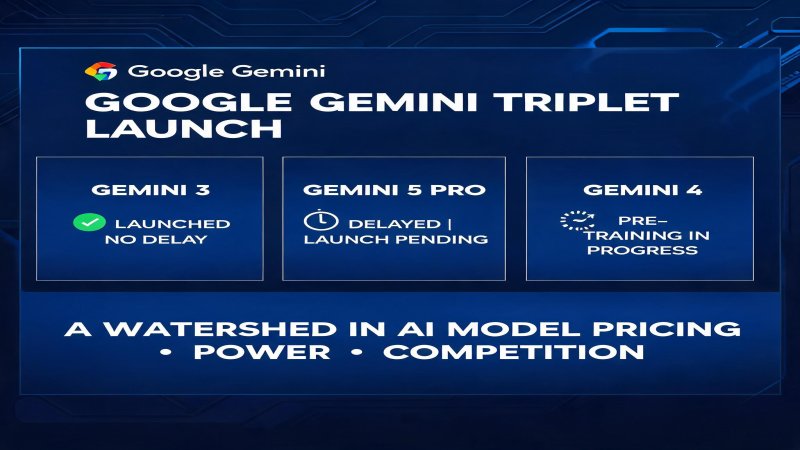
Google Gemini Triplet Launch + 3.5 Pro Delay + Gemini 4 Pre-training: A Watershed in AI Model Pricing-Power Competition
Event Recap
On July 21, 2026, Google released three Gemini models in a single day: Gemini 3.6 Flash, Gemini 3.5 Flash-Lite, and Gemini 3.5 Flash Cyber, covering the full price spectrum from ultra-low-cost to enterprise-tier to security-vertical. On the same day, Alphabet stock dropped 4.4%, evaporating approximately $200 billion in market capitalization, after The Information and SiliconAngle reported that Gemini 3.5 Pro was delayed to late August because its coding performance had not met internal targets. DeepMind simultaneously announced the launch of "the most ambitious Gemini 4 pre-training in history", the largest-scale pre-training since Gemini 1.0 in 2023, spanning multimodal long-context, reasoning, and Agent capabilities as the three main axes.
The three new models demonstrate a clear layered pricing and verticalization strategy. Gemini 3.6 Flash targets primary inference and Agent workloads, priced at $1.50 per million input tokens and $7.50 per million output tokens, a 17% reduction from the previous-generation 3.5 Flash output price of $9. Gemini 3.5 Flash-Lite is the extreme low-cost tier, delivering 350 tokens/second throughput at $0.30 input / $2.50 output, directly competing with Mistral Small 3.2 and Llama 4 8B Instruct on price. Gemini 3.5 Flash Cyber is Google's first model custom-built for security research scenarios, running on the internal CodeMender platform, restricted to government and "trusted partner" use, and not available through the commercial API.
On benchmarks, Google reported Gemini 3.6 Flash achieving 49% on DeepSWE coding tasks (3.5 Flash: 37%), 63.9% on MLE-Bench (49.7%), 83.0% on OSWorld-Verified desktop Agent (78.4%), and 1421 on GDPval-AA v2 economic value (1349), comprehensively outperforming its predecessor. On the security side, Flash Cyber discovered 55 unique vulnerabilities in the V8 JavaScript engine, compared to 47 for 3.5 Flash and 36 for Claude Opus 4.6, but Google explicitly stated the model is "not auto-deployed across all products, still under human supervision", in response to industry controversy over automated AI patching.
Gemini 3.5 Pro's delay stems from "final-stage coding benchmarks not meeting DeepMind internal thresholds", related to training data expansion and RLHF tuning progress; Google chose to postpone rather than lower standards. Alphabet's same-day 4.4% stock drop and ~$200 billion market-cap loss mark the largest single-day decline of 2026 year-to-date. DeepMind simultaneously disclosed that Gemini 4 pre-training has begun, with reference architecture scale, modality coverage, long context (4M+ tokens), and Agent/tool-use capabilities, representing the largest training run in the Gemini series since 1.0. On the infrastructure side, Google announced completion of the Frozen v2 silicon-frozen AI chip design, claiming 6-10x TPU energy efficiency improvement, with production scheduled for 2028, marking a generational leap in Google's in-house AI silicon.
Technical Deep-Dive
Google's product matrix reveals three major shifts in model strategy: layered price coverage, vertical scenario customization, and hardware co-design.
Gemini 3.6 Flash's pricing of $1.50 input / $7.50 output is 25%–40% lower than OpenAI GPT-5.6 Standard at $2.50 / $10 and approximately 50% lower than Anthropic Claude Fable 5 Sonnet at $3 / $15. Flash-Lite at $0.30 / $2.50 puts the "low-latency, low-cost" segment directly in line with Mistral Small and Llama 4 8B, with 350 tokens/sec throughput targeting real-time conversation and edge Agent scenarios. This means Google is simultaneously delivering price advantages at both the primary and low-cost tiers, posing a direct challenge to OpenAI/Anthropic's "mid-to-high-end pricing moat".
On verticalization, Flash Cyber is the first AI-vendor model independently released for security research. The 1M context window allows analysis of large codebases and vulnerability datasets, and the 55 unique V8 engine vulnerabilities (vs 47 for 3.5 Flash and 36 for Claude Opus 4.6) demonstrate that structured code understanding has surpassed Claude Opus 4.6. However, Google's explicit "no auto-deployment" position responds to pressure on Anthropic and OpenAI for being criticized as "over-commercialized" on "AI auto-patching".
At the hardware layer, Frozen v2's 6-10x TPU energy efficiency with 2028 production is a key piece in Google's hedge against NVIDIA dependency and construction of "compute sovereignty". Compared to NVIDIA Rubin single-GPU HBM4 capacity and power consumption, Frozen v2 sinks inference and training workloads onto dedicated silicon, potentially reducing per-token costs by over 50%.
On the competitive landscape, Google's compression of three model launches into 24 hours reveals a clear intent: to complete "price anchoring" before the late-July cluster of OpenAI GPT-5.6 three-tier (submitted as intel ID 8457), xAI Grok 4.5, Anthropic Fable 5, Moonshot Kimi K3 2.8T open-source, and Alibaba Qwen3.8-Max-Preview launches, using "low price + high benchmark + vertical scenario" as the new competitive axis.
Financial Logic
Gemini 3.6 Flash's $7.50 output price represents a 17% reduction from 3.5 Flash's $9, seemingly modest, but in enterprise API contexts where usage routinely reaches hundreds of millions of tokens, this means single large-scale inference tasks can save thousands of dollars. Combined with the $1.50 input price, Google directly anchors the "primary model" at the $1.50/$7.50 band, aiming to capture mid-tier customers from GPT-5.6 Standard and Fable 5 Sonnet.
Flash-Lite at $0.30/$2.50 hits open-source model pricing directly, competing head-on with Mistral Small 3.2 ($0.40/$2.00) and self-deployed Llama 4 8B Instruct (near $0/$0). Google's "low price + high benchmark + commercial license" combination aims to suppress the self-deployed open-source trend, using price and convenience to pull customers back to the API model.
The financial value of Frozen v2 is even more significant. Google's internal TPU cluster currently involves roughly $60 billion in annual capex; Frozen v2's 6-10x energy efficiency implies 50%+ savings in power and cooling costs for the same compute. Based on projected 2027 Google Cloud AI inference revenue of $80 billion and 2,000 Petaflop-day equivalent, Frozen v2 full deployment could save $15–20 billion in annual operating costs.
The cost of delaying 3.5 Pro is Alphabet's 4.4% single-day drop and ~$200 billion in evaporated market cap. But from a strategic view, Google actively chose "delay over degradation" to avoid the "early-launch misfire" negative effects of OpenAI GPT-5.6. The launch of Gemini 4 pre-training sends a "long-term commitment continues" signal to the market, offsetting short-term stock pressure.
Strategic Deep-Dive
Google's multi-front operations reveal a maturing strategy in the LLM competition.
First, layered price coverage. The three-tier structure (Flash primary, Flash-Lite low-cost, Flash Cyber vertical) directly matches OpenAI's three tiers (GPT-5.6 Soul/Terra/Luna) and Anthropic Fable 5's three layers. Google's advantage lies in lower prices (Flash output $7.50 vs GPT-5.6 Standard $10), deeper vertical reach (Flash Cyber security-specific), and clearer self-developed chip roadmap (Frozen v2 2028 production).
Second, verticalization acceleration. Flash Cyber is Google's first "customized for security research" model, marking the transition of AI majors from "general-purpose LLMs" to "industry LLMs". This logic can subsequently extend to medical (Med-Gemini), financial (Fin-Gemini), code (Code-Gemini), educational (Edu-Gemini), forming a "model-as-vertical-service" ecosystem.
Third, long-tail roadmap. The launch of Gemini 4 pre-training is Google's "arms race response" to "GPT-5.6 + Fable 5" competition. 4M+ token context, native multimodal fusion, and Agent/tool-use capabilities represent pre-emptive positioning against OpenAI/Anthropic on "next-generation flagship models".
Fourth, self-developed hardware to reduce dependency. Frozen v2's 6-10x TPU energy efficiency and 2028 production give Google the most complete path in "AI compute sovereignty" (self-developed models + self-developed TPU + self-developed Cloud TPU v5e/v6 + self-developed chip Frozen v2). This is an advantage that Meta (GPU dependent), Microsoft (NVIDIA primary + AMD secondary + self-developed Maia), and Anthropic (NVIDIA/Google TPU hybrid) lack.
Fifth, impact on the Chinese AI ecosystem. Gemini 3.6 Flash's price, Flash-Lite's low cost, and Flash Cyber's security vertical create "international price pressure" on domestic Kimi K3 2.8T open-source and Qwen3.8-Max-Preview. However, Flash Cyber's restriction to "government + trusted partners" simultaneously prompts Chinese AI vendors to accelerate "security-vertical model self-development".
Challenges and Concerns
The Gemini triplet's concerns stem primarily from three areas.
First, Pro delay reveals engineering shortcomings. Gemini 3.5 Pro's delay due to coding performance not meeting internal targets, combined with prior Gemini 2.0 demo controversy and 3.0 long-context debate, raises external skepticism about Google's "version jump + delayed release" cadence. DeepMind's excessive strictness on "benchmark thresholds" may lead to "excessive perfectionism", especially in an environment where OpenAI/Anthropic have already "launched first, captured market".
Second, Flash Cyber's security double-edged sword. The 55 V8 vulnerability discoveries show the model's code understanding capability exceeding Claude Opus 4.6, but Google's explicit "no auto-deployment" declaration limits commercialization space. The "high-barrier + small-customer" characteristics of security research scenarios constrain Flash Cyber's revenue contribution. By contrast, Anthropic's Claude Code Agent commercialization path is more direct.
Third, all benchmarks are from Google itself. DeepSWE 49%, MLE-Bench 63.9%, OSWorld-Verified 83.0%, GDPval-AA v2 1421 are all Google self-evaluations, lacking independent third-party (Stanford HELM, MLCommons) reproduction. Although Flash Cyber's 55 V8 vulnerability discoveries are consistent with Project Zero internal research, the disclosure depth and attack-chain details are not fully public.
Fourth, talent and organizational challenges. The Gemini team has lost multiple core members in the past 18 months (some joining OpenAI, Anthropic, xAI), and Pro delay may further exacerbate personnel flow. DeepMind's collaboration efficiency with Google Research, and commercialization alignment with Google Cloud, are critical to whether Gemini 4 pre-training can be delivered on schedule.
Fifth, regulatory and compliance risk. Flash Cyber restricts use to "government + trusted partners", but EU AI Act, US EO 14110, and China's Generative AI Management Measures impose different compliance requirements on "security research AI models"; Google must provide differentiated access control for different regions.
Conclusion
Google's Gemini triplet on July 21, 2026 is a watershed event in AI LLM competition. Its significance lies not in "how strong the models themselves are", but in Google systematically demonstrating for the first time a four-dimensional strategic matrix: "layered pricing + vertical scenarios + self-developed hardware + long-term roadmap".
For enterprise AI decision-makers: Within 30 days, evaluate Gemini 3.6 Flash as a cost replacement for GPT-5.6 Standard (estimated 25%–40% inference cost reduction); evaluate Flash-Lite for real-time conversation, edge Agent, and batch document processing; evaluate Flash Cyber for security research scenarios (note access restrictions); evaluate Frozen v2 2028 production's impact on Google Cloud's long-term costs.
For investors: Alphabet faces short-term pressure (already down 4.4%, evaporated $200 billion), but Gemini 4 pre-training + Frozen v2 long-term investment represents the most systematic strategy in the AI era. Google's "price + vertical + hardware" combination creates structural pressure on OpenAI/Anthropic; watch AI compute demand and Google Cloud growth curves.
For the AI industry: Google has validated that "model layering + vertical customization + self-developed silicon" is the sustainable competitive path for AI majors. OpenAI GPT-5.6 three-tier, Anthropic Fable 5, and Meta Llama 5 must respond to the three axes of "price + vertical + hardware", otherwise they will face a comprehensive Google counterattack in 2027. China's Kimi K3 and Qwen3.8-Max also need to accelerate breakthroughs in the "open-source + low-price + vertical" combination.
For the Chinese AI ecosystem: Flash Cyber's "geopolitical restriction" is a double-edged sword, exposing the gap in the Chinese AI ecosystem in "security-vertical models" while providing differentiation opportunities for domestic vendors (360 Security, Qi An Xin, Ant Security, DeepSeek) in the "security-vertical LLM" space.
Key next-stage milestones: (1) Whether Gemini 3.5 Pro launches on schedule in late August and whether coding performance meets DeepMind's internal threshold; (2) Gemini 4 pre-training progress report in 2026 Q4, whether 4M+ token context is validated; (3) Whether Gemini 4 launches in H1 2027, whether native multimodal fusion + Agent capabilities surpass GPT-5.6 / Fable 5; (4) Frozen v2 2028 production's impact on Google Cloud TPU ecosystem; (5) Within 24 months, OpenAI/Anthropic/Meta/xAI "anti-price-war + anti-vertical-war + anti-hardware-war" strategies.
On July 21, 2026, Google used three models + one delay + one pre-training launch + one self-developed chip to tell the market: AI LLM competition has moved from "benchmark leaderboard" to four-dimensional competition of "price + vertical + hardware + long-term roadmap". This is not an ending, but the beginning of a new phase.
Why it Matters
Google's Gemini triplet on July 21, 2026 is a watershed in AI LLM competition, with significance far beyond 'how strong the models are': (1) 'Layered model pricing' systematization: primary Flash ($1.50/$7.50) + low-cost Flash-Lite ($0.30/$2.50) + vertical Flash Cyber (security-specific) three-tier structure, 25%-50% lower than GPT-5.6 Standard ($2.50/$10) / Fable 5 Sonnet ($3/$15), directly challenging OpenAI/Anthropic's mid-to-high-end pricing moat; (2) 'Vertical LLM' first落地: Flash Cyber customized for security research (1M context, V8 55 vulnerabilities exceeding Claude Opus 4.6's 36), marking AI majors' transition from 'general-purpose LLM' to 'industry LLM', with potential extension to medical/financial/code/educational; (3) 'Self-developed hardware to reduce dependency' acceleration: Frozen v2 6-10x TPU energy efficiency, 2028 production, is Google's key piece to hedge against NVIDIA dependency, potentially saving $1.5-2 billion in annual operating costs; (4) 'Long-tail roadmap' launched: Gemini 4 pre-training (4M+ token, native multimodal, Agent tools) hedging against GPT-5.6 + Fable 5 'arms race'; (5) 'Pro delay' cost: Alphabet evaporated ~$200 billion same-day, but Google chose 'delay over degradation' to avoid 'early-launch misfire'; (6) Impact on Chinese AI ecosystem: Flash Cyber 'geopolitical restriction' prompts domestic security-vertical LLM self-development acceleration, Kimi K3/Qwen3.8-Max facing 'open-source + low-price + vertical' combination pressure.
DECISION
- Investors: Alphabet (GOOGL.US) faces short-term pressure (already down 4.4%, evaporated $200 billion), but Gemini 4 pre-training + Frozen v2 long-term investment represents the most systematic strategy in the AI era; Google Cloud growth curve and AI compute demand are core observation indicators; watch 2026 Q4 Gemini 4 pre-training progress report and 2028 Frozen v2 production; OpenAI/Anthropic face structural price+vertical pressure, valuation models need adjustment; CuspAI and other AI for Materials companies are new 'materials bottleneck' layer investment opportunities
- Hyperscaler CTOs/CIOs: Within 30 days, evaluate Gemini 3.6 Flash as a cost replacement for GPT-5.6 Standard (estimated 25%-40% inference cost reduction); evaluate Flash-Lite for real-time conversation, edge Agent, batch document processing; evaluate Flash Cyber for security research scenarios (note government+trusted partner access restrictions); evaluate Frozen v2 2028 production's long-term impact on Google Cloud TPU ecosystem; establish 'OpenAI primary + Anthropic secondary + Google Gemini supplementary' multi-vendor strategy
- AI Chip Vendors: Evaluate Google TPU + Frozen v2 competitive pressure on NVIDIA (saving $1.5-2 billion annual operating costs); promote HBM4/CoWoS long-term contracts (SK Hynix/Samsung); evaluate Google self-developed chip path's demonstration effect on other Hyperscaler self-developed chips (AWS Trainium, Microsoft Maia); evaluate AMD MI455X 432GB HBM4 + Helios rack response strategy
- Chinese AI Ecosystem: Benefits from Flash Cyber 'geopolitical restriction' + Kimi K3/Qwen3.8-Max open-source challenge; promote 360 Security/Qi An Xin/Ant Security/DeepSeek etc. 'security-vertical LLM' self-development; evaluate cooperation opportunities with overseas AI for Materials companies like CuspAI; promote full-stack adaptation of domestic AI chips (Ascend/Cambricon/Hygon) with Kimi K3
- Regulators/Policy: Monitor antitrust risk of AI majors' 'vertical LLM' (industry LLM may form data/customer barriers); monitor Flash Cyber 'government+trusted partner' access control's demonstration for global AI governance; monitor AI model price war's survival pressure on small and medium AI vendors; monitor impact of China-US AI LLM 'layered+vertical' path on global AI governance
PREDICT
- 7-22~7-31: First batch of Gemini 3.6 Flash enterprise customer deployment cases, expected first 10-20 Hyperscaler/Enterprise pilots; Gemini 3.5 Flash-Lite cost savings data used in ChatGPT/Gemini App internal conversation; Flash Cyber first batch of government pilots (US/UK/EU/Israel etc.)
- 8-15~8-30: Gemini 3.5 Pro expected to launch, whether coding performance meets DeepMind internal threshold (DeepSWE 60%+) is core verification; simultaneous disclosure of Gemini 4 pre-training staged data (training compute/dataset size/initial capabilities)
- 9-15~9-30: OpenAI/Anthropic response strategies to 'price+vertical+hardware' competition; whether GPT-5.6 Pro / Fable 5 Pro launches ahead of schedule; xAI Grok 4.5 / Meta Llama 5 response
- Within 12 months: 2026 Q4 Gemini 4 pre-training progress report, whether 4M+ token context is validated; Flash Cyber V8 55 vulnerabilities beyond more security research scenario expansion; Gemini 3.5 Flash-Lite adoption rate in edge Agent / real-time conversation
- Within 12-24 months: 2027 H1 Gemini 4 launch expectation, whether native multimodal fusion + Agent capabilities surpass GPT-5.6/Fable 5; 2028 Frozen v2 production's reshaping of Google Cloud TPU ecosystem; Chinese AI ecosystem 'security-vertical LLM' self-development breakthrough; OpenAI/Anthropic/Meta/xAI 'anti-price-war + anti-vertical-war + anti-hardware-war' strategy landing
Get 3-5 key AI infrastructure signals weekly →
💬 Comments (0)