
Event Overview
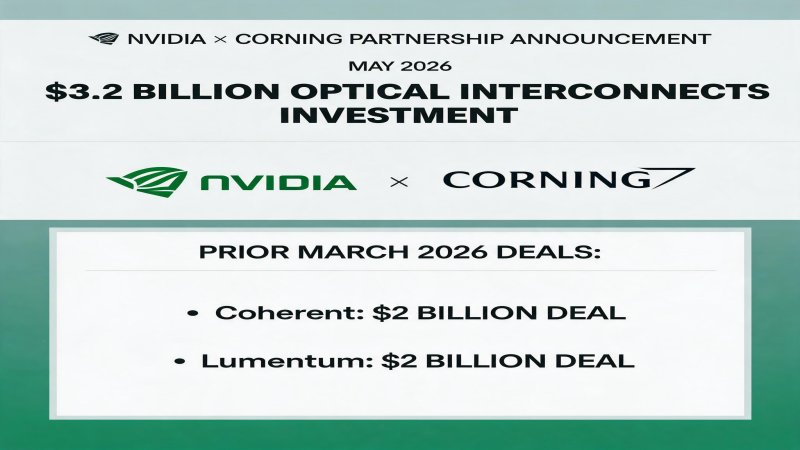
On May 6, 2026, NVIDIA and Corning officially signed a multi-year commercial and technology partnership agreement, with NVIDIA having the right to invest up to $3.2 billion in Corning. The core terms include: $500 million initial investment for 3 million warrants at a symbolic exercise price of $0.0001 per share, with the option to purchase an additional 15 million shares at $180 per share (potential $2.7 billion). Additionally, NVIDIA will provide hundreds of millions in prepaid payments to support Corning in building three new optical connectivity manufacturing plants in North Carolina and Texas. ⚡Verified
This is not an isolated case. In March 2026, NVIDIA had already invested $2 billion each in Coherent and Lumentum to lock in high-end laser and optical chip production capacity. ⚡Verified
Three investments within three months, cumulative commitment exceeding $7 billion—this is not simply supply chain layout, but the concrete implementation of Jensen Huang's strategy of "AI factories need light" announced at GTC 2026.
The Triple Ceiling of Copper Cables: Physical Limits Reached
Understanding NVIDIA's optical pivot requires first examining the triple physical ceiling of copper cables in AI scenarios.
Bandwidth Ceiling: The single-channel bandwidth ceiling for copper cables is approximately 800Gbps, while 1.6T optical modules have entered mass production in 2026, and 3.2T optical modules have entered customer validation. When bandwidth requirements reach 1.8TB/s, the effective transmission distance of copper cables is less than 1 meter—unable to cover even the height of a standard server rack. ⚡High Confidence
Power Consumption Ceiling: The GB200 NVL72 rack deploys over 5,000 differential high-speed copper cables with a total length of 3.2 kilometers, with power consumption from copper cables alone reaching several kilowatts. More critically, power consumption rises exponentially with transmission distance. In million-GPU clusters, interconnect network power consumption accounts for over 30% of total data center power consumption; if all-copper interconnect is used, power consumption would exceed 1 million kilowatts, equivalent to a medium-sized city's electricity consumption. ⚡High Confidence
EMI Ceiling: In high-density AI cluster wiring environments, signal crosstalk between adjacent copper cables seriously affects reliability. As an insulator, optical fiber is completely immune to electromagnetic interference, with significant advantages in high-density deployment scenarios.
Corning CEO Weeks revealed: "Even over short distances, data transmission efficiency using photons is three times that of electrons; over long distances, the efficiency gap reaches as high as 20 times."
NVIDIA's Billion-Dollar Optical Communication Strategy: Supply Chain Control, Not Simple Investment
The structural differences in NVIDIA's investments in the three optical companies reveal deep strategic intentions.
The Essence of the Corning Agreement is Capacity Lock-in: Among the up to $3.2 billion investment ceiling, the $500 million initial investment exchanged for 3 million warrants at a symbolic exercise price, meaning NVIDIA obtained priority supply rights at extremely low cost. The truly important part is the "hundreds of millions in prepaid payments"—this money helped Corning build three new factories directly in the U.S., directly increasing U.S. optical connectivity manufacturing capacity by 10 times, optical fiber production by over 50%, ⚡Verified and creating 3,000+ jobs.
Coherent + Lumentum Locks Core Components: The two $2 billion investments in March 2026 targeted InP (Indium Phosphide) laser capacity, a core CPO component. Lumentum holds approximately 50-60% global EML (Externally Modulated Laser) market share, ⚡Verified and is NVIDIA's primary CW light source supplier for CPO switches. Coherent owns the world's first 6-inch InP wafer fab, with capacity transitioning from 4-inch to 6-inch.
Vertical Integration Closed Loop: From optical fiber raw materials (Corning) → optical modules (multiple suppliers) → optical engines (Coherent/Lumentum) → CPO switches (NVIDIA self-developed), NVIDIA is building a complete optical communication supply chain closed loop.
"Vertical Relies on Copper, Horizontal Relies on Light": Jensen Huang's Dual-Pattern Strategy
At GTC 2026, Jensen Huang revised his previous "optical in, copper out" statement, explicitly stating that "optical and copper together" is the future. This judgment is based on precise technoeconomic analysis.
Inside the Rack (Scale-up): Copper Remains Optimal
In short-distance interconnects within a single rack or between GPU dies, copper cables have irreplaceable advantages:
- Zero power consumption: Passive copper cables do not consume electricity
- Extremely low latency: Electrical signal transmission speed approaches the speed of light
- Extremely high reliability: No need to consider laser lifetime, fiber bending loss, and other issues
- Cost advantage: A single passive copper cable costs only 1/10th of the same-speed optical module; the NVL72 rack copper cable solution saves over 80% compared to optical interconnects
Cross-Rack/Cross-Facility (Scale-out): Fiber Irreplaceable
Vera Rubin NVL576 organizes 8 NVL72 racks into a 576 GPU computing domain through optical interconnects, with total bandwidth reaching 768TB/s; Rosa Feynman NVL1152 further expands to 1152 GPUs. ⚡Verified In these cross-rack interconnect scenarios, optical fiber's advantages in bandwidth, power consumption, and distance are overwhelming.
Jensen Huang explicitly stated: "The next-generation AI infrastructure will require massive optical connectivity, because computing demands are growing rapidly, and copper wires can no longer meet the requirements."
CPO Technology Roadmap: From Switches to Chips
Co-Packaged Optics (CPO) is the technology that directly packages optical engines on the same substrate as switch chips, shortening the electrical signal path from centimeters to millimeters, reducing power consumption by over 50%. ⚡Verified
2026-2027: Switch-Level CPO Scale
NVIDIA's Spectrum-X Photonics CPO switch has entered full-scale production. As the world's first fully integrated 512-lane 200G CPO Ethernet switch system, it is integrated into the Spectrum-6 SPX network rack within the Vera Rubin platform, with switching capacity of 102.4Tb/s. Full-year CPO switch shipment in 2026 is expected to be approximately 20,000 units. ⚡Verified
2027-2028: Rack-Level CPO Deployment
Rubin Ultra super node will organize 8 NVL72 racks through CPO interconnects into a 576 GPU computing domain, with total bandwidth reaching 1.5PB/s, 12 times that of the previous generation. ⚡High Confidence
2028 and Beyond: Chip-Level Optical I/O
Feynman-generation AI accelerators will completely eliminate transitional solutions, fully transitioning to CPO architecture, achieving chip-level optical interconnects. Broadcom plans CPO product shipments of 30,000-50,000 units in 2027. ⚡High Confidence
Competitive Landscape: All Heroes Race the Optical Track
NVIDIA is not the only giant betting on optical interconnects. Broadcom has already delivered 51.2T CPO switches (Tomahawk 5-Bailly) to customers in October 2025, and launched the 102.4T upgrade version (Tomahawk 6-Davisson). ⚡Verified Intel is also developing CPO co-packaged optics solutions. ⚡Vendor Claim
Meta signed a $6 billion long-term agreement with Corning in January 2026 to expand the North Carolina fiber optic cable factory, becoming the primary customer for Corning's new capacity. ⚡Verified
The optical interconnect market is exploding: Global market size in 2025 was approximately $15.38 billion, expected to reach $43.14 billion by 2034, CAGR 12.2%. ⚡High Confidence
Vulnerability Analysis
Traditional Problem: Supply Chain Concentration Risk
The essence of NVIDIA's optical investment is "supply chain lock-in" rather than "supply chain diversification." Corning, Coherent, and Lumentum occupy absolute dominance in high-end optical communication components; insufficient capacity at any one company affects the overall situation. Lumentum has stated that capacity through late 2027 is basically locked, with 2028 full-year capacity expected to be fully booked within two quarters.
AI Attack Vector: Security Monitoring Blind Spots in Optical Interconnects
Unlike copper cable electrical signals, fiber optic transmission is not easily electromagnetically intercepted, but it also brings new security issues: optical signals cannot be monitored by traditional IDS (Intrusion Detection Systems), creating physical layer security blind spots. Attackers can use fiber optic splitters or bending loss effects for covert data theft, while existing security monitoring methods are difficult to detect.
Defense Direction: Zero-Trust Architecture for Optical Networks
Addressing this risk requires incorporating optical interconnects into zero-trust architecture from the design phase: optical signal scrambling/encryption, real-time link integrity monitoring, optical power anomaly alerts, optical switch path verification, and other observability technologies will become standard.
Predictions
Short-term (within 3 months): 1.6T optical module shipments surge, Corning U.S. new factory construction begins, Lumentum/Coherent capacity expansion accelerates. As scale effects emerge, optical module costs begin entering a declining curve.
Medium-term (within 6 months): Vera Rubin NVL576 deployment drives cross-rack optical interconnects to become standard for AI data centers, CPO penetrates from switch-level to rack-level. NVIDIA CPO switch shipment target: 80,000-100,000 units.
Long-term (within 12 months): CPO 2028 mass production schedule confirmed, Feynman architecture details disclosed. NVIDIA's optical communication supply chain closed loop officially completed. "Optical in, copper out" becomes an established fact at the Scale-out level, with the dual-pattern structure of copper inside racks and optical between racks fully established.
Why it Matters
DECISION
PREDICT
Get 3-5 key AI infrastructure signals weekly →
💬 Comments (0)