
I. Event Recap
Fortinet, a global leader in cybersecurity, adopts the convergence of networking and security as its core strategy. Facing AI-driven attacks, Fortinet released FortiOS 8.0 in March 2026, introducing innovations such as AI attack surface visibility, AI-aware application control, and MCP protocol visibility. However, the early 2026 incident where 600+ FortiGate firewalls were breached by AI-assisted hackers served as a wake-up call for this security giant.
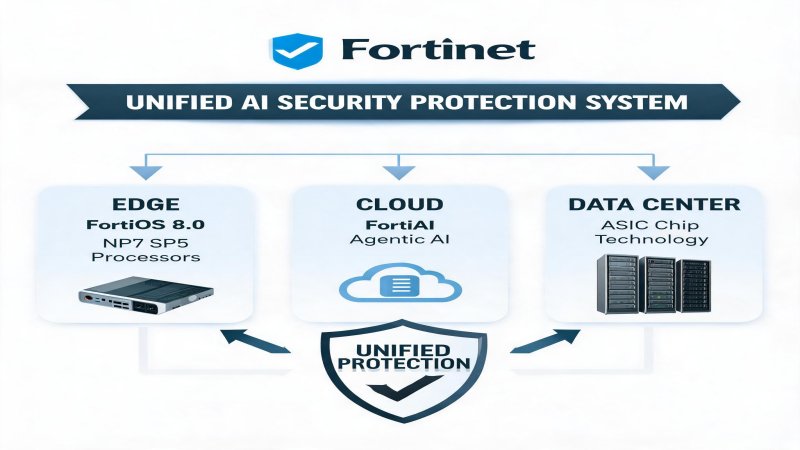
Financially, Fortinet's FY2025 full-year revenue reached $6.8 billion, up 14% year-over-year; billings grew 16% to $7.55 billion; free cash flow reached $2.21 billion; and non-GAAP operating margin was 35%. More notably, Fortinet's cumulative investment in proprietary ASICs exceeds $1 billion, with 60% market share in unit shipments. The G-series firewalls (FortiGate 3500G/400G) are based on new NP7 and SP5 processors, running on FortiOS 8.0, creating a generational gap from the older F-series.
Global cybersecurity spending grew 15% in 2026, with AI-specific security tools growing over 20%. While Fortinet's FY2025 results were solid, it faces competitive pressure from Palo Alto Networks' and Cisco's aggressive AI security layouts. Ken Xie emphasized at the FortiOS 8.0 launch: "Through FortiOS 8.0, we have established a foundation that allows businesses to flexibly scale security without hindering operations."
II. Technical Depth
2.1 FortiOS 8.0: AI Security Evolution of a Unified Operating System
FortiOS 8.0 is Fortinet's flagship product for addressing AI-era security challenges. Its AI security enhancements can be summarized into five core capabilities:
| Capability | Technical Details | Business Value |
|---|---|---|
| FortiView for AI Attack Surface | Real-time visibility, distinguishing approved from unauthorized AI tools, identifying Shadow AI | Quickly identify risky or unknown AI usage, reduce compliance exposure |
| AI-Aware Application Control | Allows approved GenAI tools while blocking risky actions that could expose sensitive data | Protect intellectual property, customer data, and regulated information |
| MCP and A2A Visibility | Reveals hidden AI activities and interactions between applications, agents, and tools | Reduce blind spots for data misuse or leakage |
| OCR-Enhanced DLP | Detects sensitive data embedded in images, scans, and screenshots | Close common data leakage vulnerabilities from traditional text-only inspection |
| Security Fabric AI Agent | Simplifies troubleshooting and configuration through guided conversational workflows | Reduce IT team operational burden, shorten response times |
2.2 FortiAI: The Paradigm Shift from Copilot to Agentic AI
FortiAI represents a paradigm shift from passive AI assistance to active Agentic AI. Unlike traditional chatbots, FortiAI is deeply integrated into Fortinet systems with three core capabilities:
Sees: Correlates logs, alerts, and telemetry data across devices and platforms, with contextual awareness of network topology and real-time logs. FortiAI doesn't analyze single alerts in isolation but correlates firewall logs, endpoint events, network traffic, and threat intelligence into complete attack chains.
Speaks: Natural language interaction for queries and commands, automatically generating CLI and Jinja scripts without manual coding. FortiAI can explain network topology diagrams for accurate configuration, enabling junior engineers to complete complex network adjustments.
Acts: Autonomously executes multi-step workflows without repeated prompts. Coordinates cross-environment tasks with FortiSOAR, supporting Human-in-the-Loop checkpoints to ensure critical changes are controlled. For example, when suspicious activity is detected, FortiAI can automatically isolate infected devices, adjust firewall policies, generate incident reports, and wait for human confirmation at critical steps.
2.3 ASIC Chips: Hardware Barrier for AI Data Center Security
Fortinet's core competitive advantage lies in self-developed ASIC chips. Cumulative investment exceeding $1 billion and 60% shipment market share constitute a difficult-to-replicate technical moat.
| Chip/Device | Positioning | Key Performance Indicators |
|---|---|---|
| NP7 (Network Processor) | Traffic acceleration | Supports 400GbE connectivity, wire-speed deep packet inspection |
| SP5 (Services Processor) | Security compute | Dedicated hardware-accelerated security compute, zero CPU overhead |
| FortiGate 3500G | Data center NGFW | High-throughput AI workload protection, quantum-safe cryptography |
| FortiGate 400G | Hyperscale NGFW | LLM traffic management, layered defense for AI workloads |
2.4 Secure AI Data Center: Layered Defense for GPU Clusters
Fortinet's Secure AI Data Center solution directly addresses the urgent need to protect large-scale GPU clusters and AI workloads:
- LLM Traffic Management: Manages all model traffic, enforcing guardrails on inputs and outputs, covering on-premises, hybrid, and public cloud deployments, eliminating code injection, tampering, and data exfiltration attempts
- Layered Defense: Inspects and sanitizes all traffic before it reaches AI models, granular application security protecting AI models and APIs, real-time zero-day detection and vulnerability prioritization
III. Financial Logic
3.1 Platformization Model Profitability
Fortinet's financial data proves that "unified platform" is not just a technical strategy but a profit model. FY2025 full-year revenue of $6.8 billion (up 14% YoY), billings of $7.55 billion (up 16% YoY), free cash flow of $2.21 billion, and non-GAAP operating margin of 35%. These numbers show Fortinet is not a company trapped in a mature device niche, but a platform vendor with strong cash generation capabilities.
The unified platform's profit logic lies in:
- R&D Efficiency: A single operating system (FortiOS) driving all products avoids the cost of duplicate development across multiple product lines
- Sales Efficiency: After customers buy FortiGate, the marginal cost of upselling FortiSwitch, FortiAP, and FortiSASE is extremely low
- Operational Efficiency: Unified management platforms reduce customer operational complexity while lowering Fortinet's technical support costs
3.2 ASIC Investment Scale Effects
The cumulative ASIC investment exceeding $1 billion appears substantial, but amortized across 60% shipment market share, unit costs have significant advantages. ASIC specificity enables Fortinet to offer performance that competitors struggle to match at lower costs, which is particularly critical in high-throughput AI data center scenarios.
3.3 AI Security Revenue Growth Potential
Fortinet has not yet separately disclosed AI security revenue, but the launch of FortiOS 8.0's AI features and Secure AI Data Center solutions marks AI security's evolution from "feature enhancement" to "independent revenue line." With the global AI cybersecurity market projected to reach $133 billion by 2030 (29% CAGR), Fortinet's ASIC acceleration advantages position it to capture significant share in this high-growth market.
IV. Strategic Depth
4.1 Unified Platform Strategy: Simplification as Competitiveness
Fortinet's AI security strategy is built around three pillars: Unified Platform, AI-Driven Security, and High-Performance Enforcement. The Unified Platform integrates all products through FortiOS, significantly reducing operational complexity and TCO. This strategy holds special appeal in a macro environment of tightening budgets—enterprises increasingly prefer reducing vendor counts, and Fortinet's "one-stop" security platform precisely caters to this trend.
4.2 Agentic AI: Evolution from Assistance to Autonomy
Fortinet leads the industry in AI security operations automation. FortiAI's Agentic capabilities shift SOC from human-driven to agent-driven, a transformation with strategic significance:
- Workforce Cost Optimization: Junior security analysts with FortiAI can complete complex tasks originally requiring senior engineers
- Response Speed Improvement: Time from detection to response shrinks from hours to minutes or even seconds
- Scalability: Agentic AI enables SOC to handle multiples of previous alert volumes without proportionally increasing headcount
4.3 Differentiated Positioning in Competitive Landscape
In the global IT and telecom cybersecurity market, Fortinet ties with Cisco at 2% share, far below Palo Alto Networks' 5%. But Fortinet's differentiated positioning is clear:
| Dimension | Fortinet | Palo Alto Networks | Cisco |
|---|---|---|---|
| Core Advantage | ASIC hardware acceleration + unified platform | Platformization + ecosystem breadth | Network-security convergence + Talos intelligence |
| AI Data Center | 400GbE wire-speed detection, performance-first | Prisma AIRS full lifecycle coverage | Hypershield built-in security |
| Price Positioning | Mid-range, high cost-performance | Premium, comprehensive features | Mid-to-high range, network bundling |
| Cloud-Native Capability | Moderate, continuously improving | Leading, deeply integrated with Google Cloud | Strong, multi-cloud support |
V. Challenges and Concerns
5.1 Trust Crisis from Security Incidents
The early 2026 incident where 600+ FortiGate firewalls were breached by AI-assisted hackers represents a major trust challenge for Fortinet. Attackers used AI tools to automate identification and exploitation of unpatched devices, exposing the critical importance of device management and patch updates. The incident's impact includes:
- Customer questioning of FortiGate device security
- Competitors potentially attacking Fortinet's "unified platform" strategy—"the risk of all eggs in one basket"
- Regulators potentially strengthening compliance requirements for network device security updates
Fortinet's response strategies include strengthening FortiGuard security update push, introducing more automated patch management features, and enhancing device health monitoring through FortiAI. But trust rebuilding takes time.
5.2 Shortcomings in Ecosystem Openness
Compared to Palo Alto Networks' 75+ joint integrations with Google Cloud and $2 billion in partnership revenue, Fortinet's open ecosystem strategy is relatively conservative. With multi-cloud and hybrid cloud becoming mainstream, deep integration capabilities with cloud vendors are increasingly important. While Fortinet supports major cloud platforms, it lacks strategic-level bindings similar to Palo Alto Networks' partnership with Google Cloud.
5.3 Insufficient Layout in AI Model Supply Chain Security
While Fortinet provides LLM runtime protection, its layout in AI model supply chain security (such as model file scanning, MCP server risk assessment, AI BOM governance) is not as comprehensive as Cisco AI Defense. As Agentic AI proliferates, model supply chains will become primary targets for attackers, and Fortinet needs to accelerate filling this gap.
5.4 Cloud-Native Capability Catch-Up Pressure
Some customer feedback indicates Fortinet's cloud-native security capabilities still have room for improvement compared to pure cloud security vendors (such as Zscaler, Netskope). While FortiOS 8.0 enhances SASE capabilities, in emerging areas such as cloud workload protection, container security, and serverless security, Fortinet needs to accelerate innovation.
VI. Conclusion
Fortinet addresses AI-era security challenges with a trinity strategy of "Unified Platform + ASIC Performance + Agentic AI." Its core logic is: ensuring security doesn't slow down the network through hardware acceleration, simplifying operations through a unified platform, and achieving autonomous response through Agentic AI.
For enterprise users, Fortinet's AI security layout provides three key values:
- Performance Assurance: ASIC acceleration ensures AI workload high throughput is unaffected by security inspection. In AI data center scenarios, 400GbE wire-speed threat detection is Fortinet's unique technical advantage, which is decisive for enterprises needing to protect large-scale GPU clusters.
- Operational Simplification: A single operating system and management platform significantly reduces security architecture complexity. FortiOS 8.0's FortiView for AI attack surface and Security Fabric AI agent enable security teams to manage network, endpoint, and cloud security policies from one console.
- Autonomous Response: FortiAI's Agentic capabilities shift SOC from human-driven to agent-driven. Automated alert classification, threat investigation, and response orchestration enable enterprises to handle the surge of threat volume in the AI era without proportionally increasing security headcount.
From an investment perspective, Fortinet's FY2025 35% non-GAAP operating margin and $2.21 billion free cash flow demonstrate the profitability and cash generation capability of the platformization model. However, the brand trust damage from the 600+ FortiGate breach incident, cloud-native capability catch-up pressure, and insufficient layout in AI model supply chain security are challenges Fortinet needs to address in 2026-2027. If Fortinet can maintain ASIC performance advantages while rapidly filling cloud-native and AI supply chain security gaps, its "high cost-performance AI security" positioning will gain greater market traction.
Why it Matters
Fortinet's ASIC technology has irreplaceable advantages in AI data center high-throughput scenarios. With the global AI cybersecurity market projected to reach $133 billion by 2030 (29% CAGR), Fortinet's hardware acceleration solution enables real-time threat detection without sacrificing AI workload performance—a capability software security solutions cannot match. Meanwhile, FortiOS 8.0's unified platform strategy significantly reduces security architecture complexity, holding special appeal in a macro environment of tightening budgets. However, the early 2026 incident where 600+ FortiGates were breached exposed the "single point of failure" risk of unified platforms, and Fortinet needs to enhance supply chain security capabilities while maintaining platform simplicity.
DECISION
- For AI data center scenarios with extremely high network performance requirements (GPU clusters, large-scale model training), prioritize Fortinet's ASIC acceleration solution, evaluating FortiGate 3500G/400G throughput and price advantages.
- Enterprises seeking simplified security architecture and lower TCO should evaluate FortiOS unified platform integration value, but must establish strict device management and patch update mechanisms.
- Enterprises deploying FortiGate should immediately enable FortiGuard auto-updates and deploy FortiAI for device health monitoring to defend against AI-assisted attacks.
- Enterprises focusing on Agentic AI security operations automation should prioritize evaluating FortiAI's autonomous execution capabilities, but should set Human-in-the-Loop checkpoints at critical steps.
PREDICT
- Within 12 months, FortiAI will evolve from an assistive tool to an agent capable of autonomously executing 80% of routine SOC tasks, and Fortinet will launch AI model supply chain scanning to fill capability gaps.
- Within 2 years, next-generation ASICs (NP8/SP6) will integrate dedicated AI inference engines, achieving on-chip threat detection with 3x+ performance improvement.
- Within 3 years, Fortinet's Secure AI Data Center solution will establish strategic-level integrations with 3+ major cloud vendors, becoming one of the mainstream choices for AI infrastructure security.
Get 3-5 key AI infrastructure signals weekly →
💬 Comments (0)