
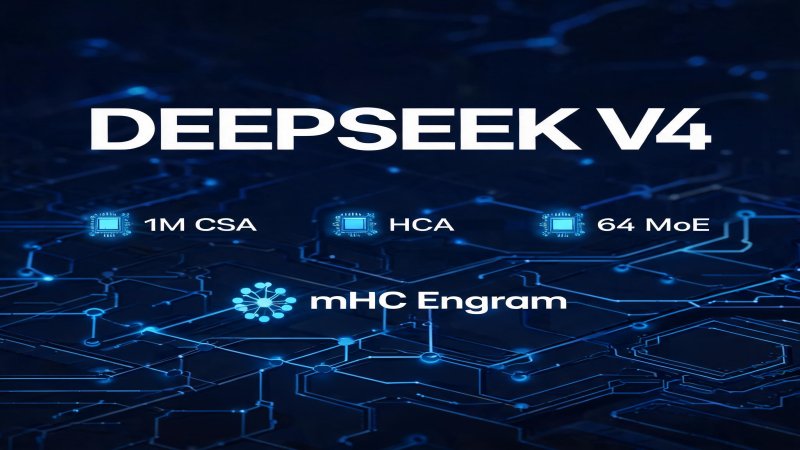
Constraint 0: The Starting Problem — 1M Context Is a Hard Requirement, But V3's Architecture Can't Handle It
V3's MLA (Multi-head Latent Attention) compressed KV Cache by 80-90%, performing well at 128K context. But at 1M?
Simple math: V3's KV Cache at 128K is ~508 GiB (✅derivable from technical report). Linear scaling to 1M gives ~4000 GiB. A single 8×H100 node has only 640GB HBM — can't fit even 1/6 of it.
So 1M context isn't just "change the sequence length parameter." V3's MLA compression is sufficient at 128K but insufficient at 1M.
This determines V4's first architectural constraint: must compress another order of magnitude beyond MLA.
Constraint 1→Innovation 1: CSA+HCA Hybrid Attention (Paying MLA's Debt)
V4's solution is two-level compression:
CSA (Compressed Sparse Attention) — filter first, keeping only KV pairs "worth attending to" for the current token. Like scanning a table of contents before reading chapters.
HCA (Heavily Compressed Attention) — compress further, fusing multiple tokens' KV into a single compressed token with up to 128× compression ratio.
The results are striking: at 1M context, V4-Pro requires only 27% of V3.2's per-token FLOPs and 10% of its KV Cache. Total KV Cache drops from ~508 GiB to ~58 GiB (8.7× savings).
| Metric | V3.2 @128K | V4-Pro @1M | Change |
|---|---|---|---|
| Per-token FLOPs | Baseline | 27% | -73% |
| KV Cache | ~508 GiB | ~58 GiB | -90% |
| Context length | 128K | 1M | 8× |
But HCA borrows new debt: positional information loss.
128× compression means 128 tokens share the same KV cache. What about RoPE positional encoding? V4 uses "inverse RoPE" — applying inverse RoPE correction to attention outputs.
This is clever but means positional information is "patched in" rather than "built in." At extreme context lengths, positional correction precision becomes an implicit bottleneck. The technical report provides no ablation on positional accuracy at different compression rates — an unpaid debt.
Key insight: CSA+HCA isn't a "highlight feature" but a forced choice from the 1M context hard requirement. Without this compression, 1M context is simply infeasible. The 128× compression rate itself is a hyperparameter — more compression means faster inference but worse positional accuracy and long-range dependency.
Constraint 2→Innovation 2: 64+ Fine-Grained MoE Routing (Paying 1M Context + Inference Cost Debt)
CSA+HCA solved KV Cache, but introduced a new problem: inference FLOPs at 1M context remain high.
V3's MoE uses 8 experts selecting 2, activating 37B parameters. If V4 simply scales up (1.6T) without changing MoE structure, inference cost at 1M context would explode — each token must compute KV for massive experts.
V4's solution: split 8 large experts into 64+ micro-experts, dynamically selecting ~10 per token.
What changes?
- Parameter efficiency: 1.6T total but only 49B activated (3%), sparser than V3's 37B/671B (5.5%)
- Inference cost: each token only computes KV for 10 micro-experts, not 8 large ones
- Expert precision: micro-experts are specialized, routing match accuracy is higher
Routing function changes from Sigmoid to Softplus, shared expert isolation introduced (common knowledge fixed, routing entropy -40%), load balancing switches to dynamic bias adjustment.
But 64+ experts borrows new debt: training stability.
With 8 experts, occasional overload is manageable. With 64+, routing collapse risk increases exponentially — numerical outliers in MoE layers amplify through routing, creating vicious cycles that trigger loss spikes.
Constraint 3→Innovation 3: mHC + Anticipatory Routing + SwiGLU Clamping (Paying 64+ Experts' Debt)
V4 uses three techniques to prevent training collapse:
Anticipatory Routing: routing network uses parameters lagging 1-2 steps to compute routing indices, decoupling routing decisions from expert computation. Prevents the vicious cycle of "routing oscillates wildly due to expert output outliers."
SwiGLU Clamping: directly clamps SwiGLU outputs to [-10,10]. Simple but effective.
mHC (Manifold-Constrained Hyper-Connections): constrains inter-layer information flow on a learned manifold, letting gradients propagate along geometrically constrained smooth paths rather than bouncing randomly. Reports 6-7% training efficiency improvement.
The team candidly acknowledges these methods' underlying mechanisms remain open questions. This isn't modesty — trillion-parameter MoE training stability genuinely lacks elegant general solutions.
mHC borrows new debt: extra computation during inference. Gating parameters and manifold constraint computation add ~2-3% overhead at inference (negligible). But during training, each forward pass costs ~5% more FLOPs.
Key insight: If you only look at V4's MoE routing and mHC, they seem like "two independent innovations." But from the constraint chain perspective, mHC is a necessary condition for 64+ expert training, not a nice-to-have. Without mHC and anticipatory routing, 64+ expert training would most likely collapse.
Constraint 4→Innovation 4: Engram Conditional Memory (Paying Inference Efficiency + Long Context Debt)
CSA/HCA compressed KV Cache, MoE reduced activated parameters, but one waste remains: the model uses precious inference compute to "recall" static knowledge (the capital of France) rather than "think" (solve a new math problem).
Engram offloads static knowledge to an external memory module with O(1) lookup. At inference, the model learns "when to query memory" rather than "re-derive from scratch." Needle-in-a-Haystack test: 97% accuracy (⚠️Vendor Claim).
Engram borrows new debt: deployment architecture becomes more complex.
V4 inference is no longer a "single model, single process" simple service. You need:
- A high-bandwidth DRAM-stored Engram memory bank
- Low-latency query channels between model and memory bank
- Different domain Engrams requiring independent maintenance and updates
This means V4's deployment threshold is significantly higher than V3. V3 you can spin up with vLLM in one command; V4 requires additional infrastructure. For small teams, this may be a bigger barrier than VRAM.
Constraint 5: Muon Optimizer (Paying Trillion-Parameter Training Convergence Debt)
AdamW performs well at hundred-billion parameter scale, but convergence quality degrades at trillion parameters. V4 switches to Muon — momentum updates based on matrix orthogonalization.
Good training results, but ecosystem is the problem: Megatron-LM, DeepSpeed, vLLM all have first-class AdamW support. If you want to fine-tune based on V4, Muon compatibility is a potential pitfall. Current recommendation: fine-tune with AdamW first, switch to Muon when framework support matures.
Mapping the Constraint Chain
1M context hard requirement → KV Cache explosion (Constraint 0) → CSA+HCA compression (Innovation 1) → Positional info loss (New Debt 1)→ Inverse RoPE correction (Patch) | Inference FLOPs still high (New Debt 2) → 64+ fine-grained MoE (Innovation 2) → Training stability collapse (New Debt 3) → Anticipatory routing + Clamping + mHC (Innovation 3) → Training FLOPs +5% (New Debt 4) | Static knowledge wastes inference compute (New Debt 5) → Engram conditional memory (Innovation 4) → Deployment architecture complexity (New Debt 6)
Every link is "because X, must do Y, but Y introduces Z." V4's architecture is not a "feature list" but a set of tightly coupled solutions to engineering constraints.
Why it Matters
V4's architecture is a "constraint chain" not a "feature list": each innovation patches the previous one while borrowing new debt. Understanding this chain is essential to understanding V4's deployment cost and design space.
The true cost of 1M context is underestimated: CSA/HCA's 128× compression isn't an "optimization option" but a "forced choice." Higher HCA compression means faster inference but worse positional accuracy and long-range dependency — a trade-off the technical report doesn't quantify.
Deployment threshold is far higher than V3: Engram memory bank, 64+ expert all-to-all communication, Muon compatibility — V4 isn't a model you spin up with vLLM in one command; it requires additional infrastructure.
DECISION
For Teams Planning V4 Deployment
- Verify whether you truly need 1M context: if 128K suffices, V3 may be more cost-effective — 1M context deployment costs 3-4× more than 128K
- Ensure inter-node bandwidth ≥400Gbps: 64+ expert all-to-all communication is far greater than 8 experts; insufficient bandwidth makes MoE routing a bottleneck
- Prepare Engram infrastructure: without high-bandwidth DRAM for memory bank, you're limited to pure GPU solutions with 3-5× VRAM requirements
- Validate HCA positional accuracy: 128× compression's positional correction may be degraded in your target scenarios; run Needle-in-a-Haystack validation for long-document cross-section references
- Fine-tune with AdamW first: Muon's framework compatibility isn't mature yet; AdamW fine-tuning may have convergence differences but is safer
For Investors
- Focus on deployment ecosystem, not model parameters: V4's deployment complexity means opportunities for inference service providers — middleware that simplifies V4 deployment has value
- V4's inference cost advantage is structural: MoE+MLA+CSA/HCA enables 8-10× concurrency on same hardware — a hardware-agnostic efficiency advantage
PREDICT
| Timeframe | Prediction |
|---|---|
| Short-term (0-6 months) | V4-Pro deployment concentrated among top-tier inference providers; small teams primarily use V4-Flash; Engram deployment solutions become hot topics in open-source community |
| Mid-term (6-18 months) | CSA/HCA positional accuracy issues catalyze new attention compression approaches; MoE training stability research accelerates, alternatives to anticipatory routing and mHC emerge |
| Long-term (18+ months) | "Architecture debt chain" becomes a paradigm for LLM design — next-gen models will design from constraint derivation rather than feature stacking; inference efficiency race replaces parameter race |
Get 3-5 key AI infrastructure signals weekly →
💬 Comments (0)