
Opening: Fire and Ice on the Same Day
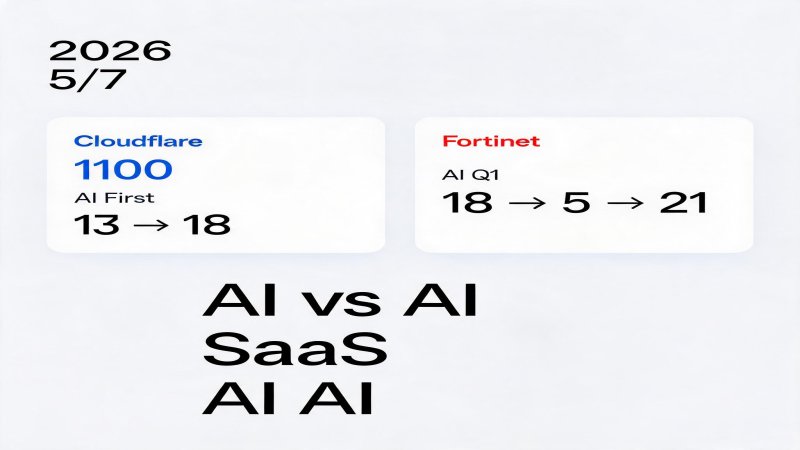
On May 7, 2026, the cybersecurity industry staged a textbook market divergence. Cloudflare announced layoffs of 1,100 employees (~20%), pivoting entirely to an Agentic AI-First operating model. Despite Q1 revenue of $639.8M beating expectations with 34% YoY growth, the stock plunged 13-18% after hours. On the same day, Fortinet posted Q1 results: revenue of $1.85B (+20% YoY), adjusted EPS of $0.82 (beating by 33%), and billings of $2.09B (+31%) - sending the stock surging 21%.
Even more notable: Datadog soared 29% the same day, and the iShares Software ETF (IGV) outperformed the semiconductor ETF (SOXX), with the software sector rallying broadly. But Cloudflare stood alone as the contrarian in this software surge - the market was saying: we will pay for AI making software stronger, but we will not endorse AI replacing a company's own people.
Cloudflare's AI-First Transformation: Efficiency or Storytelling?
Cloudflare co-founders Matthew Prince and Michelle Zatlyn framed the layoffs in their open letter as not a cost-cutting exercise, not an assessment of individuals' performance, but about Cloudflare defining how a world-class, high-growth company operates and creates value in the agentic AI era. The letter disclosed that Cloudflare's internal AI usage surged over 600% in the past three months, with employees running thousands of AI agent sessions daily.
On the data front, Cloudflare's Q1 was indeed impressive: revenue of $639.8M (+34% YoY), beating the $622M consensus; adjusted EPS of $0.25, beating by $0.02; full-year revenue guidance of $2.805-2.813B, slightly above consensus. But the 14% after-hours decline was driven primarily by Q2 revenue guidance of $664-665M falling slightly short of the $665.3M consensus, compounded by $140-150M in restructuring charges concentrated in Q2.
The market's skepticism logic is clear:
- What exactly did 600% AI usage growth replace? If AI truly made the company more efficient, why didn't Q2 revenue guidance reflect incremental gains? Why was the full-year guidance increase so conservative?
- The "not cost-cutting" framing doesn't hold up. The 20% workforce reduction saves real labor costs, but the company chose to narrate it as "AI-First transformation" rather than acknowledging headcount reduction from structural efficiency gains.
- Contrast with Block's 40% layoff and 17% stock rally. The difference: Block's layoffs came with clear margin improvement expectations, while Cloudflare's came with conservative revenue guidance and declining gross margins (GAAP gross margin from 75.9% to 71.2%).
The deeper issue: Cloudflare, as a network infrastructure and SASE vendor, derives its core value from network scale and developer ecosystem - not from labor-intensive services. Using AI to replace internal HR, finance, and marketing roles has no direct correlation with core business growth. This is not "AI makes the product better" - it is "AI makes the company cheaper." And SaaS market valuation logic has never been about how much you can save, but about how much you can earn.
Fortinet's AI-Empowered Path: Why the Market Believes AI Makes Security Stronger
Fortinet's Q1 2026 numbers were nearly flawless: revenue of $1.85B (+20% YoY), beating expectations by $120M; adjusted EPS of $0.82, beating by $0.20; billings of $2.09B (+31%), far exceeding analyst estimates of $1.82B; record free cash flow of $1.01B; non-GAAP operating margin of 36%.
More importantly, the growth drivers: Unified SASE billings grew 31% YoY, AI-driven Security Operations continued to accelerate, and OT security billings grew over 70%. Fortinet raised full-year revenue guidance to $7.71-7.87B and EPS guidance from $2.94-3.00 to $3.10-3.16.
The market's belief in Fortinet's AI narrative rests on three pillars:
- AI directly enhances product capability. FortiAI-Protect delivers proactive defense and automated blocking of zero-day threats through FortiGuard global threat intelligence and AI capabilities; FortiAI-Assist compresses security investigation and response time from hours to minutes. AI is not replacing Fortinet's employees - it is replacing customers' manual security operations.
- FortiOS unified OS is the optimal carrier for AI empowerment. All Fortinet products share a single operating system, meaning AI capabilities can be deployed once and activated across the entire platform - enabling rapid scaled monetization rather than停留在 proof-of-concept.
- AI drives platform consolidation, not replacement. Fortinet CEO Ken Xie explicitly noted that AI-driven Security Operations billings grew 29%, accounting for 10% of the business, with customers consolidating multiple security vendors onto Fortinet's integrated platform. AI makes Fortinet's one-stop security platform narrative more compelling.
BTIG analyst Gray Powell upgraded Fortinet to Buy with a $125 price target post-earnings, arguing that AI-powered ransomware threats and expanding AI data center infrastructure are boosting demand for Fortinet's security solutions, not threatening security vendors. BofA set the Street-high target of $130.
Two Paths Compared: Self-Disruption vs Augmentation - Which Is More Sustainable?
| Dimension | Cloudflare (Self-Disruption) | Fortinet (Augmentation) |
|---|---|---|
| AI Core Logic | AI replaces own workforce, improves operational efficiency | AI enhances product capabilities, increases customer value |
| Business Model | Network infrastructure + SASE + Developer platform | Security-dedicated platform + Unified OS + ASIC hardware |
| AI Monetization Path | Indirect: resource release through internal efficiency gains | Direct: AI features embedded in products, driving billings growth |
| Q1 Revenue Growth | 34% YoY ($640M) | 20% YoY ($1.85B) |
| Operating Margin | Non-GAAP 11.4% | Non-GAAP 36% |
| Gross Margin Trend | Declining (75.9% to 71.2%) | Stable (~80%) |
| Free Cash Flow | $84.1M (13% margin) | $1.01B (58% margin) |
| Market Reaction | Down 13-18% after hours | Up 15-21% |
From a financial model perspective, the fundamental difference is: Cloudflare's AI-First transformation is a cost structure reshaping - short-term labor savings offset by restructuring charges ($140-150M), with long-term effectiveness dependent on whether released resources translate into product innovation and revenue growth. Fortinet's AI empowerment is a revenue structure upgrade - AI features embedded directly in the product matrix, scaled rapidly through the FortiOS unified OS, with a clear monetization path.
Cloudflare's advantage lies in its network scale and developer ecosystem - 330+ city data centers globally, the Workers developer platform, AI inference services - these are the infrastructure of the AI era. But the problem is that the logical chain between these infrastructure advantages and laying off 20% to go AI-First does not hold together. You do not need to lay off your HR and marketing teams to prove your AI inference service is stronger.
Ripple Effects for SaaS: After Cloudflare, Who Follows?
Cloudflare is not the first company to cite AI as a reason for layoffs, but it is the first SaaS company to position AI Agent replacing human labor as a strategic narrative rather than a cost-reduction measure. This distinction matters enormously.
As of 2026, over 98,689 tech employees have been laid off. On May 7 alone, beyond Cloudflare, Upwork announced a 24% workforce reduction and Bill Holdings cut up to 30%. Coinbase previously laid off 14%, with CEO Brian Armstrong describing the company as becoming an AI-centric intelligence, with humans around the edge aligning it.
But Cloudflare's case provides a critical signal: the capital market's tolerance for the AI replaces labor narrative is far lower than expected. Block's 40% layoff and 17% stock rally worked because the market saw margin improvement; Cloudflare's 20% layoff and 18% decline happened because the market only saw conservative revenue guidance and declining gross margins.
The lesson for the SaaS industry: if you are going to tell an AI transformation story, put AI in your products, not in your layoff announcements. Investors will pay for AI augmentation but will not endorse AI replacement - at least not until revenue growth significantly accelerates.
Enterprise Customer Perspective: AI Replacing Operations vs AI Enhancing Protection
From the enterprise customer's procurement decision perspective, the two paths have fundamentally different impacts.
Cloudflare's AI-First transformation is neutral for customers: improved internal operational efficiency does not directly translate to enhanced product functionality, and customer perception is limited. The growth of Cloudflare Workers AI inference services (signing a record $100M+ contract in Q1) is an independent growth logic with no direct connection to the layoffs.
Fortinet's AI empowerment represents incremental value for customers: FortiAI-Protect's automated zero-day threat blocking, FortiAI-Assist's minute-level security response, FortiAI-SecureAI's AI runtime security protection - these capabilities directly improve security ROI. Fortinet's Unified SASE ARR reaching $1.15B (+26% YoY) and Security Operations ARR reaching $435M (+30% YoY) prove that customers are paying for AI-enhanced security capabilities.
For CISOs and security procurement decision-makers, AI helps fewer people do more is far less compelling than AI helps discover threats that humans cannot detect. The former is a cost logic; the latter is a risk logic - and security procurement has always been risk-driven.
Investor Framework: Choosing Between Two Paths
For investors, the Cloudflare-Fortinet divergence provides a clean framework for evaluating SaaS companies' AI transformations:
- Look at where AI lives: AI in internal operations means a cost story with limited valuation upside; AI in product portfolio means a revenue story with greater valuation elasticity.
- Look at the monetization path: Can AI-driven efficiency gains translate into revenue acceleration within 2-3 quarters? If not, it is just cost-cutting in AI packaging.
- Look at gross margin trajectory: Cloudflare's GAAP gross margin declining from 75.9% to 71.2% signals that AI infrastructure investment is eroding profitability; Fortinet's stable ~80% gross margin shows that high-margin AI features are consolidating earnings power.
- Look at customer behavior: Fortinet added 6,600+ new customers in Q1, with Unified SASE and Security Operations as the fastest-growing segments - customers are voting with their budgets.
In the current market environment, AI-augmentation companies (Fortinet, Datadog, Palo Alto Networks) offer significantly more certainty than AI-replacement companies (Cloudflare, Coinbase, Upwork). However, if Cloudflare can demonstrate over the next 2-3 quarters that its AI-First operating model genuinely accelerates product iteration and revenue growth, the valuation recovery potential is equally enormous - it just requires more time to validate.
Why it Matters
Cloudflare's AI-First layoff transformation represents the SaaS industry's first large-scale execution of an AI Agent replacing human labor strategy - it is not just Cloudflare's choice but a structural inflection point for the entire industry. Fortinet's AI-empowered path proves that the cybersecurity industry narrative has shifted from AI disrupts security to AI empowers security - this narrative shift directly determines the flow of billions of dollars in capital. The divergence of these two paths will profoundly influence SaaS companies' AI transformation path selection and capital allocation decisions over the next 2-3 years.
DECISION
For enterprise security buyers: Fortinet's AI-empowered path provides more direct security ROI - AI-enhanced threat detection and automated response capabilities are quantifiable. Recommend prioritizing Fortinet's FortiAI capabilities in security architecture evaluations. Cloudflare's network infrastructure advantages (SASE, Workers AI) remain strong, but do not conflate the company's internal AI transformation with product AI capabilities.
For investors: Short-term certainty favors AI-augmentation plays (Fortinet, Datadog) with clear AI monetization paths and adequate customer validation. Cloudflare's AI-First transformation is a high-risk, high-reward long-term bet - key watchpoints are whether revenue growth accelerates and gross margins stabilize over the next 2-3 quarters. If the AI-First operating model genuinely accelerates product iteration, current valuations may represent a low point.
For SaaS professionals: The core lesson from Cloudflare's case is that AI transformation narratives must be linked to revenue growth, not just cost reduction. Investors and customers ultimately pay only for value increments, not cost decrements.
PREDICT
Short-term (3-6 months): Cloudflare's stock will remain under pressure until Q2-Q3 earnings prove that the AI-First transformation has delivered visible product iteration acceleration and revenue growth. Fortinet will continue to strengthen on AI security demand, with Unified SASE and Security Operations potentially becoming new growth engines. More SaaS companies will follow the AI layoff path but will frame their narratives more cautiously.
Medium-term (6-18 months): The cybersecurity industry will see clear valuation divergence between AI-augmentation and AI-replacement companies - the former enjoying premiums, the latter facing discounts. If Cloudflare successfully validates its AI-First model, it could become a SaaS industry template; if it fails, it will intensify market distrust of the AI layoff narrative.
Long-term trend: The two paths will eventually converge - AI-augmentation companies will gradually introduce AI into internal operations for efficiency, while AI-replacement companies must productize AI capabilities to justify valuations. The core of the divergence is not which type of AI to do but where does AI appear first - products before operations, revenue before costs.
Get 3-5 key AI infrastructure signals weekly →
💬 Comments (0)