
<h2>I. Event Recap: Cloudflare Rings the Bell on AI Crawler Fees</h2>
<p>In July 2026, Cloudflare, the global internet infrastructure giant, officially launched its AI Content Paid Gateway (internally codenamed Pay Per Crawl), marking a structural crack in the 'open web free crawling' paradigm that has operated for over three decades. According to Cloudflare's official announcement, the content paid gateway entered private beta on July 1, 2026, allowing website owners and publishers to charge AI crawlers on a per-access basis, with a minimum rate set at $0.01 per successful content retrieval. More dramatically, Cloudflare simultaneously announced that starting September 15, 2026, its default security policy will block all mixed-use crawlers (bots that blend search indexing, AI agent activity, and model training) from accessing any ad-supported pages unless crawler operators pre-declare willingness to pay and authenticate via signed requests.</p>
<p>The triggering context for this decision is the exponentially growing crawler traffic from AI companies over the past 18 months. Cloudflare data shows that approximately 20% of traffic on its network comes from various automated programs, with AI crawlers growing far faster than traditional search engine crawlers. The training data demands of models like OpenAI, Anthropic, and Google Gemini have caused publisher server loads to surge without any economic compensation. From late 2025 to early 2026, media groups including The New York Times, Axel Springer, and News Corp filed copyright lawsuits against AI companies, pushing industry tensions to a critical point. Cloudflare's paid gateway essentially provides a technical, commercial solution to this conflict at the infrastructure layer.</p>
<p>Looking at the timeline, Cloudflare's groundwork showed early signs. In July 2025, Cloudflare launched the AI Crawl Control feature in private beta, allowing site administrators to selectively block or allow AI crawlers. In January 2026, the company acquired an edge AI orchestration platform, strengthening its ability to identify AI workloads. At the May 2026 Investor Day, CEO Matthew Prince first publicly mentioned the 'Content Independence Day' concept, hinting that publishers would regain control over the distribution rights of their content assets. By July 2026, the combination of the paid gateway and default blocking policy formally landed, forming a complete closed loop from 'technical control' to 'commercial monetization.'</p>
<p>Financially, Cloudflare's Q1 2026 earnings report showed total revenue reaching $639.8 million, up 34% year-over-year, far exceeding the previous guidance range of $620-621 million. Non-GAAP gross margin was 72.8%, down 130 basis points year-over-year but still at an industry high. The company's current market cap is approximately $90.6 billion, with full-year 2026 revenue expected at about $2.81 billion, maintaining growth around 30%. At this scale, opening a new AI content paid revenue line—based on conservative assumptions of the top 1,000 global websites being accessed by AI crawlers 10 million times daily with a 50% charge rate—could represent tens of millions of dollars in annual incremental revenue potential.</p>
<h2>II. Technical Depth: HTTP 402 and AI Crawler Identification Engineering</h2>
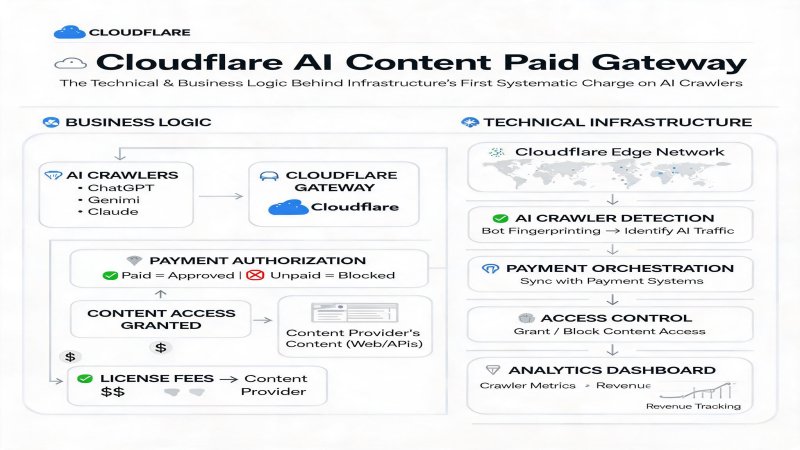
<p>The technical core of Cloudflare's AI Content Paid Gateway can be deconstructed into three layers: traffic identification, policy decision, and billing settlement. At the traffic identification layer, Cloudflare relies on its Bot Management system, which has been operating for over a decade, and the world's largest Verified Bots program, constructing multi-dimensional AI crawler detection capabilities. The system integrates machine learning classifiers, behavioral fingerprint analysis, and request feature matching to distinguish search engine crawlers (like Googlebot), legitimate API calls, malicious crawlers, and AI training crawlers. The key technical breakthrough lies in the precise identification of mixed-use crawlers—these bots typically use the same IP ranges and user-agent strings as search engines but exhibit distinct access patterns: search crawlers follow robots.txt rules, maintain relatively uniform access frequency, and prioritize entry pages; AI training crawlers often perform deep recursive crawling, ignore nofollow tags, and exhibit burst access during off-peak hours.</p>
<p>At the policy decision layer, Cloudflare introduced the HTTP 402 Payment Required status code as the entry point for billing negotiation. This status code has been defined in RFC standards for a long time but has rarely been used at scale in real-world web applications. Cloudflare reactivated it and gave it commercial semantics: when an unpaid AI crawler triggers a policy, the system returns a 402 response while including a URL pointing to the Cloudflare Pay Per Crawl marketplace and billing metadata in the response headers. Crawler operators can choose to complete paid registration, obtain an API key, and include signatures in subsequent requests to pass verification. This design cleverly leverages existing HTTP protocol infrastructure, achieving backward compatibility without requiring massive client-side modifications.</p>
<p>The billing settlement layer adopts a Pay Per Successful Retrieval model. 'Success' is defined as the crawler obtaining a complete 200 response without being intercepted by the cache layer. The minimum unit price is set at $0.01 per retrieval, and publishers can set higher rates or completely block access through the control panel. Cloudflare, as the platform operator, extracts a certain percentage of revenue (the specific percentage has not been publicly disclosed, with industry estimates ranging from 15% to 30%). The payment process is integrated into Cloudflare's existing billing system, supporting both monthly settlement and developer prepaid modes.</p>
<p>From an architecture performance perspective, this system imposes new computational requirements on Cloudflare's edge network spanning 330+ cities worldwide. Every AI crawler request requires real-time classification, policy matching, and billing status querying, adding approximately 5-10ms of latency overhead. However, considering that Cloudflare's average response time is already at the millisecond level and AI crawlers are far less sensitive to latency than human users, this overhead is engineering-acceptable. More importantly, Cloudflare's Workers edge computing platform allows these policies to be executed at nodes closest to users without needing to return to central servers, ensuring scalability.</p>
<h2>III. Financial Logic: From Bandwidth Costs to Content Asset Monetization</h2>
<p>The financial logic behind Cloudflare's AI Content Paid Gateway is essentially an upward extension of the CDN business model. Traditional CDN revenue primarily comes from bandwidth distribution (traffic-based billing) and security protection (request or subscription-based billing), with publishers as content providers occupying a 'consumed' position in this value chain—they pay CDN fees to distribute content but never receive returns from secondary uses like AI training. Cloudflare's paid gateway transforms publishers from 'cost centers' to 'revenue sources' while opening a new platform commission revenue line for itself.</p>
<p>From Cloudflare's own financial structure, over 70% of Q1 2026's $639.8 million revenue comes from large customers (annual contract value exceeding $100,000), who are precisely the content platforms most active with AI crawlers (news sites, social media, knowledge bases). The launch of the paid gateway will further lock in the stickiness of these large customers because the AI crawler monetization feature can only be seamlessly enabled on the Cloudflare network. From a unit economics perspective, if a large publisher is accessed by AI crawlers 100 million times monthly, at the minimum rate of $0.01 per retrieval, monthly revenue could reach $1 million. Even if Cloudflare only extracts a 20% platform fee, that's $200,000 in incremental revenue with near-zero marginal cost.</p>
<p>From AI companies' cost structure perspective, this change will significantly increase data acquisition costs for model training. Taking OpenAI's GPT-5 training as an example, if it needs to crawl tens of trillions of tokens of high-quality web content, at $0.01 per retrieval, content acquisition costs alone could rise from near zero to tens of millions of dollars. This cost pressure will accelerate AI companies' shift toward 'licensed data partnerships' and 'synthetic data generation,' indirectly driving additional revenue growth for compute providers like NVIDIA and AWS. Therefore, while Cloudflare's paid gateway directly charges AI crawlers, its financial ripple effects will permeate the entire AI industry chain.</p>
<p>The key financial metric investors need to watch is whether Cloudflare can separately disclose AI-related service revenue in its Q2 or Q3 2026 earnings. If this revenue line reaches 5% of quarterly revenue (approximately $32 million), it will validate market recognition of Cloudflare's 'AI infrastructure layer' positioning and support its current high valuation at approximately 25x price-to-sales ratio. Conversely, if adoption falls below expectations, the company may need to lower full-year revenue guidance in the second half of 2026, triggering a valuation correction.</p>
<h2>IV. Strategic Depth: CDN Three-Way Battle and AI Infrastructure Positioning War</h2>
<p>Cloudflare's AI Content Paid Gateway is not an isolated product launch but a critical move in the CDN industry's AI infrastructure positioning war. The current global CDN market shows a 'one superpower with multiple strong powers' pattern: Cloudflare ranks first with over 575,000 deployed websites, Amazon CloudFront has about 111,000, and Akamai maintains strength in the traditional enterprise market though its website count has fallen behind. As AI workloads become the core growth driver of cloud infrastructure, CDN vendor competition dimensions are expanding from 'transmission speed' and 'DDoS protection' to 'AI traffic management' and 'data sovereignty control.'</p>
| Dimension | Cloudflare | AWS CloudFront | Akamai | Fastly |
|---|---|---|---|---|
| Global Website Deployments | 575,620+ | 111,265+ | ~90,000 | ~25,000 |
| Edge Node Coverage | 330+ cities | 600+ edge locations | 325,000+ servers | 80+ POPs |
| AI Crawler Identification | Native support, ML+behavioral analysis | Basic Bot Control | Bot Manager (enterprise) | Basic bot detection |
| Content Paid Gateway | Launched (Pay Per Crawl) | None | None | None |
| AI Workload Optimization | Workers AI + inference acceleration | SageMaker edge inference | Basic CDN caching | Compute@Edge |
| Pricing Model | Fixed rate + pay-per-use | Traffic + request-based | Enterprise custom pricing | Bandwidth + request-based |
| Publisher Ecosystem Binding | High (self-service + developer-friendly) | Medium (AWS ecosystem linkage) | High (traditional media relationships) | Medium (tech-driven customers) |
<p>From the table above, Cloudflare holds clear first-mover advantages in both 'AI crawler identification' and 'content paid gateway' dimensions. AWS CloudFront possesses the widest edge infrastructure (600+ locations), but its Bot Control feature mainly targets security scenarios rather than commercial monetization. Additionally, Amazon faces conflicts of interest in launching similar features since it is itself an AI company (with Claude competitors and Amazon Bedrock). Akamai has deep roots in traditional media and large enterprise customers, but its technology stack centers on cache distribution, with relatively weak edge computing and real-time ML classification capabilities, requiring 12-18 months to catch up. Fastly's Compute@Edge technical architecture is advanced, but its smaller scale makes it difficult to independently drive industry standard formation.</p>
<p>The deeper strategic consideration lies in the battle for 'data layer control rights.' The value of AI models heavily depends on the quality and diversity of training data, and by controlling the distribution layer of 20% of global traffic, Cloudflare essentially holds the 'faucet' for data flow. The paid gateway is not just a charging tool but a strategic fulcrum for Cloudflare to extend upstream into the AI industry chain—Cloudflare could fully launch an 'authorized data marketplace' in the future, allowing publishers to directly sell structured datasets to AI companies with Cloudflare acting as a trusted intermediary extracting commissions. If this model succeeds, it will transform Cloudflare from a 'pipe operator' to a 'data exchange operator,' fundamentally changing its bargaining position in the tech industry chain.</p>
<h2>V. Challenges and Concerns: Technical Evasion, Regulatory Uncertainty, and Churn Risk</h2>
<p>Despite the groundbreaking significance of Cloudflare's AI Content Paid Gateway, the technical and commercial challenges it faces are equally significant. The primary risk comes from technical evasion by AI crawlers. Advanced AI operators could completely bypass detection through: using residential proxy networks to simulate real user access, disguising crawler traffic as browser automation testing, or indirectly obtaining content through third-party data aggregators. Cloudflare's Verified Bots program relies on crawler operators' 'voluntary declarations,' but for uncooperative malicious or gray-area crawlers, ML classifier accuracy always has an upper limit (industry-leading bot detection systems typically achieve 95%-97%), meaning a 3%-5% miss rate will still cause significant economic losses in high-traffic scenarios.</p>
<p>The second major challenge is regulatory uncertainty. The EU's Digital Markets Act (DMA) and AI Act are constructing regulatory frameworks for platform power and AI data usage. As a de facto traffic gatekeeper, Cloudflare's practice of charging AI crawlers could be viewed by regulators as 'abuse of market dominance' or 'setting unreasonable trading conditions.' Particularly when Cloudflare simultaneously charges publishers CDN fees and AI companies content access fees, pricing transparency in this two-sided market will become a focal point for antitrust scrutiny. Both the US Federal Trade Commission (FTC) and the EU Commission could launch investigations into Cloudflare's pricing strategy in 2027.</p>
<p>The third risk is potential churn among publisher customers. Some large content platforms (like Reddit, Stack Overflow) have already established direct commercial relationships with AI companies through private APIs and data licensing agreements. They may feel that Cloudflare's per-use billing model dilutes their pricing power and choose to migrate to CDN providers that don't interfere with AI crawler access. Additionally, some small website owners may worry that blocking AI crawlers will reduce their visibility in AI search engines (like Perplexity, ChatGPT Search), thereby affecting organic traffic, and thus remain on the sidelines about the paid gateway.</p>
<p>Finally, Cloudflare's own organizational execution capability faces tests. The company recently announced layoffs of approximately 1,100 people (about 20% of total employees), the largest organizational adjustment since IPO. Although management called this an 'AI-first strategic restructuring,' large-scale layoffs may negatively impact product delivery speed and customer support quality. As a product requiring highly customized customer support (helping publishers set rates, handling billing disputes with AI companies), the paid gateway places considerable load on sales and customer success teams.</p>
<h2>VI. Conclusion: Paradigm Shift at the Infrastructure Layer and Investment Recommendations</h2>
<p>The launch of Cloudflare's AI Content Paid Gateway represents one of the most strategically significant product innovations at the internet infrastructure layer in the past decade. It not only achieves precise identification and billing of AI crawlers at the technical level but also redefines the value distribution mechanism of content distribution at the commercial level—publishers move from 'being freely used' to 'being charged by value,' and Cloudflare evolves from a 'bandwidth pipe operator' to a 'data traffic exchange.' The irreversibility of this shift lies in the fact that AI models' demand for high-quality training data will only continue growing, while publishers' awakening to content asset monetization has become an industry consensus, with Cloudflare standing precisely at the intersection of supply and demand.</p>
<p>For technology procurement decision-makers, we recommend incorporating Cloudflare's AI Crawl Control feature into the CDN evaluation checklist for the second half of 2026. If your platform withstands over 1 million AI crawler accesses daily, enabling the paid gateway will deliver very significant ROI—even at the minimum $0.01 per retrieval, monthly revenue could increase by tens of thousands of dollars, far exceeding additional CDN costs. For enterprises still using AWS CloudFront or Akamai, we recommend pressuring existing vendors to launch equivalent AI crawler management features within 12 months; otherwise, migration or multi-cloud CDN strategies should be considered.</p>
<p>For tech investors, Cloudflare's 'AI infrastructure' narrative is moving from proof-of-concept to commercial deployment. The current market cap of approximately $90.6 billion corresponds to about 25x the expected 2026 revenue, a valuation level reflecting market premium for high growth and business model innovation. The success of the paid gateway will be the key catalyst determining whether this valuation is justified. We recommend reassessing positions after the Q3 2026 earnings release: if the AI-related revenue line is independently disclosed for the first time with growth exceeding 50%, the current valuation is supportable; if adoption falls below expectations or faces major regulatory resistance, consider reducing positions.</p>
<p>For AI company tech leads, we recommend immediately launching a 'data acquisition cost audit' and incorporating crawler traffic fees into model training TCO models. Simultaneously, accelerate direct data licensing negotiations with large publishers to lock in long-term fixed rates, avoiding price fluctuation risks under Cloudflare's per-use billing system. In the medium to long term, investing in synthetic data generation technology and private domain data construction will be the most reliable path to reducing dependence on the public web.</p>
<p>Cloudflare's launch of the AI Content Paid Gateway is like installing a precise 'traffic toll station' on the foundational infrastructure of the internet. In the short term, this will trigger fierce interest competition among AI companies, publishers, and CDN vendors; in the medium to long term, it may give birth to an entirely new 'Data as a Service' (DaaS) industry layer, allowing data to be precisely measured, priced, and traded like oil. Whether you are a technology practitioner, enterprise decision-maker, or investor, you need to prepare for this paradigm shift.</p>
Why it Matters
Cloudflare handles approximately 20% of global web traffic, making its AI paid gateway launch an industry-defining event. For AI companies, this signals the end of the era of free training data acquisition, with content retrieval costs set to rise significantly. For publishers and content platforms, this opens a new channel to monetize content assets. For Cloudflare itself, this creates an entirely new revenue line on top of its $639.8 million quarterly revenue (up 34% YoY), potentially reshaping the business model of the entire CDN industry.
DECISION
For AI company tech leads: Immediately audit current AI crawler traffic costs and evaluate TCO differences between direct Cloudflare contracts vs. indirect payments through publishers. For content platform PMs: Enable AI Crawl Control in the Cloudflare dashboard, set appropriate paywalls or blocking strategies, and test content monetization potential. For CDN architects: Include AI crawler identification and billing capabilities in RFP evaluation matrices—Cloudflare currently holds a first-mover advantage in this dimension. For tech investors: Watch for separate disclosure of 'AI services' revenue lines in Cloudflare's Q2-Q3 earnings, which will determine whether valuation can break through the $100 billion threshold.
PREDICT
Q3 2026: At least 2-3 mainstream CDN vendors (Akamai, Fastly, or AWS CloudFront) will launch similar AI crawler charging features, with clear industry follow-on effects. Q4 2026: The first major publishers (News Corp level) will publicly disclose million-dollar-level revenues from AI crawler payments, validating the business model. H1 2027: The EU or US will introduce regulatory frameworks specifically targeting AI crawler payments, involving price transparency and antitrust provisions. H2 2027: AI companies will accelerate investments in 'synthetic data' and 'private data partnerships' to reduce dependence on public web crawling.
Get 3-5 key AI infrastructure signals weekly →
💬 Comments (0)