
I. Event Recap
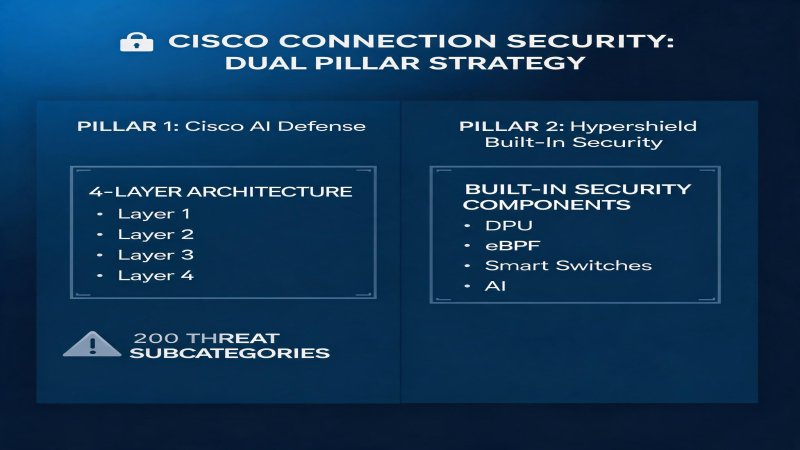
Between 2025 and 2026, the explosive growth of generative AI and Agentic AI technologies fundamentally reshaped the cyber threat landscape. Cisco, a dual leader in global networking and security, has demonstrated an extremely aggressive strategic posture during this transformation. In January 2025, Cisco officially launched Cisco AI Defense—a unified platform purpose-built for AI security. In May 2025, at the Technology Innovation AI Summit, CEO Chuck Robbins systematically articulated the "Connection + Security" dual-pillar strategy for the first time.
Financial signals are equally strong. Cisco's FY2026 Q1 earnings showed quarterly revenue of $14.9 billion and GAAP net income of $2.9 billion. AI infrastructure orders from hyperscalers reached $1.3 billion, with the company explicitly targeting $3 billion in FY2026 AI infrastructure revenue. The Splunk acquisition synergy is materializing: Q4 FY2025 security business new logos grew 14%, with continued strong demand for Secure Access, XDR, Hypershield, and AI Defense. Security now accounts for 19.5% of Cisco's FY2025 revenue, surging 59% year-over-year.
More telling are Cisco's Cybersecurity Readiness Index figures: only 5% of Chinese enterprises have reached mature security readiness, while 92% have experienced AI-related security incidents. Globally, 86% of enterprises experienced AI security incidents in the past 12 months, and only 4% worldwide have reached mature cybersecurity readiness. These numbers constitute the market foundation for Cisco's AI security product line.
II. Technical Depth
2.1 Cisco AI Defense: Four-Layer Integrated Architecture
Cisco AI Defense is not simply an AI firewall, but a continuous security layer covering "Discover-Detect-Protect-Comply." According to the May 2026 updated datasheet, its technical architecture breaks down into four core components:
| Component | Core Capability | Technical Details |
|---|---|---|
| AI Cloud Visibility | AI asset auto-discovery | Auto-detects models, agents, MCP servers, and tool integrations across Amazon Bedrock, Google Vertex, and Azure AI Foundry; maps MCP-connected workflows |
| AI Supply Chain Risk Management | Supply chain risk scanning | Scans model files, code repositories, and MCP servers; identifies malicious code, poisoned data, backdoor components; generates per-asset risk scores |
| AI Model and Application Validation | Algorithmic red teaming | Auto-runs 200+ attack techniques and threat subcategories: 45+ prompt injection techniques, 30+ data privacy categories, 20+ security targets, 50+ safety categories |
| AI Runtime Protection | Real-time runtime protection | Inspects all prompts and responses, covers MCP traffic, detects unauthorized tool usage, privilege escalation, harmful action chains, memory poisoning |
2.2 Hypershield: The Paradigm Shift from "Bolt-on" to "Built-in" Security
Hypershield, launched in April 2024, is based on a revolutionary premise: security should happen in the data path, not bolted to the side. Traditional security models route traffic to centralized security appliances for inspection—a bottleneck in an era where AI workloads generate massive east-west traffic.
Hypershield's technical implementation relies on three pillars:
- Tesseract Security Agent: Lightweight eBPF-based agents distributed near workloads, enabling microsecond-level policy enforcement
- DPU Offloading: Uses data processing units to offload security compute from the main CPU, avoiding performance penalties and ensuring AI training cluster throughput is unaffected
- Nexus 9300 Smart Switch: DPU-enabled switches unveiled at Cisco Live EMEA 2025 that embed security directly into the network fabric, supporting east-west traffic micro-segmentation
In AI training clusters, 1,000 GPUs may exchange terabytes of data for model synchronization—Hypershield ensures this east-west traffic is protected without leaving the data path. This design is decisive for hyperscale data centers.
2.3 AI-Native Reconstruction of Network Devices
At Cisco Live 2025, Cisco unveiled a new-generation network architecture purpose-built for AI workloads:
| Device/Product Line | Core Security Features | Use Cases |
|---|---|---|
| Nexus 9300 Smart Switch | Hypershield-ready, DPU-embedded security, east-west traffic micro-segmentation | AI data centers, GPU clusters |
| Catalyst C9000 Smart Switch | Hypershield-ready, post-quantum cryptography MACsec, network segmentation | Campus networks, branch offices |
| Secure Firewall 6100 Series | AI accelerators, microsecond processing latency, AI/ML threat detection | High-concurrency AI data center traffic |
| Secure Firewall 200 Series | Integrated SD-WAN, distributed AI scenario secure connectivity | Branch offices, edge computing |
III. Financial Logic
3.1 Strategic Elevation of Security Business
Cisco's security business is transforming from "ancillary revenue" to "strategic growth pillar." FY2025 security revenue share jumped to 19.5%, a 59% year-over-year increase, with Splunk integration as the core driver. Q1 FY2026 service revenue consensus is pegged at $2.24 billion, indicating 11% growth. Although Q3 FY2026 security revenue was flat year-over-year at $2 billion, management explicitly positions security as a strategic pillar "directly tied to the AI infrastructure cycle, enterprise resiliency spending, and observability-driven cyber defense."
3.2 AI Infrastructure Revenue Engine
Cisco's bet on AI infrastructure is paying off. FY2026 Q1 hyperscaler AI infrastructure orders reached $1.3 billion, with a full-year target of $3 billion. This figure reflects strong demand for AI data center networking equipment—the two-tier architecture of Nexus switches and Silicon One G200 chips supports 32,000 GPUs, reducing energy consumption by 30% compared to traditional solutions. The bundled sales model of security and networking means every dollar of AI infrastructure revenue drives additional security product revenue.
3.3 R&D Investment and Ecosystem Partnerships
Cisco's Secure AI Factory partnership with NVIDIA has passed UEC (Ultra Ethernet Consortium) certification, enabling Cisco to penetrate the AI training cluster network security market. The strategy of open-sourcing an 8-billion-parameter AI security foundation model both lowers customer deployment barriers and expands Talos threat intelligence influence—analyzing 900 billion security events daily, constituting a moat that is difficult to replicate.
IV. Strategic Depth
4.1 Strategic Intent Behind "Connection + Security" Dual-Pillar Drive
Cisco's "Connection + Security" strategy is not simply a product bundle, but an architectural-level redefinition. The connection side builds AI-native network infrastructure through self-developed chips (Silicon One G200) and SD-WAN/Secure Access; the security side adopts "defending AI with AI" as its core, providing full-stack protection from infrastructure to application layer.
The deep logic is that in the AI era, networking and security are no longer two separable procurement decisions, but a unified architectural choice. When enterprises buy Cisco network equipment, they simultaneously acquire embedded security capabilities—this is Hypershield's core value proposition.
4.2 Competitive Landscape and Differentiated Positioning
In the global IT and telecom cybersecurity market, Palo Alto Networks leads with 5% share, CrowdStrike holds 3%, while Cisco and Fortinet tie at 2% each. Although not first in market share, Cisco's unique advantages include:
- Exclusivity of Network-Security Convergence: As the only vendor with both globally leading networking equipment and cybersecurity product portfolios, Cisco's built-in security concept is difficult to replicate
- First-Mover Advantage in Agent Security: First to extend zero trust to AI agents, establishing agent identity and access management systems, seizing the initiative in Agentic AI security standard-setting
- Talos Intelligence Ecosystem: 900 billion events/day analysis capability provides AI Defense with a real-time threat intelligence moat
4.3 Compliance and Standards Leadership
AI Defense's protection framework actively maps to NIST AI-RMF, MITRE ATLAS, and OWASP Top 10 for LLM industry standards. The Cisco AI Defense research team actively participates in standard development and industry working groups, helping organizations maintain compliance as regulations evolve. This standards leadership holds strategic value in an increasingly stringent global AI regulatory environment (such as the EU AI Act).
V. Challenges and Concerns
5.1 High Market Education Costs
AI security remains an emerging market, and enterprise customer awareness of AI-specific threats is insufficient—only 48% of employees understand AI threats. This means Cisco must invest heavily in market education, while competitors are doing the same simultaneously.
5.2 Hypershield Adoption Resistance
Hypershield's distributed architecture requires significant network transformation. Enterprises need to replace or upgrade switches to support DPU and eBPF, representing substantial capital expenditure. In a macro environment of tightening budgets, technical advancement does not automatically translate into procurement decisions.
5.3 Intensifying Competition and Standards Uncertainty
Palo Alto Networks' $28 billion acquisition spree rapidly filled gaps in identity, observability, and AI model security; Fortinet leverages ASIC hardware advantages to build barriers in high-throughput AI data center scenarios. AI security standards (especially MCP security specifications) are still rapidly evolving, requiring product roadmaps to maintain high flexibility, increasing R&D uncertainty.
5.4 Short-Term Security Revenue Volatility
Q3 FY2026 security revenue was flat year-over-year at $2 billion, indicating that Splunk integration synergy release still requires time. Management has confidence in medium-term growth, but short-term financial performance may face pressure.
VI. Conclusion
Cisco is undergoing a strategic transformation from "networking equipment vendor" to "security guardian of the AI era." Its core logic is clear: leveraging networking advantages as the foundation, AI technology as the lever, and open ecosystems as the boundary to build a full-stack security system covering infrastructure, data, applications, and agents.
For enterprise users, Cisco's AI security layout delivers three key values: reduced AI adoption risk, simplified security architecture, and future-proof investment protection. Cisco AI Defense's 200+ threat subcategory assessment and algorithmic red teaming capabilities enable enterprises to systematically manage AI-specific threats while enjoying AI efficiency gains; Hypershield embeds security into the network itself, reducing the number and complexity of independent security devices; post-quantum cryptography and AI-native design ensure network infrastructure can address security challenges for the next 5-10 years.
From an investment perspective, Cisco's security business is at a critical transition point from "integration phase" to "growth phase." The FY2026 $3 billion AI infrastructure revenue target and continued Splunk synergy release will provide medium-term growth momentum for the security business. However, Hypershield's large-scale deployment progress and the speed of AI security market education will be the key variables determining whether this transformation succeeds.
Why it Matters
As AI attack methods rapidly evolve, traditional bolt-on security architectures can no longer meet the protection needs of AI workloads generating massive east-west traffic. By embedding security into network devices themselves, Cisco achieves true built-in security, which has irreplaceable advantages in AI data center scenarios. Gartner projects 2026 global information security spending at $244.2 billion (up 13.3% YoY), with AI-specific security tools growing over 20%. Cisco's network-security convergence strategy enables it to capture budget growth from both networking and security. Additionally, Cisco was the first to extend zero trust to AI agents, setting a benchmark for Agentic AI security governance.
DECISION
- When planning AI security strategies, enterprises should prioritize vendors with "network-security convergence" capabilities, especially those with existing Cisco infrastructure where Hypershield upgrade paths provide built-in security.
- Enterprises using generative AI applications should deploy AI Defense for AI asset discovery (across AWS/Azure/GCP) and runtime protection (200+ threat subcategory assessment).
- Enterprises concerned about quantum computing threats should proactively deploy Catalyst C9000's post-quantum MACsec and WAN encryption features.
- Investors should watch for signals of Cisco's security business transitioning from "integration phase" to "growth phase," focusing on Hypershield large-scale deployment progress and AI security market education speed.
PREDICT
- Within 12 months, Hypershield will become standard configuration for Cisco network devices, driving built-in security from concept to large-scale deployment, expected to cover 500+ large enterprise customers.
- Within 2 years, AI agent identity management will become a standard feature of zero trust architecture, with Cisco Identity Intelligence's agent discovery capabilities extending beyond Cisco environments.
- Within 3 years, post-quantum cryptography will move from "ready" to "enabled by default," becoming the factory standard for network devices, with Cisco leading related industry standard development.
Get 3-5 key AI infrastructure signals weekly →
💬 Comments (0)