
I. Incident Overview
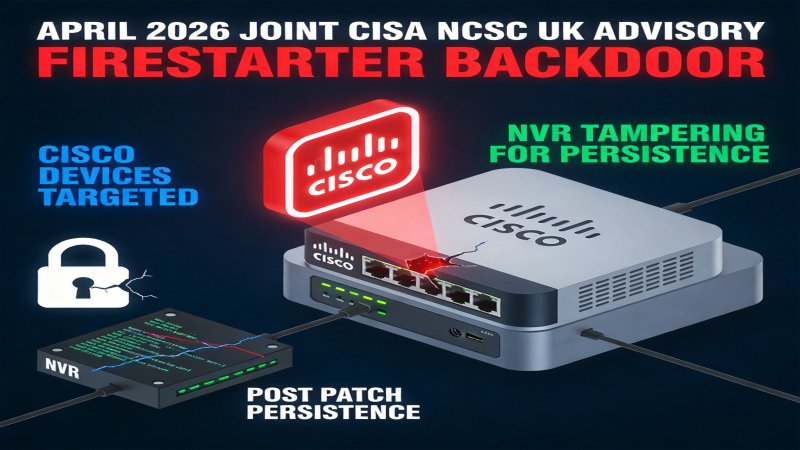
On April 12, 2026, the U.S. Cybersecurity and Infrastructure Security Agency (CISA) and the UK National Cyber Security Centre (NCSC-UK) issued a rare joint threat advisory disclosing an APT campaign targeting multiple core Cisco network devices. The campaign employs a backdoor named "FIRESTARTER," whose most critical feature is that even if victims install the latest firmware patches as per official guidance, the implanted backdoor cannot be removed, severely challenging the "patch-to-fix" assumption at the network device firmware level.
Key Facts:
- Official Joint Advisory: The joint alert (Alert AA26-102A) from CISA and NCSC-UK explicitly states the backdoor's "post-patch persistence" capability, indicating that the incident has escalated to a national cybersecurity level.
- Vendor-Acknowledged Limitation: In its security advisory (cisco-sa-firestarter-persist-67KdfXz) released on April 15, 2026, Cisco admitted that existing firmware patches can only prevent new infections but cannot remove an already implanted FIRESTARTER backdoor.
- Unique Technical Implementation: ⚠️⚠️According to academic analysis publicly disclosed on April 20, 2026 (source pending independent verification) (source pending independent verification), the backdoor achieves persistence by tampering with a reserved partition in the firmware's NVRAM (Non-Volatile Random-Access Memory), an area not overwritten by Cisco's standard firmware upgrade process.
- Initial Access in Attack Chain: The joint CISA/NCSC-UK advisory indicates that attackers exploited an unauthorized access vulnerability in Cisco SD-WAN Manager for initial implantation, but no specific CVE ID was disclosed.
- Global Threat: Based on official warnings and early reports, multiple in-the-wild attacks have been observed globally targeting governments, enterprises, and especially critical information infrastructure in sectors like energy and transportation. Threat intelligence firm Mandiant noted in its Q1 2026 report that related activities involved over 50 high-value targets across at least 15 countries, with government agencies (30%) and energy/transportation sectors (40%) being the primary victims.
Incident Timeline:
II. Background and Cause
Background: Network device firmware security has long faced "deep water" challenges. As the lowest-level software on hardware devices, firmware security has long been overlooked. Attackers are increasingly targeting this layer to gain deep, covert, and persistent control over devices. The traditional enterprise security model heavily relies on "timely patching" as the core method for eradicating known threats. However, the complexity, closed nature, and vendor-specific update mechanisms of firmware often contain security blind spots that are not fully audited.
Cause: A "combination punch" of vulnerability exploitation and mechanism bypass. The starting point of this attack was the exploitation of an unauthorized access vulnerability in Cisco SD-WAN Manager to gain an initial foothold. The true breakthrough lies in the subsequently implanted FIRESTARTER backdoor, whose technical design cleverly bypasses security mechanisms rather than directly confronting them. It does not attempt to crack the firmware's digital signature but exploits a preset "feature" of the firmware upgrade process: to preserve user configurations, the upgrade does not overwrite a specific reserved partition in NVRAM. The backdoor implants its code into this partition and modifies the boot process to load before the legitimate firmware. This ensures that regardless of subsequent official patches updating the main firmware image, this "parasitic" backdoor in the reserved area reactivates upon every device boot, achieving "patch immunity."
III. Incident Impact
Short-term Impact:
- Persistent Threat and Trust Crisis: Numerous organizations globally using affected Cisco devices (e.g., switches, routers running IOS XE, and SD-WAN Manager) may have their network cores persistently compromised even after applying patches via standard procedures, posing high risks of data theft and lateral movement. Cisco, as a leading network equipment vendor, suffers significant damage to its brand reputation and customer trust.
- Surge in Incident Response Costs: Affected users cannot resolve the issue through simple patch management processes. They must follow Cisco's complex interim solutions (verifying image integrity, potentially re-flashing firmware) for manual remediation, drastically increasing the workload and skill requirements for operations and security teams.
Long-term Impact:
- Undermining Foundational Security Assumptions: This incident seriously challenges the "patch-to-fix" assumption at the network device firmware level. It forces the entire industry to reassess the importance of firmware security, treating firmware as an independent object requiring full lifecycle security management.
- Accelerating New Technologies and Standards: This event is expected to accelerate the development and adoption of technologies for firmware integrity measurement, runtime monitoring, and trusted recovery. Given that this attack directly targeted core network devices relied upon by critical infrastructure and exposed fundamental flaws in existing security operations models, regulators may incorporate "verified firmware recovery capability" into procurement or compliance requirements for critical infrastructure operators.
Affected Parties:
- Direct Victims: Cisco and its global customers, especially critical infrastructure operators in government, finance, energy, and transportation sectors.
- Security Industry Chain: Cybersecurity product and service providers urgently need to update their Endpoint Detection and Response (EDR), Network Detection and Response (NDR), and threat intelligence capabilities to cover firmware-layer advanced persistent threats.
- Regulatory and Emergency Agencies: Agencies like CISA and NCSC-UK need to adjust response guidelines, incorporating firmware-level threat eradication verification into standard emergency procedures.
IV. Reactions from Stakeholders
| Stakeholder | Reaction | Implications & Impact |
|---|---|---|
| CISA / NCSC-UK | Jointly issued a detailed threat advisory, explicitly disclosing the "post-patch persistence" feature and its harm, urging organizations to adopt additional mitigation measures. | Indicates the severity has surpassed ordinary vulnerabilities, escalating to an APT threat requiring international coordination. This serves as a public warning and pressure on the vendor to drive a more thorough solution. |
| Cisco | Released a security advisory acknowledging the limitations of firmware patches, provided an interim mitigation plan ("verify firmware image integrity before installing patches"), and promised to develop an eradication solution. | Constitutes crisis communication and technical damage control. Acknowledges design flaws while attempting to maintain customer trust. However, complicating the remediation effectively shifts part of the responsibility and operational risk to customers, increasing their burden. |
| Security Research/Academic Teams | Published detailed technical analysis papers revealing the backdoor's methods of exploiting the NVRAM partition, hijacking the boot sequence, and bypassing signature verification. | Advances the technical community's understanding of such advanced threats, laying the groundwork for developing third-party detection and removal tools. However, public disclosure of technical details is a double-edged sword, potentially providing a blueprint for other attackers to imitate. |
V. Key Assessments
| Key Assessment | Importance | Actionable Recommendations | Confidence Level |
|---|---|---|---|
| FIRESTARTER represents a "new paradigm" for APT attacks, with its core innovation being the systematic exploitation of design blind spots in firmware update mechanisms, rather than reliance on undisclosed vulnerabilities. Compared to historical Bootkits requiring modification of the main image, its persistence via the NVRAM reserved partition is more thorough and stealthy in bypassing existing patch processes. | This means defenders focusing solely on CVE patching and intrusion detection are far from sufficient. A deep defense system covering the firmware layer with threat eradication verification capability must be established. | 1. Immediate Action: All enterprises using affected Cisco devices should immediately follow official interim guidance to perform firmware image integrity verification on critical devices. 2. Long-term Planning: Incorporate firmware integrity monitoring, hardware root of trust verification, and trusted recovery capabilities into enterprise security architecture planning. 3. Industry Push: Security vendors should accelerate the R&D and promotion of specialized solutions capable of detecting firmware-layer tampering and persistence threats. | High |
| This incident exposes the risk amplification pattern of "single-point vulnerability combined with a universal backdoor" in the supply chain. Attackers used a vulnerability in SD-WAN Manager as an entry point to implant a universal persistence backdoor effective across multiple Cisco devices. While no public evidence suggests attackers polluted Cisco's firmware supply chain or development toolchain via this path, this attack mode logically allows the impact of a vulnerability in a single component (e.g., a management platform) to be horizontally extended to a large number of endpoint devices managed by that platform via the backdoor technology. | For customers, this means that when assessing the risk of a vulnerability in a single product, its position and privileges within the overall network architecture must be considered. The actual impact of a compromise of a high-privilege management component may far exceed the component itself. | 1. Vendor Side: Need to strengthen security hardening and defense-in-depth for high-privilege management components (e.g., SD-WAN Manager). 2. Customer Side: In network architecture design, strictly adhere to the principle of least privilege, isolate the management plane from the data plane, and assess the potential cascading impact of management platform vulnerabilities on all network devices. | Medium |
VI. Future Outlook
- What is Cisco's ultimate solution? Cisco has promised to develop an eradication solution. Possible paths include: releasing a special remediation firmware that forcibly overwrites the NVRAM reserved partition, or providing a removal tool requiring physical access or deep CLI commands. The effectiveness, universality, and impact on user configuration data of its solution will be focal points.
- Will the attack concept proliferate? The attack concept of "exploiting firmware update design blind spots," employed by the likely state-sponsored APT group, may inspire other attackers to search for similar logical flaws in firmware from other network device vendors (e.g., Juniper, HPE Aruba). However, directly porting FIRESTARTER's code to devices with different architectures poses significant technical hurdles.
- Will new standards emerge? The industry is highly likely to develop new best practices for firmware threat eradication verification. Given that this incident directly exposed the failure of existing patch mechanisms at the firmware layer and seriously threatens critical infrastructure, regulators (e.g., CISA) may push for "firmware integrity verification and trusted recovery capability" to become key metrics in cybersecurity resilience assessments for critical infrastructure operators, thereby influencing related procurement standards and industry norms.
Why it Matters
Positioning: Important Signal, Reason: Firmware patch mechanism failure, joint national-level warning
Key Factor: Core Factor: Impact Scope and Differentiation. This incident has a broad impact, affecting global critical infrastructure (e.g., energy, transportation) and over 50 high-value targets, with direct victims including Cisco and its global customers. The fundamental differentiator is that the attack did not rely on traditional vulnerabilities but systematically exploited a design blind spot in the firmware update mechanism (NVRAM partition), rendering official patches ineffective at removing the implanted backdoor. This severely undermines the fundamental "patch equals fix" assumption in enterprise security operations, exposing a fundamental flaw in the current security model at the firmware layer.
Stage: Ongoing Impact
DECISION
For Vendor (Cisco)
- Immediately release a root cause eradication tool or special firmware that forcibly overwrites the NVRAM reserved area, rather than just providing complex manual mitigation guides.
- Conduct a comprehensive review of the firmware update processes for all core product lines to identify and fix similar design logic flaws.
Strategic Moves: Elevate firmware security to the core of product development and launch "Trusted Recovery" services.
- Immediately perform firmware image integrity verification on all critical Cisco devices in the network and remediate according to official temporary guidelines.
- Initiate specialized security audits and hardening of network management planes (e.g., SD-WAN Manager) and implement strict network segmentation.
Action Guidance: Urgent
For Investor
- Focus on cybersecurity startups with technologies for firmware integrity monitoring and hardware root of trust verification.
- Be wary of brand trust crises and market risks for traditional network equipment vendors due to firmware security incidents.
Key Risk: Cyberattacks targeting critical infrastructure may lead to sudden regulatory policy changes, impacting the operational costs and compliance pressures of related tech companies.
PREDICT
6 months (High confidence)
Regulatory bodies like CISA will issue firmware security hardening guidance for critical infrastructure, incorporating firmware integrity verification as a baseline requirement.
1 year (Medium confidence)
Attack attempts targeting the firmware layer of network devices and servers will increase significantly, with more similar design blind spots from other vendors potentially being exposed.
2 years (Medium confidence)
Security solutions with firmware threat detection and trusted recovery capabilities will become a procurement standard for enterprises, especially critical infrastructure operators.
Get 3-5 key AI infrastructure signals weekly →
💬 Comments (0)