
I. Event Recap
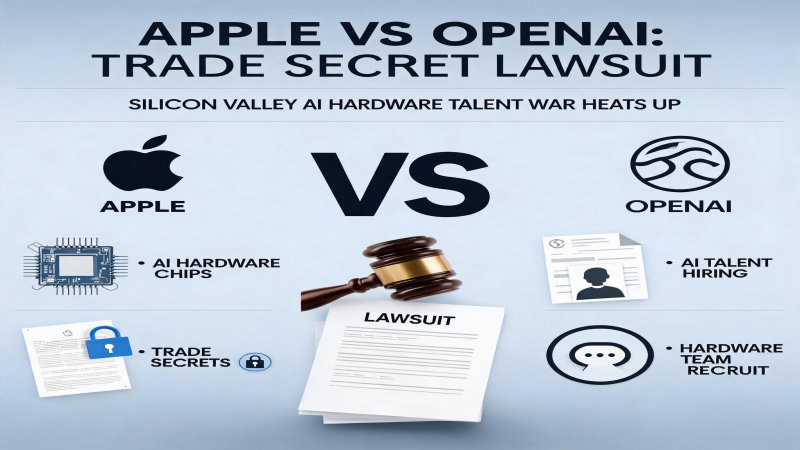
On July 10, 2026, Apple filed a 41-page complaint in the U.S. District Court for the Northern District of California, formally suing OpenAI and two former Apple employees—OpenAI Chief Hardware Officer Tang Tan and former Apple Systems Electrical Engineer Chang Liu. Apple alleges that OpenAI orchestrated a systematic 'poaching' campaign to recruit former Apple employees and gain access to advanced trade secrets including unreleased products, component specifications, and supplier relationships, all to accelerate the development of its consumer AI hardware devices.
On July 17, the Financial Times reported that Apple had sent legal warnings to approximately 40 former Apple employees currently working at OpenAI, demanding they preserve documents and communications potentially relevant to the case. This indicates Apple believes the scope of alleged leaks may extend beyond the individuals named in the original complaint. Apple's filing states: 'This is just the tip of the iceberg. Apple cannot see what happens behind OpenAI's closed doors, where this misconduct has been normalized and exemplified by leadership.'
The central figure, Tang Tan, worked at Apple for 24 years and served as head of product design for iPhone and Apple Watch before departing in late 2025 to become OpenAI's Chief Hardware Officer. The other defendant, Chang Liu, left Apple in January 2026 and joined OpenAI's hardware team shortly after. Apple alleges Tan used confidential project codenames during OpenAI interviews to probe candidates about Apple's unreleased products, while Liu retained his Apple-issued laptop after departure and exploited authentication vulnerabilities to make multiple unauthorized accesses to Apple's internal network in January 2026, downloading dozens of confidential files including technical presentations and unreleased product specifications. Apple claims Liu texted a colleague 'LOL' after discovering he still had network access.
In February 2026, Apple sent a letter to OpenAI General Counsel Che Chang requesting protective measures, investigations, and remedial actions, but OpenAI 'never responded.' Notably, Apple's external attorney Gabriel Gross accidentally sent a follow-up email intended for another former Apple employee named Wang to Che Chang instead, and this email misdirection led to a breakdown in communication that ultimately escalated into public litigation. Apple is seeking an injunction requiring OpenAI to cease using any Apple information in AI hardware development, return all copies of trade secrets and confidential information, and hold relevant individuals liable for breach of contract and economic damages. An OpenAI spokesperson responded that 'no evidence has been found to support this complaint' and stated the company 'is not interested in other companies' trade secrets.'
II. Technical Depth
The technical core of this case lies in the boundaries of trade secrets in AI hardware design. Apple alleges that the stolen confidential information covers three categories—unreleased products, component specifications, and supplier relationships—which represent the most valuable intellectual property assets in the consumer electronics hardware industry.
At the hardware architecture level, Apple's core competitiveness lies in its highly integrated System-in-Package (SiP) capabilities, proprietary chip and sensor fusion design, and rigorous supply chain control systems. Taking Apple Watch as an example, it integrates the S-series SiP, optical heart rate sensor, blood oxygen sensor, temperature sensor, and accelerometer among dozens of components within an extremely small physical space, achieving low-power, high-precision multimodal health monitoring. The iPhone's Face ID module integrates a dot projector, infrared camera, and flood illuminator, whose precision calibration algorithms and exclusive supply agreements constitute exceptionally high technical barriers.
OpenAI's hardware ambitions began with its approximately $6.5 billion acquisition of io Products, founded by former Apple design director Jony Ive, in 2025. Jony Ive led the design of the iPod, iPhone, iPad, and Apple Watch, and his involvement signaled OpenAI's intention to transform from a pure software company into an integrated hardware-software entity. Market rumors suggest OpenAI is developing an AI-native device that may employ a natural language interaction interface, freeing users from traditional screens and keyboards. To achieve this, OpenAI must overcome core hardware engineering bottlenecks: low-power edge AI inference chip design, multi-sensor fusion architecture, and miniaturized thermal solutions—precisely the core capabilities Apple has accumulated over the past two decades.
From a chip perspective, Apple's A-series and M-series chips employ an ARM architecture licensing plus self-developed microarchitecture strategy, with its Neural Engine long maintaining industry leadership in inference performance per watt. If OpenAI is to build competitive AI hardware, it must achieve breakthroughs at the chip level—either by partnering with Qualcomm or MediaTek for custom chips, or by developing its own ASICs like Apple. Either path makes talent with Apple chip design experience critically important. Tang Tan's 24 years at Apple involved deep participation in every aspect from baseband integration to sensor layout, making his understanding of Apple's hardware methodology virtually irreplaceable.
III. Financial Logic
From a financial perspective, this lawsuit reflects a profound restructuring of the AI industry value chain. Apple's hardware business contributed approximately $320 billion in revenue in fiscal 2025 with gross margins around 36%, while OpenAI's 2025 revenue was roughly $8-10 billion despite a valuation of $85.2 billion (Anthropic's latest funding valuation even reached $90 billion). This valuation inversion demonstrates capital markets' extreme optimism about the future monetization potential of the AI software layer, but also suggests that the hardware layer may be the next value洼地.
For Apple, this lawsuit is not merely about intellectual property protection but a defensive battle for control of the AI hardware entry point. If OpenAI successfully launches an AI-native hardware device, it could divert user time and data flows from Apple's premium consumer electronics market. The $6.5 billion acquisition price for Jony Ive's io Products is trivial relative to OpenAI's total valuation, but if it enables the creation of 'the iPhone of the AI era,' the returns would be exponential.
For Apple, the direct costs of litigation (legal fees, discovery) are insignificant relative to annual revenue, but the potential upside is substantial: if the court grants an injunction, it could significantly delay OpenAI's hardware launch window. More critically, the lawsuit sends a strong signal throughout the industry that poaching Apple hardware talent carries legal risks, helping stem the talent outflow. According to Apple's complaint, over 400 former Apple employees currently work at OpenAI—a number that poses a material threat to Apple's talent reserves.
From OpenAI's perspective, losing the case could result in a triple blow of injunctions, damages, and reputational loss. An injunction might force a hardware redesign, delaying product launch by 6-12 months; in the white-hot window of AI hardware competition, such a delay could be fatal. Additionally, Apple's requested trade secret return obligations could force destruction of completed engineering drawings and prototypes, causing tens of millions to hundreds of millions of dollars in direct losses.
IV. Strategic Depth
The strategic significance of this case far exceeds an ordinary trade secret dispute—it marks the full extension of Silicon Valley AI competition from the software model layer to the hardware entry point. Below is a strategic comparison matrix of major competitors in the AI hardware space:
| Dimension | Apple | OpenAI | Meta | Microsoft | |
|---|---|---|---|---|---|
| Core Hardware Products | iPhone, Apple Watch, Vision Pro, Mac | AI-native device (in development) | Pixel, Nest, Pixel Watch | Ray-Ban Meta smart glasses, Quest | Surface, Xbox, OEM partnerships |
| Chip Design Capability | A/M/S series, industry-leading | None, relies on partners/acquisitions | Tensor G series, moderate | Qualcomm custom partnerships, weak | None, relies on Intel/AMD/NVIDIA |
| AI Hardware Strategy | On-device AI priority, privacy-centric | Defining new AI device form factors | AI+Android ecosystem integration | Social+AI glasses, low-cost普及 | Copilot+PC, ecosystem enablement |
| Key Talent Source | Internal development, Jonathan Ive departed | Heavy recruitment of former Apple employees | Internal+limited external recruitment | Acquired Oculus, CTRL-labs | Traditional PC OEM DNA |
| Supply Chain Control | Top-tier, TSMC priority capacity | Startup phase, limited bargaining power | Moderate, Samsung foundry | Dependent on EssilorLuxottica | Traditional PC supply chain |
| 2025 Hardware Revenue | ~$320 billion | $0 (no hardware released) | ~$28 billion (hardware) | ~$4 billion (VR/AR) | ~$20 billion (Surface+Xbox) |
OpenAI's offensive strategy is 'fast follow plus top talent.' Through Jony Ive's prestige and the hands-on experience of numerous former Apple employees, OpenAI attempts to bypass Apple's two-decade accumulation curve, trading capital for time. The risk lies in the fact that hardware complexity far exceeds software, and supply chain management and manufacturing yield control require years of experience that cannot be replicated through talent poaching alone in the short term.
Google and Meta represent two alternative paths: Google possesses the Android ecosystem and self-developed Tensor chips but has long lagged Apple in premium hardware design and user experience; Meta has chosen to enter through the smart glasses category, partnering with EssilorLuxottica to lower manufacturing barriers, but with clear compromises in computing power and functionality. Microsoft adopts an ecosystem enablement strategy through the Copilot+PC program, partnering with OEM manufacturers to avoid the capital-intensive competition of direct hardware manufacturing.
V. Challenges and Risks
Apple faces challenges in the burden of proof. The core of a trade secret lawsuit is proving the defendant's 'improper acquisition' and 'use' of confidential information. Apple must demonstrate that OpenAI's product designs contain specific technical details stolen from Apple, not merely that they hired employees familiar with Apple's methodologies. Under the U.S. legal system, there is a subtle boundary between 'knowledge residing in employees' minds' and 'trade secrets being stolen.' If OpenAI's hardware designs are based on industry general knowledge and employees' personal experience rather than direct copying of Apple's confidential files, Apple's probability of winning will drop significantly.
Another challenge is time. Even if Apple ultimately prevails, the litigation process may take 2-3 years, by which time OpenAI's hardware products may have completed multiple iterations. While injunctive relief can accelerate this process, courts typically require plaintiffs to prove 'irreparable harm' and 'likelihood of success on the merits' before granting injunctions—an extremely high standard.
For OpenAI, the greatest concern is the 'chilling effect' on talent recruitment. Following the public filing of this case, other companies' legal departments may intensify monitoring of employee departures, and enforcement of non-compete agreements and confidentiality obligations will become stricter. Furthermore, if the court finds that OpenAI engaged in systematic poaching, it could trigger broader industry backlash and even attract antitrust scrutiny from regulators.
From an industry perspective, this lawsuit may slow the overall pace of AI hardware innovation. If top hardware talent hesitates to change jobs due to legal risks, startups' hardware innovation capabilities will be constrained, and the industry may reconcentrate around large companies with complete hardware systems. This contrasts sharply with the 'free flow of talent' culture of the open-source software movement, suggesting that the AI hardware field may evolve toward a more closed competitive landscape.
VI. Conclusion
Apple's trade secret lawsuit against OpenAI is a landmark event marking the expansion of AI industry competition from software to hardware entry points. For different stakeholders, we offer the following specific recommendations:
For technology investors: Closely monitor litigation progress and OpenAI's hardware product timeline. If Apple obtains an injunction, OpenAI's hardware launch will be delayed by 6-12 months, benefiting Apple, Google, and Meta, which already have hardware deployments. Consider increasing positions in companies with core patents in edge AI chips and sensors, such as Qualcomm (smart glasses chips) and Sony (image sensors).
For corporate HR and legal: Re-examine the coverage of employee confidentiality agreements and non-compete clauses. For hardware engineers with access to core product roadmaps and supply chain information, strengthen departure audits and document access log monitoring. Meanwhile, when recruiting from competitors, conduct strict 'clean room' compliance reviews to avoid similar litigation.
For AI startups: Hardware entrepreneurship has far higher capital barriers and talent walls than software. When considering hardware routes, prioritize modular solutions (such as leveraging existing smartphone supply chains) rather than full-stack self-development to reduce dependence on top hardware talent. Building formal partnerships with supply chain giants like Apple and Samsung is more sustainable than poaching their employees.
For procurement decision-makers: In enterprise AI hardware procurement, prioritize suppliers with complete intellectual property systems. If OpenAI launches enterprise AI devices in the future, assess their exposure to injunction risks to avoid product discontinuation or service interruption after purchase.
The ultimate outcome of this case will profoundly affect talent mobility rules and competitive dynamics in Silicon Valley's AI hardware industry. Regardless of the verdict, the 'AI hardware talent war' has entered a white-hot phase, and the triple game of law, technology, and capital will define the industry landscape for the next decade.
Why it Matters
This lawsuit marks the expansion of AI industry competition from software models to hardware entry points. Apple possesses the world's strongest consumer electronics hardware design capabilities and supply chain control, while OpenAI—through acquiring Jony Ive's io Products and recruiting numerous former Apple employees—attempts to bypass two decades of accumulated expertise. If OpenAI successfully launches AI-native hardware, it will directly threaten Apple's control over user time and data flows in the premium consumer electronics market. The case outcome will redefine Silicon Valley hardware talent mobility rules and may accelerate or delay overall AI hardware innovation.
DECISION
For tech investors: Monitor litigation progress closely; an Apple injunction would benefit incumbents with hardware deployments. Consider Qualcomm, Sony, and other edge AI chip and sensor leaders.
For corporate HR and legal: Re-examine confidentiality and non-compete agreements; strengthen departure audits and access log monitoring.
For AI startups: Prioritize modular hardware solutions and formal partnerships with supply chain giants rather than employee poaching.
For procurement decision-makers: Prioritize suppliers with complete IP systems and assess OpenAI hardware injunction risks.
PREDICT
Short-term (3 months): Courts may hold preliminary injunction hearings; OpenAI's hardware product roadmap may be adjusted.
Medium-term (6-12 months): If Apple's probability of winning appears high, OpenAI may be forced to redesign hardware solutions, delaying product launch by 6-12 months.
Long-term (1-3 years): The verdict will reshape Silicon Valley hardware talent mobility rules, potentially driving stricter non-compete legislation and significantly raising barriers for AI hardware startups.
Get 3-5 key AI infrastructure signals weekly →
💬 Comments (0)