
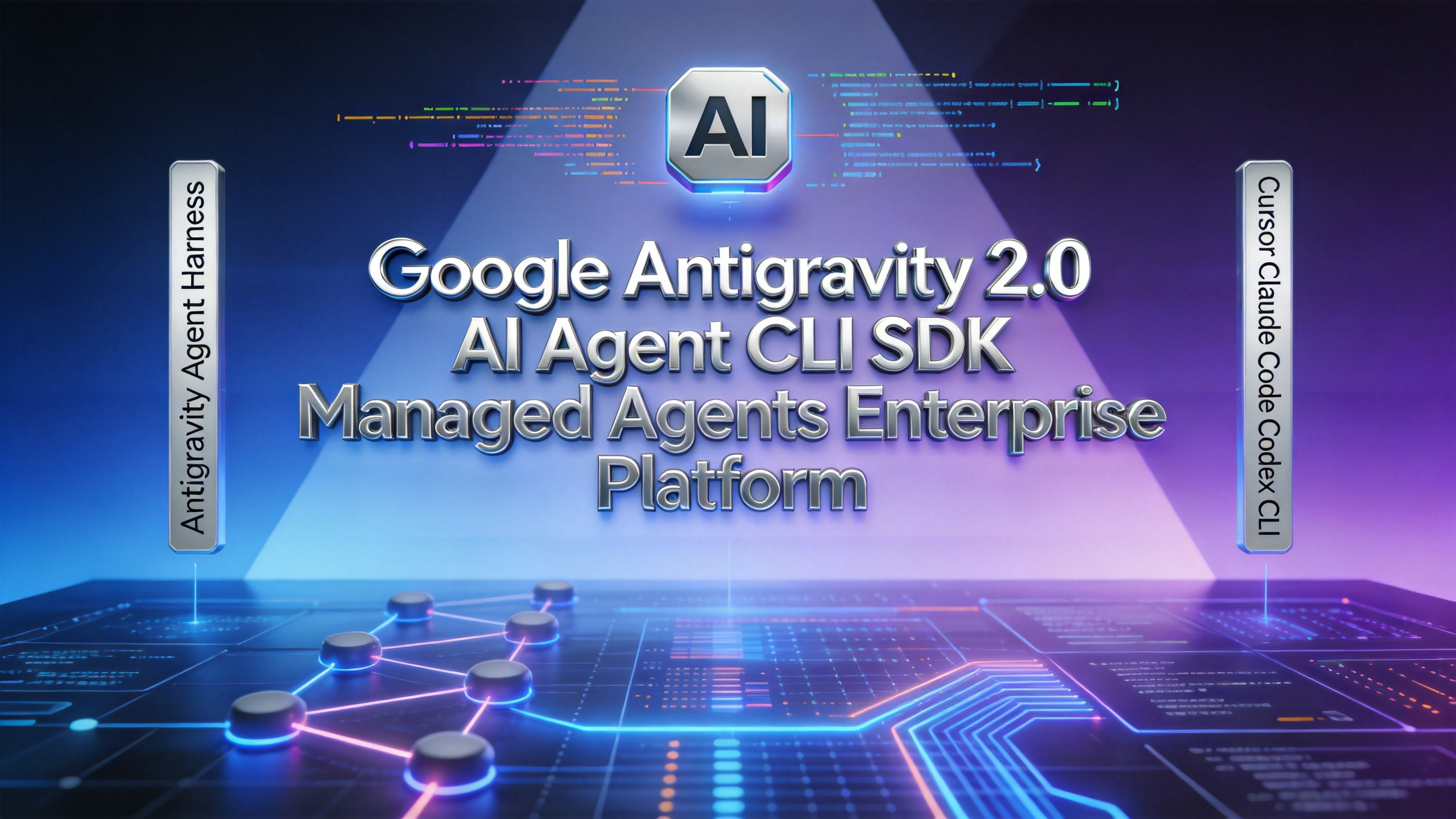
Antigravity 2.0: Google's Ambition to Become the Operating System of the Agent Era
Core Judgment
Google has elevated Antigravity 2.0 from an "AI-assisted coding tool" to an "Agent operating system." When enterprise Agents are built and run on Antigravity, the injection point for security policies migrates from the network layer to the platform layer. This means: the platform's own security capabilities will become the core competitive advantage, while traditional network perimeter security will give way to platform-intrinsic Agent governance capabilities.
1. Antigravity 2.0 Product Overview: From Coding Tool to Agent OS
1.1 Fundamental Shift in Product Positioning
Antigravity 2.0, released at Google I/O 2026 (May 19, 2026), marks the product's completion of a genetic leap from "AI coding IDE" to "Agent-first development platform." [Vendor Claim]
According to Google's official blog, the original Antigravity was released in November 2025 alongside Gemini 3, positioned as "AI-powered IDE with agent sidebar." Version 2.0 explicitly positions itself as an "agent-first development platform," emphasizing "multi-Agent parallel orchestration" and "dynamic sub-Agent workflows" as core product value. [Verified]
The strategic intent: Google no longer positions Antigravity as a competitor to Cursor or Claude Code, but aims to become the "infrastructure layer" of the Agent era—similar to the role operating systems played in the PC or smartphone era.
1.2 Unified Architecture of Five Product Entry Points
Antigravity 2.0 is actually a unified product matrix with five entry points, not a single application: [Vendor Claim]
| Product Entry | Form | Positioning | Target Users |
|---------|------|------|---------|
| Antigravity 2.0 Desktop App | Standalone desktop application (not browser plugin or IDE extension) | Agent orchestration center with Editor View and Manager View | GUI-preferring developers |
| Antigravity CLI | Go-based command line tool | Lightweight terminal workflow, sharing authentication/context/skills/config with desktop app | Terminal-heavy users |
| Antigravity SDK | Programmatic API | Build custom Agent runtimes, deploy to own infrastructure | Enterprise dev teams |
| Managed Agents (Gemini API) | API endpoint | Cloud-managed Agent execution environment with persistent sandbox Linux | Zero-ops teams |
| Gemini Enterprise Agent Platform | Enterprise deployment path | Cloud OAuth integration, inheriting Google Cloud security and compliance | Google Cloud enterprise customers |
This "five entry points, one core" architecture ensures Google's Agent technology stack covers the full spectrum from individual developers to large enterprises—all entry points ultimately converge on the same Antigravity Agent Harness.
2. Agent Harness: The Security Core of Antigravity
2.1 What is Agent Harness
Agent Harness is Antigravity's core runtime framework, responsible for Agent lifecycle management, permission control, and security policy enforcement. It is the "kernel" of the Agent operating system.
Agent Harness's core capabilities include:
- Agent lifecycle management: From creation, execution, pause, to termination of the complete lifecycle
- Permission boundary control: Defining and enforcing Agent tool access permissions
- Resource isolation: Ensuring isolation between Agents in CPU, memory, and network resources
- Audit logging: Recording all Agent behavior, supporting compliance and incident response
2.2 Security Model Evolution
Traditional development platform security model:
- Code-level security: SAST/DAST scanning
- Runtime security: Container security, network policies
- Infrastructure security: Cloud security configuration
Antigravity 2.0's Agent-level security model:
- Identity security: Agent Identity + Cloud OAuth
- Behavioral security: Agent Harness permission control + audit
- Runtime security: Managed Agents sandbox isolation + egress control
- Code security: CodeMender automatic vulnerability scanning and repair
This evolution is fundamentally significant: security policies are no longer applied at the network boundary or infrastructure level, but directly injected at the Agent runtime layer. This is the essence of "platform-native security."
3. Dynamic Sub-Agent Security Challenges
3.1 Dynamic Sub-Agent Mechanism
One of Antigravity 2.0's most important capabilities: Agents can dynamically create sub-Agents to handle subtasks. This mechanism introduces new security challenges:
- Permission inheritance: Do sub-Agents inherit parent Agent permissions? What is the inheritance boundary?
- Identity chain: How to trace the complete identity chain from parent Agent to sub-Agent?
- Resource isolation: How to prevent sub-Agents from consuming excessive resources?
- Audit continuity: How to ensure the audit trail is not broken during sub-Agent creation and destruction?
3.2 Sub-Agent Permission Model
Antigravity's sub-Agent permission model follows the "least privilege" principle:
- Sub-Agents can only access tools and data explicitly granted by the parent Agent
- Sub-Agents cannot create further sub-Agents (limiting permission escalation paths)
- Sub-Agent lifecycle is managed by the parent Agent (automatically destroyed when parent terminates)
However, the effectiveness of this model depends on the parent Agent's security awareness—malicious or compromised parent Agents may grant excessive permissions to sub-Agents.
4. Impact on Enterprise Development Processes
4.1 CI/CD Security Integration
Antigravity 2.0's tight integration with CI/CD pipelines introduces new security requirements:
- Agent code review: Agent-generated code needs security review processes, especially when Agent autonomy is high
- Pipeline permission management: Agents operating in CI/CD pipelines need clear permission boundaries, preventing unauthorized access to production environments
- CodeMender integration: Code security Agents should be integrated as security gates in CI/CD, not optional tools
4.2 Developer Security Responsibility Shift
Traditional model: developers write code, security team reviews code.
Antigravity model: developers guide Agents, Agents write code, CodeMender reviews code.
This shift means: developers' security responsibilities shift from "writing secure code" to "guiding Agents to write secure code." This requires new developer security training and awareness improvement.
5. Competitive Landscape Impact
Antigravity 2.0's positioning creates new competitive dynamics:
| Competitor | Competitive Dimension | Antigravity Advantage | Competitor Counter |
|------|------|------|------|
| Cursor | AI coding experience | Agent orchestration + multi-Agent parallel | Focus on single-Agent coding experience |
| Claude Code | Terminal Agent | Managed Agents + cloud execution | Claude's strong reasoning capabilities |
| GitHub Copilot | IDE integration | Standalone application, not constrained by IDE | Deep GitHub ecosystem integration |
| AWS Bedrock | Cloud Agent platform | Developer experience + enterprise security | AWS enterprise customer base |
6. Key Conclusions and Action Recommendations
Core Conclusions
1. Antigravity 2.0 is not a coding tool upgrade: It is the emergence of an Agent operating system, redefining the relationship between development platforms and security
2. Platform-native security is both a moat and a cage: Enterprises gain Agent governance capabilities at the cost of deep platform binding
3. Dynamic sub-Agents are the biggest unknown risk: Current security models are not yet mature enough for dynamic Agent hierarchies
Action Recommendations
| Role | Action Item |
|------|--------|
| CISO | Assess Antigravity's Agent governance capabilities vs. enterprise security requirements; formulate Agent development platform security policies |
| Development Team Lead | Evaluate Antigravity's impact on existing development processes; develop Agent coding security guidelines |
| Security Architect | Design cross-platform Agent security architecture, avoiding single-platform dependency |
| Platform Selection Decision-maker | Compare Antigravity vs. alternatives (Cursor, Claude Code, Copilot) on security capabilities, not just coding experience |
Sources
Google Official Blog (I/O 2026): https://blog.google/innovation-and-ai/technology/ai/google-io-2026-all-our-announcements/
SiliconAngle: https://siliconangle.com/2026/05/19/google-accelerates-agent-native-software-development-expanded-antigravity-platform/
VendorDeep Analysis | Published: May 2026
Why it Matters
Antigravity 2.0 redefines the security boundary of Agent development platforms, with platform-intrinsic Agent governance capabilities replacing network perimeter security as the core control point
DECISION
Enterprise dev teams evaluating Agent platforms should assess the depth and breadth of platform security capabilities, not just coding efficiency
PREDICT
Agent development platforms will build in security policy engines within 18 months, becoming the de facto standard entry point for application-layer security
Get 3-5 key AI infrastructure signals weekly →
💬 Comments (0)