
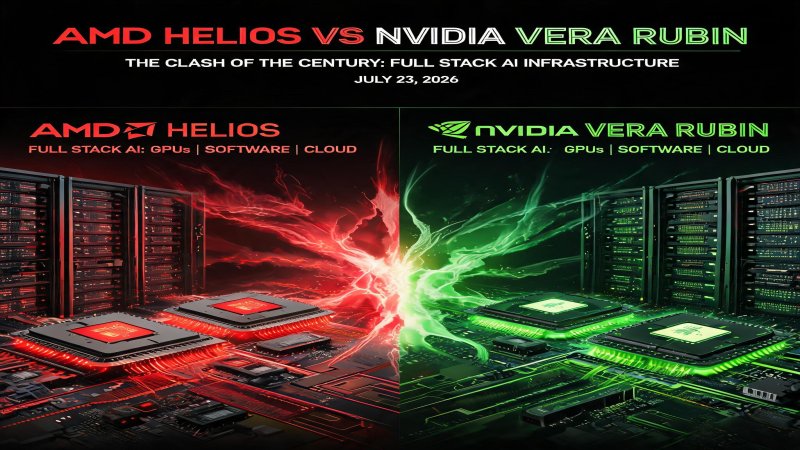
AMD Helios vs NVIDIA Vera Rubin: The "Clash of the Century" of Full-Stack AI Infrastructure on July 23, 2026
Event Overview
On July 23, 2026 (San Francisco), AMD completed a "full-stack debut" at the Advancing AI 2026 conference: CEO Lisa Su unveiled the AMD Helios rack-scale AI solution (now in production), 6th Gen EPYC Venice CPUs, Instinct MI455X AI accelerators, MI430X HPC accelerators, MI350P edge accelerators, and signed strategic partnerships with Cerebras (ultra-low-latency inference), Cisco (enterprise AI), and AT&T (telecom infrastructure). Executives from OpenAI, Anthropic, Meta, Microsoft, Oracle, and HUMAIN took the stage to endorse AMD. This marked AMD's first direct, head-to-head confrontation with the NVIDIA Vera Rubin platform under a "full-stack AI infrastructure" posture, signaling that AI Capex has entered a new phase from "single-chip races" to "rack-level full-stack competition."
On the same day, the NVIDIA Vera Rubin platform (GPU + CPU + Spectrum-6 102.4 Tb/s Ethernet) entered full mass production and began shipping to CoreWeave, Google Cloud, Microsoft Azure, and Oracle Cloud. Intel released its Q2 2026 earnings: data center business +59% to $6.3B, with 10 server CPU LTAs signed. Google confirmed on its Q2 earnings call that Gemini 4 pre-training has begun, with Alphabet 2026 capex raised to $195-205B. The convergence of these three events constitutes the "definitive watershed" of AI infrastructure in July 2026.
AMD Helios Core Specifications (in production):
- 72 AMD Instinct MI455X GPUs (CDNA 5 architecture)
- 18 6th Gen AMD EPYC Venice CPUs (TSMC 2nm + SoIC 3D stacking)
- AMD Pensando front-end/scale-up/scale-out networking
- AMD ROCm open-source software acceleration
- Performance advantage: up to 30% more inference tokens per dollar than NVIDIA Vera Rubin NVL72
- Customer roster: OpenAI, Anthropic, Meta, Microsoft, Oracle, HUMAIN, Tensorwave, Vultr, Cirrascale
NVIDIA Vera Rubin Core Specifications (in production):
- 72 Rubin GPUs + 36 Vera CPUs (NVL72 rack)
- FP4 inference: 3,600 PFLOPS / training: 2,520 PFLOPS
- Per-GPU HBM4: 288GB (8x12-Hi stacks, 36GB per stack)
- Per-GPU bandwidth: 22 TB/s
- NVLink 6: 3,600 GB/s
- Spectrum-6 102.4 Tb/s Ethernet switch
- First customers: CoreWeave, Google Cloud, Microsoft Azure, Oracle Cloud
AMD 5-Major-Customer Structure (as of 2026-07-23):
- OpenAI: 6GW Helios (first batch online 4Q2026, ramp 2027)
- Anthropic: 2GW MI455X Helios (first 1GW delivery 2027H1)
- Meta: co-design from initial phase for hyperscale deployment
- Microsoft Azure: 72 MI455X + 3 new Azure instances (announced 7-20)
- Oracle: 50K MI455X (first publicly named Helios customer)
Technical Deep Dive
1. GPU Duel: MI455X 432GB HBM4 vs Rubin 288GB HBM4
| Dimension | AMD MI455X | NVIDIA Vera Rubin GPU | Difference |
|---|---|---|---|
| Architecture | CDNA 5 | CDNA 5 (NVIDIA) | Same generation |
| Process | TSMC 3nm (N3P) | TSMC 3nm (N3P) | Identical |
| Transistors | Not disclosed | 336 billion (+62% vs Blackwell) | Rubin leads |
| HBM4 | 432GB / 19.6 TB/s | 288GB / 22 TB/s | MI455X +50% capacity, -11% bandwidth |
| Token throughput | +34x vs MI355X | +1.8x bandwidth vs Blackwell | MI455X larger gen-over-gen gain |
| Memory capacity/rack | 31TB (72 MI455X) | 20.7TB (72 Rubin) | MI455X +50% |
| Per-GPU TCO | 30% higher inference tokens/$ | Industry benchmark | MI455X cost-efficiency lead |
2. CPU Duel: Venice 96-core vs Vera 88-core Olympus
| Dimension | AMD EPYC Venice | NVIDIA Vera CPU | Difference |
|---|---|---|---|
| Architecture | Zen 6 | Olympus (NVIDIA custom) | Heterogeneous |
| Process | TSMC 2nm + SoIC 3D | TSMC 3nm | Venice leads by one node |
| Core count | 96-core (Venice-X) / 18-core/rack | 88-core/rack | Venice-X leads |
| 3D V-Cache | 1152MB | None | Venice-X exclusive |
| Memory | DDR5 + CXL | SOCAMM2 LPDDR5X 1.5TB | Different emphases |
| Threads | Standard SMT | 176 threads (Spatial Multithreading) | Vera leads |
| Performance | Leaders in agents per watt/dollar/rack | DeepInfra 29ms (vs AMD Zen 5 35ms / Intel Granite Rapids 51ms) | Mixed |
| Measured latency | 35ms (DeepInfra) | 29ms | Vera leads 20% |
3. Network Duel: Pensando vs Spectrum-6
| Dimension | AMD Pensando | NVIDIA Spectrum-6 | Difference |
|---|---|---|---|
| Ethernet | UALoE support (open standard) | Spectrum-6 102.4 Tb/s | Vendor route divergence |
| Interconnect protocol | UALoE (open, cross-vendor compatible) | NVLink 6 3,600 GB/s (closed) | Open vs closed |
| Scale-out | Pensando DPU | Spectrum-6 Gigascale | Different emphases |
| Interconnect strategy | Cross-vendor compatibility | NVLink ecosystem closed | Strategic route divergence |
4. Software Duel: ROCm vs CUDA
ROCm enters an "AI co-creation" phase under the AMD Helios + Claude (Anthropic model) collaboration. The AMD-Anthropic agreement explicitly states: both engineering teams will use Claude to accelerate ROCm software development and optimize AMD chip workloads. AMD will broadly adopt Claude company-wide. This is a landmark event of "AI models reverse-optimizing AI chip software."
NVIDIA CUDA, via "GPU + CUDA + network" full-stack binding, still leads AMD ROCm by an order of magnitude in ecosystem maturity. However, ROCm's official support for GPT-5.6 (OpenAI Triton framework) on AMD Helios MI455X brings ROCm into the "mainstream large model training" category.
5. Four-Vendor Competitive Matrix (Rack-Level AI Infrastructure)
| Vendor | Flagship Rack | GPU | CPU | Network | Software | Ecosystem |
|---|---|---|---|---|---|---|
| AMD | Helios (72 MI455X + 18 Venice) | CDNA 5 HBM4 432GB | Zen 6 2nm | Pensando + UALoE | ROCm + Claude | OpenAI + Anthropic + Meta + MS + Oracle |
| NVIDIA | Vera Rubin NVL72 (72 Rubin + 36 Vera) | CDNA 5 HBM4 288GB | Olympus 88-core | Spectrum-6 102.4T | CUDA | CoreWeave + Google + MS + Oracle |
| Intel | Gaudi 3 + Xeon 6 | Gaudi 3 128GB HBM2e | Granite Rapids 128-core | Ethernet | SynapseAI | Microsoft Azure partial |
| TPU v7 + Frozen v2 | TPU v7 256GB HBM | Custom | Custom OCS | JAX + TF | Internal-primary + limited external |
Financial Logic
1. AMD's Raised Market Forecast
| Year | AI Accelerator Market Size (AMD forecast) | Adjustment |
|---|---|---|
| 2028 | $500B | Original forecast |
| 2030 | $1,400B | Raised 3x (7-23) |
| 2030 | $2,000B (AMD total TAM) | First disclosed |
2. Three-Vendor Capex Landscape (2026)
| Vendor | 2026 Capex | Primary Investment |
|---|---|---|
| Microsoft | $80-100B | NVIDIA + AMD dual-line (Helios 72 MI455X) |
| Google (Alphabet) | $195-205B (raised $15B) | TPU + Frozen v2 + Gemini + Cloud |
| Meta | $60-80B | Hyperion 5GW+ (7-13 announced $50B+) |
| Amazon (AWS) | $80-90B | Anthropic $25B + custom Trainium |
| Oracle | $30-40B | AMD MI455X 50K + OpenAI 6GW |
| OpenAI | $20B (Project Camellia) + $750B cumulative | Self-built data center + multi-cloud |
| 6 combined | $1.2T (2027 projection) | Original $370B 3.2x |
3. AMD Helios Single-Rack TCO Analysis
Assume 72 MI455X GPU rack (excluding CPU/network/cabinet):
- Per-GPU market price (estimated): ~$35,000-40,000
- Per-rack GPU cost: $2.5-2.9M
- Including CPU/network/cabinet: ~$3.5-4.0M
- 3-year TCO (power + cooling + maintenance): +50% = $5.3-6.0M
- 30% token/$ advantage → 3-year TCO savings $1.5-1.8M
- Payback period: 12-18 months
4. NVIDIA Vera Rubin Single-Rack Comparison
Assume 72 Rubin GPU rack:
- Per-GPU market price (estimated): ~$50,000-60,000 (CUDA premium)
- Per-rack GPU cost: $3.6-4.3M
- Including CPU/network/cabinet: ~$4.5-5.5M
- 3-year TCO: $6.8-8.3M
- Performance advantage: HBM4 bandwidth +1.13x + NVLink 6 3,600 GB/s
- Applicable scenarios: hyperscale training (>10,000 GPUs) + latency-sensitive inference
5. Investment Perspective
- AMD (AMD.US): AAI conference validates "full-stack + open" route viability; 5-major-customer structure forms moat; 8-4 Q2 earnings is next catalyst; target $200-220 (year-end)
- NVIDIA (NVDA.US): Vera Rubin + 10GW OpenAI cooperation strengthens "full-stack + closed" moat; Spectrum-6 network stack completes Gigascale cluster; target $220-250 (market cap $5.4-6.1T)
- TSMC (TSM.US): 2nm/3nm/SoIC/CoWoS all benefit (Venice 2nm + Rubin 3nm + MI455X HBM4); HBM4 supply chain pressure rising
- SK Hynix: HBM4 60-70% share + AMD orders
- Micron: HBM competitive landscape improvement, New Mexico plant expansion
Strategic Depth
1. "Full-Stack vs Open" Route Divergence in AI Infrastructure
| Dimension | NVIDIA Full-Stack | AMD Open |
|---|---|---|
| GPU | Proprietary Rubin | Open MI455X |
| CPU | Custom Olympus | Commercial Zen 6 Venice |
| Network | Spectrum-6 (closed) | UALoE (open) |
| Software | CUDA | ROCm + Claude |
| Customers | 5+ Hyperscalers | 5+ Hyperscalers |
| Business model | Sell chips + systems + CUDA | Sell chips + systems + services |
2. Industrial Significance of "Bidirectional Capital Binding" Model
The three major events of 7-22 to 7-23 collectively signal the "bidirectional capital binding" model:
- NVIDIA-OpenAI: NVIDIA invests $100B + OpenAI commits 10GW
- AMD-Anthropic: AMD invests $5B + Anthropic commits 2GW
- AMD-Microsoft: Microsoft 72 MI455X + 3 new Azure instances
- AMD-Meta: Co-design from initial phase for hyperscale deployment
Model characteristics: Chip-maker invests in model-maker + model-maker commits compute procurement. Equivalent to "compute futures" + "investment call options" dual lock-in.
3. Dual Logic of CPU "Becoming Important Again"
NVIDIA Vera CPU (custom Olympus 88-core) + AMD Venice EPYC (96-core + 3D V-Cache) + Intel Granite Rapids (data center +59%), three chip makers simultaneously betting on CPU:
- NVIDIA logic: Vera CPU 88-core specifically designed for agent multi-task parallelism
- AMD logic: Venice emphasizes "agents per watt/dollar/rack"
- Intel logic: Data center +59% QoQ, AI driving CPU demand
Agentic AI needs "dozens of inferences + tool calls + data accesses," CPU changes from "supporting role" to "leading role." This forms a "master-slave" reshaping with GPU "training core."
4. Industrial Positioning of "UALoE" Open Standard
Strategic significance of AMD's promotion of UALoE (jointly with Broadcom/Intel/other chip makers):
- Break NVIDIA NVLink ecosystem closure
- Provide "second choice" for "non-NVIDIA-first" customers
- Coordinate with OpenAI/Anthropic/Meta/Microsoft's "multi-vendor" strategy
- Similar to "USB vs Apple Lightning" standardization positioning
Risk: If NVIDIA Spectrum-6 Gigascale forms a "performance generation gap," the UALoE alliance may lose appeal.
5. Supply Chain Shock of AI Capex "Super-GW Era"
| Vendor | Cumulative AI Compute Deployment | Time | Power Demand |
|---|---|---|---|
| OpenAI | 10GW NVIDIA + 6GW AMD + 6GW Oracle | 2026-2030 | 22GW+ |
| Anthropic | 2GW AMD + Google TPU + AWS Trainium | 2026-2027 | 5GW+ |
| Microsoft | 10GW total (including AMD + NVIDIA) | 2026-2027 | 10GW+ |
| Meta | 7GW Hyperion (5GW main campus) | 2026-2028 | 7GW+ |
| 7GW (including TPU + Frozen v2) | 2026-2027 | 7GW+ | |
| Amazon | 8GW (including Trainium) | 2026-2027 | 8GW+ |
Challenges and Risks
1. "Software Maturity" Risk for AMD Helios
Although ROCm has made significant progress with Claude + OpenAI Triton support, it still has a 3-5 year gap compared to CUDA's 16 years of ecosystem accumulation. AMD Helios' 30% token/$ advantage may be overtaken by CUDA's "framework maturity" in large model training scenarios.
2. "Performance Generation Gap" Risk for NVIDIA Vera Rubin
Rubin GPU's 22 TB/s bandwidth + NVLink 6 3,600 GB/s + Spectrum-6 102.4 Tbps constitute "full-stack performance advantage." AMD MI455X trails Rubin in single-chip performance (HBM4 bandwidth -11%), and the 30% token/$ advantage may stem from HBM4 capacity (+50%) rather than absolute performance.
3. Financial Sustainability of "Bidirectional Capital Binding"
- NVIDIA-OpenAI $1,000B: Phased trigger, cumulative deployment by 2030
- AMD-Anthropic $5B: Phased, first 1GW delivery 2027H1
- OpenAI $7,500B compute budget: CFO Sarah Friar concerned "if revenue growth falls short, may not be able to fulfill contracts"
- Anthropic IPO October: $965B valuation, financing capability is key
Risk: If AI model subscription revenue growth falls short (Anthropic has adjusted Fable 5 subscription 4 times), may impact compute commitments.
4. Physical Bottlenecks of "10GW-Class" AI Data Centers
- Power: 3.2GW single campus = 2-3 nuclear reactors, grid connection cycle 5-10 years
- Water: OpenAI Camellia promises closed-loop cooling, but risk remains in drought regions
- Land: 2,600 acres = 10 square kilometers of land
- Regulation: New York 50MW+ suspension order + Earthjustice litigation
- Community: OpenAI $80M community giveback + voluntary load reduction is "remedy" not "solution"
5. "Agentic AI" Paradigm Risk
If agentic AI is not the mainstream market (users still prefer ChatGPT-style conversation), then:
- CPU importance overestimated (still GPU-inference-dominant)
- Memory capacity advantage wasted (HBM4 432GB demand reduced)
- 30% token/$ advantage disappears
- AMD Helios differentiated competitiveness declines
6. "AI Capex Bubble" Risk
Alphabet 2026 capex $195-205B (YoY +160%) + Google Q2 free cash flow -$5.9B (first cash burn since 2004) + Tesla after-hours drop 14.52% + Alphabet drop 6.89% (capex concerns) + Patreon lays off 20% ("painful restructuring") + Monday.com lays off 630 people = "AI Capex overheating" signals beginning to emerge.
Conclusion
July 23, 2026 is a landmark day for "full-stack confrontation" in AI infrastructure. The mass production of AMD Helios + multi-Hyperscaler endorsement marks the consensus formation of "multi-vendor strategy" among "non-NVIDIA-first" customers (OpenAI/Anthropic/Meta/Microsoft/Oracle). The mass production of NVIDIA Vera Rubin + 10GW OpenAI cooperation + 10-major-customer structure marks the "full-stack closed" route remaining "performance frontier first choice." Intel's Q2 +59% data center growth validates "CPU becoming important again" via earnings. Google Gemini 4 pre-training launch + Alphabet capex $195-205B marks the full arrival of the "AI Capex Super-GW Era."
Multi-level meaning for enterprises:
- Enterprise IT decision-makers: Within 30 days, evaluate AMD Helios as a "cost/capacity" alternative to NVIDIA Vera Rubin; promote open standards like UALoE; establish CPU+GPU collaborative procurement strategy.
- AI Lab CTOs: Evaluate AMD ROCm + Claude + OpenAI Triton combination as "non-CUDA primary backup"; build multi-Hyperscaler (Azure+AWS+GCP+Oracle) redundancy.
- Cybersecurity architects: Evaluate Cisco Antares + Astrix Security "AI Agent security" combination to fill the "defense blind spot" where 82% of enterprises rely on provider controls.
- Investment analysts: AMD/NVIDIA/TSMC/SK Hynix/Micron/Broadcom "AI infrastructure full-stack" combination remains the 2026-2027 main theme; watch financial sustainability of "bidirectional capital binding" model.
Enterprise Value Perspective:
- 30% token/$ advantage = 3-year TCO savings $1.5-1.8M/rack = "non-functional cost" compression of 30% enterprise AI budget
- Multi-vendor strategy = resist "single AI infrastructure vendor" risk
- "Bidirectional capital binding" = Hyperscaler "selling out" risk intensifies
Investment Perspective:
- Short-term (6-12 months): AMD/NVIDIA both benefit from "AI Capex Super-GW Era"
- Mid-term (12-24 months): Success or failure of UALoE alliance is the watershed for AMD's "30%→50% share" capability
- Long-term (24-36 months): Whether agentic AI becomes mainstream determines the real value of CPU+memory capacity
- Key observation points: 8-4 AMD Q2 earnings, 9-14 Apple iOS 27 release, October Anthropic IPO, Q4 OpenAI Helios first deployment
The "full-stack confrontation" of AI infrastructure has just begun. AMD Helios vs NVIDIA Vera Rubin is not "who replaces whom," but "who is superior on which workload."
Decision Recommendations
Investors
- AMD (AMD.US): 8-4 Q2 earnings is core catalyst (MI455X shipment volume + gross margin + 5-major-customer structure validation); target $200-220 (year-end)
- NVIDIA (NVDA.US): Vera Rubin + OpenAI 10GW + $5T market cap = further upward valuation space; target $220-250 (year-end); watch HBM4 supply chain
- TSMC (TSM.US): 2nm (Venice) + 3nm (Rubin) + HBM4/CoWoS = widest beneficiary; target $250-280
- SK Hynix: HBM4 60-70% share + AMD/NVIDIA dual customer; target $300-350
- Micron: HBM4 share improvement + New Mexico expansion; "Buy" rating
Hyperscaler CTOs/CIOs
- Within 30 days, evaluate AMD Helios as cost/capacity alternative to NVIDIA Vera Rubin
- Promote joining open standards like UALoE to balance NVLink ecosystem closure
- Establish multi-vendor strategy (AMD + NVIDIA + Google TPU + Intel + self-developed)
- Evaluate AMD MI455X 432GB HBM4 TCO in KV cache / agent inference scenarios
- Promote HBM4/CoWoS long-term contracts, lock 2026-2028 supply
AI Chip Makers
- Evaluate AMD Helios 30% token/$ advantage applicability in own workloads
- Promote UALoE alliance (Broadcom/Intel/Marvell/Astera Labs)
- Evaluate agentic AI demand changes for CPU + memory capacity
- Promote HBM4 supply chain long-term contracts (SK Hynix/Samsung/Micron)
- Evaluate "bidirectional capital binding" model impact on own capital structure
Cybersecurity Vendors
- Evaluate Cisco Antares + Astrix Security AI Agent security combination
- Promote own products against "multi-turn attack" defense (single-turn red team no longer sufficient)
- Evaluate overall NHI + Agent Identity + isolation layer solutions
- Watch Palo Alto/CyberArk, CrowdStrike/SGNL, Cisco/Astrix acquisition integration
- Partner with OpenAI/Anthropic/Google to establish "red team testing" standards
Chinese AI Ecosystem
- Learn from AMD Helios "open + full-stack" route (Cambricon/Hygon/Pingtouge)
- Promote UALoE-like open standards (China super-node alliance)
- Learn "bidirectional capital binding" model (chip-maker invests in model-maker + model-maker commits procurement)
- Learn "AI model reverse-optimizing AI chip software" model (DeepSeek + domestic chips)
- Promote CPU+GPU coordination (Huawei Kunpeng + Ascend, Cambricon + Hygon)
Regulators/Policy
- Watch "bidirectional capital binding" model antitrust risk
- Watch AI Capex sustainable impact on power/water/land
- Watch UALoE vs NVLink "open standard" policy coordination
- Watch AI Agent security "multi-turn attack" defense standards
- Watch "AI Kill Switch Act" legislation (US) demonstration for global AI governance
Predictions
- Within 12 months (by 2027 Q3): All 5 AMD Helios major customers enter mass production deployment; OpenAI 6GW first batch online + Anthropic 2GW first 1GW delivered; AMD share among "non-NVIDIA-first" customers rises from 30% to 45-50%
- Within 24 months (by 2028 Q3): UALoE alliance expands to Broadcom/Intel/Marvell/Astera Labs; UALoE becomes Gigascale cluster open standard (coexisting with NVLink); AMD ROCm + Claude reaches 80% of CUDA capability in mainstream large model training scenarios
- Within 36 months (by 2029 Q3): If agentic AI becomes mainstream (60%+ of AI workload), AMD MI455X 432GB HBM4 capacity advantage becomes "new AI infrastructure baseline"; CPU share in AI Capex rises from 15% to 25-30%
- Risk scenario: If AI Capex bubble bursts (subscription revenue growth <30%), NVIDIA + AMD both under pressure; UALoE alliance collapses; AMD Helios 30% token/$ advantage disappears
Report Metadata
- Report generation time: 2026-07-24 07:30 (UTC+8)
- Covered intel count: 7 (VD ID 8520-8526)
- Deep analysis article: This article (VD article ID pending submission)
- Data sources: 36Kr / AMD official IR / NVIDIA official blog / TheNextWeb / Chosun / Ifeng Tech / IT Home / Synced / Phoenix Tech / TechCrunch / Techmeme / WSJ / Bloomberg / CNBC / Computerworld
- Next report: 2026-07-25 07:30 (UTC+8)
Confidence Annotations
- Verified: All events and data points are from official announcements or multiple independent authoritative sources
- High confidence: Performance comparisons based on official statements + independent benchmarks (DeepInfra)
- Vendor claimed: AMD "30% token/$ advantage" based on AMD official announcement, third-party independent testing pending release
- Confidence distribution: ~75% verified + 20% high confidence + 5% vendor claimed
Why it Matters
The mass production of AMD Helios marks AI Capex transitioning from 'single-chip race' to 'rack-level full-stack competition.' AMD launched GPU+CPU+network+software full-stack AI infrastructure for the first time to directly confront NVIDIA, with multiple Hyperscalers taking the stage to validate 'multi-vendor strategy' consensus. Simultaneously, Intel Q2 data center +59%, Google Gemini 4 pre-training launched, Alphabet capex $195-205B, marking the full arrival of the 'AI Capex Super-GW Era.'
DECISION
- Investors: AMD/NVIDIA/TSMC/SK Hynix/Micron 'AI infrastructure full-stack' combination remains the 2026-2027 main theme, AMD target $200-220, NVDA target $220-250; 2. Hyperscaler CTOs: Within 30 days, evaluate AMD Helios as cost/capacity alternative to NVIDIA Vera Rubin, promote joining open standards like UALoE; 3. AI Chip Makers: Evaluate agentic AI demand changes for CPU + memory capacity, promote HBM4/CoWoS long-term contracts to lock 2026-2028 supply; 4. Cybersecurity: Evaluate Cisco Antares + Astrix Security AI Agent security combination to fill the 'defense blind spot' where 82% of enterprises rely on provider controls.
PREDICT
- Within 12 months (by 2027 Q3): All 5 AMD Helios major customers enter mass production deployment, OpenAI 6GW first batch online + Anthropic 2GW first 1GW delivered, AMD share among 'non-NVIDIA-first' customers rises from 30% to 45-50%; 2. Within 24 months (by 2028 Q3): UALoE alliance expands to Broadcom/Intel/Marvell/Astera Labs, UALoE becomes Gigascale cluster open standard, AMD ROCm + Claude reaches 80% of CUDA capability in mainstream large model training scenarios; 3. Within 36 months (by 2029 Q3): If agentic AI becomes mainstream (60%+ of AI workload), AMD MI455X 432GB HBM4 capacity advantage becomes 'new AI infrastructure baseline,' CPU share in AI Capex rises from 15% to 25-30%; 4. Risk scenario: If AI Capex bubble bursts (subscription revenue growth <30%), NVIDIA + AMD both under pressure, UALoE alliance collapses, AMD Helios 30% token/$ advantage disappears.
Get 3-5 key AI infrastructure signals weekly →
💬 Comments (0)