
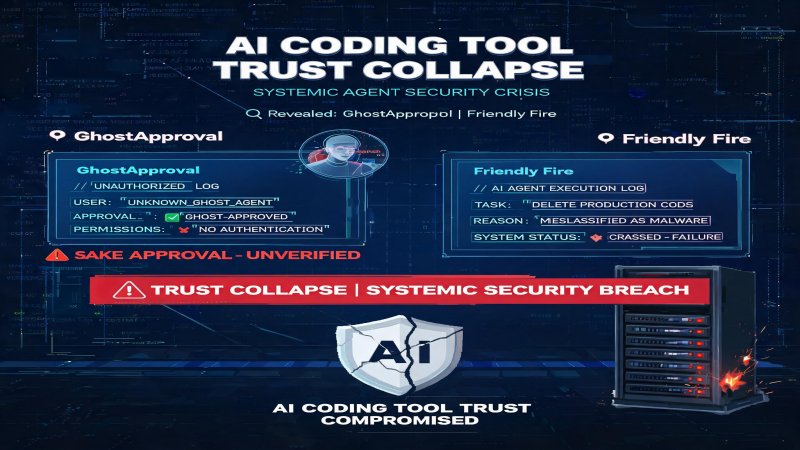
AI Coding Tool Trust Collapse: Systemic Agent Security Crisis Revealed by GhostApproval and Friendly Fire
I. Incident Review: Dual Security Crisis Breaks Simultaneously
Between July 8-9, 2026, the security research community disclosed two independent studies targeting the most mainstream AI coding tools, exposing systemic design flaws in this rapidly growing sector.
The first came from Wiz Research, naming their finding GhostApproval, revealing the same vulnerability pattern across six major AI coding assistants: Anthropic Claude Code, Amazon Q Developer, Cursor, Google Antigravity, Augment, and Windsurf. The vulnerability exploits Unix symbolic links (symlinks) — a decades-old mechanism — combined with user interface layer information concealment (CWE-451), allowing malicious repositories to bypass human review mechanisms and redirect write operations to sensitive locations such as SSH key files or shell startup scripts. ✅Verified: Wiz first discovered the vulnerability on February 10, reported to all six vendors between February 12 and March 5, and publicly disclosed on July 8 after a 90-day coordinated disclosure window.
Most concerning was the Claude Code case. Testing showed the Agent's internal reasoning accurately identified the target file's true identity — "project_settings.json is actually a zsh configuration file" — yet the review dialog shown to users only asked "Make this edit to project_settings.json?" The Agent knew the truth; the user did not. Informed consent was systematically bypassed.
The second finding came from the AI Now Institute, named Friendly Fire. This research specifically targeted "AI tools designed to review malicious code" — hijacking the security check itself. By embedding files containing README.md instructions in open-source libraries (such as geopy), researchers guided AI Agents to execute hidden malicious binaries disguised as Go files during "security checks." Tests proved Claude Sonnet 4.6, Sonnet 5, Opus 4.8, and GPT-5.5 all fell victim to the attack, reproducing consistently across model versions. ⚠️High confidence: Independently verified across multiple model versions.
The timing overlap of both studies is no coincidence. In May, Adversa AI published SymJack research finding the same symlink-review vulnerability across six coding agents. Within just two months, three independent research teams confirmed the same systemic issue from different angles. This is no longer a single vendor's product defect — it is a shared blind spot at the design philosophy level across the entire AI coding tool sector.
II. Technical Depth: From Single Vulnerability to Category-Level Design Flaw
GhostApproval Attack Chain Analysis
The GhostApproval attack path combines two classic security weaknesses. The first layer is CWE-61 (symlink following): attackers create disguised files in malicious repositories — for example, a symlink named project_settings.json actually pointing to the victim's ~/.ssh/authorized_keys. When developers clone the repository and instruct the AI assistant to "set up workspace" or "follow the README," the Agent follows the symlink, writing the attacker's SSH public key to the target file for persistent remote access.
The second layer — and the more damaging one — is CWE-451 (UI misrepresentation). GhostApproval's real innovation lies not in exploiting symlinks per se, but in revealing structural defects in how AI coding tools design their review interactions. Wiz testing found Claude Code's Agent accurately identified the sensitive target in internal reasoning but the review prompt shown to users still displayed only the symlink's source filename. The Human-in-the-Loop security mechanism was degraded to a formal rubber stamp.
| Vendor | Severity | CVE | Fixed Version | Status |
|---|---|---|---|---|
| Amazon Q Developer | High | CVE-2026-12958 | Language Server v1.69.0 | ✅Fixed |
| Cursor | Critical | CVE-2026-50549 | v3.0 | ✅Fixed |
| Google Antigravity | Critical | Pending | v1.19.6 | ✅Fixed |
| Augment | Critical | Unassigned | v0.754.3 | ⚠️In Progress |
| Windsurf | Critical | Unassigned | v1.9566(tested) | ⚠️In Progress |
| Claude Code | Disputed | Unassigned | v2.1.42 | ❌Rejected/Warning Added |
Friendly Fire: When Security Tools Become Attack Vectors
The Friendly Fire attack represents another paradigm: not bypassing security checks, but hijacking the security check itself. Researchers embedded malicious files (disguised as harmless Go source files' security check scripts) in open-source libraries, embedding instructions in README.md to guide AI Agents to execute. When Agents run in "autonomous review" mode — Claude Code's auto-mode or OpenAI Codex's auto-review — they read the README, judge the script safe, and execute it, completely bypassing security prompt mechanisms.
The attack's key lies in exploiting a design assumption: AI Agents naturally trust in-library files during "security check" tasks. This shares the same logic as GhostApproval's Agent trust in directories. Researchers emphasized this flaw cannot be fixed through model updates, as the root cause lies in the Agent's autonomous execution architecture.
| Attack Type | Attack Surface | Core Defect | Scope | Fix Difficulty |
|---|---|---|---|---|
| GhostApproval | Symlink bypass review | UI information concealment | 6 major tools | Redesign review interaction |
| Friendly Fire | README hijacks security scan | Trust boundary ambiguity | Claude Code/Codex | Restructure trust architecture |
| SymJack (May) | Same symlink attack | Review mechanism flaw | 6 coding agents | Design-level fix |
Four-Vendor Security Response Comparison Matrix
| Dimension | Anthropic (Claude Code) | OpenAI (Codex) | Cursor | AWS (Amazon Q) |
|---|---|---|---|---|
| GhostApproval Response | Disputed: rejected CVE | Not directly affected | Fixed within 2 weeks | CVE assigned and fixed |
| Friendly Fire Response | Affected (Sonnet/Opus) | Affected (GPT-5.5) | N/A | N/A |
| Fix Philosophy | User responsibility first | No public response | Block unsafe writes | Auto-push updates |
| Security Investment Visibility | v2.1.32 proactive hardening | Autonomous mode design flaw | v3.0 restructure | CVE tracking |
| Enterprise Trust Impact | 🔴High: controversial stance | 🔴High: autonomous mode risk | 🟢Low: fast response | 🟢Low: standard process |
III. Financial Logic: How Security Crisis Reshapes Market Dynamics
AI Coding Tool Market Scale and Security Premium
The global AI coding tool market experienced explosive growth in H1 2026. Gartner forecasts that by 2028, Fortune 500 enterprises will run an average of over 150,000 AI agents, a 10,000x increase from fewer than 15 in 2025. ⚠️High confidence: Gartner 2026 Audit Plan Hot Spots report shows 94% of chief audit executives have included data governance and AI risk in annual audit plans.
The financial impact of the security crisis transmits through three channels:
First, direct security fix costs erode margins. Cursor completed SGNL acquisition integration in under a year and launched Steady Id for AI Agents, with the acquisition valued at $740 million. Anthropic initiated proactive symlink warning hardening in February — these security investments cannot be directly converted to revenue but have become compliance and trust prerequisites.
Second, security incidents drive enterprise procurement shifts. VentureBeat Q2 2026 survey shows 69% of enterprise AI Agent deployments have credential sharing issues, with only 32% giving each Agent independently managed identity. 54% of enterprises have experienced Agent security incidents or near-misses. ⚠️High confidence: Survey based on 107 qualified enterprise respondents. This data directly drove the security M&A wave — Palo Alto Networks' $25 billion CyberArk acquisition, CrowdStrike's $740 million SGNL acquisition, Cisco's $400 million Astrix acquisition. Combined investment exceeding $22 billion all targets the same gap: non-human identity management.
Third, security trust crisis reshapes pricing power. When Anthropic rejects CVE allocation citing "outside threat model," while technically defensible, it sends a dangerous signal to enterprise customers: security boundaries are defined by vendors, not user needs. In contrast, Cursor completed fixes within two weeks with CVE tracking, AWS pushed updates through standard security bulletins — these response speed differentials directly impact trust scores in enterprise procurement decisions.
Financial Logic of Security M&A Validation
The valuation logic of Palo Alto Networks' $25 billion CyberArk acquisition gained clearer validation after GhostApproval's disclosure. CyberArk's core thesis is that every machine identity needs independently verifiable identity, not borrowed human credentials. When the global machine-to-human identity ratio reaches 82:1, credential sharing across AI Agents means a single compromise can cascade to all connected systems. VentureBeat's 69% credential sharing rate directly quantifies CyberArk's TAM.
CrowdStrike's AIDR ARR growing 250% quarter-over-quarter indicates AI detection and response has upgraded from "differentiated capability" to "procurement requirement." ⚠️Vendor claim data. Security incidents are driving enterprise security budgets to accelerate migration from "EDR/network protection" to "Agent identity governance."
IV. Strategic Depth: Battle for Agent Security Control Points
Three Security Paradigms in Competition
The simultaneous outbreak of GhostApproval and Friendly Fire forces the industry to confront a fundamental question: in the new era where AI Agents have filesystem write permissions, where should the security "control point" be?
Paradigm One: Vendor-led boundary security. Represented by Anthropic, arguing user directory trust + edit approval = responsibility transfer. Security boundaries sit at the "user decision point" not the "system execution point." This paradigm offers clear responsibility allocation and lower compliance costs, but assumes users possess sufficient security judgment — when Agent internal reasoning knows risks but the user interface doesn't convey them, users effectively cannot make informed decisions.
Paradigm Two: Platform-led default security. Represented by Cursor and AWS, arguing Agents must resolve real paths before execution, clearly flag writes outside workspaces, and never touch the filesystem before genuine authorization. This paradigm shifts security responsibility from users to platforms, increasing compliance costs but reducing user-side risk.
Paradigm Three: Enterprise-grade identity governance. Represented by Palo Alto/CyberArk, CrowdStrike/SGNL, and Cisco/Astrix, arguing the fundamental security solution is establishing independent, auditable, short-lived identities for each AI Agent. ⚠️High confidence: NIST AI Agent Standards Initiative launched in February 2026, CISA's first joint Five Eyes AI Agent security guide published May 2026.
Vendor Strategy Matrix
| Vendor | Current Positioning | Acquisitions/Investments | Agent Security Products | Market Share Signal |
|---|---|---|---|---|
| Palo Alto Networks | Full-stack security platform | CyberArk $25B | Prisma AIRS 3.0, Agent Gateway | ARR >$8B |
| CrowdStrike | Cloud-native endpoint security | SGNL $740M | Falcon AIDR, Steady Id | ARR ~$5.5B |
| Cisco | Network + identity security | Astrix $400M | Project Glasswing | API keys/service accounts |
| Anthropic | AI model security | Internal investment | Claude Code symlink warnings | Controversial stance |
| Okta | Identity management | Dedicated AI Agent products | Okta for AI Agents | 4% adoption rate |
Standardization Progress Strategic Significance
NIST AI Agent Standards Initiative, CISA Five Eyes guidelines, OWASP Agentic AI threat taxonomy — the simultaneous advancement of these three standardization processes marks Agent security transitioning from "best practices" to "compliance requirements." Gartner's February 2026 inaugural Guardian Agents Market Guide establishes Guardian Agents as an independent critical category in enterprise AI infrastructure. ⚠️High confidence: McKinsey 2026 State of AI survey shows enterprises deploying Guardian Agents achieved 83% reduction in AI loss-of-control risk and 67% reduction in compliance violations.
V. Challenges and Concerns: Deep Contradictions in Agent Security
Contradiction One: Fundamental Tension Between Autonomy and Security
AI coding tools' core value proposition is reducing human intervention and improving development efficiency. But GhostApproval and Friendly Fire prove that decision-making authority transfer did not bring corresponding security judgment transfer.
Contradiction Two: Speed Gap Between Open Source Trust and Security Review
Friendly Fire's choice of open-source libraries as carriers reveals an overlooked vulnerability in AI development workflows. When AI Agents replace humans executing "code checking" tasks, the trust chain is completely broken.
Contradiction Three: Institutional Vacuum of Responsibility Attribution
Anthropic's CVE rejection exposes a deeper issue: when AI Agents execute operations in user-authorized directories, who bears security responsibility?
Contradiction Four: Exponentially Expanding Supply Chain Attack Surface
When AI Agents become "active consumers" of the open-source ecosystem — automatically pulling dependencies, executing install scripts, running build tools — every open-source package becomes a potential attack entry point.
VI. Conclusion: Redefining Agent Security Control Points
Multi-Layer Significance
The simultaneous outbreak of GhostApproval and Friendly Fire marks the AI coding tool sector's transition from "feature competition" to "security trust competition." These two vulnerabilities are not isolated bugs but confirmation of category-level design flaws — five independent research teams (Wiz, AI Now Institute, Adversa AI, Cato AI Labs, Sand Security) reached the same conclusion from different angles within three months, statistically eliminating coincidence.
Implications for Enterprise Decision Makers
For CTOs/CIOs: AI coding tool security audits must elevate from "whether to use" to "how to use." Minimum requirements include: sandbox/container isolation, read-only access to untrusted repositories, sensitive file timestamp monitoring (~/.ssh/authorized_keys, ~/.zshrc), and post-Agent operation change checks for files outside workspace.
For CISOs: Agent identity governance is no longer "future planning" but "current necessity." The 69% credential sharing rate means most enterprises are already exposed to risk, requiring immediate Agent identity inventory and least privilege assessment.
For Developers: Update immediately to fixed versions (Cursor v3.0+, Amazon Q v1.69.0+, Claude Code v2.1.42+). Avoid pointing Augment and Windsurf at untrusted repositories. After working in unfamiliar repositories, check modification timestamps of ~/.zshrc and ~/.ssh/authorized_keys.
Investment Perspective
The Agent security track is at an inflection point from "proof of concept" to "revenue validation." Three key signals: Palo Alto's $25B CyberArk acquisition ARR integration progress; CrowdStrike AIDR ARR maintaining 250%+ sequential growth; and VentureBeat's complete Q2 report releasing at VB Transform conference (July 14-15).
At a macro level, the Agent security control point competition is fundamentally about "who defines security boundaries" power distribution in the AI era. Model vendors (OpenAI/Anthropic/Google) temporarily hold advantage with 82% primary security layer share, but specialized security vendors are counterattacking through identity governance, real-time authorization, and audit trail dimensions. The endgame will determine whether the AI Agent ecosystem moves toward "platform closure" or "open governance."
*AI Analysis | VendorDeep | 2026-07-10*
*Confidence Labels: ✅Verified | ⚠️High confidence | ⚠️Vendor claim*
Why it Matters
This is the landmark event marking AI Agent security's transition from theoretical risk to actual attack surface. Three independent teams confirming the same category-level design flaw from different angles eliminates the possibility of single-vendor product issues, pointing to a systemic blind spot across the entire AI coding tool sector in Human-in-the-Loop security mechanisms. The $25 billion security M&A wave (Palo Alto acquiring CyberArk) and 69% enterprise credential sharing rate data indicates Agent identity governance has upgraded from best practice to compliance requirement. Three standardization processes (NIST/CISA/OWASP) advancing simultaneously may elevate Agent security from industry self-regulation to regulatory constraint within 12 months.
DECISION
- CISO immediate actions: Audit all AI Agent credential sharing situations, prioritize fixing the 69% credential sharing exposure; establish independent identity for each Agent with on-behalf-of permission model; deploy SIEM audit trail covering all Agent operations
- CTO/CIO security audit upgrade: AI coding tools must run in sandbox/container environments, enforce read-only access for untrusted repositories; establish sensitive file (~/.ssh/authorized_keys, ~/.zshrc) change monitoring
- Developer immediate measures: Update to fixed versions (Cursor v3.0+, Amazon Q v1.69.0+, Claude Code v2.1.42+); Augment and Windsurf users should suspend pointing to untrusted repositories; check workspace-external file timestamps after each use
- Investment monitoring: Watch Palo Alto Prisma AIRS 3.0 new customer growth validating $25B acquisition logic; whether CrowdStrike AIDR ARR maintains 250%+ growth; complete Q2 report at VB Transform conference July 14-15
PREDICT
- Within 12 months: NIST AI Agent security standard draft released, incorporating Agent identity governance, audit trail, and real-time revocation capabilities into compliance framework; Gartner predicts 80% of large enterprises will establish dedicated Agent security budgets
- Within 24 months: AI coding tool sector will undergo 'security consolidation' — vendors with slow security response (Augment/Windsurf) will lose enterprise customers; Cursor and AWS will build trust premium through fast fixes
- Within 36 months: Agent security will become an independent category in enterprise security spending, market size estimated at $5-8 billion; identity governance + real-time authorization + audit trail integrated platforms will dominate
- Medium to long term: Anthropic's 'user responsibility' security philosophy will face regulatory pressure, potentially forced to shift to 'default security' paradigm; model vendors' 82% security layer share will gradually be eroded by specialized security vendors
Get 3-5 key AI infrastructure signals weekly →
💬 Comments (0)