
AI Agent Security M&A Wave: Cisco and Palo Alto's Dual Acquisitions Define a New Battlefield
I. Background and Core Conflict
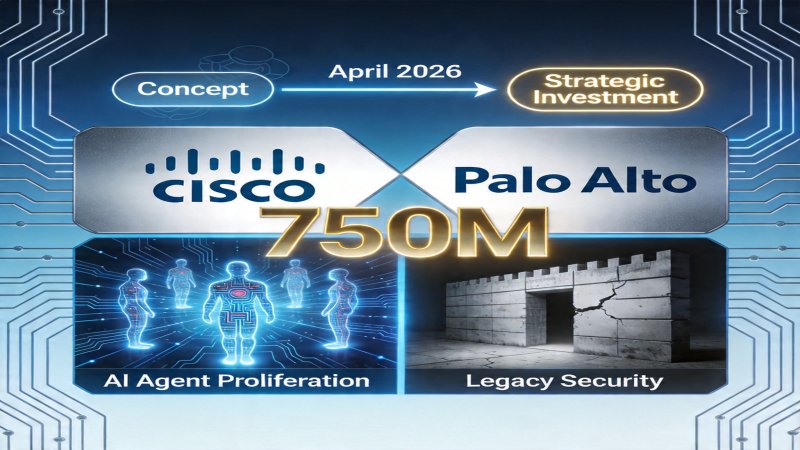
The second week of April 2026 witnessed a landmark event in the cybersecurity industry: Cisco and Palo Alto Networks announced acquisitions of AI Agent security startups within a week, with a total transaction value of $750 million. Cisco acquired identity security vendor Astrix Security for $350 million, while Palo Alto completed the acquisition of endpoint security vendor Koi Security for $400 million. This strongly signals that AI Agent security is evolving from a technical concept into a strategic investment area.
The core conflict lies in the clash between the rapid penetration of AI Agents within enterprises and the failure of existing security models. Traditional security architectures, built around human users and static rules, struggle to address new risks posed by autonomous, tool-calling non-human entities (AI Agents), such as privilege abuse, anomalous behavior, and supply chain attacks. A market supply gap exceeding 60% is driving leading vendors to rapidly fill the capability void through acquisitions.
Why now? According to Gartner's "2026 AI Agent Security Technology Guide" released on April 5, 2026, based on a survey of 500 global large enterprises, over 40% of large enterprises plan to or will initiate AI Agent security capability development within the next 12-18 months. This "planned deployment" encompasses a broad range of preliminary activities from technology validation and budget planning to purchase intent, creating a gap with actual implementation, yet it reflects clear strategic intent. Market demand and technological maturity have reached a tipping point, driving leading vendors to rapidly build capabilities via M&A to meet customers' growing urgency.
II. Evolution and Trends
Past (Pre-2026): Severe Security Lag
AI Agent technology evolved from automation tools to handling core business workflows, but dedicated security solutions were scarce. Enterprises primarily relied on fragmented policies and traditional tools for protection, leaving significant blind spots. Organizations like Gartner released technology guides in early 2026, identifying identity, endpoint, and behavior auditing as core directions.
Present (Early 2026 - Present): Concentrated M&A and Market Heating Up
2026 has become a critical inflection point. Industry guides clarified the technological direction, prompting leading vendors to immediately engage in large-scale acquisitions for market positioning. Cisco acquired AI observability vendor Galileo in March and Astrix in April; Palo Alto acquired Koi in April. The large-scale influx of capital reflects leading vendors' anticipation of the sector's potential, but ultimate market acceptance remains to be validated.
Future Trends: Drivers and Potential Paths for Consolidation
Market consolidation is driven by both forces and resistance. Drivers include: customer preference for integrated platform solutions, the potential trend of technological standardization (centered on identity and endpoint), and leading vendors' intent to build ecosystem barriers through M&A. Obstacles include: the inherent fragmentation of the AI Agent technology stack, high cross-platform integration costs, and potential overvaluation of startups due to capital influx.
- Diverging Market Consolidation Paths: If the integrations by Cisco and Palo Alto gain market acceptance, more traditional cybersecurity vendors (e.g., Fortinet, Check Point) may follow with acquisitions; otherwise, the market may maintain a multi-vendor, fragmented competitive landscape.
- Technology Evolution Towards Full-Stack: Security capabilities will evolve from point solutions to integrated platforms covering identity, endpoint, behavior, and data. Underlying observability (e.g., the capability gained by Cisco's Galileo acquisition) becomes the foundation for precise control.
- Exploration of Standard Frameworks: The industry will begin exploring technical standards, but the frameworks may be more diverse than those revealed by current acquisitions (identity, endpoint), potentially including data security, policy governance, and other directions.
III. Key Players and Dynamics
| Key Player | Position & Strategy | Core Interest |
|---|---|---|
| Cisco | Full-Stack Strategist. Building an observation and control loop through acquisitions of Astrix (identity security) and Galileo (AI Observability), planning integration into its Zero Trust product matrix. | Seizing market first-mover advantage, expanding product lines to address new enterprise demands, enhancing overall solution competitiveness and customer stickiness. |
| Palo Alto Networks | Extending Endpoint Advantage. Acquiring Koi Security (Agentic Endpoint Security) to rapidly strengthen AI Agent endpoint detection and response capabilities, integrating into the Cortex XDR product line. | Consolidating existing advantages in endpoint security, addressing new threat types, maintaining market growth momentum. |
| Other Cybersecurity Vendors (e.g., Fortinet, CrowdStrike) | Observers or Proactive Followers. Facing strategic decisions, may engage in M&A, partnerships, or in-house development to avoid falling behind in the next-generation security race. | Capturing opportunities in a high-growth sector, filling capability gaps, preventing customer attrition. |
| Enterprise Customers | Demand-Driven Purchasers. Seeking solutions that effectively manage risk and are easy to integrate, preferring platform-based products to reduce complexity and total cost. | Ensuring AI Agent application security and compliance, balancing technological innovation with operational risk. |
Competitive Dynamics Analysis: Leading vendors are attempting to seize talent and technological assets through acquisitions to establish early barriers, but their effectiveness depends on subsequent product integration and market execution. Cisco's and Palo Alto's acquisitions focus on identity and endpoint security respectively, providing two clear reference directions for the market. Startups become scarce resources, potentially increasing market concentration. Future competition will revolve around depth of product integration, solution pricing, and ecosystem building.
IV. Impact and Signals
Impact on Security Vendors:
- Strategic Acceleration and Concretization: The event forces mainstream vendors to reassess and accelerate their AI Agent security strategies. Traditional perimeter security and network equipment vendors (e.g., Fortinet, Juniper) may face the greatest pressure, needing to quickly acquire AI-native security capabilities via M&A; Cloud-native security vendors (e.g., Zscaler, Wiz) may accelerate in-house development, integrating AI Agent security into their existing cloud security platforms. Specific actions may include establishing independent product lines, increasing AI Agent security R&D budgets to over 15%.
- Integration Challenges Highlighted: Post-acquisition integration of technology, products, and teams becomes a critical test; synergy determines ultimate success.
- Potential Landscape Reshaping: Vendors acquiring core capabilities early through M&A may gain first-mover advantage. However, execution risks in M&A integration, rapid iteration of technology roadmaps, and high costs could also put early aggressors at a disadvantage.
Impact on Enterprise Customers:
- More Options Amid Increased Complexity: Customers gain more product choices but may also face increased multi-vendor integration complexity and management costs.
- Accelerated Application Deployment: The emergence of specialized security capabilities lowers the risk threshold for deploying AI Agents, potentially promoting their wider enterprise adoption.
- Procurement Strategy Adjustment Needed: Enterprises must incorporate AI Agent security into overall architecture planning, prioritizing evaluation of integration capabilities with existing security stacks.
Impact on Investors:
- Sector Value Gains Attention: Large-scale M&A provides valuation benchmarks for the AI Agent security sector, establishing it as a high-potential investment hotspot.
- Shift in Investment Focus: Investors will focus more on startups with unique core technologies and the M&A integration execution capabilities of public vendors.
- Potential Increase in Valuation Expectations: Valuation expectations for similar startups may be driven higher, and financing activities may become more active.
V. Key Assessments
| Key Assessment | Importance | Action Recommendations | Confidence Level & Basis |
|---|---|---|---|
| The AI Agent security sector has entered a rapid consolidation phase. M&A will be the core path for leading vendors to build capabilities, with more M&A activity expected in 2026-2027. | Large market supply gap and surging demand; M&A enables rapid acquisition of technology, teams, and customers, shortening time-to-market. | 1. Cybersecurity vendors should assess their capability gaps in identity, endpoint, observability, etc., and formulate M&A or partnership strategies. 2. Investors can prioritize investing in technologically leading startups within the sector. | High. Basis: Clear market supply-demand contradiction (gap >60%); leading vendors have validated this path with action; capital attention is extremely high. |
| Cisco's and Palo Alto's dual acquisitions define two core directions for AI Agent security: identity security and endpoint security. These will become the industry's standard reference framework. | Provides clear guidance for other vendors and enterprise customers; subsequent technology development and market education will revolve around these directions. | 1. Enterprise customers should prioritize evaluating integrated solutions for identity control and endpoint protection during vendor selection. 2. Vendors can focus on niche areas or expand full-stack capabilities. | Medium. Basis: Directions defined by leading vendor practice, but technology roadmap is still early; new critical dimensions (e.g., data flow security) may emerge. |
| AI Agent security will evolve from standalone products towards platformization and observability integration. Cisco's acquisition of Galileo indicates that underlying observability capabilities are becoming a key competitive differentiator. | Observability provides full-stack visibility into AI Agent operations, serving as the foundation for identity and endpoint security, enhancing overall protection effectiveness. | 1. Vendors need to strengthen integration between observability and security products. 2. Enterprises should focus on platform-based solutions to reduce management complexity. | Medium. Basis: Logically, observability is a prerequisite for effective control, but quantitative validation of this value in large-scale commercial deployments is not yet sufficient. |
VI. Questions to Watch
- Subsequent Followers: Which cybersecurity vendors (e.g., Fortinet, CrowdStrike) will be the fastest to follow with M&A or release AI Agent security products? Will their strategy be M&A, partnership, or in-house development?
- Standard Setting: How will technical standards or best practices for AI Agent security be developed, and which organizations (e.g., NIST, CSA, alliances of leading vendors) might lead?
- Enterprise Deployment Challenges: What are the main challenges for enterprises deploying AI Agent security (e.g., cost, integration difficulty with complex legacy systems, internal security skills gap)?
- Integration Effectiveness: What is the progress and customer feedback on post-acquisition product integration? Does it meet the expected goals of improving security effectiveness and reducing operational complexity?
Why it Matters
Positioning: Landscape Reshaping, Leading vendors are acquiring to seize definition rights in a new arena.
Key Factor: The core driver is the rapid penetration of AI Agents into enterprise core workflows, rendering traditional security models obsolete and creating a clear and urgent market demand. Technical guidelines from institutions like Gartner have defined the direction. Leading vendors are rapidly acquiring technology, talent, and early market position through major M&A (Cisco acquiring Astrix & Galileo, Palo Alto acquiring Koi), attempting to build new competitive moats from scratch and reshape the security market landscape.
Stage: Early Explosion
DECISION
For Vendor (Other cybersecurity vendors (e.g., Fortinet, CrowdStrike))
- Immediately assess capability gaps in identity, endpoint, and observability, formulating a clear roadmap for reinforcement.
- Define M&A targets or in-house/partnership strategies within 3 months to avoid falling behind in the next-gen security competition.
Strategic Moves: Highly likely to enter the space via acquisition or strategic partnership.
- Immediately incorporate AI Agent security into IT architecture planning, prioritizing integrated solutions for identity and endpoint protection.
- Require vendors to articulate their AI Agent security roadmap and integration capabilities when procuring new security products.
Action Guidance: Wait-and-see within 3 months
For Investor
- Focus on startups with differentiated technologies in AI Agent behavior analysis, data flow security, or policy governance.
- Evaluate listed cybersecurity vendors' post-merger integration capabilities, not just their acquisition activities.
Key Risk: M&A integration failure, rapid iteration of technical routes, inflated startup valuations due to capital influx.
PREDICT
6 months (High confidence)
At least one major cybersecurity vendor (e.g., Fortinet or CrowdStrike) will announce an acquisition or launch an AI Agent security product.
1 year (Medium confidence)
The market will see the emergence of integrated platform solution prototypes centered on identity, endpoint, and observability.
2 years (Medium confidence)
AI Agent security will evolve from standalone products to standard modules within major security platforms, with significantly increased market concentration.
Get 3-5 key AI infrastructure signals weekly →
💬 Comments (0)