
Introduction: The Great Architectural Reckoning
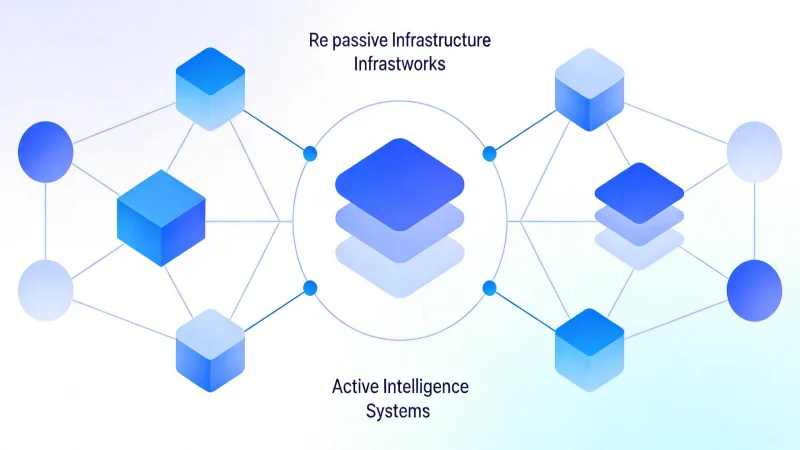
For the past three decades, enterprise networks have operated under a relatively stable paradigm: they were the plumbing—essential, invisible, and largely static. The rise of artificial intelligence is shattering this assumption. We are entering an era where the network is no longer merely a transport mechanism for applications but becomes an active, intelligent participant in the very fabric of enterprise operations.
This shift represents a fundamental architectural reckoning. The enterprise network of 2030 will look nothing like the network of today. It will be characterized by three transformative forces: the embedding of AI into network infrastructure itself, the emergence of autonomous agents as first-class network citizens, and the complete reimagining of security and connectivity paradigms for an AI-native world.
Part I: The Technical Foundation—How AI is Rewiring Network Infrastructure
From SD-WAN to AI-Native Networking
The transition from traditional WAN architectures to software-defined networking (SD-WAN) represented the last major evolution in enterprise networking. SD-WAN brought centralized control, policy-based routing, and improved cloud connectivity. But it remained fundamentally reactive—a system designed to follow rules written by humans.
AI-native networking represents a paradigm shift. Instead of human operators defining static policies, AI systems continuously analyze network telemetry, predict demand patterns, and dynamically reconfigure network resources in real-time. This shift is enabled by three technological advances:
First, the proliferation of network telemetry has created unprecedented visibility. Modern networks generate petabytes of data about packet flows, latency patterns, congestion events, and security anomalies. AI models, particularly large language models adapted for time-series analysis, can process this data at scales impossible for human operators.
Second, closed-loop automation systems are maturing. These systems don't just detect anomalies—they autonomously remediate them. When a critical application experiences degradation, AI systems can instantly reroute traffic, adjust QoS policies, or spin up additional bandwidth without human intervention.
Third, the integration of AI with intent-based networking (IBN) is finally delivering on long-promised capabilities. Network operators express business intent—"ensure video conferencing maintains 99.99% availability during Pacific Rim business hours"—and AI systems continuously translate that intent into dynamic network configurations.
The Compute-Network Symbiosis
Perhaps the most profound technical shift is the breakdown of traditional boundaries between compute and network. The rise of distributed AI workloads is forcing this convergence. Training large language models requires massive GPU clusters with specialized networking fabrics. Inference workloads are increasingly distributed across edge locations, cloud regions, and on-premises infrastructure.
This has given rise to what industry analysts call "AI fabrics"—networks designed specifically for distributed AI workloads. These fabrics incorporate features like:
- In-network computing: Where network switches perform aggregation and reduction operations traditionally handled by servers
- Adaptive routing: That dynamically balances traffic across multiple paths to prevent congestion in all-to-all communication patterns common in distributed training
- Programmable data planes: That allow AI workloads to directly interact with network forwarding logic
The implications for enterprise network architects are significant. They can no longer treat network and compute as separate domains. Infrastructure teams must evolve into integrated platform teams that understand the intimate relationship between AI workload patterns and network behavior.
Part II: The Model Dimension—How AI Development is Shaping Network Demand
The Changing Nature of AI Workloads
Understanding the future of enterprise networks requires understanding how AI models themselves are evolving. Three trends in AI development have profound implications for network architecture.
Trend One: The Growth of Multimodal Models
Early enterprise AI deployments focused on text-based models. Today, multimodal models that process text, images, video, and audio simultaneously are becoming standard. This shift dramatically changes network requirements. A single multimodal inference request might involve loading large image embeddings, streaming video frames, and generating text responses—all with strict latency requirements. Networks must support highly variable bandwidth demands with consistent quality of service.
Trend Two: The Rise of Compound AI Systems
Enterprises are moving beyond single-model deployments toward compound AI systems—architectures that chain multiple models together with retrieval-augmented generation (RAG), routing logic, and validation steps. A typical enterprise AI application might involve: a routing model directing queries to specialized sub-models, a retrieval system pulling context from vector databases, multiple LLMs generating candidate responses, and a verification model checking outputs.
For networks, this creates complex communication patterns. Instead of simple client-to-model traffic, we see model-to-model communication, model-to-database traffic, and orchestration overhead. Network latency becomes multiplicative—a 10ms delay in one component of a five-step chain becomes a 50ms impact on end-user experience.
Trend Three: The Shift Toward Reasoning Models
The emergence of reasoning-focused models (such as OpenAI's o1 series) introduces a new architectural pattern. These models perform extensive internal chain-of-thought reasoning before generating outputs, creating highly variable and unpredictable inference durations. Traditional load-balancing approaches that assume consistent per-request resource consumption break down. Networks must support bursty, unpredictable traffic patterns while maintaining predictability for interactive applications.
Edge vs. Cloud: A New Equilibrium
Early AI deployments were heavily centralized—massive cloud clusters for training and inference. The economic and latency realities of AI are driving a new distribution model.
Training will remain largely centralized. The capital expenditure required for training clusters, combined with the efficiency gains from scale, means training will concentrate in purpose-built facilities. However, inference is rapidly distributing. Several factors drive this: data residency requirements, latency sensitivity for real-time applications, bandwidth costs for moving large datasets, and the growing capabilities of edge hardware.
This creates a new network architecture pattern that industry observers call "AI mesh"—a distributed network connecting:
- Hyperscale training clusters
- Regional inference hubs
- Edge inference nodes at enterprise locations
- On-premises infrastructure for sensitive workloads
The enterprise network of the future must seamlessly interconnect these layers, with intelligent routing that considers cost, latency, compliance, and availability. This represents a significant departure from current architectures, which typically assume a primary cloud provider as the center of gravity.
Part III: The Agentic Revolution—Personal and Enterprise Agents as Network Citizens
The Emergence of Agentic Traffic
The most disruptive change on the horizon is the rise of autonomous agents as first-class network citizens. Today, network traffic originates from humans using applications. Tomorrow, a substantial portion of enterprise network traffic will consist of agents interacting with agents, with minimal human involvement.
This shift is already visible in early deployments. Customer service agents handling routine inquiries, procurement agents negotiating with supplier systems, research agents synthesizing information from multiple sources—these agents operate continuously, often without direct user interaction.
For network architects, agentic traffic introduces fundamentally new patterns:
Volume and Persistence: A single human user might spawn dozens of agents simultaneously, each maintaining persistent connections to various services. Traditional assumptions about concurrent connection counts, session durations, and traffic patterns become obsolete.
Peer-to-Peer Agent Communication: While current architectures assume client-server patterns, agents will increasingly communicate directly with other agents. A procurement agent might need to negotiate directly with multiple supplier agents simultaneously, creating bursty peer-to-peer traffic patterns that traditional enterprise networks are not optimized to handle.
Orchestration Complexity: Agent workflows create complex dependency chains. A research agent might spawn analysis sub-agents, which spawn data-collection sub-agents. Network failures can cascade through these dependency chains in unpredictable ways.
Identity and Authentication: Agents need their own identity and authentication mechanisms. Traditional user-centric security models break when traffic originates from autonomous software entities. The network must support machine identities at scale, with granular authorization policies that distinguish between different agents operating on behalf of the same user.
Personal Agents: The Network's New Frontier
Consumer and enterprise AI agents are beginning to converge. The same personal agents that help consumers manage schedules and communications are being integrated into enterprise workflows. This convergence creates new network challenges.
Personal agents maintain persistent, context-rich relationships with their users. When these agents interact with enterprise systems, they blur traditional boundaries between personal and corporate networks. Network architects must design systems that can accommodate personal agents accessing enterprise resources while maintaining security and compliance.
This requires new approaches to identity federation, context-aware access control, and data segregation. The network must understand not just who is making a request, but which agent is making it, for what purpose, and with what context.
Enterprise Agents: The New Workload Class
Enterprise agents represent a distinct workload class with unique network requirements. Unlike traditional applications designed for human interaction, enterprise agents operate at machine scale and machine speed.
These agents fall into several categories:
- Automation agents: Execute predefined workflows across multiple systems
- Orchestration agents: Coordinate complex multi-step processes involving multiple AI models and data sources
- Monitoring agents: Continuously observe system behavior and trigger responses
- Security agents: Detect and respond to threats autonomously
- Network agents: Manage and optimize network infrastructure
What distinguishes these agents from traditional automated systems is their autonomy and adaptability. They make decisions, learn from outcomes, and adjust their behavior without human intervention. This creates network requirements focused on reliability, low latency, and high throughput for machine-to-machine communication.
The network must support agent-to-agent communication with extremely low latency—often sub-millisecond for tightly coupled agent workflows. It must provide predictable performance for time-sensitive agent coordination. And it must maintain visibility into agent traffic patterns for security and troubleshooting purposes.
Part IV: Security and Trust in the AI-Native Network
The Identity Crisis
Traditional network security is built on a foundation of user identity, device identity, and location. The AI-native network undermines all three pillars.
When agents act autonomously, who is responsible for their actions? When models generate responses that influence business decisions, how do we audit accountability? When traffic flows from unknown endpoints at unpredictable times, what does "trusted" even mean?
These questions are forcing a fundamental rethinking of network security architecture. Three principles are emerging:
Continuous Authentication: Rather than authenticate once and assume trust, the AI-native network continuously verifies every transaction. This extends beyond user authentication to include model provenance, agent authorization, and data lineage.
Zero Trust for Agents: Zero trust principles must extend to machine identities. Every agent request is treated as untrusted until verified, regardless of source. Agent identities must be cryptographically verifiable, with fine-grained authorization policies that reflect the agent's purpose and authority.
Observability as Security: In an environment where autonomous agents can take actions at machine speed, security cannot rely on human review. The network must provide comprehensive observability that enables AI-powered security systems to detect anomalies in real-time and respond autonomously.
The Data Governance Imperative
AI workloads introduce new data governance challenges that the network must address. Training data, model weights, inference inputs, and generated outputs all have different security requirements and compliance implications.
The network must enforce data governance policies at the infrastructure level. This includes:
- Ensuring sensitive training data never leaves approved locations
- Preventing unauthorized exfiltration of model weights
- Logging and auditing all inference requests for compliance
- Enforcing data residency requirements across distributed deployments
This represents a shift from network security focused on preventing unauthorized access to network security focused on ensuring appropriate data handling throughout the AI lifecycle.
Part V: The Road Ahead—Architectural Principles for AI-Native Networks
Principle One: Networks Must Be Intent-Driven
The complexity of AI-native environments makes manual network management impossible. Network operators must move from specifying configurations to specifying intent. The network should understand business priorities, application requirements, and security policies, then autonomously configure itself to achieve them.
This requires networks that can:
- Understand natural language descriptions of business intent
- Continuously validate that network behavior matches intent
- Automatically remediate when deviations occur
- Provide explainable reasoning about network decisions
Principle Two: Networks Must Be Programmable
AI workloads require network behavior that cannot be anticipated at design time. Networks must be deeply programmable, allowing AI systems and agents to dynamically influence network behavior through APIs.
This programmability must extend to:
- Data plane programmability for in-network computation
- Control plane programmability for dynamic routing decisions
- Management plane programmability for policy and configuration
Principle Three: Networks Must Be Observability-Native
In an environment where AI systems make autonomous decisions based on network conditions, observability is not optional. Networks must be designed to provide comprehensive, real-time visibility into all aspects of network behavior.
This includes:
- Rich telemetry at all layers of the stack
- Distributed tracing across complex AI workflows
- Predictive analytics that anticipate issues before they impact workloads
- Integration with AI observability platforms
Principle Four: Networks Must Be Distributed
The future enterprise network will not have a single center of gravity. It must seamlessly connect edge locations, cloud regions, colocation facilities, and on-premises infrastructure into a unified fabric.
This distributed architecture requires:
- Consistent policy enforcement across all locations
- Intelligent workload placement based on cost, latency, and compliance
- Seamless connectivity for agents regardless of location
- Resilience to failures in any single location
Principle Five: Networks Must Be Sustainable
The energy consumption of AI workloads is already a significant concern. As AI adoption scales, network infrastructure must be designed with sustainability as a primary constraint.
This means:
- Optimizing network paths for energy efficiency
- Enabling workload placement based on carbon intensity
- Designing hardware for improved power efficiency
- Providing visibility into network-related energy consumption
Conclusion: The Network as Strategic Asset
The transition to AI-native enterprise networks represents more than a technical upgrade—it is a strategic transformation. Organizations that treat the network as plumbing will find themselves unable to compete with those that treat the network as a strategic asset.
The winners in the AI era will be those who recognize that network architecture is inseparable from AI strategy. They will invest in intent-driven, programmable, observable, distributed, and sustainable networks. They will design for agentic traffic patterns and autonomous operations. And they will build security architectures that can handle the complexity of machine identities and AI-generated content.
For network professionals, this represents both an existential challenge and an unprecedented opportunity. The skills that defined networking for the past three decades—deep knowledge of routing protocols, configuration management, and troubleshooting—must be augmented with expertise in AI, data science, and software engineering. The network team of the future will be as much a software development team as an infrastructure team.
The AI era will not simply use enterprise networks—it will remake them. Organizations that embrace this transformation will build networks that are not just faster and more reliable, but fundamentally more intelligent: networks that learn, adapt, and evolve alongside the AI systems they support. In doing so, they will create the foundation for a new generation of enterprise capabilities that we can barely imagine today.
The network is no longer just connecting the enterprise. It is becoming the enterprise's nervous system—and in the AI era, a nervous system that cannot think, adapt, and act autonomously is no nervous system at all.
Get 3-5 key AI infrastructure signals weekly →
💬 Comments (0)