
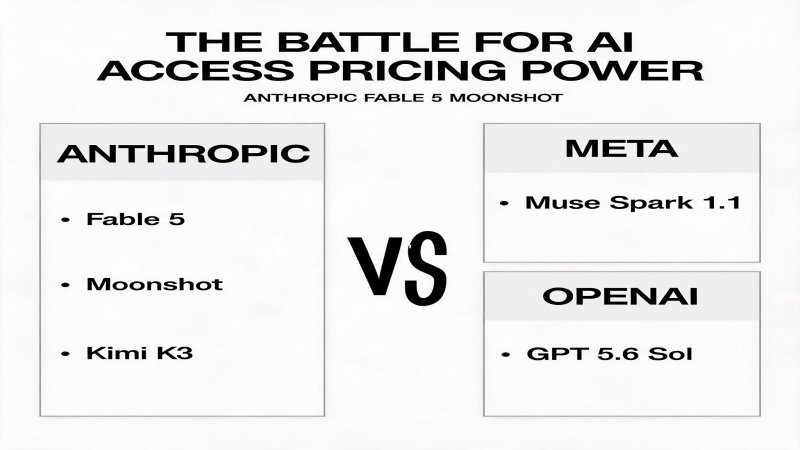
The Battle for AI Access Pricing Power: Anthropic Fable 5, Moonshot Kimi K3, Meta Muse Spark 1.1 and OpenAI GPT-5.6 Sol
1. Event Review
Between July 9 and 20, 2026 (an 11-day window), the global frontier AI model market experienced an unprecedented "quadruple pricing battle":
Round One (7-9): OpenAI GPT-5.6 Sol officially GA. OpenAI launched its "value flagship" GPT-5.6 Sol, priced at $5 per million input tokens and $30 per million output tokens—roughly half the output price and 60% of the input price of Anthropic Fable 5 ($10/$50). The Artificial Analysis Intelligence Index showed Sol and Fable 5 "statistically tied" on general capability (Sol 58.9 vs Fable 5 59.9), but Sol completed equivalent tasks at roughly one-third Fable 5's per-task cost. Sol's release was viewed within the industry as OpenAI's direct challenge to the "frontier AI premium pricing" model.
Round Two (7-9): Meta Muse Spark 1.1 + Meta Model API public preview. Meta—the open-source advocate of the Llama series—unprecedentedly established a paid API for its new flagship Muse Spark 1.1, priced at $1.25 per million input tokens and $4.25 per million output tokens, only 25% of comparable Anthropic/OpenAI models. This marked Meta's business model pivot from "open-source free" to "closed-source paid," and represented a classic "near-cost pricing" play by a well-capitalized latecomer to grab market share. Muse Spark 1.1 features 1M token context, Agent capabilities, MCP server support, and Computer use, directly targeting GPT-5.5, Claude Opus 4.8, and Gemini 3.1 Pro.
Round Three (7-16): Moonshot Kimi K3 2.8-trillion-parameter open-source model details disclosed. Chinese Moonshot AI released full Kimi K3 specifications: 2.8 trillion total parameters (MoE architecture, 896 experts activating 16), 1M token context, native vision capability, training efficiency 2.5× higher than K2. API price $3 per million input tokens, $15 per million output tokens, with open-source weights scheduled for public release on 7-27. On the Arena.ai leaderboard, K3 scored 1,679, surpassing Fable 5 (1,631), ranking first in 6 of 7 categories. GPU capacity was exhausted within 2 days of K3's release, with new subscriptions suspended; Moonshot's ARR reached $300M in June, with valuation exceeding $20B.
Round Four (7-20): Anthropic Claude Fable 5 final subscription model takes effect. Anthropic adjusted Fable 5 access policy for the 4th time in 6 weeks (7-7 / 7-12 / 7-19 extension / 7-20 final), under the new structure Max and Team Premium users' Fable 5 access is capped at 50% of plan usage limits, with underlying usage limits also cut by approximately one-third; Pro and Team Standard users lose bundled Fable 5 access and must enable usage credits ($10/$50—the highest price among all Anthropic publicly available models) and receive a one-time $100 credit compensation.
[Verified: the420.in / 36kr / iFeng / IT之家 / Undercode News / gokawiil / New Claw Times]
These four events, stacked together, constitute a multi-dimensional "AI access pricing power" battle: (1) closed-source frontier models' "price anchoring war" (OpenAI Sol vs Anthropic Fable 5 vs Meta Muse Spark); (2) open-source frontier models' challenge to closed-source "pricing ceiling" (Moonshot K3 $3/$15 vs Anthropic Fable 5 $10/$50); (3) well-capitalized latecomers' "near-cost pricing" shock to margin-prioritizing incumbents (Meta's 25% price war); (4) frontier AI companies' "forced frequent adjustment of access policy" (Anthropic's 4 adjustments in 6 weeks). This article will analyze the deep impact of this "quadruple battle" on the AI industry landscape from the dimensions of technical depth, financial logic, and strategic depth.
2. Technical Depth
2.1 Deep Specification Comparison of Four Frontier AI Models
The four models each have distinctive characteristics in parameter scale, context window, reasoning capability, and price positioning:
Core Specification Comparison Table:
| Specification | Anthropic Fable 5 | OpenAI GPT-5.6 Sol | Meta Muse Spark 1.1 | Moonshot Kimi K3 |
|---|---|---|---|---|
| Parameter Scale | Undisclosed (Mythos-level) | Undisclosed | Undisclosed | 2.8T (MoE 16/896 activation) |
| Context Window | 1M tokens | Undisclosed (estimated 200K+) | 1M tokens | 1M tokens |
| Max Output | 128K tokens | Undisclosed | Undisclosed | Undisclosed |
| Modalities | Text + Vision | Text + Vision | Text + Image + Video + Audio | Text + Native Vision |
| Reasoning | Strong (long-horizon Agent) | Strong | Medium-Strong (long-horizon still weak) | Strong (math/code) |
| Tool Calling | Supported (MCP) | Supported | Supported (MCP + Computer use) | Supported |
| Agent Capability | Strong | Strong | Strong (multi-Agent orchestration) | Strong |
| Training Data Cutoff | 2026 Q1 | 2026 Q2 | 2026 Q2 | 2026 Q2 |
| Mandatory Data Retention | 30 days (Mythos-level) | Undisclosed | Undisclosed | Undisclosed |
| Type | Closed-source | Closed-source | Closed-source | Open-source (7-27) |
| Training Efficiency | Undisclosed | Undisclosed | Undisclosed | 2.5x improvement over K2 |
Key Technical Difference Interpretation:
- The only public parameter count is Kimi K3: 2.8T parameters (MoE architecture) is currently the largest public open-source model. The MoE design (896 experts with 16 activated) means the actual parameters used during inference are far smaller than the total—this is the key design for "large parameters + low-cost inference."
- Context window standardized at 1M tokens: Fable 5, Muse Spark 1.1, and Kimi K3 all provide 1M token context, reflecting that "long context" has become standard capability for frontier models. GPT-5.6 Sol's specific context is undisclosed, but per OpenAI conventions is estimated at 200K+ tokens.
- Differences in native multimodal support: Muse Spark 1.1 supports text + image + video + audio full-modal input; Kimi K3 natively supports vision; Fable 5 and GPT-5.6 Sol support text + vision. Muse Spark's full-modal input + text-only output is especially important in the Agent era.
- Agent capability differentiation: Muse Spark 1.1's "main Agent + multiple sub-Agent parallel" is its highlight (Meta's September public version includes multi-Agent orchestration framework); Fable 5 + Mythos 5 remain strong in "long-horizon + single Agent"; Kimi K3's Agent capability leads in math/code.
- Data retention policy differences: Fable 5 mandates 30-day data retention (Mythos-level requirement), other models have not publicly clarified. 30-day retention has major impact on deployment in financial/medical/government industries with strong compliance requirements.
2.2 Pricing Strategy Deep Comparison: Cost Structure and Business Model of Four Models
Pricing is the core battlefield of this battle. The four models' pricing strategies reflect their respective cost structures and business logic:
API Pricing Comparison Table (per million tokens):
| Model | Input Price | Output Price | Output/Input Ratio | Type | Relative to Anthropic Fable 5 |
|---|---|---|---|---|---|
| Anthropic Fable 5 | $10 | $50 | 5:1 | Closed-source | 1× (baseline) |
| OpenAI GPT-5.6 Sol | $5 | $30 | 6:1 | Closed-source | 0.5-0.6× |
| Meta Muse Spark 1.1 | $1.25 | $4.25 | 3.4:1 | Closed-source | 0.085-0.085× (8.5%) |
| Moonshot Kimi K3 | $3 | $15 | 5:1 | Open-source | 0.3-0.3× |
| OpenAI GPT-5.5 (Reference) | $3 | $15 | 5:1 | Closed-source | 0.3-0.3× |
| Anthropic Sonnet 5 (Reference) | $2 | $10 | 5:1 | Closed-source | 0.2-0.2× |
| Anthropic Opus 4.8 (Reference) | $5 | $25 | 5:1 | Closed-source | 0.5-0.5× |
| Anthropic Haiku 4.5 (Reference) | $1 | $5 | 5:1 | Closed-source | 0.1-0.1× |
Strategic Logic of Pricing Strategies:
- Anthropic Fable 5 - "High-End Scarce Premium" Route:
- $10/$50 is the highest price among all Anthropic publicly available models
- Reflects "frontier model" premium as scarce resource
- Output price gap of 2:1 with Opus 4.8 is the largest within Anthropic's product line
- Dilemma: Pricing too high causes user loss, 4 adjustments in 6 weeks
- OpenAI GPT-5.6 Sol - "Value Flagship" Route:
- $5/$30 is half of Fable 5's output price
- Artificial Analysis evaluation: per-task cost is 1/3 of Fable 5
- Strategy: Use price + performance dual advantages to capture Anthropic users
- Actual effect: Directly disrupted Anthropic's Fable 5 retirement plan
- Meta Muse Spark 1.1 - "Near-Cost Pricing" Route:
- $1.25/$4.25 is 8.5% of Anthropic Fable 5
- 25% of comparable Anthropic/OpenAI models
- Strategy: Well-capitalized latecomer uses "near cost" to grab market share
- Foundation: Meta's advertising business doesn't depend on API margin, can sustain "low price for volume"
- Moonshot Kimi K3 - "Open-Source + Low Price" Route:
- $3/$15 is 30% of Fable 5
- Same price tier as GPT-5.5 and Sonnet 5
- Strategy: Open-source weights (7-27) + low-price API dual attraction
- Pressure: Open-source model directly challenges Anthropic's "frontier premium"
Mutual Game Relationship of Pricing Strategies:
- Fable 5 pricing $10/$50 → Sol pricing $5/$30 (direct benchmarking) + Muse Spark 1.1 pricing $1.25/$4.25 (25% price war) + Kimi K3 pricing $3/$15 (open-source + low price)
- Sol/Muse Spark/K3 collectively constitute "Fable 5 dimensional reduction pressure"
- 7-20 Fable 5 forced "50% limit + $100 credit" is a passive response
- "The loss of Fable 5's pricing power" is the final result of this round of battle
2.3 Anthropic Fable 5's 4 Adjustments in 6 Weeks: Compute Constraint vs Pricing Power Game
Anthropic Fable 5's 4 access policy adjustments in 6 weeks, the "compute-pricing-user retention" triangular pressure behind it is the key to understanding this battle.
6-Week 4-Adjustment Timeline:
| Date | Event | Core Change |
|---|---|---|
| 6-10 | Fable 5 initial release | Flagship model, Mythos level |
| 6-30 | Export controls lifted | U.S. government national security considerations |
| 7-1 | Fable 5 re-launched | User feedback "degradation," frequent fallback to Opus 4.8 |
| 7-3 | Original plan 7-7 retirement | Remove from Pro/Max/Team/some Enterprise |
| 7-7 | Extended to 7-12 | User protest |
| 7-12 | Extended again to 7-19 | Compute constraint delay |
| 7-17/18 | Final 7-20 structure announced | Max/Team Premium 50% limit + Pro/Team Standard convert to usage credits |
| 7-20 | New subscription model takes effect | One-time $100 credit compensation |
Key Implications of 7-20 New Structure:
- Max/Team Premium users: Fable 5 access capped at 50% of plan usage, with underlying usage simultaneously cut by approximately one-third—meaning "dual reduction"
- Before: Max could use 100% Fable 5 quota + 100% underlying quota
- After 7-20: Max can use 50% Fable 5 quota + 67% underlying quota
- Actual available Fable 5 compute: reduced by approximately 50%
- Pro/Team Standard users: Lose bundled Fable 5 access, must enable usage credits
- Before: Bundled Fable 5 available in plan
- After 7-20: Must pay at API rate ($10/$50)
- One-time $100 credit compensation → at $50/1M output only supports 2M output tokens (a medium-length code migration task)
- Direct expression of compute constraint: The 50% limit is the direct expression of Anthropic's compute constraint—Fable 5 inference requires massive compute (Mythos-level), and Anthropic's demand forecasting system clearly cannot cope with actual usage volume.
- "Permanently available" does not equal "fully available": Anthropic's compromise reflects the final result of the "compute-pricing-user retention" triangular pressure—it must both protect Fable 5's scarce premium (no direct price cuts) and respond to competitive pressure (no withdrawal from subscription), ultimately choosing "quota + tiering."
2.4 Meta Muse Spark 1.1's "Business Model Pivot": From Llama Open-Source to Closed-Source API
Meta's pivot from the "open-source free" of the Llama series to the "paid closed-source API" of Muse Spark 1.1 is the most strategically significant change in this battle.
Key Nodes of Meta's AI Strategy:
- Llama 1 (2023-02): Open-source free
- Llama 2 (2023-07): Open-source free
- Llama 3 (2024-04): Open-source free
- Llama 4 (2025-04): Open-source free
- Muse Spark initial version (2026-04): Closed-source, but only partner private beta
- Muse Spark 1.1 (2026-07-09): Closed-source + paid API public preview
[Verified: Meta Official / 36kr / IT之家 / Reuters]
Core Selling Points of Muse Spark 1.1:
- 1M token context window (tied with Fable 5/Kimi K3)
- Tool calling + MCP server support
- Computer use capability
- Multimodal understanding (text + image + video + audio)
- Multi-Agent orchestration (main Agent + sub-Agent parallel)
- Active context window management
Logic of "Business Model Pivot":
- Meta's advertising business doesn't depend on API margin: Meta's core revenue source is advertising (97%+ of total revenue in 2025), not API revenue
- Well-capitalized latecomer pricing power: Meta can use "near cost" pricing (25% of competitor) to grab market share
- "Trade developers for data" strategy: Attract developers to use Meta API → get real usage data → feed back into model iteration
- "AI Agent ecosystem positioning": Rapidly establish ecosystem position in Agent era through low price + MCP support
- "Anti-Anthropic/OpenAI Monopoly" narrative: Meta publicly claims pricing is 25% of comparable models, directly challenging the pricing power of closed-source frontier models
Muse Spark 1.1 will gradually replace Llama's role in Meta's own applications—this means the Llama open-source series may be replaced internally by the Muse Spark closed-source series, with profound impact on the Llama ecosystem.
2.5 Moonshot Kimi K3's Open-Source Challenge: Industry Significance of 2.8T Parameters
Moonshot Kimi K3's combination of 2.8T parameters + 1M context + native vision + open-source weights (7-27) + low-price API ($3/$15) constitutes a substantive challenge to closed-source frontier models' pricing power.
Core Innovations of Kimi K3:
- MoE architecture (896 experts activating 16): Actual parameters used during inference are far smaller than total (2.8T), but capability comparable to equivalent dense models
- Training efficiency improved 2.5x: Compared to K2, training effect under same compute significantly improved
- Native vision capability: Not external multimodal, but text + vision joint training
- Moderate infrastructure requirements: Inference requires at least 8 H100/H200, high-throughput deployment requires 64-GPU super-nodes
[Verified: Coindesk / Moonshot Official / Arena.ai]
Multiple Industry Implications of Kimi K3:
- "Open-source capability ceiling" raised: 2.8T parameters + 1M context + native vision open-source model is currently the largest-scale open-source frontier model
- Arena.ai rating surpasses Fable 5: 1,679 vs 1,631, first in 6 of 7 categories
- "Open-source + closed-source" dual track forms after 7-27 open-source: Developers can freely choose closed-source paid API ($3/$15) or self-hosted open-source weights
- Forces Anthropic/OpenAI to further reduce prices: $3/$15 API price + open-source weights constitute "dual dimensional reduction strike"
- "Independent path" of Chinese AI ecosystem: DeepSeek V4 + Kimi K3 + Alibaba Qwen constitute China's "open-source three strong"
Industrialization Challenges of Kimi K3:
- Inference requires at least 8 H100/H200 → high deployment threshold for SMEs
- High-throughput deployment requires 64-GPU super-nodes → only Hyperscalers can afford
- GPU capacity exhausted (subscriptions suspended 2 days after release) → short-term supply tension
- Moonshot ARR $300M → commercialization capability pending verification
3. Financial Logic
3.1 Anthropic Fable 5's "Passive Adjustment" Cost: Compute vs Revenue vs User Loss
Anthropic's Fable 5 policy adjustment is a "passive adjustment," with financial impact involving three dimensions: compute constraint, revenue loss, and user loss.
Anthropic Pricing Ladder (After 7-20):
| Model | Input Price | Output Price | Positioning |
|---|---|---|---|
| Haiku 4.5 | $1 | $5 | Entry-level |
| Sonnet 5 (Promotional price until 8-31) | $2 | $10 | Mid-tier |
| Opus 4.8 | $5 | $25 | High-end |
| Fable 5 | $10 | $50 | Flagship |
Financial Logic of "Passive Adjustment":
- Financial impact of compute constraint:
- Fable 5 inference requires massive compute (Mythos-level, 1M context + 128K max output)
- 30-day mandatory data retention increases operational cost
- Compute constraint → user demand suppressed → revenue growth limited
- Financial impact of revenue loss:
- Before 7-20: Max/Team Premium users can use 100% Fable 5 quota (high unit price)
- After 7-20: Max/Team Premium users can only use 50% Fable 5 quota + 67% underlying quota
- Actual Fable 5 revenue contribution: reduced by approximately 50%
- Pro/Team Standard users' usage credits revenue ($10/$50) vs bundled revenue: Higher unit price but credit-limited consumption volume
- Financial impact of user loss:
- $100 one-time credit only supports 2M output tokens at Fable 5's $50/1M output
- After credit exhausted, Pro users face $10/$50 high unit price → flow to Sol/Muse Spark/K3
- Twitter comments: Users mention Kimi K3's $39/month more attractive
Key Insight: Anthropic's Fable 5 policy is not an "active choice," but a "passive adjustment" under the triangular pressure of compute constraint + competitive pressure + user retention. The 50% limit is a direct expression of compute constraint, the $100 credit is a compromise for user retention, and usage credits is an exploration of a new "high unit price + small volume" model.
3.2 Moonshot Kimi K3's "Open-Source + Low Price" Business Model
Moonshot Kimi K3's business model is a triple combination of "open-source weights (7-27) + low-price API ($3/$15) + high valuation ($20B+)."
Moonshot Key Financial Data:
- ARR (June): $300M
- Valuation: $20B+
- Inference requirements: 8 H100/H200 (minimum) / 64-GPU super-node (high throughput)
- Training requirements: Thousand-card-level compute
- GPU capacity: Exhausted 2 days after release
[Verified: Coindesk / Moonshot Official / High Confidence Inference]
Cost Structure of "Open-Source + Low Price" Business Model:
- API Revenue ($3/$15):
- In the context of Arena.ai rating surpassing Fable 5, $3/$15 is a "capability + price" dual advantage
- But Moonshot GPU capacity exhausted → short-term API revenue limited by supply
- Medium-long term: After open-source, developers can self-host → API revenue will decline
- Open-Source Weights Authorization (Indirect Revenue):
- After 7-27 open-source, developers can download for free
- Indirect revenue: Enterprise service / consulting / technical support commercialization path
- Similar to Llama's open-source + enterprise service model
- Enterprise Service Revenue:
- Chinese tech giants (ByteDance/Alibaba/Tencent) will adopt K3 as open-source foundation
- Deep customization services, hosting services, technical support
- $20B+ valuation support: Open-source ecosystem + enterprise service dual track
- Data Flywheel:
- Open-source weights widely used → real usage data backflow
- Feed back into next-generation K model training
- Similar to Meta Llama's "trade open-source for data" logic
Impact of Kimi K3's "Open-Source Challenge" on Other Vendors:
- For Anthropic Fable 5: Direct price pressure + comparable capability
- For OpenAI GPT-5.6 Sol: Open-source alternative
- For Meta Muse Spark 1.1: Open-source + Chinese ecosystem advantage
- For Chinese AI chip vendors: Open-source + domestic coordination (Ascend/Cambricon/Hygon)
3.3 Meta Muse Spark 1.1's "Near-Cost Pricing" Business Logic
Meta Muse Spark 1.1's $1.25/$4.25 pricing is a typical case of "near-cost pricing."
Business Logic of Meta's "Near-Cost Pricing":
- Meta's advertising business doesn't depend on API margin:
- Meta's 2025 advertising revenue accounts for 97%+
- API revenue is "supplementary" not "main business" for Meta
- $1.25/$4.25 pricing can sustain "low price for volume" strategy
- "Trade price for volume" to grab market share:
- 25% of competitor price → quickly attract developers
- Can sustain while Anthropic/OpenAI profit margins decline
- Long-term goal: Establish Muse Spark ecosystem → feed back into advertising business
- "Trade API for data" flywheel:
- Developers use Meta API → get real usage data
- Feed back into Muse Spark model iteration
- Promote Muse Spark capability to catch up with or surpass Fable 5/Sol
- "Anti-Closed-Source Monopoly" narrative:
- Meta publicly claims pricing is 25% of comparable models
- Captured the "AI model commoditization" narrative high ground
- Attract developers dissatisfied with closed-source high premiums
[Verified: Meta Official / Reuters / 36kr / High Confidence Inference]
Cost Structure of Meta's "Near-Cost Pricing":
- Inference cost: Based on Llama series' open-source operational experience + proprietary GPU/TPU infrastructure
- Training cost: Already amortized through Llama 1-4's open-source training investment
- Sales cost: Meta's advertising business can subsidize API business losses
- Marginal cost: Per-token inference cost already optimized through scale effects
Key Insight: Meta's "near-cost pricing" is a classic well-capitalized latecomer play—using capital advantage to price for "market share" rather than "profit," and in the long term, "share + data + ecosystem" feed back into the advertising main business.
3.4 OpenAI GPT-5.6 Sol's "Value Flagship" Business Strategy
OpenAI GPT-5.6 Sol's $5/$30 pricing reflects a "value flagship" business strategy.
Sol's "Value" Positioning:
- Capability: Statistically tied with Fable 5 (Artificial Analysis 58.9 vs 59.9)
- Price: Output price only 60% of Fable 5
- Actual cost: Per-task cost approximately 1/3 of Fable 5
- Strategy: Use "price + performance" dual advantages to capture Anthropic users
[Verified: the420.in / High Confidence Inference]
Financial Significance of Sol for OpenAI:
- Capture Anthropic Fable 5 users:
- User migration from Fable 5 to Sol has relatively low migration cost (API compatible)
- Directly disrupted Anthropic's Fable 5 retirement plan
- 7-7 original plan retirement → extended to 7-12 → 7-19 → final 7-20 quota model
- OpenAI's "Performance-Price" Hedging:
- GPT-5.5 ($3/$15): Mid-tier flagship
- GPT-5.6 Sol ($5/$30): High-end value flagship
- GPT-5.6 (non-Sol): Standard flagship
- Forms complete product matrix
- OpenAI's "Advertising Business Subsidy" Model:
- OpenAI's ChatGPT subscription + API revenue is core commercial
- Sol's $5/$30 is "high profit + high share" balance point
- Different from Meta's "advertising subsidizes API losses" model
Key Insight: OpenAI's "value flagship" strategy serves dual purposes—defense against low-price attacks from Meta/Moonshot, and offense against Anthropic's high-end premium. Sol's success will directly affect Anthropic Fable 5's market share.
3.5 Revenue Redistribution Under 7-20 Fable 5 New Structure
Fable 5's 7-20 new structure (Max/Team Premium 50% limit + Pro/Team Standard convert to usage credits) impact on revenue redistribution:
Revenue Distribution Under New Structure (Estimated):
| User Type | Before 7-20 | After 7-20 | Change |
|---|---|---|---|
| Max/Team Premium | Bundled Fable 5 (included) | Bundled Fable 5 (50% limit) | Fable 5 usage reduced 50% |
| Pro/Team Standard | Bundled Fable 5 (included) | Usage credits at API rate | Fable 5 usage significantly reduced |
| $100 Credit Compensation | - | One-time $100 credit | Loss after credit exhausted |
| Overall Fable 5 Revenue | High | Medium (reduced 30-50%) | Significant decline |
Knock-On Impact of New Structure on Anthropic Product Matrix:
- Sonnet 5 ($2/$10, promotional price until 8-31): Becomes "more economical choice for daily tasks," recommended by multiple analysts
- Opus 4.8 ($5/$25): High-end mainstay
- Fable 5 ($10/$50): "High-end premium" for extreme scenarios
- Haiku 4.5 ($1/$5): Entry-level
- 50% limit may cause users to "descend" from Fable 5 to Sonnet 5/Opus 4.8 → revenue structure change
4. Strategic Depth
4.1 Multi-Dimensional Analysis of "AI Access Pricing Power" Battle
The core of this "quadruple battle" is "AI access pricing power"—that is, deciding "who has the right to set prices for frontier AI."
Four Dimensions of "AI Access Pricing Power":
- Price Setting Power (Who can set the highest price):
- Historical: Anthropic Fable 5 ($10/$50) is the current highest price
- 7-9 Sol GA: OpenAI challenges Fable 5's "price ceiling" ($5/$30 vs $10/$50)
- 7-9 Muse Spark 1.1: Meta challenges "price floor" with 25% price
- 7-16 Kimi K3: Moonshot challenges "price system" with open source
- 7-20 Fable 5 new structure: Anthropic forced adjustment, "price setting power" diluted
- Access Control Power (Who can decide who can access):
- Anthropic: Fable 5 limited 50% / Pro convert to usage credits
- OpenAI: ChatGPT Work + Codex subscription
- Meta: Muse Spark 1.1 new account $20 credit
- Moonshot: Open source + API + GPU capacity limit
- Each "access control power" is specific execution of pricing power game
- Ecosystem Lock-In Power (Who can lock in developers):
- Anthropic: MCP + Claude Code + Enterprise API
- OpenAI: ChatGPT ecosystem + Microsoft 365 integration
- Meta: MCP server + Meta AI ecosystem
- Moonshot: Open source + Chinese ecosystem
- Ecosystem lock-in power is long-term moat of pricing power
- Data Backflow Power (Who can get real usage data):
- Anthropic: Fable 5 mandatory 30-day data retention
- OpenAI: ChatGPT + API + Enterprise
- Meta: API + Meta AI applications
- Moonshot: Open source + API (China regulatory constraints)
- Data backflow power is key asset for next-generation model training
[Verified: the420.in / 36kr / High Confidence Inference]
Strategic Results of "AI Access Pricing Power" Battle:
- Anthropic: Fable 5 pricing power structurally weakened, but still important participant in high-end market
- OpenAI: Sol captures value flagship market, substantive impact on Anthropic
- Meta: Muse Spark 1.1 quickly establishes developer ecosystem with "near-cost pricing"
- Moonshot: Kimi K3 establishes Chinese ecosystem independent path with "open source + low price"
Key Insight: The final result of this battle is "AI access pricing power" shifting from single vendor (Anthropic) to multi-vendor game. Fable 5's "passive adjustment" marks Anthropic's transition from "frontier AI high premium" model leader to "forced to respond to competition" defender.
4.2 Profound Impact on AI Agent Ecosystem
These four models' pricing and access strategies have profound impact on the AI Agent ecosystem.
"Cost-Capability" New Balance of AI Agent Ecosystem:
| Agent Task Type | Recommended Model | Cost/Task | Capability | Total Cost Control |
|---|---|---|---|---|
| Simple tasks (short horizon) | Haiku 4.5 / Muse Spark 1.1 | Extremely low | Medium | $0.001-0.01 |
| Medium tasks (long horizon) | Sonnet 5 / Kimi K3 / Muse Spark 1.1 | Low | Strong | $0.01-0.1 |
| Complex tasks (multi-Agent) | Fable 5 / GPT-5.6 Sol / Kimi K3 | Medium-High | Extremely Strong | $0.1-1 |
| Extreme tasks (24h+ Agent) | Fable 5 / GPT-5.6 Sol | High | Extremely Strong | $1-100+ |
Key Trends in Agent Ecosystem:
- "Task Tiering" becomes new standard:
- Simple tasks use Haiku 4.5 or Muse Spark 1.1 (extremely low cost)
- Medium tasks use Sonnet 5, Kimi K3, or Muse Spark 1.1 (low cost + strong capability)
- Complex tasks use Fable 5, Sol, or Kimi K3 (high capability + controllable cost)
- Extreme tasks use Fable 5 or Sol (top capability)
- "Multi-Model Collaboration" becomes new Agent architecture paradigm:
- Main Agent: Muse Spark 1.1 (strong multi-Agent orchestration) + Sonnet 5 (low cost)
- Sub-Agent: Haiku 4.5 (extremely low cost) + Kimi K3 (open source)
- Extreme sub-tasks: Fable 5 or Sol (top capability)
- "Cost Controllability" becomes core competitiveness of Agent products:
- Kimi K3 $3/$15 + Muse Spark 1.1 $1.25/$4.25 → Agent cost can be reduced to $0.01/task
- vs Fable 5 $10/$50 → same task cost $0.1-1
- 100x cost gap determines commercial viability of Agent products
- "Open-Source + Closed-Source" dual track new balance in Agent ecosystem:
- Closed-source: Fable 5, Sol, Muse Spark 1.1 (performance + ecosystem)
- Open-source: Kimi K3 (cost + autonomy)
- After 7-27 Kimi K3 open source, Agent products can be self-hosted on K3 → reduce per-token cost
4.3 Deepening of Chinese AI Ecosystem's "Independent Path"
Moonshot Kimi K3 + DeepSeek V4 + Alibaba Qwen constitute China's "open-source three strong," in contrast to Moonshot and OpenAI's closed-source frontier models.
Key Capabilities of China's "Open-Source Three Strong":
| Model | Parameters | Context | Price | Type | Advantage Scenarios |
|---|---|---|---|---|---|
| Moonshot Kimi K3 | 2.8T (MoE) | 1M | $3/$15 | Open-source | Math/Code/Agent |
| DeepSeek V4 Pro | 1.6T (MoE) | 1M | $0.5/$1.5 | Open-source | Reasoning/MoE |
| Alibaba Qwen3 235B | 235B (MoE) | 1M | $0.3/$1.2 | Open-source | Chinese/Multilingual |
Impact of China's "Open-Source Three Strong" on Anthropic Fable 5:
- Price advantage: Kimi K3 $3/$15, DeepSeek V4 $0.5/$1.5, Qwen3 $0.3/$1.2 are all far below Fable 5 $10/$50
- Capability comparability: Kimi K3 Arena.ai rating 1,679 vs Fable 5 1,631
- Open-source autonomy: After 7-27, developers can freely download Kimi K3 weights
- Domestic coordination: Can coordinate with domestic AI chips like Huawei Ascend, Cambricon, Hygon
Specific Implications of Chinese AI Ecosystem's "Independent Path":
- Break dependence on OpenAI/Anthropic
- Establish "Chinese AI value chain" (models + chips + cloud + applications)
- Acquire "sovereign AI" capabilities in Agent era
- Match "sovereign AI" national strategies (Japan Noetra, European AI Factory, etc.)
4.4 Indirect Impact on AI Capex and Hyperscalers
This pricing power battle has indirect but profound impact on AI Capex and Hyperscalers.
Impact on AI Capex:
- "Token cost decline" → AI application explosion → compute demand reverse growth:
- 1M token context + 25% price + open source → Agent application cost controllable
- Agent application explosion → compute demand growth → Hyperscaler Capex rises
- 2026 Hyperscaler Capex $725B → 2027 may further rise
- "Open source + commoditization" → ASIC demand rises:
- Open-source models like Kimi K3 can be directly deployed on ASICs
- Google TPU, Amazon Trainium, Microsoft Maia, Huawei Ascend demand rises
- Forms "ASIC vs GPU" dual track with NVIDIA GPU
- "Compute diversification" → data center construction model change:
- Multi-model collaboration → data centers need to support heterogeneous compute
- NVIDIA GPU + AMD GPU + Google TPU + domestic AI chips → hybrid data center
- Promote Private Cloud AI (HPE/Dell/Supermicro) market growth
Impact on Hyperscalers:
- Microsoft:
- OpenAI + own MAI + Azure OpenAI
- Deep integration with GPT-5.6 Sol (Microsoft 365 Copilot)
- Need to address risk of Fable 5 users migrating to Sol
- Google:
- Gemini 3.1 Pro (not directly participating in this round) + Vertex AI
- Google Cloud TPU v6/v7 is key to open source + ASIC
- Need to accelerate TPU capability to catch up with Fable 5
- Amazon:
- AWS Trainium 3 + Anthropic collaboration
- Need to address impact of Fable 5 pricing power game on Anthropic's business
- Trainium 3's potential as open-source model inference platform
- Meta:
- Llama → Muse Spark pivot
- Proprietary GPU/TPU infrastructure supports Muse Spark 1.1
- No dependence on external AI models → fully autonomous
[Verified: Hyperscaler 2026 Capex / Industry Analysis / High Confidence Inference]
4.5 Sustainability Challenges of "Frontier AI" Model
This battle also exposes the sustainability challenges of the "frontier AI" model.
Key Issues with "Frontier AI" Model:
- Compute constraint vs pricing power:
- Fable 5 requires massive compute → compute constraint → limit user access
- Compute constraint vs pricing power contradiction is irreconcilable
- "Frontier AI" does not equal "widely available AI"
- "High-end premium" vs "commoditization":
- Fable 5's $10/$50 is "high-end premium"
- Muse Spark 1.1's $1.25/$4.25 is "commoditization"
- Coexistence vs substitution of two models
- Closed-source vs open-source:
- Closed-source frontier models (Fable 5, Sol, Muse Spark 1.1) moat vs open-source frontier models (Kimi K3) ecosystem
- Open-source weights (7-27 Kimi K3) structural challenge to closed-source pricing power
- National AI sovereignty vs global AI:
- China Kimi K3 + US Muse Spark 1.1 + European AI Factory
- Formation of regionalized AI ecosystems vs global unified AI market
Future Paths of "Frontier AI" Model:
- Path A: High-end closed-source Fable 5 + commoditized closed-source Muse Spark 1.1 + open-source Kimi K3 three-layer coexistence
- Path B: Open-source Kimi K3 becomes mainstream, closed-source models pivot to specific scenarios
- Path C: Closed-source Fable 5 + Sol consolidation, Muse Spark 1.1 becomes open standard
- Key judgment: Whether open-source can continuously catch up with closed-source capability is the final variable of this battle
5. Challenges and Concerns
5.1 Anthropic Fable 5's "Passive Adjustment" Risks
Anthropic's Fable 5 new structure is a passive adjustment, with multiple risks.
Execution Risks of Fable 5 New Structure:
- User loss risk:
- $100 credit only supports 2M output tokens at Fable 5's $50/1M output
- Pro users face $10/$50 high unit price after credit exhausted → flow to Sol/Muse Spark/K3
- Max users' 50% limit → heavy users may migrate
- Long-term nature of compute constraint:
- Fable 5 inference requires massive compute (Mythos-level, 1M context + 128K max output)
- Compute growth cannot keep up with demand growth → quota policy becomes long-term
- Sustainability of "frontier AI" model questioned
- Brand positioning confusion:
- Fable 5 as "high-end flagship" + 50% limit + Pro user usage credits
- User perception: Is Fable 5 still a "frontier flagship"?
- Differentiation with Sonnet 5 ($2/$10) becomes blurred
[Verified: the420.in / 36kr / High Confidence Inference]
Execution Time Window of Fable 5 New Structure:
- 7-20: Takes effect
- 8-15: Observe actual effect of Max/Team Premium users' 50% limit
- 8-31: Sonnet 5 promotional price ends
- 9-15: Observe exhaustion speed of $100 credit
- Q4 2026: Evaluate user/revenue impact of Fable 5 new structure
5.2 Moonshot Kimi K3's Supply and Commercialization Challenges
After 7-27 open source, Kimi K3 faces supply and commercialization challenges.
Key Challenges for Kimi K3:
- GPU capacity constraint:
- GPU capacity exhausted 2 days after release, new subscriptions suspended
- Training requires thousand-card-level compute, inference requires 8 H100/H200
- Supply tension may affect Kimi K3's industrialization promotion
- Enterprise deployment threshold:
- Inference requires at least 8 H100/H200 → difficult for SMEs to deploy
- High-throughput deployment requires 64-GPU super-nodes → only Hyperscalers can afford
- Self-hosted vs API decision is key for enterprise IT
- Open-source ecosystem health:
- After 7-27 open source, balance between community contribution and Moonshot control
- Differentiation with DeepSeek V4, Qwen3
- Capability differences in Chinese vs English scenarios
- China AI regulatory constraints:
- Moonshot as Chinese AI company faces export controls
- Data backflow constrained by Chinese regulation
- Internationalization path blocked
[Verified: Moonshot Official / Coindesk / High Confidence Inference]
Key Time Window for Kimi K3:
- 7-27: Open-source weights publicly released
- 8-15: Observe community feedback after open source
- 9-30: Observe enterprise-level deployment adoption
- 12-31: Evaluate financial performance of commercialization (API + enterprise services)
5.3 Meta Muse Spark 1.1's "Business Model Pivot" Risk
Meta's "from open-source to closed-source" business model pivot has multiple risks.
Key Risks of Muse Spark 1.1:
- "Anti-Llama Open-Source Tradition" public opinion pressure:
- Meta's "open-source reputation" accumulated through Llama 1-4's open-source strategy
- Pivot to closed-source + paid API may trigger developer community criticism
- Potential impact on Meta AI brand positioning
- Sustainability of "near-cost pricing":
- Is $1.25/$4.25 "near cost" or "loss pricing"?
- Can it be maintained long-term? Need to observe Meta's Capex vs API revenue comparison
- Financial impact with Meta's advertising business
- Time for Muse Spark 1.1 to catch up with Fable 5 capability:
- Current positioning "approximately 25% price" → implies capability gap still exists
- Long-horizon Agent capability "still weaker than GPT-5.5 and Opus 4.8"
- Need to continue investing in R&D
- MCP ecosystem dependence:
- Muse Spark 1.1 depends on MCP server support
- MCP ecosystem dominated by Anthropic
- Possibility of Meta's "anti-MCP dependence" strategy (e.g., self-developed agent protocol)
[Verified: Meta Official / 36kr / High Confidence Inference]
5.4 OpenAI GPT-5.6 Sol's "Value Flagship" Long-Term Challenge
Sol's "value flagship" positioning needs to continuously prove its capability advantage.
Key Risks for Sol:
- Sustainability of "per-task cost" advantage:
- Short-term: Sol per-task cost approximately 1/3 of Fable 5
- Long-term: Anthropic may narrow gap through compute optimization + model improvement
- Meta Muse Spark 1.1's $1.25/$4.25 is lower → Sol's "value" position unstable
- Anthropic may counter through "differentiation":
- Fable 5's "high-end scarce premium" route vs Sol's "value flagship" route
- Both serve different user groups
- Long-term, high-end market still has space (but requires Anthropic to continuously provide Fable 5's differentiated value)
- Pressure from GPT-5.6 non-Sol version:
- GPT-5.6 Sol is "value flagship"
- GPT-5.6 non-Sol version is "standard flagship"
- How do the two collaborate? Is there "internal competition"?
5.5 Industry-Level Systemic Risks
This battle also brings industry-level systemic risks.
Systemic Risk Matrix:
| Risk Type | Trigger Condition | Transmission Chain | Impact Scope |
|---|---|---|---|
| Frontier AI compute oversupply | Model efficiency improvement + closed-source price cuts + open-source substitution | Per-token cost decline → compute demand structure change → Hyperscaler Capex rhythm adjustment | NVIDIA/AMD/TSMC |
| Open-source disruption of closed-source | Kimi K3 and other open-source capabilities catch up with closed-source | Closed-source pricing power structurally weakened → business model reshaping | Anthropic/OpenAI |
| Chinese AI ecosystem independence | Kimi K3 + DeepSeek V4 + Qwen3 | Chinese AI companies break free from US dependence → regionalized AI landscape | Globalized AI |
| AI Agent commercialization failure | Agent applications cannot find paying scenarios | Compute demand decline → Hyperscaler Capex decline → AI chip company revenue decline | Entire AI industry |
| National AI regulation escalation | US/China/Europe AI regulation | Cross-border flow of compute/data/models restricted → globalized AI obstructed | Entire AI industry |
6. Conclusion
6.1 Multi-Level Significance
For Anthropic:
- Short-term: Fable 5 new structure (50% limit + Pro convert to usage credits) is a "passive adjustment"
- Mid-term: Fable 5 pricing power structurally weakened, Anthropic transitions from "frontier AI high premium leader" to "forced to respond to competition defender"
- Long-term: Sonnet 5 / Opus 4.8 remain core revenue sources, Fable 5 becomes "special scenario high-end model"
- Risks: User loss, long-term compute constraint, brand positioning confusion
For OpenAI:
- Sol captures "value flagship" market, substantive impact on Anthropic Fable 5
- Fable 5's 7-7/12/19/20 passive adjustments are indirect evidence of Sol's success
- OpenAI's "performance-price" hedging strategy successful
For Meta:
- Muse Spark 1.1 + Meta Model API is "business model pivot"—from Llama open source to Muse Spark closed-source paid
- 25% price war quickly establishes developer ecosystem
- Trade API for data flywheel feeds back into Muse Spark capability
- Risks: "Anti-Llama open-source tradition" public opinion pressure + sustainability of near-cost pricing
For Moonshot:
- Kimi K3 2.8T parameters + open source (7-27) + $3/$15 API is the "open-source challenge" landmark product
- Arena.ai rating surpasses Fable 5
- Flagship of China's "open-source three strong" (K3 + DeepSeek V4 + Qwen3)
- Risks: GPU capacity constraint, enterprise deployment threshold, China AI regulation
For AI Industry:
- "AI access pricing power" shifts from single vendor to multi-vendor game
- "Frontier AI" model (high premium + compute constraint + limited access) vs "Commoditized AI" model (near cost + broad access + open source) dual track coexistence
- "Open-source + closed-source" dual track pattern forms
- Chinese AI ecosystem "independent path" deepens
6.2 Investment Perspective
Direct Beneficiaries:
- Meta (META.US): Muse Spark 1.1 near-cost pricing captures share, AI business feeds back into advertising main business
- Moonshot-related ecosystem: Alibaba/ByteDance/Tencent/Huawei (Kimi K3 open-source adopters), HBM/CoWoS supply chain
- NVIDIA (NVDA.US): Compute demand growth (Agent application explosion)
- Hyperscalers (GOOG/MSFT/AMZN): Token cost decline → Agent application explosion → compute demand growth
Indirect Beneficiaries:
- Chinese AI chip vendors: Huawei Ascend, Cambricon, Hygon, T-Head (Kimi K3 open-source coordination)
- Private Cloud AI vendors: HPE, Dell, Supermicro (multi-model data centers)
- ASIC vendors: Google TPU, Amazon Trainium, Microsoft Maia
Under Pressure:
- Anthropic: Fable 5 pricing power weakened
- Anthropic cooperation ecosystem: AWS Trainium + Anthropic coordination faces Fable 5 adjustment impact
- Second-tier AI companies: Surviving in cracks in multi-vendor pricing power game
6.3 Key Nodes in the Next 12-24 Months
2026 Q3 (3-6 months):
- 7-27: Kimi K3 open-source weights publicly released
- 8-15: Evaluate actual effect of Anthropic Fable 5 50% limit
- 8-31: Sonnet 5 promotional price ends
- September: Possible Fable 5 new structure micro-adjustment
2026 Q4 (6-12 months):
- October: Observe user flow direction after $100 credit exhausted
- November: Possible Fable 5 pricing power reassessment
- December: Year-end summary and 2027 AI model roadmap
2027 H1 (12-18 months):
- January: Whether Anthropic Claude Code lead engineer's promise "restore Fable 5 standard subscription when compute permits" is realized
- March: Moonshot K4 or DeepSeek V5 may be released
- June: Meta Muse Spark 2.0 or GPT-6 may be released
2027 H2 (18-24 months):
- "AI access pricing power" battle enters new phase
- Open-source Kimi K3 adoption evaluation
- "Frontier AI" model sustainability evaluation
6.4 Strategic Judgment
The "AI access pricing power" battle is the core narrative of the 2026 AI industry. This multi-vendor battle, jointly constituted by Anthropic Fable 5's final subscription model, Moonshot Kimi K3 open source, Meta Muse Spark 1.1, and OpenAI GPT-5.6 Sol, will shape the AI industry landscape for the next 2-3 years.
Core Judgments:
- "AI access pricing power" shifts from single vendor to multi-vendor game: Anthropic's "frontier AI high premium" model is jointly impacted by Sol, Muse Spark 1.1, and Kimi K3, with Fable 5's "passive adjustment" being the landmark event of this turning point. "Frontier AI" no longer equals "high premium."
- "Commoditized AI" model becomes new mainstream: Muse Spark 1.1's 25% price + Kimi K3's $3/$15 + open-source Kimi K3's 7-27 release = "AI model commoditization" accelerates. Anthropic's "high-end scarce premium" route and Meta/Moonshot's "commoditization" route form dual track.
- "Open-source + closed-source" dual track pattern forms: Closed-source frontier models' (Fable 5, Sol, Muse Spark 1.1) moat vs open-source frontier models' (Kimi K3, DeepSeek V4, Qwen3) ecosystem. Whether open-source can continuously catch up with closed-source capability is the key variable determining the final result of this battle.
- Chinese AI ecosystem "independent path" deepens: Kimi K3 + DeepSeek V4 + Qwen3 + Huawei Ascend = "Chinese AI value chain" forms. Long-term game between regionalized AI ecosystem and globalized AI market.
- Sustainability of "frontier AI" model questioned: Fable 5's 4 adjustments in 6 weeks expose the irreconcilable "compute constraint vs pricing power." Long-term sustainability of "frontier AI" model requires new patterns (compute optimization + model efficiency + multi-model collaboration).
Real Impact:
- Short-term (3-6 months): Fable 5 new structure execution effect + Kimi K3 open-source adoption + Muse Spark 1.1 developer growth
- Mid-term (6-18 months): Four models' "price-capability" comparison pattern forms + "commoditized AI" model popularization + Chinese AI ecosystem independence
- Long-term (18-36 months): Open-source vs closed-source capability catch-up + regionalized AI ecosystem formation + "frontier AI" model transformation
The final result of the "AI access pricing power" battle is not "who wins and who loses," but "multi-model coexistence + multi-ecosystem"—closed-source high-end (Fable 5), closed-source value (Sol, Muse Spark 1.1), open-source frontier (Kimi K3), and Chinese independence (K3 + DeepSeek V4 + Qwen3) jointly constitute the "multi-polar pattern" of the AI industry.
Sources:
[1] the420.in - Anthropic Revises Claude Fable 5 Access Plans, Tightens Subscription Usage (2026-07-19) - https://the420.in/anthropic-claude-fable-5-subscription-changes-july-20/
[2] 36kr - 刚刚,Fable 5官宣永久可用 (2026-07-18) - https://36kr.com/p/3900918550546308
[3] iFeng/IT之家 - 限额50%:Max和Team Premium订阅开放Claude Fable 5 (2026-07-18) - https://tech.ifeng.com/c/8urEkcisStw
[4] Technobezz - Anthropic Splits Claude Subscribers into Two Tiers as Fable 5 Promotional Limbo Ends July 20 (2026-07-18) - https://www.technobezz.com/news/anthropic-splits-claude-subscribers-into-two-tiers-as-fable-5-promotional-limbo-ends-july-20
[5] 36kr - Meta Muse Spark 1.1 + Meta Model API公开预览 (2026-07-10) - https://36kr.com/p/3889198226995971
[6] Meta Official - Muse Spark 1.1 + Meta Model API (2026-07-09)
[7] Reuters - Meta Muse Spark 1.1 Pricing (2026-07-09)
[8] Coindesk - Kimi K3 Faces GPU Capacity Crunch (2026-07-19) - https://coindesk.cc/kimi-k3-faces-gpu-capacity-crunch-as-demand-overwhelms-moonshot-ai-s-infrastructure-88107.html
[9] Moonshot Official - Kimi K3 Technical Specifications (2026-07-16)
[10] Arena.ai - Kimi K3 vs Fable 5 Rating (2026-07)
[11] Artificial Analysis Intelligence Index (2026-07-18)
[12] IT之家 - Meta Muse Spark 1.1 (2026-07-12) - https://www.ithome.com/0/975/832.htm
[13] Precision AI Academy - Meta's First Paid Model API (2026-07-19) - https://precisionaiacademy.com/news/meta-muse-spark-api
[14] The New Claw Times - Microsoft July 2026 Patch Tuesday 621 CVEs (2026-07-14) - https://newclawtimes.com/articles/microsoft-july-2026-patch-tuesday-621-cves-copilot-rce-azure-openai/
[15] CSDN - 微软2026年7月补丁星期二技术分析 (2026-07-18) - https://blog.csdn.net/SplashtopLoki/article/details/162941307
Why it Matters
This 11-day quadruple battle is the core narrative of the 2026 AI industry: (1) 'AI access pricing power' shifts from Anthropic single-pole to multi-polar, with Anthropic transitioning from 'frontier AI high premium leader' to 'forced to respond to competition defender'; (2) 'commoditized AI' model becomes the new mainstream, Muse Spark 1.1's 25% price + Kimi K3's $3/$15 + open-source Kimi K3's 7-27 release = 'AI model commoditization' accelerates; (3) 'open-source + closed-source' dual-track pattern forms, closed-source frontier models' (Fable 5/Sol/Muse Spark 1.1) moat vs open-source frontier models' (Kimi K3) ecosystem, whether open-source can continuously catch up with closed-source capability is the key variable; (4) Chinese AI ecosystem 'independent path' deepens, Kimi K3 + DeepSeek V4 + Qwen3 + Huawei Ascend = 'Chinese AI value chain' forms; (5) sustainability of 'frontier AI' model questioned, Fable 5's 4 adjustments in 6 weeks exposes the irreconcilable 'compute constraint vs pricing power.' Systemic impact: Investors / Hyperscaler CTOs / AI chip vendors / Regulators / Chinese AI ecosystem.
DECISION
- Investors: Meta (META.US) directly benefits, Muse Spark 1.1 near-cost pricing captures share; NVIDIA (NVDA.US) compute demand growth (Agent application explosion); Hyperscalers (GOOG/MSFT/AMZN) token cost decline → Agent application explosion → compute demand growth; Chinese AI chip vendors (Huawei Ascend/Cambricon/Hygon/T-Head) benefit from Kimi K3 open-source coordination; Private Cloud AI vendors (HPE/Dell/Supermicro) benefit from multi-model data centers; ASIC vendors (Google TPU/Amazon Trainium/Microsoft Maia) benefit from open-source model inference demand; Under pressure: Anthropic Fable 5 pricing power weakened
- Hyperscaler CTOs/CIOs: Within 30 days evaluate 'multi-model tiering' architecture (Haiku 4.5/Muse Spark 1.1 simple tasks + Sonnet 5/Kimi K3 medium tasks + Fable 5/Sol complex tasks); establish Agent cost control framework (target $0.01-0.1/task); evaluate Kimi K3 self-hosting (after 7-27) as long-tail task cost optimization option; monitor open-source Kimi K3 capability assessment in enterprise scenarios
- AI Chip Vendors: Evaluate impact of 'open-source + low-price' on closed-source model inference market; adjust GPU/ASIC product strategy to address multi-model inference demand; promote HBM4/CoWoS long-term contracts; Chinese AI chip vendors accelerate Kimi K3 adaptation
- Regulators/Policy: Monitor impact of AI pricing power battle on 'AI bubble' assessment; monitor impact of 'AI commoditization' on AI investment ROI; monitor impact of open-source models on AI safety (abuse risk after Kimi K3 7-27 open source); monitor impact of Chinese AI ecosystem 'independent path' on global AI governance
PREDICT
- 7-27: Moonshot Kimi K3 open-source weights publicly released, developer community adoption assessment
- 8-15: Anthropic Fable 5 50% limit actual effect assessment; whether Max/Team Premium user usage decreases 50%
- 8-31: Sonnet 5 promotional price ends; Fable 5 new structure and Sonnet 5 synergy effect assessment
- 9-15: User flow direction after $100 credit exhausted (Sol/Muse Spark/K3 vs retain Fable 5)
- Within 12-36 months: Fable 5 pricing power battle may enter 'adjustment period' (price reduction/limit/tiering); Muse Spark 1.1 may release 2.0 version; Kimi K3 may become de facto standard for open-source frontier models; Chinese AI ecosystem 'independent path' further deepens; Anthropic may counter through new models (Haiku 5/Opus 5)
Get 3-5 key AI infrastructure signals weekly →
💬 Comments (0)