
Technical Architecture Analysis of Palo Alto Prisma AIRS 3.0
Background and Overview
In March 2026, Palo Alto Networks officially released Prisma AIRS 3.0, whose core mission is to address the novel security challenges brought by the large-scale application of AI Agents. According to a lab test report from third-party media DarkReading, its detection accuracy reached 99.7% in tests against 500 predefined known AI Agent samples; in 1000 simulated known malicious operations, its runtime sensitive operation blocking success rate was 100%. This confirms its high-precision capability in baseline risk scenarios, but it does not represent its ability to handle unknown threats, zero-day attacks, or highly adversarial environments. Performance in such scenarios lacks public validation, presenting significant uncertainty. Traditional security solutions struggle to cover the full lifecycle risks of AI Agents, from development and deployment to autonomous operation, spurring the need for dedicated architectures for AI Agent Full Lifecycle Security. Prisma AIRS 3.0 signifies Palo Alto's expansion of its security product line from cloud-native applications and foundational model security deep into complex, dynamic agent-driven architectures.
Architecture Layers
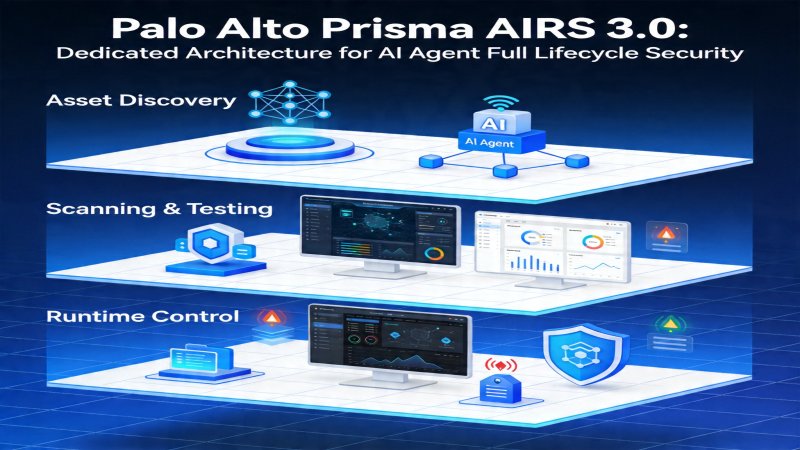
AIRS 3.0 adopts a three-layer architecture design, systematically covering the complete chain from asset discovery to runtime protection for AI Agents.
- Discovery & Asset Layer: Serves as the security baseline, automatically scanning enterprise code repositories and deployment platforms to identify and inventory AI Agent assets, supporting 17 mainstream frameworks, providing an accurate inventory for subsequent security operations.
- Scanning & Testing Layer: Focuses on "shift-left" security. Performs supply chain security scans on AI Agent build artifacts (Artifacts); and proactively discovers risks through AI red team automated attack simulations.
- Control & Runtime Layer: The core of the architecture. Uses the Agent Gateway as a unified control plane to enforce policies on runtime interactions and operations; the Prisma Browser Security Sandbox provides an isolated runtime environment, a key differentiator from traditional solutions.
Key Technologies
AIRS 3.0 achieves deep protection through four key technologies, focusing on addressing the unpredictable risks arising from AI Agent autonomy.
- Agent-to-Agent Communication Control
- Problem Solved: Prevents unauthorized data exchange, command hijacking, or lateral movement during autonomous collaboration between AI Agents.
- Core Principle: At the Agent Gateway level, based on micro-segmentation policies and context-aware technology, identifies, audits, and controls all communication traffic between AI Agent entities.
- Tested Performance: According to the official blog, on specific hardware configurations (e.g., servers with Xeon Gold 6348 CPUs), its control plane throughput increased by approximately 120% compared to AIRS 2.0. The company claims its architecture supports registration of up to 100,000 Agents, but this concurrent management capability under real-world enterprise mixed workloads lacks public test reports.
- Dynamic Permission Approval Mechanism
- Problem Solved: Addresses the issue where traditional static permission models are too coarse or approval processes are too rigid to adapt to the dynamic operational needs of AI Agents.
- Core Principle: Combines real-time risk context (e.g., user identity, operation content, target resource sensitivity) for dynamic risk assessment, enabling instant approval or escalation to human approval.
- Tested Performance: Official data shows its average response latency is reduced to 0.2 seconds, minimizing impact on business fluidity while ensuring security control.
- Real-time Sensitive Operation Interception
- Problem Solved: Prevents AI Agents from executing malicious or anomalous operations such as data exfiltration or system destruction during runtime.
- Core Principle: Deploys a high-performance detection engine at the Agent Gateway, which analyzes operation instructions issued by AI Agents in real-time based on predefined behavior models and security policies, and executes blocks.
- Tested Performance: Third-party testing (DarkReading) achieved a 100% blocking success rate in 1000 simulated known malicious operations, with a false positive rate below 0.3%.
- Prisma Browser Security Sandbox
- Problem Solved: Isolates the runtime environment of AI Agents, preventing malicious activities (e.g., data exfiltration, malicious code injection) via browsers or external tools.
- Core Principle: Provides an isolated browser execution environment for AI Agents that need to interact with external web resources, restricting all external interactions within this sandbox.
- Limitations: Currently, there are no public quantitative data detailing the specific implementation technology of the Prisma Browser Security Sandbox, its performance overhead (e.g., introduced latency, resource utilization), or its impact on AI Agent functionality (e.g., specific plugin invocation).
Principle Workflow
The security operations of AIRS 3.0 follow a closed-loop process from prevention to response, with its core performance metrics preliminarily validated by third-party testing.
- Asset Discovery & Inventory: The system automatically scans the enterprise environment, classifying and registering AI Agents via an identification engine. In DarkReading tests, identification accuracy for 500 samples reached 99.7%.
- Artifact Security Scan: Performs deep static analysis on build artifacts. Official tests based on its internal risk library claim it can detect 98% of known supply chain risk patterns, with scanning speed on specific test sets being 3 times faster than AIRS 2.0. However, this data lacks independent third-party verification, and its detection rate for unknown or variant supply chain attacks is unknown.
- AI Red Team Automated Testing: Automates attack simulations. The official blog states its risk scenario coverage increased by 47% compared to the previous generation, covering 92% of mainstream Agent risk scenarios.
- Runtime Control & Protection: All operation requests are processed through the Agent Gateway. Tests show its dynamic approval latency is 0.2 seconds, sensitive operation blocking success rate is 100%, and false positive rate is below 0.3%.
Competitive Landscape Analysis
The AI Agent security market is in an early "land grab" phase, with vendors adopting different technical routes based on their strengths.
| Competitor | Technical Route | Advantages | Disadvantages |
|---|---|---|---|
| CrowdStrike (Falcon for AI) | Extends from Endpoint Security (EPP/EDR) foundation | Strong endpoint behavior monitoring & threat intelligence; mature threat hunting capabilities | Potentially shallow coverage of AI Agent full lifecycle (e.g., Artifact scanning, red team testing); dedicated runtime control plane not prominent |
| Zscaler (Posture Control for AI) | Based on Zero Trust Network Access (ZTNA) architecture | Strong network-layer Data Loss Prevention (DLP) & access control; cloud-native architecture easy to deploy | More focused on access security for external AI services, limited deep lifecycle management capability for internally developed AI Agents |
| Microsoft (Defender for Cloud + Security Copilot) | Integrates CSPM, CWPP & AI-driven security operations | Deep integration with Azure AI services; leverages Security Copilot for intelligent analysis & response | Solution is relatively fragmented, requiring multi-product combination; dedicated modules for AI Agents may still be under development |
Core Differentiation:
- Integrated Full Lifecycle Solution: AIRS 3.0 provides a complete, integrated solution from development (Artifact scanning), testing (red team automation) to runtime (Agent Gateway), rather than point capabilities.
- High-Performance Runtime Control Plane: Its Agent Gateway is designed for large-scale, dynamic environments, featuring 100k-level Agent concurrent management and 0.2-second low-latency approval capability.
- Unique Runtime Isolation: Provides runtime environment isolation via the built-in Prisma Browser Security Sandbox, a capability not emphasized by many competitors.
Market Dynamics: Palo Alto is leveraging its existing cloud security platform (Prisma Cloud) and channel advantages to try and capture the "architectural-level solution" positioning in the early market. However, the success of this strategy depends on its product's actual effectiveness, integration difficulty with existing ecosystems, and the response speed of competitors (e.g., CrowdStrike with its strong endpoint and intelligence network). It is premature to assert it can establish an "advantage."
Key Assessments
Based on current information and technical analysis, the following key assessments are formed:
| Key Assessment | Importance | Follow-up Action Suggestions | Confidence Level |
|---|---|---|---|
| Palo Alto is building a unified, full-stack cloud-native security moat through AIRS 3.0, spanning from code and cloud workloads to AI Agents. This is a key piece for consolidating its position in large enterprises and increasing stickiness. | High | Focus on the deep integration and collaborative defense mechanisms between AIRS and other Prisma Cloud modules (CSPM, CWPP). | High |
| The performance metrics released with AIRS 3.0 (e.g., 99.7% discovery rate, 0.2s latency) set a new benchmark for AI Agent security products. Its high-performance control plane constitutes a short-term competitive barrier. | Medium | Continuously verify the reproducibility of these metrics in different customers' real, complex environments, and monitor competitors' catch-up speed. | Medium |
| The 'Agent Gateway runtime control plane' is the core and soul of the AIRS 3.0 architecture. Its capability determines the success or failure of transitioning AI Agent security from "visibility" to "true control." | High | Deeply analyze architectural details of the Agent Gateway, such as its policy engine, traffic parsing capability, and collaboration mechanism with the sandbox. | High |
Open Research Questions
Despite the clear architecture of AIRS 3.0, the following key details require further investigation:
- Collaboration & Division of Labor: How do AIRS 3.0 and Palo Alto's traditional NGFW & Cloud NGFW specifically divide labor and collaborate in AI Agent traffic protection? Is there a unified policy management interface?
- Sandbox Implementation Details: What is the specific implementation technology of the Prisma Browser Security Sandbox (e.g., container-based lightweight virtualization)? What is its performance overhead and impact on AI Agent functionality (e.g., plugin invocation)?
- Policy Model Transparency: What specific policy models and risk calculation factors does the dynamic permission approval mechanism rely on? How are security and business fluidity quantified and balanced (Is the 0.3% false positive rate acceptable in critical businesses like finance)?
- Ecosystem Compatibility & Cost: For enterprises not using the Prisma Cloud platform, what is the complexity and integration cost of independently deploying AIRS 3.0? Does it support open integration with third-party CI/CD pipelines or monitoring platforms?
Why it Matters
Positioning: Ecosystem Expansion, Reason: Extends cloud-native security moat to AI Agent lifecycle
Key Factor: Core Factor: Competitive Barrier. AIRS 3.0 attempts to build a short-term technical barrier through its integrated full-lifecycle solution (discovery, scanning, testing, runtime) and the proprietary Agent Gateway control plane. Its claimed high-performance metrics (e.g., 0.2s latency, 100k concurrency) are key differentiators. However, the solidity of this barrier heavily depends on its validation in complex real-world environments and the catch-up speed of competitors (e.g., CrowdStrike's endpoint depth, Zscaler's network-layer control).
Stage: Innovation Trigger
DECISION
For Vendor (Palo Alto Networks)
- 1. Immediately initiate third-party benchmarking to publicly validate AIRS 3.0's performance and security efficacy under complex mixed workloads.
- 2. Accelerate disclosure of Prisma Browser sandbox technical details, quantifying its performance overhead and functional limitations to reduce customer evaluation risk.
Strategic Moves: Deeply bundle AIRS 3.0 into the Prisma Cloud platform for sales to increase customer stickiness.
- 1. Conduct proof-of-concept in non-core business scenarios, focusing on testing Agent Gateway latency and the sandbox's impact on business flow.
- 2. Evaluate the integration complexity and policy unification capability of deploying AIRS 3.0 standalone with the existing security stack (e.g., NGFW, EDR).
Action Guidance: Observe
For Investor
- 1. Monitor Palo Alto's large customer wins and renewal rate data in the AI Agent security space.
- 2. Track the release cadence and performance benchmarks of competing products (e.g., CrowdStrike, Zscaler) in AI Agent security modules.
Key Risk: The claimed high performance and full-lifecycle advantages of AIRS 3.0 have not been fully validated for effectiveness and cost-efficiency in real enterprise environments.
PREDICT
6 months (High confidence)
At least one major competitor (e.g., CrowdStrike) will release an integrated AI Agent security solution benchmarked against AIRS 3.0.
1 year (Medium confidence)
Independent third-party benchmark reports will emerge, revealing performance and protection efficacy differences among vendors' AI Agent security solutions in real scenarios.
2 years (Medium confidence)
The AI Agent security market will form clear tiers centered on "runtime control plane" capability, distinguishing integrated solutions from point solutions.
Get 3-5 key AI infrastructure signals weekly →
💬 Comments (0)