
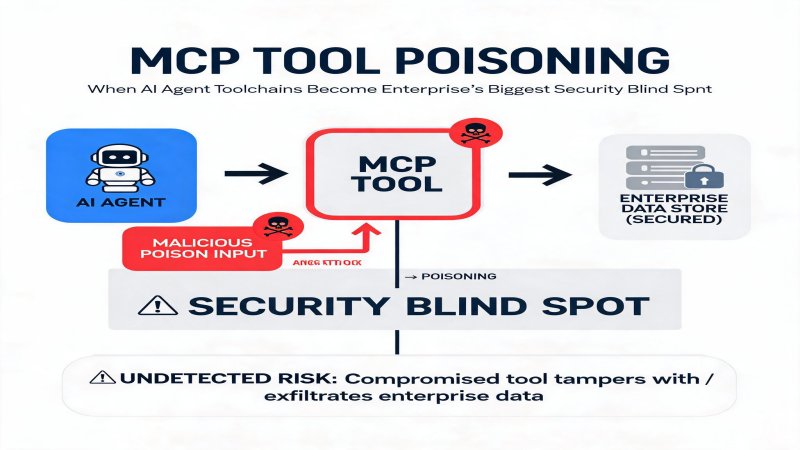
MCP Tool Poisoning: When AI Agent Toolchains Become Enterprise's Biggest Security Blind Spot
> AI Analysis | Confidence: ✅Verified / ⚠️High Confidence / ⚠️Vendor Claims
Event Overview
On June 30, 2026, Microsoft Incident Response and the Defender security research team jointly published a technical blog post titled "Securing AI Agents: When AI Tools Move from Reading to Acting." The core warning pointed to a deeply unsettling reality: an attacker needs only to modify the description text of an MCP (Model Context Protocol) tool—a few lines of natural language metadata—to make an enterprise AI agent, under the guise of entirely legitimate operations, silently exfiltrate sensitive business data to an attacker-controlled server. No malicious code execution. No privilege escalation. Every step looks "normal," and conventional security tools (DLP/EDR/WAF) remain completely silent. ✅Verified
This is not theoretical. The MCPTox benchmark (published August 2025) tested tool-poisoning attacks against 45 real MCP servers and 353 authentic tools, finding attack success rates as high as 72.8%, while AI models' refusal rate for malicious tools was under 3%. ✅Verified Even more alarming, the first real-world malicious MCP software package has already appeared—in September 2025, Koi Security discovered the postmark-mcp package on npm, which after 15 clean releases, quietly inserted a single line of code in version 1.0.16 that secretly BCC'd every email the agent sent to an attacker. ✅Verified
MCP—dubbed the "USB-C port for AI"—completed its leap from experimental project to enterprise infrastructure in just 18 months. As of July 2026, 78% of enterprise AI teams have MCP-backed agents in production, monthly SDK downloads reach 97 million (a 970x increase from 100,000 at launch in November 2024), public MCP servers exceed 9,400, and private servers are estimated between 28,000 and 37,000. ✅Verified Anthropic released MCP in November 2024, donated it to the Linux Foundation's Agentic AI Foundation (AAIF) in December 2025, co-founded by Anthropic, Block, and OpenAI, with Google, Microsoft, AWS, Cloudflare, and Bloomberg as platinum members. ✅Verified
However, the protocol's security model has far from kept pace with its diffusion. In April 2026, OX Security audited 7,000+ publicly accessible MCP servers and discovered 14+ CVEs, several with CVSS scores exceeding 9.0. ⚠️High Confidence When asked to patch the root cause—the STDIO transport model allowing any MCP server to request host system access at the OS level—Anthropic's response was: this is "expected behavior." Not a bug. Not an oversight. Expected behavior. ✅Verified
On May 20, 2026, the U.S. National Security Agency (NSA) Artificial Intelligence Security Center published "Model Context Protocol (MCP): Security Design Considerations for AI-Driven Automation" (Document U/OO/6030316-26), explicitly warning that MCP's proliferation has outpaced its security model's maturity. ✅Verified OWASP's "Top 10 for Agentic Applications" published in December 2025 lists Tool Misuse (ASI02) and Agentic Supply Chain Vulnerabilities (ASI04) as first-tier risks. ✅Verified
A battle over AI Agent trust boundaries is now fully underway.
Technical Deep Dive
MCP Protocol Architecture: Why "AI's USB-C" Is Also "Attacker's USB-C"
MCP is built on JSON-RPC 2.0 with a client-server architecture. Three core components: Hosts (AI applications users interact with—Claude Desktop, ChatGPT, Cursor), Clients (connectors within the Host that communicate with Servers), and Servers (lightweight services exposing specific capabilities). ✅Verified
Each MCP Server can expose four capability primitives:
| Primitive | Function | Security Property |
|---|---|---|
| Tools | Executable actions (send messages, create files, run queries) | Writable—Agent can mutate system state |
| Resources | Read-only data (files, database records, API responses) | Read-only—Agent cannot mutate |
| Prompts | User-initiated pre-built instruction templates | User-controlled |
| Sampling | Server requests Host's LLM to perform inference | Requires user consent |
Core architectural flaw: the instruction-data boundary has dissolved. MCP mixes tool descriptions (essentially operational instructions) with actual data in the same context window. Tool descriptions enter the Agent's working memory alongside the user's genuine instructions, and the model has no reliable way to distinguish legitimate instructions from malicious ones planted by upstream maintainers. ✅Verified
This creates a fatal contrast with how humans process information. A human employee can leverage social context and long-term memory to identify anomalies—for instance, an "invoice processing tool" suddenly requesting collection of all unpaid invoices as parameters to send. AI Agents lack this cognitive hardware: once information enters the context window, all text is treated equally. ✅Verified
MCP Attack Surface Panorama: Eight Attack Patterns
Based on Ransomnews's June 2026 attack surface mapping and multiple independent security research efforts, the 2026 MCP ecosystem exhibits eight recurring attack patterns: ✅Verified
| Attack Type | Mechanism | Real-World Incident | CVSS/Severity |
|---|---|---|---|
| Tool Poisoning | Malicious instructions in tool description/parameter schema | Malicious "weather query" MCP stole 5,000+ users' GitHub tokens | ⚠️Vendor Claim |
| Rug Pull | Dynamically modify tool definitions to malicious versions after gaining trust | "Code formatting" MCP deleted .git folders on Christmas Day | ⚠️Vendor Claim |
| Cross-Server Attack | Malicious server manipulates Agent's interactions with all other trusted servers | Malicious "notes tool" manipulated "database tool" to leak customer data | ⚠️Vendor Claim |
| Stored Prompt Injection | Persistent injection via GitHub Issues/DB records | GitHub MCP server vulnerability affected 2M+ Claude Desktop users | ⚠️Vendor Claim |
| Line Jumping | Injection during tools/list handshake, before any user action | Discovered by Trail of Bits | ⚠️High Confidence |
| Tool-Chaining Exfiltration | Data theft through composition of authorized calls | Invariant Labs: GitHub MCP private repository leak | ✅Verified |
| Token Sprawl | Single Host holds union of all connected Server scopes | Architectural flaw | ⚠️High Confidence |
| RCE | Classic command injection/deserialization vulnerabilities in servers | CVE-2025-6514 (CVSS 9.6), CVE-2025-49596 (CVSS 9.4) | ✅Verified |
Deep Analysis of Four Verified Attack Incidents
Incident 1: GitHub MCP Data Theft (May 2025, Invariant Labs) ✅Verified
Attack chain: Developer active in both public and private repositories grants Agent broad Personal Access Token → Attacker embeds malicious instructions in a public repo Issue → Developer asks Agent to triage Issues → embedded instructions steer Agent to read private repositories → private project details and salary information leaked into a public PR.
Key insight: No software bug in the traditional sense. Over-broad Token permissions + tool composition = complete data exfiltration path. Every individual call was "authorized."
Incident 2: Supabase MCP Data Leak (2025, General Analysis) ✅Verified
Attack chain: Attacker submits ticket with hidden instructions → Agent calls execute_sql to read the ticket (authorized action 1) → instructions treated as user intent → Agent issues SQL query against integration_tokens table (authorized action 2) → writes stolen API keys and OAuth tokens back to public ticket → attacker reads.
Key insight: Every individual operation was authorized. The exfiltration existed in the composition—privileged read followed by write to an attacker-visible sink.
Incident 3: postmark-mcp Supply Chain Poisoning (September 2025, Koi Security) ✅Verified
The first real-world malicious MCP package. Ran 15 clean versions on npm as a legitimate email tool, then version 1.0.16 quietly inserted one line of code: secretly BCC'd every email the Agent sent to an attacker. No prompt injection needed. No model behavior exploitation—direct code-level theft.
Incident 4: Asana Cross-Tenant Data Leak (June 4, 2025) ✅Verified
MCP server multi-tenant isolation flaw: users from one organization could see another organization's project data, tasks, comments, and files. Asana estimated approximately 1,000 customers were exposed. No prompt injection. No tool-chain composition—just an authorization bug hastily shipped in an AI connector.
STDIO Transport Model: "Flaw by Design"
MCP supports two transport modes: STDIO (local inter-process communication) and HTTP/SSE (network-boundary communication). The STDIO problem is structural:
When MCP uses STDIO as transport, the MCP Server runs as a subprocess of the Host process, inheriting access to the host system's OS resources. The SDK passes configuration data (file paths, commands, arguments, environment variables) directly into parameters for spawning child processes, without any sanitization. ✅Verified
As security researcher Paddo.dev summarized: "There is no allowlist, no sanitization, no capability scoping. The reference SDK hands the string to the OS and trusts the caller to be careful." ✅Verified
This means: any MCP server—legitimate or malicious—can request the same OS-level access through the same mechanism. There is no protocol-level checkpoint. ✅Verified
OX Security found that LiteLLM's hard allowlist was bypassed with a single argument injection string, and Flowise's command allowlist was bypassed by shifting dangerous behavior into argument space. Each maintainer is independently rediscovering the same fix, mounting it on top of a protocol that should have done the work once. ✅Verified
Why Conventional Security Tools Fail Completely
| Security Tool | Design Purpose | Why It Fails Against MCP Attacks |
|---|---|---|
| DLP | Monitor data crossing defined boundaries | MCP attacks exfiltrate data as subprocess operations—DLP sees legitimate process invocations |
| EDR | Monitor endpoint behavioral deviations | STDIO subprocess execution is architecturally indistinguishable from legitimate tool use at OS layer |
| WAF | Inspect inbound HTTP traffic | STDIO doesn't use HTTP; malicious payloads are embedded in natural language text |
| SIEM | Correlate security event logs | Agent operation logs aren't standard data sources; lack behavioral baselines |
Financial Logic
Enterprise Exposure: Quantifying the "Invisible" Risk
OWASP estimates that 90% of current AI Agents hold excessive privileges, and Agents move 16x more data than human users. ⚠️High Confidence An Agent operating at machine speed with legitimate credentials can extract thousands of records in seconds.
Microsoft ecosystem risk quantification (SCC Intelligence Assessment): ⚠️Vendor Claim
| Metric | Estimate |
|---|---|
| Loss per significant exfiltration incident | $500K–$5M (mid-to-large enterprise) |
| Annualized Loss Exposure (ALE) | $125K–$2.5M |
| Significant incident frequency | Once per 2–4 years (organizations using unvetted MCP Servers) |
Compliance Cascade
- GDPR: Exfiltration of EU resident personal data through MCP-connected tools can occur without triggering existing breach detection controls, creating notification and liability obligations
- HIPAA: Agents accessing PHI in healthcare environments through MCP tools represent potential unauthorized disclosure vectors
- SOC 2 / ISO 27001: Change management and access management requirements apply directly to MCP tool description management; absence of these controls is an auditable deficiency
- NIST AI RMF: Requires continuous risk management—Agent permissions should be revocable in real-time, not reviewed quarterly
The MCP Security Market: A New Category Forming
MCP security is catalyzing an entirely new product category—Agent security gateways/control planes:
| Vendor/Project | Positioning | Core Capability | Stage |
|---|---|---|---|
| Microsoft Prompt Shields | Prompt injection detection | Model-layer defense | Commercial |
| Microsoft Purview DLP | Data loss prevention | Agent operation auditing | Commercial |
| Microsoft Entra Agent ID | Agent identity management | Per-Agent independent identity | Commercial |
| Anthropic MCP Tunnels | Private network Agent connectivity | End-to-end encryption, no inbound firewall | Limited Research Preview |
| Ramparts | MCP security scanning | Tool description auditing | Open source |
| CyberMCP | MCP security framework | Compliance checking | Open source |
| OX Security MCP Scanner | MCP vulnerability scanning | 7,000+ server auditing | Commercial |
| ETDI Signed Tool Definitions | Anti-Rug Pull | OAuth + signature verification | Academic stage |
Cost Comparison: Prevention vs. Remediation
| Control Measure | Implementation Cost | Potential Loss Without It |
|---|---|---|
| Per-Agent identity + least privilege | Low (configuration change) | $500K+ per incident |
| Tool description change review process | Low (process change) | Silent data exfiltration for months |
| MCP Server allowlist | Medium (operational change) | Supply chain attack affecting entire organization |
| Human approval for high-risk actions | Medium (efficiency loss) | Financial fraud, IP leakage |
| Agent behavioral monitoring baseline | Medium-High (new tool deployment) | Unable to detect ongoing exfiltration |
Strategic Deep Dive
Vendor Strategic Matrix: Who Will Define the "Agent Security" Category
| Dimension | Microsoft | Anthropic | Open Source Community | |
|---|---|---|---|---|
| Protocol control | MCP client implementations (Copilot/Azure) | MCP protocol creator → donated to AAIF | Native MCP support (Gemini/Vertex) | Independent audit tools + alternative frameworks |
| Security narrative | "Enterprise full-stack defense" | "Expected behavior, developer responsibility" | No clear position yet | "Protocol design flaw, needs redesign" |
| Core products | Prompt Shields + Entra Agent ID + Purview + Sentinel | MCP Tunnels + Self-Hosted Sandboxes | Open Knowledge Format (OKF) v0.1 | Ramparts / CyberMCP / OX Scanner |
| Identity approach | Entra Agent ID (per-Agent independent identity) | OAuth 2.1 + PKCE in MCP spec | OKF knowledge catalog | SPIFFE/SPIRE workload identity |
| STDIO position | Not publicly stated | "Expected behavior" | Not publicly stated | "Must deprecate, migrate to HTTP/SSE" |
| Business logic | Agent security → Microsoft 365 security stack stickiness | Security → enterprise adoption → API revenue | Security → GCP/Vertex lock-in | Security → open ecosystem trust |
| Weak signals | Tying Agent security to proprietary stack may limit non-MSFT scenarios | "Expected behavior" stance may undermine enterprise confidence | OKF v0.1 too early-stage | Fragmented, lacks unified standards |
Three-Layer Competitive Game
Layer 1: Protocol governance contest. MCP's journey from Anthropic proprietary to AAIF (Linux Foundation) public governance represents a critical inflection point for AI infrastructure governance. With 190 member organizations and five major cloud providers co-governing, MCP's security standards will become the de facto industry standard, not any single vendor's private decision. However, AAIF's current focus is on feature expansion (Elicitation, Agent Payments Protocol) rather than security hardening.
Layer 2: Security product category definition. Microsoft is attempting to fold Agent security into its existing security product matrix (Entra + Purview + Sentinel + Defender), creating the equation "MCP security = Microsoft security stack extension." Anthropic, through MCP Tunnels and Self-Hosted Sandboxes, is building barriers in the enterprise private deployment direction. The two strategic directions have fundamental tension: Microsoft's "layer-on defense" vs. Anthropic's "architecturally built-in."
Layer 3: The data-layer vs. model-layer fundamental divide. This is the most strategically significant divergence. Model-layer defenses (Prompt Shields, safety alignment) are probabilistic—sufficiently crafted prompt injection can bypass them. Data-layer governance (API gateway-enforced least privilege, deterministic access controls) is deterministic—regardless of what the model is told, the data layer will refuse unauthorized operations. OWASP explicitly states: 90% of AI Agents have excessive privileges, and model-layer defenses should not be the primary control for structural flaws. ✅Verified
MCP Ecosystem vs. npm/PyPI: Why Supply Chain Risk Is Worse
| Dimension | npm/PyPI | MCP Ecosystem |
|---|---|---|
| Execution timing | At install time (discrete, auditable event) | At runtime (natural language triggered, invisible to traditional audit tools) |
| Sandbox isolation | postinstall scripts run in constrained context | STDIO subprocesses have no protocol-level sandbox |
| Ecosystem maturity | 10+ years of supply chain security iteration | 9 malicious test packages accepted by 9 of 11 registries without review |
| Attack persistence | Package removed =失效 | Tool descriptions can be dynamically updated, no re-approval triggered |
| Impact scope | Project-level | Organization-level (Agent can operate across systems) |
Challenges and Concerns
1. "Patch Illusion"—CVE Fixes Cannot Reach Root Cause
OX Security documented four CVE bypass families—four distinct attack paths that remain viable after patching because each exploits the architectural trust model, not the specific code that was patched: ✅Verified
- Family 1 — Direct injection: Multiple tools accept arbitrary command and argument fields through public-facing UIs, passed into STDIO parameters
- Family 2 — Hardening bypass: Allowlists bypassed via argument injection—string allowlists are not trusted execution models
- Family 3 — Zero-click IDE injection: Windsurf, Cursor, Claude Code, Gemini-CLI, and GitHub Copilot all found vulnerable
- Family 4 — Hidden backend paths: UI dangerous features removed, but privileged STDIO code paths remain
MCP SDK patches cannot retroactively protect downstream implementations built on unpatched versions—over 150 million combined downloads across npm and PyPI, all inheriting the same architectural exposure. ✅Verified
2. Instruction-Data Inseparability—LLM's Structural Limitation
OpenAI has acknowledged that prompt injection "is unlikely to ever be fully solved." ⚠️Vendor Claim This isn't a defect of any particular model, but a fundamental limitation of current Transformer architectures: all content in the context window is treated equally, with no native "trust level" tagging.
This means: no matter how complete safety alignment is, as long as tool descriptions and data share the same context window, the attack surface exists structurally. Model-layer defenses are useful but insufficient—they reduce attack surface but don't eliminate it.
3. The Agent Identity Governance Vacuum
NIST's National Cybersecurity Center of Excellence February 2026 concept paper states: AI Agents should be treated as distinct non-human identities requiring enterprise-grade lifecycle management. ⚠️High Confidence Yet in most current deployments:
- Agents have no independent identity, inheriting human user credentials
- No standardized Agent identity registration/discovery mechanism exists
- Agent behavior cannot be attributed to specific authorization chains
- Permissions cannot be revoked in real-time
As security expert Ido Shlomo (Token Security CTO) noted: "If security teams cannot answer what agents they have, who owns an agent, what intent it was created for, what systems it can access, or when it should be retired—they already have an ungoverned entity in their environment." ✅Verified
4. "Deploy First, Govern Later" Inertia
78% of enterprise AI teams have MCP Agents in production, yet most lack:
- Complete inventory of MCP Servers (including shadow MCP)
- Review processes for tool description changes
- Per-Agent least-privilege credentials
- Behavioral baselines and anomaly detection for Agent operations
This pattern closely mirrors cloud security history: mass cloud adoption first, then years spent catching up with CASB, CSPM, CWPM security controls. MCP security is repeating this pattern.
5. Standardization Pace vs. Threat Evolution Speed
NSA guidance, OWASP Top 10, and NIST AI RMF have all been published in 2025-2026, but standardization deployment is far slower than attack evolution:
- MCP's OAuth 2.1 authorization specification addresses the identity authentication layer but is powerless against tool description poisoning and chain exfiltration
- ETDI's proposed signed tool definitions remain at the academic stage
- AAIF's focus is on feature expansion rather than security hardening
- Enterprise MCP Registries (e.g., JFrog solutions) remain early-stage
Conclusions
Core Judgments
MCP tool poisoning is not a software bug—it is a structural flaw in protocol architecture. ✅Verified When tool descriptions share the same context window as data, when STDIO transport bypasses all protocol-level security checks, and when conventional security tools' inspection models simply don't cover natural language attack surfaces—patching CVEs is like applying band-aids to a leaking ship.
Tool descriptions are system prompts. ✅Verified Modifying an MCP tool's description is equivalent to modifying an Agent's system instructions. Yet in most organizations, tool description changes require no approval process whatsoever. This is the largest governance blind spot in 2026 enterprise AI deployments.
The MCP ecosystem is at the "npm circa 2010" stage—but with higher risk. ✅Verified npm took 10+ years to build supply chain security infrastructure. MCP doesn't have this timeline: 97 million monthly downloads, 78% enterprise production deployment, 9,400+ public Servers—the attack surface is already comprehensively exposed.
Data-layer governance, not model-layer defense, is the correct primary control. ✅Verified Model-layer defenses are probabilistic (can be bypassed); data-layer governance is deterministic (refuses unauthorized operations regardless of what the model is told). Per-Agent independent identity + least-privilege credentials + gateway-enforced access control + real-time revocability—these four controls shrink the blast radius of nearly every known MCP attack.
Implications for Three Audiences
For Vendors (MCP Server developers, AI platforms):
- Treat every MCP Server as a supply chain link, not a one-time integration
- Tool description changes should receive review equivalent to code changes
- Invest in signed tool definitions (ETDI pattern) and manifest-only execution
- Long-term: migrate from STDIO to HTTP/SSE, rebuilding trust boundaries at the protocol level
For Enterprise Users (CTO/CISO/Security Architects):
- Within 30 days: complete inventory of all Agent deployments and their data access permissions
- Maintain tenant-level MCP Server allowlists; disable "allow all"
- Establish independent identity for each Agent; implement least-privilege credentials
- Mandatory human approval for high-risk actions (fund transfers, data egress, account changes)
- Incorporate Agent operation logs into SIEM; establish behavioral baselines
For Investors:
- Agent security gateways/control planes are a forming new product category—benchmark against the 2015-2018 cloud security track
- Focus on vendors pursuing data-layer governance (deterministic controls) rather than model-layer defense (probabilistic controls)
- MCP auditing and compliance tools are a near-term monetizable market segment
- Long-term winners will be platforms that simultaneously build capabilities across three dimensions: Agent identity management + toolchain observability + data-layer enforcement
Why it Matters
MCP tool poisoning is not a single CVE but a structural protocol architecture flaw—tool descriptions are system prompts, and modifying descriptions is equivalent to modifying Agent instructions. With 78% of enterprises in MCP production, 97 million monthly downloads, and 9,400+ public servers running, this security blind spot has enormous impact. Conventional security tools (DLP/EDR/WAF) are completely ineffective against natural-language attack surfaces; data-layer governance, not model-layer defense, is the correct primary control. This is spawning an entirely new product category of Agent security gateways/control planes.
DECISION
- Enterprise CTOs/CISOs: Within 30 days, complete inventory of all MCP Agent deployments and data access permissions; establish tenant-level MCP Server allowlists; disable 'allow all' mode
- Security Architects: Establish independent identity for each Agent (reference Microsoft Entra Agent ID); implement least-privilege credentials; mandate human approval for high-risk actions
- MCP Server Developers: Subject tool description changes to review equivalent to code changes; invest in signed tool definitions and manifest-only execution; long-term migrate to HTTP/SSE transport
- Investors: Focus on the emerging Agent security gateway/control plane category—prioritize vendors pursuing data-layer governance (deterministic controls) over model-layer defense (probabilistic controls)
PREDICT
- Within 12 months: AAIF will release MCP signed tool definition specification v1.0, addressing protocol-level defense against rug pulls and tool poisoning
- Within 12-18 months: Agent security gateways will become an independent product category, with at least 3 startups raising Series A+ funding (focused on Agent identity management + toolchain observability + data-layer enforcement)
- Within 18-24 months: STDIO transport will be de facto deprecated in enterprise sensitive scenarios, with HTTP/SSE becoming default; over 50% of Fortune 500 will require MCP Server security certification
- Within 36 months: MCP security auditing will become mandatory for SOC 2/ISO 27001 compliance; enterprises without Agent behavioral monitoring will face audit failures
Get 3-5 key AI infrastructure signals weekly →
💬 Comments (0)