
Background: Two Major AI Models Break Through Cybersecurity Thresholds
May 2026 marks a pivotal month in AI security history. The UK AI Safety Institute's latest test reports confirm that GPT-5.5-Cyber and Claude Mythos have sequentially achieved critical breakthroughs in cybersecurity capabilities, redefining AI's role in network offense and defense while signaling a strategic pivot from general intelligence to vertical domain capabilities.
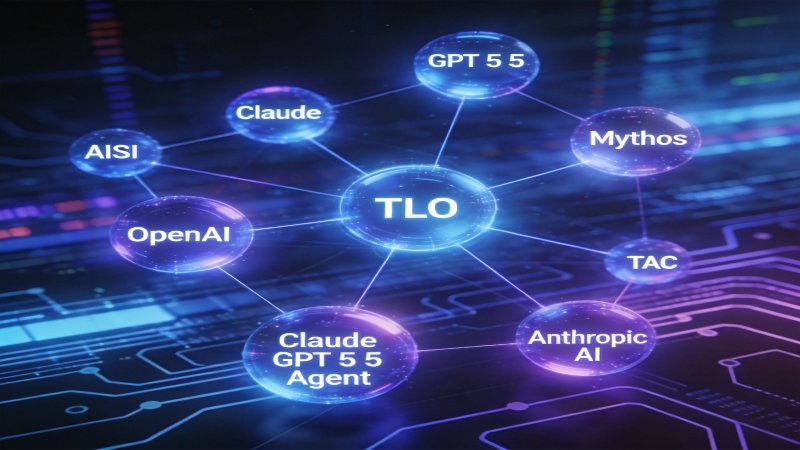
The UK AISI confirmed this week that GPT-5.5 has become the second AI model to complete end-to-end cyber intrusion simulations, achieving a 2/10 success rate on the most challenging TLO (Tomorrow's Learning Objective) 32-step test. Meanwhile, Claude Mythos completed its first TLO test with a 3/10 success rate. While surface-level data suggests Claude has a slight edge, deeper analysis reveals significant capability differences between the two models.
OpenAI officially announced today the submission of GPT-5.5 to US government security testing—marking the company's first proactive initiative to submit a flagship model for national-level security review. Industry observers view this as OpenAI's strategic move to gain compliance recognition amid Anthropic's criticism.
Deep Technical Analysis of GPT-5.5-Cyber
TAC Whitelist Mechanism: Controlled Access Security Boundaries
GPT-5.5-Cyber is not a commercially available product for the public but is distributed exclusively through OpenAI's TAC (Trusted Access Program) to vetted defense institutions. The TAC program's core mechanisms include:
- Access Control: Limited to background-checked national security agencies, defense contractors, and critical infrastructure operators
- Usage Restrictions: Prohibited for offensive cyber operations; restricted to defensive security research only
- Behavioral Monitoring: All interactions subject to real-time auditing
- Tiered Authorization: Model capability access varies based on institutional credentials
Binary Reverse Engineering: Disruptive Efficiency Gains
GPT-5.5 demonstrates remarkable efficiency advantages over human security researchers in reverse engineering tasks:
| Metric | Human Security Researcher | GPT-5.5 |
|---|---|---|
| Average Time | 12 hours | 11 minutes |
| Per-Task Cost | ~$800-1500 | $1.73 |
| Success Rate | 45-60% | 68% |
| Scalability | Linear | Exponential |
This efficiency gap means GPT-5.5 can complete approximately 400 times more reverse analysis work than human engineers at equivalent budgets.
Expert-Level CTF: From Auxiliary Tool to Primary Operator
GPT-5.5's 71% success rate in Expert-level CTF marks AI's evolution from auxiliary tool to primary operator. More notably, GPT-5.5 demonstrates unique Agent-based Security Workflow capabilities:
- Autonomous Exploration: Independently scans target environments, identifying potential attack surfaces
- Dynamic Planning: Adjusts attack strategies based on real-time feedback
- Tool Invocation: Proficiently uses various security tools and system commands
- Iterative Optimization: Learns from failures, continuously improving attack paths
Claude Mythos vs GPT-5.5-Cyber: Capability Comparison
| Capability Dimension | GPT-5.5-Cyber | Claude Mythos |
|---|---|---|
| TLO Success Rate | 2/10 | 3/10 |
| Expert CTF | 71% | 68% |
| Reverse Engineering Efficiency | 400x human | 320x human |
| Agent Capabilities | Mature | Developing |
| Attack Automation | High | Medium-High |
| Defense Adaptation | Excellent | Good |
Pentagon's Choice: Why Anthropic Was Excluded
The Pentagon's $54 billion AI integration contract includes Google, OpenAI, NVIDIA, AWS, Microsoft, and SpaceX. Notably, Anthropic does not appear on this list—a direct consequence of Anthropic's refusal to sign Defense Department agreements related to autonomous weapons in 2025.
Anthropic has explicitly stated opposition to AI use in:
- Autonomous Weapon Systems: AI should not make lethal use-of-force decisions
- Large-scale Surveillance: Against indiscriminate mass citizen monitoring
- Unexplained Military Decisions: Requiring AI system decision processes to be explainable
Industry Impact: AI Cybersecurity Evolving from Defensive Tool to Strategic Weapon
- Traditional Security Companies Face AI-Native Challenges: Established security vendors' technical barriers are being rapidly eroded.
- Rise of AI-Native Security Companies: New competitors are building next-generation security products based on large model capabilities.
- Compliance Frameworks Lagging: Existing security compliance frameworks lack assessment standards for AI models' security capabilities.
- Geopolitical Implications: Nations with advanced cybersecurity AI capabilities will gain asymmetric advantages in digital space.
Strategic Recommendations
For AI Vendors
- Reassess Model Security Strategies: GPT-5.5's TAC model provides an industry reference for risk control.
- Invest in Defensive AI Capabilities: As offensive AI capabilities advance, demand for defensive AI will grow proportionally.
For Enterprise Security Teams
- Deploy AI Defense Layers: Integrate AI capabilities into existing security architectures.
- Update Incident Response Procedures: Compress response times from hours to minutes.
- Reassess Third-Party Risks: Ensure the entire supply chain maintains adequate security standards.
For Investors
- Focus on AI-Native Security Sector: Traditional cybersecurity companies may face valuation repricing.
- Monitor Regulatory Policy Trajectory: AI security model compliance requirements may become a critical variable for industry consolidation.
Why it Matters
AI cybersecurity capability breakthroughs are reshaping national security landscape and commercial competitive order. GPT-5.5's reverse engineering efficiency reaches 400x human engineers, meaning exponential security analysis output at equivalent budgets. For national security agencies, this represents an irreplaceable strategic asset; for commercial security markets, traditional human-based security services face fundamental challenges. Anthropic's exclusion indicates AI vendors face unprecedented pressure to choose between ethical stances and commercial interests.
DECISION
AI Vendor Strategy: Reference GPT-5.5's TAC tiered access mechanism to establish a balanced framework between capability deployment and security control. Invest in defensive AI product lines to capture market demand.
Enterprise Security Team Strategy: Integrate AI capabilities into existing security architectures, update incident response procedures to match AI-accelerated attack speeds. Reassess supply chain security posture.
Investor Strategy: Focus on AI-native security sector investment opportunities, guard against traditional security company valuation repricing risks. Continuously track AI security regulatory policy trajectories.
PREDICT
Within the next 12 months, more AI vendors will launch cybersecurity-specific access programs similar to TAC. The Pentagon may incorporate AI model attack capabilities into supplier qualification standards. With the release of next-generation models like Claude 4, AI cybersecurity capability competition will intensify further, requiring enterprises to redefine security boundaries and response mechanisms.
Get 3-5 key AI infrastructure signals weekly →
💬 Comments (0)