
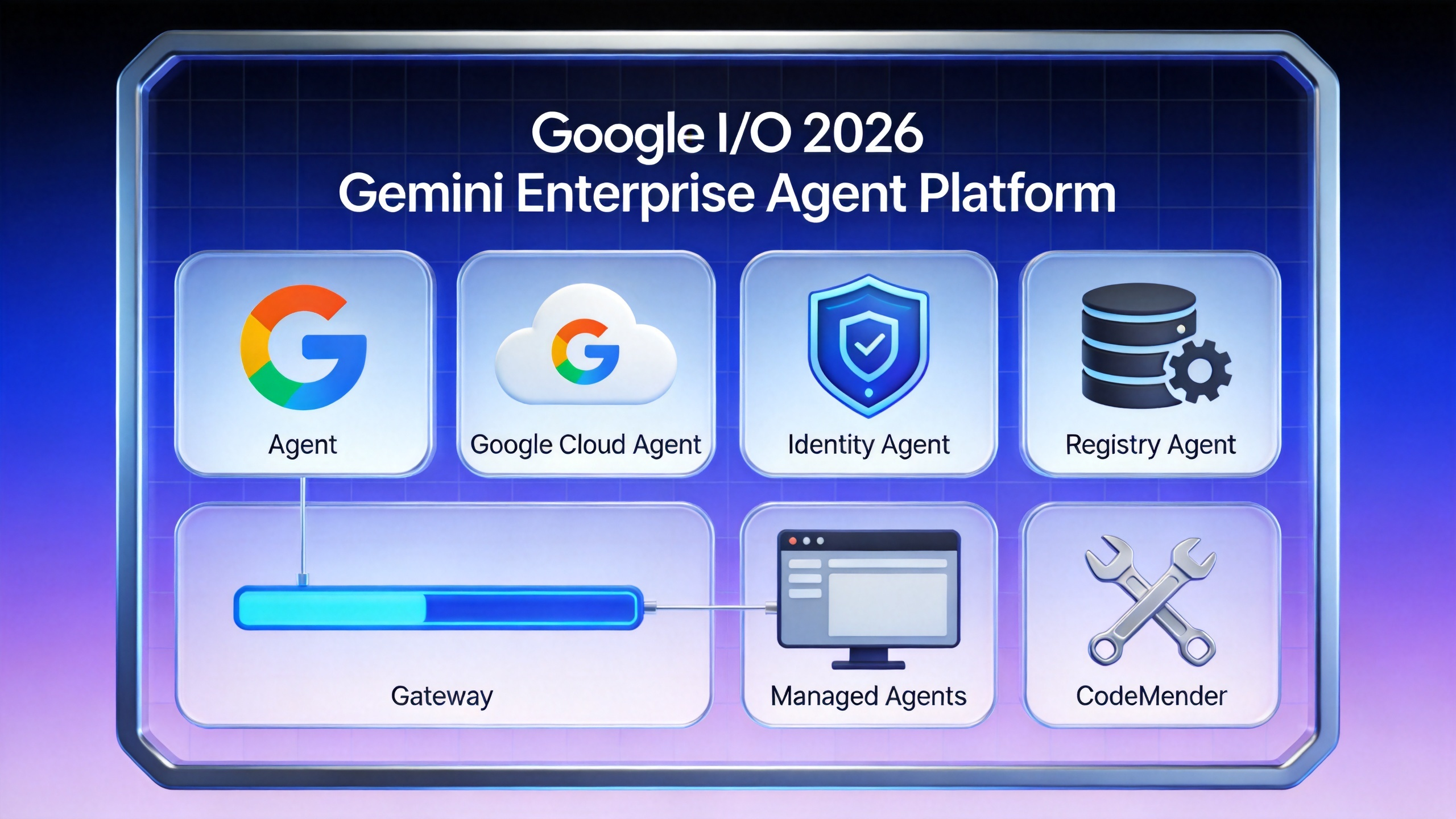
Google Gemini Enterprise Agent Platform Security Architecture: Google Finally Pushes Agent Security from Concept to Product
Core Judgment
Google completed the paradigm shift from "model marketplace" to "Agent operating system" through the Gemini Enterprise Agent Platform at I/O 2026. Its security philosophy is Platform-Native Security—all Agents must run within Google Cloud boundaries, with security built into the control plane rather than bolted on. This means: deep coupling of security capabilities with the platform delivers management efficiency, but at the cost of lock-in effects and absence of cross-platform governance.
Google Agent Security Philosophy
The Strategic Logic of Platform-Native Security
Google's bet: When Agents run within Google Cloud boundaries, Google can claim "everything is under my control"—identity assigned by me, traffic routed by me, execution sandboxed by me. This is a vertical integration strategy, embedding security capabilities into the platform's core plane.
The core assumption of this strategy is that future enterprise Agents will be deeply bound to cloud platforms, with the security control plane becoming a key dimension of platform competitiveness. By building security capabilities into the platform, Google aims to occupy a strategic position in the Agent era similar to that of operating systems in the PC era.
Five Security Components Dissected
Component 1: Agent Identity
What it is [Verified]
Agent Identity is an encrypted identity assigned by Google to each Agent, with auditable characteristics. In the Gemini Enterprise Agent Platform architecture, each Agent automatically receives a unique identifier upon registration in the Agent Registry, bound to its runtime permissions, call chains, and audit logs.
The Google Cloud developer blog explicitly states: Agent Identity integrates with Cloud OAuth, and all Agent inference runs within secure cloud boundaries, inheriting Google Cloud data privacy protections.
What problems it solves
Identity traceability: When an Agent executes sensitive operations (e.g., calling external APIs, accessing enterprise databases), the system can precisely identify which Agent performed what operation at what time
Permission boundaries: Agent Identity integrates with IAM (Identity and Access Management), ensuring Agents can only access authorized resources
Audit trail: All Agent behavior is recorded in Cloud Audit Logs, supporting compliance reviews
Limitations and Risks
Cross-platform blind spot: Agent Identity only covers Agents within Google Cloud. For Agents deployed on other clouds or on-premises, Google cannot provide identity management
Vendor lock-in: Agent Identity is tightly coupled with Agent Registry. Enterprises needing to migrate Agents face the challenge of identity rebinding
Verification depth: Official documentation has not yet disclosed specific implementation details of the encryption algorithm (e.g., key management, rotation strategies)
Component 2: Agent Registry
What it is [Verified]
Agent Registry is the unified management plane of the Gemini Enterprise Agent Platform, responsible for Agent lifecycle management—from registration, version control, to retirement. The Google Cloud developer blog notes that Skill Registry will soon be integrated into Agent Registry, forming a unified Agent and skill directory.
BackendNews confirms: Agent Registry links with Agent Identity and Agent Gateway, ensuring "only registered Agents can be invoked, only authenticated Agents can access resources."
What problems it solves
Asset visibility: Enterprises can centrally view all deployed Agents' names, versions, associated skills, and call relationships
Unified policy: Based on Agent metadata in the Registry, Agent Gateway can enforce consistent access policies
Skill reuse: Skill Registry allows enterprises to build reusable skill libraries, sharing across Agents through Agent Registry
Limitations and Risks
Skill Registry preview status: As of I/O 2026, Skill Registry is still in "coming soon" status; formal functionality pending verification
Migration complexity: If enterprises need to migrate Agents to other platforms, metadata, associated policies, and skill definitions in the Registry need reconfiguration
Multi-Agent orchestration visibility: For dynamic subagents created in the Antigravity platform, the Registry's real-time synchronization capability is not yet clear
Component 3: Agent Gateway
What it is [Verified]
Agent Gateway is the unified security policy enforcement point of the Gemini Enterprise Agent Platform. All Agent traffic must pass through this gateway. The Google Cloud developer blog explicitly states: Agent Gateway links with Agent Identity and Agent Registry, enforcing access control and audit policies at the traffic layer.
What problems it solves
Unified policy enforcement: Regardless of how many backend services an Agent calls, all traffic passes through the Gateway, achieving consistent policy coverage
North-south traffic control: Controls external data flowing into Agents, preventing prompt injection attacks
East-west traffic monitoring: Monitors call chains between Agents, detecting abnormal collaboration patterns
Limitations and Risks
Performance overhead: All Agent traffic passing through the Gateway may introduce latency; impact needs assessment for low-latency scenarios (e.g., high-frequency trading)
Protocol support: Official documentation has not clarified Agent Gateway's support level for non-HTTP protocols (e.g., gRPC, WebSocket)
Failure tolerance: Gateway single point of failure may render all Agents unavailable; high availability architecture needs assessment
Component 4: Managed Agents API
What it is [Verified]
Managed Agents API is a core feature Google launched in the Gemini API, allowing developers to create Agents through a single API call, with each Agent running in an isolated Linux sandbox. SiliconAngle confirms: Managed Agents are powered by Antigravity Agents, built on Gemini 3.5 Flash.
Core Security Features
1. Isolated Linux sandbox: Each Agent has its own filesystem, process space, and network namespace
2. Zero-trust egress policy: Developers must explicitly declare allowed external domain whitelists (egress allowlist); Agents cannot access unauthorized external endpoints
3. Tool call control: Agent tool calls (e.g., web search, code execution) are constrained by sandbox boundaries
Google's official blog explicitly states: Managed Agents "execute code and manage files in an isolated sandbox"—this is the first time Google has made sandbox isolation the standard configuration for Agents at the product level.
What problems it solves
Malicious code isolation: Even if an Agent generates malicious code, it cannot escape the sandbox
Data leak prevention: Egress whitelist mechanism prevents sensitive data from flowing through Agents to unauthorized third parties
Resource boundaries: The sandbox limits Agent CPU, memory, and storage usage, preventing resource exhaustion attacks
Limitations and Risks
Whitelist maintenance burden: As Agents depend on more external services, whitelist management complexity increases
Sandbox escape risk: Linux namespace sandboxes are not absolutely isolated (e.g., container escape vulnerabilities); additional hardening needed for high-sensitivity scenarios
Debugging difficulty: Debugging Agent behavior within sandboxes requires specialized tools; official debugging support is not yet mature
Component 5: CodeMender
What it is [Verified]
CodeMender is an AI code security Agent released by Google at I/O 2026, created by Google DeepMind researchers, for automatically scanning Agent-generated code vulnerabilities. SiliconAngle confirms: CodeMender "autonomously searches for and identifies any vulnerabilities in newly created code, including that generated by other agents."
Workflow
1. Automatic scanning: In CI/CD pipelines, CodeMender scans Agent-generated code for vulnerabilities
2. Fix recommendations: After identifying vulnerabilities, CodeMender recommends precise fixes
3. Verification testing: After code fixes, CodeMender executes security tests to ensure vulnerabilities are eliminated
The Google Cloud developer blog notes: CodeMender will be integrated into the Agent Security component of the Gemini Enterprise Agent Platform.
What problems it solves
Agent code quality: Agent-generated code may have security vulnerabilities (e.g., SQL injection, XSS); CodeMender provides security gate before deployment
Fix efficiency: Traditional security scanning tools only report vulnerabilities; CodeMender provides actionable fix recommendations, reducing manual intervention
Continuous security: Embeds code security checks into the Agent development lifecycle rather than remediation after the fact
Limitations and Risks
Fix accuracy: AI-generated fix recommendations may introduce new vulnerabilities or break functional logic; human review needed
Coverage: CodeMender's specific scan rule set has not been publicly disclosed as of I/O 2026; support level for non-mainstream languages or frameworks is unknown
Conflict with existing toolchains: Enterprises may have already deployed SonarQube, Snyk, etc.; CodeMender integration needs assessment of compatibility with existing pipelines
Impact Assessment on Enterprise Security Architecture
Short-term Impact (0-12 months)
| Assessment Dimension | Impact |
|---------|------|
| Adoption willingness | For customers already building AI applications on Google Cloud, Agent Platform provides a complete security control plane, reducing likelihood of migrating to competing platforms | | Security efficiency | The Agent Identity + Registry + Gateway trio provides previously missing Agent visibility and control, especially suitable for heavily regulated financial and healthcare industries | | Developer experience | Managed Agents' sandbox + egress whitelist may increase early-stage development friction, but long-term reduces security debt |
Mid-term Impact (12-36 months)
| Assessment Dimension | Impact |
|---------|------|
| Multi-cloud strategy | Google's "platform-native security" strategy excels in single-cloud scenarios, but enterprises with multi-cloud deployments need to maintain multiple Agent security systems | | Vendor lock-in | Deep binding of Agent Identity, Registry with Google Cloud significantly increases migration costs; enterprises must balance "security convenience" against "architectural flexibility" | | Integration with existing security infrastructure | Enterprises need to assess how existing security infrastructure links with Agent Platform, avoiding security silos |
Enterprise Self-Assessment Framework
When evaluating Agent Platform, enterprises should self-assess from the following dimensions:
| Assessment Dimension | Evaluation Question |
|---------|---------|
| Deployment environment | Do the enterprise's Agents primarily run within Google Cloud? What is the ratio of multi-cloud/hybrid deployment? | | Security compliance | What are the industry requirements for data localization and audit trails? Do Agent Platform's audit logs meet compliance needs? | | Migration planning | Does the enterprise have Agent assets running on other platforms? Are migration costs acceptable? | | Integration needs | Do existing identity management, log analysis, SIEM/SOAR tools need to interface with Agent Platform? | | Risk appetite | What is the enterprise's tolerance for vendor lock-in? Management efficiency or architectural flexibility first? |
Key Conclusions and Action Recommendations
Core Conclusions
1. Google has productized Agent security: From Identity to Registry to Gateway, Google has concretized previously conceptual Agent security into configurable, auditable product features
2. Platform-native security is a double-edged sword: Deep integration delivers management convenience, but at the cost of vendor lock-in and absence of cross-platform governance. Enterprises must balance adoption convenience against architectural autonomy.
3. CodeMender redefines code security: The closed loop from "discover problems" to "auto-fix-verify" represents the evolution direction of code security in the AI era, providing a new paradigm for Agent-generated code security assurance.
Action Recommendations
| Role | Action Item |
|------|--------|
| CISO | Assess Agent Platform's integration cost with existing security infrastructure; pilot in non-sensitive business first; formulate enterprise Agent security strategy | | Platform Architect | Design Agents with "portability" in mind; avoid hardcoding security policies into Google-specific features; establish unified framework for multi-cloud Agent deployment | | Security Operations | Establish Agent behavior baselines; integrate Agent Gateway logs with existing SIEM/SOAR; assess existing security tools' Agent behavior log parsing capabilities | | Development Team | Integrate CodeMender into CI/CD pipelines as a "shift-left" security gate; establish Agent code review processes | | Procurement Decision-makers | Negotiate for Agent Identity encryption algorithm documentation and egress policy API export capabilities; ensure viable exit paths; assess long-term subscription costs vs. lock-in risks |
Sources
Google Official Blog (I/O 2026): https://blog.google/innovation-and-ai/technology/ai/google-io-2026-all-our-announcements/
Google Managed Agents: https://blog.google/innovation-and-ai/technology/developers-tools/managed-agents-gemini-api/
Google Cloud Developer Blog: https://i636c6f7564o676f6f676c65o636f6dz.oszar.com/blog/topics/developers-practitioners/io26-news-for-agent-developers-on-google-cloud
BackendNews: https://backendnews.net/gemini-enterprise-agent-platform-powers-next-gen-ai-agents-for-business/
SiliconAngle: https://siliconangle.com/2026/05/19/google-accelerates-agent-native-software-development-expanded-antigravity-platform/
VendorDeep Analysis | Published: May 2026
Why it Matters
Google pushes Agent security from concept to product layer for the first time, with five components forming a complete Agent security control plane, defining the platform-native security paradigm
DECISION
Enterprises must weigh management efficiency against lock-in risk when evaluating Google Agent Platform; security vendors should focus on the gap market for cross-platform Agent identity governance
PREDICT
Platform-native security will become standard for mainstream cloud vendor Agent platforms, but the absence of cross-platform Agent identity standards will spawn independent identity layer vendors within 12-18 months
Get 3-5 key AI infrastructure signals weekly →
💬 Comments (0)