
1. Threat Landscape: From Technical Curiosity to Existential Crisis
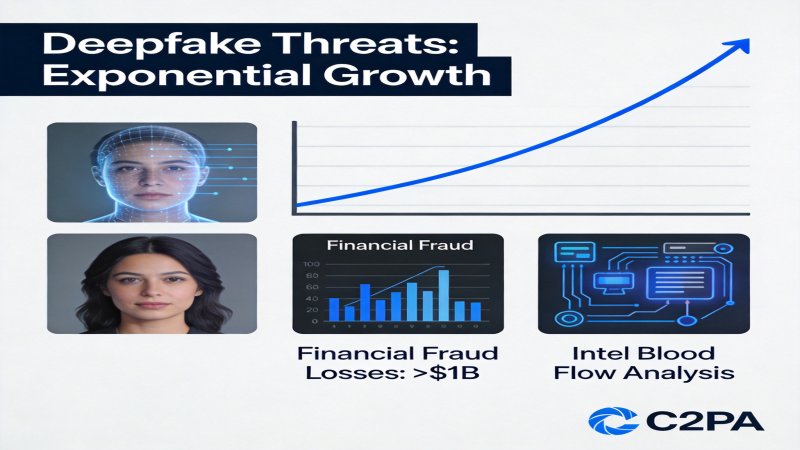
1.1 Explosive Growth: The Inflection Point of Digital Forgery
Deepfake technology has evolved from a tech geek experiment to a global digital security crisis. University at Buffalo tracking data shows online deepfake content grew from approximately 500,000 in 2023 to approximately 8 million in 2025, representing a nearly 900% annual growth rate. This growth pace far exceeds traditional cybersecurity threat evolution cycles, marking deepfakes' transition from occasional threat to systemic risk.
In the financial sector, deepfake-related losses in Q1 2025 exceeded $200 million, with average per-incident losses reaching $680,000. JP Morgan's 2026 payments outlook warns of a new deepfake attempt every five minutes. Experian's 2026 fraud forecast identifies deepfakes as the #1 emerging risk for financial institutions, surpassing ransomware and supply chain attacks. North American deepfake fraud cases surged 1,740% between 2022-2023.
1.2 Attack Evolution: From Face-Swapping Entertainment to Systemic Fraud
Deepfake abuse has infiltrated politics, economics, and society:
- Political domain: In March 2022, a fake video of Ukrainian President Zelensky calling on soldiers to surrender went viral on Twitter, severely disrupting international public opinion
- Financial crime: In Hong Kong, January 2025, a fraud ring used deepfakes to impersonate investment experts, defrauding victims of HK$34 million
- Social safety: Multiple deepfake pornography cases in Korea in 2024 triggered social upheaval
- Enterprise fraud: In phishing campaigns targeting YouTube creators, attackers used AI-generated videos of CEO Neal Mohan falsely announcing monetization policy changes
1.3 Technology Generation Shift: From GAN to Diffusion Detection Dilemma
More concerning for the security community is the generational leap in generation technology. Traditional GAN-based deepfakes achieved detection accuracy above 90%, but with diffusion and latent diffusion models, accuracy has plummeted to 61%-68%. Internal benchmarks from two European security vendors confirm this performance cliff as an open industry secret.
Dr. Sonia Mehta from MIT Media Lab observes: Passive detection is always fighting the last war. The model that beat your detector last Tuesday is already deprecated. C2PA does not try to detect fakes—it tries to make authentic content verifiably authentic, which is a fundamentally different and more durable goal.
2. Technical Approaches: The Attack-Defense Chess Game of Two Paradigms
2.1 Passive Forensics: Post-Hoc Digital Forensics
Passive forensic detection identifies forgeries by analyzing statistical anomalies in content itself. Main technical approaches include:
Physical Layer Detection
- Lighting inconsistency: Facial lighting vs. background light source angle deviation detection
- Eye movement anomalies: Blinking frequency exceeding physiological range by 30%+
- Facial blood flow analysis (rPPG): Capturing hemodynamic features from facial pixels
Signal Layer Analysis
- Biometric signals: Heart rate variability via PPG signal analysis, error rate less than 2bpm
- Audio spectral features: MFCC difference degree greater than 0.3
- GAN frequency fingerprints: Periodic artifacts in DCT domain
Data Layer Provenance
- Blockchain watermarking: Aliyun Hidden Trace supports 0.1% content ratio invisible watermarks
- Metadata forensics: EXIF tampering detection accuracy at 98%
2.2 Active Provenance: From Catching in the Act to Proving Innocence
C2PA (Coalition for Content Provenance and Authenticity) represents a fundamental paradigm shift: instead of asking is this fake?, cryptographic signatures are embedded at content creation, making any subsequent tampering invalidate the signature.
C2PA Technical Architecture
C2PA embeds cryptographically signed manifests into media files containing creation, editing, and authorship information:
- Content created → Manifest generated with metadata
- Manifest signed with private key (like HTTPS certificates)
- Manifest embedded in file
- Content edited → Previous manifest referenced by new manifest, forming provenance chain
C2PA v2.3 specification released February 2026 adds live video provenance support. Currently 6,000+ members and affiliates use Content Credentials.
3. Market Landscape: Deep Evaluation of Major Players
3.1 Technical Capability Comparison
| Vendor | Core Technology | Measured Accuracy | Latency | Deployment |
|---|---|---|---|---|
| Intel FakeCatcher | rPPG blood flow analysis | 96% (controlled) / 91% (wild) | Millisecond | Video conferencing, live auth |
| Microsoft Azure AI | Passive forensics + C2PA validation | 89% (mixed corpus) | ~1.2 sec/clip | LinkedIn identity verification |
| Reality Defender | Multi-model passive ensemble | 85% (video deepfakes) | ~3 sec | US broadcast networks |
| Sentinel AI | Ensemble passive forensics | 82% (video) / 74% (audio) | 4-8 sec | NATO comm screening |
| Sensity AI | Multi-layer + context analysis | 95-98% (standard) / 65% (advanced GAN) | Real-time (less than 5 sec video) | Law enforcement, media |
| Truepic Lens | Active provenance (C2PA v2.1) | N/A (provenance not detection) | Real-time (at capture) | AP, Reuters photo pipelines |
3.2 Intel FakeCatcher: Redefining Real-Time Detection
Intel's FakeCatcher represents the cutting edge of passive forensic technology. Its core innovation uses photoplethysmography (rPPG) to analyze blood flow signals in video pixels, rather than traditional image artifact analysis.
Technical Principle:
- When the heart pumps blood, veins change color subtly—invisible to the human eye but detectable by algorithms
- FakeCatcher collects blood flow signals from all facial areas
- Algorithms transform signals into spatiotemporal maps
- Deep learning models instantly determine authenticity
Key Advantages:
- Even when deepfakes apply face-smoothing filters, blood flow signals remain correlated in real videos but absent in synthetic ones
- Supports 72 concurrent real-time video streams (3rd Gen Intel Xeon processors)
- Integrated with Habana Gaudi chips, compressing latency to less than or equal to 40ms
3.3 Microsoft Azure: Enterprise Compliance Benchmark
Azure AI Content Safety employs a dual-track architecture combining passive forensics with C2PA validation, establishing enterprise compliance standards in financial and social platform domains.
Differentiated Capabilities:
- Integrated C2PA manifest verification to identify content provenance signatures
- Mixed corpus detection, 89% measured accuracy
- Deep integration with LinkedIn identity verification
- API interface for enterprise workflow integration
3.4 Sensity AI: Law Enforcement-Grade Standard
Sensity AI is widely recognized as the gold standard for enterprise deepfake detection, having detected 35,000+ malicious deepfakes in the past year alone.
Multi-Layer Detection Architecture:
- Pixel-level analysis
- File structure examination
- Voice pattern recognition
- Metadata verification
Real-Time Monitoring:
- Continuous monitoring of 9,000+ sources
- Tracking malicious deepfake activity
- Automated threat alerts
4. C2PA Standard: Building Trusted Content Infrastructure
4.1 From Standard to Service: Enterprise Landing
C2PA was established in 2021 by merging Adobe's Content Authenticity Initiative (CAI) and Microsoft/BBC's Project Origin, aiming to verify digital content provenance through cryptographically signed metadata. In October 2025, Adobe officially launched Content Authenticity for Enterprise, marking the standard's transition from technical specification to commercial service.
Adobe Enterprise Service Trio:
- GenStudio for Performance Marketing: Marketing teams can automatically attach Content Credentials showing generative AI usage
- Firefly Creative Production: Provides end-to-end provenance across creative operations
- Content Authenticity API: Direct access via Firefly Services, supporting custom workflow integration
4.2 Hardware Breakthrough: From Chips to Endpoints
In September 2025, Google Pixel 10 became the first smartphone with native C2PA support, cryptographically signing every photo using hardware-backed keys in the Titan M2 chip. Pixel Camera app achieved C2PA Conformance Program's highest security level—Assurance Level 2.
Camera Ecosystem Progress:
| Manufacturer | Device/Software | Status |
|---|---|---|
| Leica | M11-P, SL3 | Supported |
| Sony | Alpha 1, A9 III, A7S III, A7 IV | Supported (firmware update) |
| Sony | a9 III, a1 II, FX3, FX30, PXW-Z300 | Video signing supported |
| Nikon | Z6 III | 2025 firmware planned |
| Canon | — | Exploring implementation |
| Adobe | Firefly, Photoshop, Premiere Pro | Supported |
4.3 Compliance Pressure: EU AI Act Article 50
On August 2, 2025, EU AI Act Article 50 transparency obligations became enforceable: AI-generated synthetic content accessible in the EU must be labeled in machine-readable format. Penalties reach up to 3% of global annual turnover or 15 million euros (whichever is higher). C2PA Content Credentials serve as the primary technical mechanism for compliance.
5. Emerging Directions: Next-Generation Detection Technology Map
5.1 Frequency Domain Analysis: Detecting Beyond Spatial Dimensions
Traditional detection relies on spatial domain features (pixels, textures), but performance degrades sharply under image compression and degradation. Frequency domain analysis using FFT/DCT transforms to capture periodic forgery fingerprints has become a core direction for next-generation detection.
SpecXNet (ACM MM 2025):
- Dual-domain collaboration: Local spatial branch + Global spectral branch
- Dual Fourier Attention (DFA): Dynamic fusion of spatial and frequency features
- Cross-dataset generalization: 90.0% accuracy on TGen dataset, approximately 10% improvement over baseline
ANL Framework (Zhejiang University):
- Discovery: Real images produce structured noise, diffusion-generated images produce white noise patterns
- This feature can detect unseen generators
5.2 3D Facial Reconstruction: Capturing Geometric-Level Inconsistencies
M3D-Net (South China Agricultural University):
Multi-Modal 3D Facial Feature Reconstruction Network reconstructs depth and albedo from 2D images, capturing subtle geometric and textural inconsistencies missed by 2D analysis.
3DAD Method:
- Utilizes spatio-temporal inconsistencies in 3DMM space for forgery detection
- 3D Analysis Unit (3DAU) extracts high-level 3D representations
- Texture Perception Unit (TPU) extracts low-level texture information
5.3 Behavioral Biometrics: Soft Fingerprints Hard to Replicate
Even if deepfake videos can replicate facial appearance, they struggle to perfectly mimic complex coordinated facial movements. Behavioral biometrics have emerged as a new detection dimension.
Micro-Expression Detection (University of Bristol):
- Discovery: Face-swapped deepfakes leave distinct behavioral fingerprints during emotional expressions
- Generative models struggle to replicate complex coordinated facial movements
- Emotive dynamics become key diagnostic signals
Facial Behavior Analysis (IEEE IPAS 2025):
- Person of Interest (POI)-specific deepfake detection
- Identifies inauthentic content by learning POI-unique facial movements
- Training without deepfake samples, achieving generation-method-agnostic detection
6. Market Drivers: The Dual Engine of Compliance and Defense
6.1 Financial KYC: A Life-and-Death Compliance Battlefield
Deepfakes pose the most direct threat to the financial industry. Sumsub data shows deepfake attempts in KYC verification grew tenfold year-over-year.
Regulatory Requirements:
- EU PSD2 directive: Transaction verification requires fusion of 3+ biometric factors
- SWIFT 2025 new rules: Deepfake detection required for transfers exceeding $10,000
- SEC and CFTC signals: Institutions without adequate AI defenses will bear liability for fraud losses
6.2 Government Budget: National-Level Strategic Investment
The U.S. Department of Homeland Security (DHS) Media Forensics Hub project budget increased to $230 million in 2025, marking deepfake detection as a national security priority.
Key Procurements:
- DHS invested $2.4 million in Hive AI
- Defense Innovation Unit (DIU) selected Hive AI to counter AI-powered disinformation and synthetic media threats
- NATO established communication screening mechanisms
6.3 Market Forecast: The Leap from Hundred-Million to Ten-Billion
The deepfake detection market is experiencing explosive growth:
| Metric | 2025 | 2026 (Forecast) | 2030 (Forecast) |
|---|---|---|---|
| Deepfake Detection Market | $847 million | $1.4 billion (+65%) | $5 billion+ |
| AI Fraud Management Market | — | $18.48 billion | $37 billion |
| Identity Verification Market | $15 billion | (13-17% annual growth) | — |
Gartner predicts that by end of 2026, 30% of enterprises will consider their existing identity verification solutions inadequate against AI-generated threats.
7. Decision Framework: Enterprise Deepfake Defense Roadmap
7.1 Short-Term Actions (0-6 months)
- Assess current identity verification processes for deepfake vulnerabilities
- Deploy at least one passive forensic detection solution (Azure AI Content Safety, Reality Defender)
- Establish deepfake incident response processes
- Train key business teams to identify deepfake content
7.2 Medium-Term Building (6-18 months)
- Introduce multimodal detection combining visual, audio, and biometric factors
- Drive content creation workflows toward C2PA adoption
- Evaluate endpoint authentication (C2PA-compliant cameras, smartphones)
- Share deepfake threat intelligence with industry partners
7.3 Long-Term Strategy (18+ months)
- Establish enterprise standards for content provenance and authenticity (Content Credentials)
- Explore deep integration with blockchain and Trusted Execution Environments (TEE)
- Position for next-generation detection: frequency domain analysis, 3D reconstruction, behavioral biometrics
- Participate in industry standard-setting, drive regulatory framework improvement
7.4 Technology Selection Decision Matrix
| Use Case | Recommended Solution | Key Considerations |
|---|---|---|
| Real-time video conferencing | Intel FakeCatcher | Millisecond latency, 72 concurrent streams |
| Financial KYC | Sensity AI + Liveness Detection | Multi-layer verification, law enforcement-grade accuracy |
| Content provenance | Truepic Lens + C2PA | Trusted chain established at capture |
| Media organizations | Microsoft Azure + Reality Defender | Enterprise compliance, multimodal support |
| Photojournalism | C2PA-compliant cameras + Adobe | Hardware-level signing, end-to-end provenance |
8. Conclusion: The Moment of Trust Infrastructure Reconstruction
Deepfake detection stands at a historic turning point: upgrading from single-point technical confrontation to systemic trust infrastructure reconstruction. Traditional passive forensic detection has shown fatigue against diffusion models, while cryptographic provenance-based active authentication (C2PA) is transitioning from standard to ecosystem.
Enterprises should not view deepfake detection as an isolated security investment, but rather integrate it into the core architecture of digital trust strategy. This includes: adopting dual-track detection (passive forensics + active provenance), prioritizing multimodal fusion solutions, driving content supply chains toward C2PA standards, and continuously tracking next-generation technologies like frequency domain analysis, 3D reconstruction, and behavioral biometrics.
With full enforcement of EU AI Act Article 50 and tightening regulatory frameworks worldwide, deepfake defense is shifting from optional to mandatory. Enterprises that first establish trusted content infrastructure will seize the initiative in the upcoming digital content trust revolution.
Why it Matters
DECISION
PREDICT
Get 3-5 key AI infrastructure signals weekly →
💬 Comments (0)