
Analyzing Cisco's Full-Stack AI Agent Identity Security Architecture Layout Through Its Acquisitions of Galileo and Astrix
Background and Overview
Between March 22 and April 10, 2026, Cisco announced the acquisitions of AI observability vendor Galileo and Non-Human Identity (NHI) management vendor Astrix within 30 days, and released a white paper on the integrated full-stack architecture (Source: Cisco official announcements and white paper). This move signifies Cisco's strategy of rapidly acquiring key technologies to build what it claims to be the industry's first full-stack AI Agent identity security architecture covering from the network layer to the AI layer.
With the explosive growth of enterprise AI Agents, non-human identity security and AI behavior monitoring have become critical blind spots. Cisco aims to integrate its existing identity security product line (ISE, Duo, Identity Intelligence) and, through these acquisitions, fill the gaps in NHI management and AI observability capabilities to address emerging threats and seize the early-mover advantage in the rapidly growing AI security market.
Architecture Layering
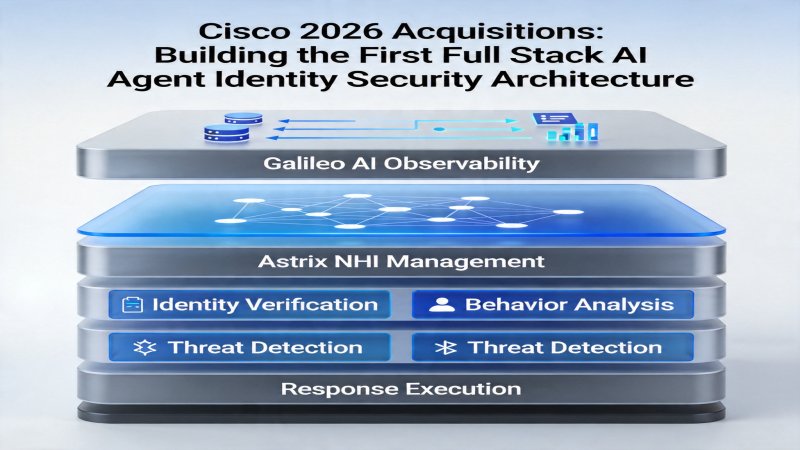
Cisco's constructed full-stack architecture is divided into six layers, designed to achieve closed-loop management of the AI Agent identity lifecycle. This architectural diagram is based on descriptions from Cisco's white paper released in April 2026. Its deployment stability and performance in large-scale, real-world hybrid environments have not yet been widely validated by third parties.
Architecture Interpretation:
- Network and Application Layers: Cisco ISE (Identity Services Engine) and Duo multi-factor authentication form the foundational access control layer, ensuring controlled initial access for all entities, including AI Agents.
- Situational Layer: Identity Intelligence provides global identity risk assessment and integrated Threat Detection and Response (ITDR) capabilities, reportedly reducing average threat response time to 12 seconds (Source: Cisco 2025 product launch press release).
- NHI Layer: The newly acquired Astrix is responsible for automatically discovering and managing non-human identities like API keys and AI Agents, constituting the core new addition to the architecture. Cisco has not publicly disclosed a clear definition of "identity types" or the composition of the test set. The credibility of the "99%" statistic is questionable, likely based on its predefined, limited test environment and lacks universal reference value.
- AI Observability Layer: The newly acquired Galileo focuses on monitoring AI Agent outputs and behaviors. Its claimed 98.7% hallucination detection accuracy is laboratory data. It does not specify key information such as the test dataset (e.g., inclusion of industry-specific terms, multimodal inputs) or the False Positive Rate (FPR). This "accuracy" is marketing language and cannot serve as a basis for procurement decisions.
- Runtime Control Layer: Intervention during AI Agent execution occurs via the MCP (Model Context Protocol) Gateway. The lack of technical details on "intent parsing" makes it impossible to evaluate its false blocking rate or defense capabilities against adversarial prompts, representing a significant technical risk for architecture implementation.
Key Technologies
1. Non-Human Identity Management (NHI) - Astrix
- Problem Addressed: Traditional identity management tools struggle to effectively discover and manage non-human identities like API keys, service accounts, and AI Agents, leading to permission sprawl.
- Core Principle: Uses agentless scanning and log analysis to automatically discover non-human identities and map them to human owners. Integrates with Identity Intelligence for permission risk assessment and enforces governance based on the principle of least privilege.
- Claimed Efficacy: According to Cisco's April 2026 white paper, its identity discovery coverage reaches 99% (Source: Cisco white paper). This metric lacks verifiability. Cisco must publicly disclose the testing methodology for "identity discovery coverage" (e.g., MITRE ATT&CK coverage, custom scanning rules) and provide comparative data against industry benchmarks; otherwise, the metric is meaningless.
2. AI Observability - Galileo
- Problem Addressed: AI Agent outputs may contain factual errors (hallucinations), sensitive information leaks, or be induced to perform malicious operations.
- Core Principle: Integrates multiple detection engines for real-time analysis of AI model inputs, outputs, and behaviors. Core capabilities include hallucination detection, prompt injection detection, and safety guardrails.
- Claimed Efficacy: The white paper discloses a hallucination detection accuracy of 98.7% and the ability to intercept risky outputs with millisecond-level latency (Source: Cisco white paper). This metric is based on laboratory or limited-scenario validation. Its processing latency, resource consumption, and stability in real-world enterprise environments with massive, heterogeneous data remain to be verified.
3. MCP Gateway (Runtime Control)
- Problem Addressed: AI Agent runtime behavior is dynamic, making static policy enforcement lag.
- Core Principle: Acts as a proxy gateway between AI Agents and target systems, parsing the Agent's "intent" in real-time and comparing it against security policies to block or correct operations.
- Claimed Efficacy: Cisco claims the MCP Gateway can reduce permission misconfiguration risk by 92% (Source: Cisco white paper). The technical implementation of "intent parsing" (e.g., dependency on specific protocols or model fine-tuning) is not detailed. Its generality and accuracy are critical for implementation.
4. Identity Security Posture Management (ISPM) - Identity Intelligence
- Problem Addressed: Assessing the enterprise identity attack surface is complex, and threat response is slow.
- Core Principle: Continuously analyzes multi-source logs, uses machine learning to assess identity risk scores, and automates response workflows.
- Reported Performance: Cisco's 2025 product launch materials indicate that after integrating ITDR capabilities, the average threat response time was reduced to 12 seconds (Source: Cisco 2025 product launch press release).
5. Zero Trust for Agentic AI
- Problem Addressed: AI Agents lack granular Zero Trust control and are often granted excessive permissions.
- Core Principle: Applies the "never trust, always verify" principle to AI Agents, requiring each Agent to register, have a clear human owner, and dynamically request minimal necessary permissions based on tasks.
- Core Components: This framework is implemented jointly by Astrix (registration), Identity Intelligence (assessment), and the MCP Gateway (enforcement).
Workflow and Principles
The workflow of Cisco's full-stack architecture follows the closed-loop management of identity security. However, the efficiency and reliability of each step in complex environments still require validation through customer case studies.
Workflow Interpretation:
- Discovery & Registration: Astrix automatically scans and discovers non-human identities. Whether its coverage truly reaches 99%, and the risks posed by potential omissions (e.g., custom protocol microservices), are questions for further research.
- Assessment & Configuration: Identity Intelligence analyzes identity permission risks and generates policies.
- Monitoring & Enforcement: During AI Agent runtime, Galileo performs real-time security analysis. If Galileo and the MCP Gateway only offer deep support for Cisco-certified models or limited platforms, it could lead to vendor lock-in, preventing protection for Agents running on mainstream cloud AI services (e.g., AWS Bedrock, Google Vertex AI). This would contradict the claimed "openness" and "full-stack" nature.
- Response: The MCP Gateway executes actions based on results, completing the loop.
Competitive Landscape Analysis
Cisco rapidly built full-stack capabilities through acquisitions but faces multifaceted competition in the AI security market. Its claimed integration advantages require market validation.
Major Competitor Comparison:
- Palo Alto Networks
- Strengths: Leader in cloud security market, strong threat detection capabilities.
- Technical Approach & Status: Provides cloud security and AI threat detection via Prisma Cloud and Cortex XDR. Its Q1 2026 public documents do not advertise a dedicated AI Agent identity management module (Source: Inference based on public documents), but this does not preclude potential similar coverage through existing API management, cloud workload identity features, etc.
- Comparison with Cisco: Cisco's architecture currently appears more explicit regarding a dedicated, pre-integrated solution for the full lifecycle management of AI Agent identities. However, Palo Alto has deep roots in cloud-native environments and threat intelligence.
- CrowdStrike
- Strengths: Clear advantages in Endpoint Protection/Detection and Response (EPP/EDR), rich threat intelligence.
- Technical Approach & Status: Focuses on endpoints, extending into AI security via the Falcon platform. Its coverage for network-layer access control and dedicated management of AI Agent non-human identities (NHI) appears relatively limited in public information.
- Comparison with Cisco: Cisco has broader coverage across network layer control (ISE) and the newly added NHI and AI observability layers, while CrowdStrike possesses greater depth in endpoint-side behavior detection and response.
- Microsoft
- Strengths: Deep integration with the Azure cloud platform, vast enterprise customer base.
- Technical Approach & Status: Leverages built-in security in Azure AI services and Microsoft Sentinel for monitoring. Its identity security solutions (e.g., Entra ID) are primarily optimized for human users; dedicated, unified support for non-human identities appears fragmented in hybrid environments.
- Comparison with Cisco: Cisco attempts to offer a unified product line across hybrid environments, while Microsoft's capabilities are more tightly bound to the Azure ecosystem. Cisco may demonstrate more flexibility in environments not dominated by Azure.
Cisco's Claimed Differentiators:
- Full-Stack Coverage: Claims to be the only provider offering an end-to-end solution from network access to AI behavior monitoring.
- Performance Metrics: Acquired technologies with claimed leading performance metrics (e.g., Galileo's 98.7% accuracy).
- Openness: The architecture reserves open interfaces, claiming compatibility with third-party products.
Market Dynamics: The AI Agent security market is in its early stages with undefined standards. Cisco attempts to establish leadership through integration but faces intense competition from cloud vendors leveraging platform ecosystems and startups specializing in niche areas.
Key Judgments
Based on currently available public information, the following judgments are made regarding Cisco's strategic move and its market impact:
| Judgment Content | Confidence Level | Importance | Specific Action Recommendations |
|---|---|---|---|
| Cisco's full-stack AI Agent identity security architecture has the potential to become the standard security solution for enterprises deploying AI Agents. | High | As AI Agents proliferate, an integrated security architecture can reduce management complexity and improve protection effectiveness, crucial for enterprise compliance and risk management. | 1. Enterprises should prioritize evaluating the applicability of this architecture and its integration with existing systems; demand that Cisco provide a detailed migration assessment framework, including API replacement workload, policy conversion tools, and methods for performance baseline comparison during parallel operation. Otherwise, migration costs will be unpredictable. 2. Competitors need to accelerate similar full-stack development or seek partnerships. |
| Cisco rapidly filled capability gaps through acquisitions, but technical integration and customer implementation outcomes remain to be seen. | Medium | Post-acquisition product fusion and performance stability will determine market acceptance, potentially facing integration challenges in the short term. | It is recommended to track Cisco's product updates and customer feedback post-2026 to validate architecture maturity. Focus on the implementation of its open interfaces and third-party-verified performance reports. |
Open Research Questions
- Large-Scale Deployment Performance: Missing data on processing latency, resource consumption, and stability of this architecture in real-world enterprise environments with massive, heterogeneous data. Requires independent third-party large-scale benchmark testing.
- Ecosystem Compatibility and Openness: Details on its compatibility and API maturity with mainstream cloud AI platforms, open-source frameworks, and third-party identity products are key to determining integration into heterogeneous IT environments. Currently, there are only claims, lacking detailed integration guides.
- Coverage Gaps in NHI Management: Cisco needs to clarify what the uncovered 1% of "identity types" specifically entails (e.g., entities using specific custom protocols, new hardware identities) and the risk mitigation measures for these blind spots.
- Migration Cost and Complexity Assessment: For enterprises already deploying other point solutions, the Total Cost of Ownership (TCO), migration timeline, and impact on business continuity for migrating to Cisco's full-stack architecture require more real-world customer migration cases to provide assessment basis.
Analysis Limitations: This report is primarily based on Cisco's official white papers, press releases from 2026, and third-party media reports. Several key performance data points (e.g., 92% risk reduction, 99% coverage) are claims by Cisco and have not been widely validated by independent third-party testing reports. Information regarding technical integration details, implementation of open interfaces, and recent dynamics of competing products may be incomplete or may have changed.
Why it Matters
Positioning: Ecosystem Expansion, rapidly integrating through M&A to seize first-mover advantage in a new track.
Key Factor: The core factor is whether Cisco can successfully build and validate its claimed 'end-to-end' technical moat. This depends on: 1) The depth and speed of integrating Galileo and Astrix technologies into products; 2) Validation of the architecture's performance and stability in real heterogeneous environments; 3) Resolving the contradiction between 'openness' and 'ecosystem lock-in' to truly support mainstream AI platforms. Currently, its moat is based more on vision and early acquisitions than proven technical superiority.
Stage: Innovation Trigger
DECISION
For Vendor (Cisco)
- Immediately initiate third-party large-scale benchmarking to provide verifiable performance data, addressing market skepticism about its claimed metrics.
- Accelerate the release of detailed integration guides and APIs for mainstream AI services (AWS, Azure, Google Cloud) to prove the architecture's openness.
Strategic Moves: Release the first integrated product suite and heavyweight reference customer cases within the next 6-12 months.
- Require Cisco to provide a Proof-of-Concept (POC) validation in your own environment, focusing on its actual coverage in hybrid cloud and existing non-Cisco AI services.
- Incorporate migration costs and ecosystem lock-in risks into the evaluation framework, demanding detailed TCO analysis and integration plans for existing security tools.
Action Guidance: Watch
For Investor
- Monitor Cisco's subsequent product release cadence and early customer feedback to verify its execution in technology integration.
- Simultaneously track moves by competitors like Palo Alto and CrowdStrike in the AI Agent security space, including M&A or product launches.
Key Risk: Technology integration falls short of expectations, or insufficient architecture openness leads to low market adoption.
PREDICT
1 year (High confidence)
Cisco will release its first 'full-stack' integrated product, but market feedback will be polarized, with early adopters primarily being existing Cisco networking/security customers.
2 years (Medium confidence)
Initial standards for the AI Agent security market will emerge. Whether Cisco's architecture becomes mainstream depends on its proven interoperability with cloud-native solutions.
3 years+ (Medium confidence)
The market will converge around a few vendors offering 'trusted platform + open ecosystem'. Deeply locked-in, closed solutions will have limited market share.
Get 3-5 key AI infrastructure signals weekly →
💬 Comments (0)