
I. Event Recap
On June 2, 2026, the U.S. Department of Commerce's National Institute of Standards and Technology (NIST) formally announced a final award of $150 million to xLight, Inc. under the CHIPS and Science Act, to construct and demonstrate a first-of-its-kind free-electron laser (FEL) prototype—a revolutionary alternative light source for extreme ultraviolet (EUV) lithography.
xLight is a Palo Alto-based startup whose Executive Chairman is Pat Gelsinger, former Intel CEO and a legendary figure in the semiconductor industry. xLight's core technology roadmap is to develop an FEL-based EUV light source to replace the LPP (Laser Produced Plasma) light source currently used in ASML's EUV lithography tools.
The strategic significance of this event extends far beyond a startup's funding success. It marks the U.S. government formally elevating "EUV light source technology roadmap diversification" to the national strategic level—breaking ASML's (through its U.S. subsidiary Cymer) exclusive monopoly in EUV light source technology, and establishing U.S. domestic advanced lithography technology capability.
xLight aims to complete verification of its first FEL-EUV prototype in 2028 and begin commercial testing with chip manufacturers. If successful, this would be the first fundamental technology roadmap challenge to ASML's commercialization of EUV lithography since the 2010s.
II. Technical Deep Dive
The core challenge of EUV lithography lies in generating extreme ultraviolet light at a wavelength of 13.5 nm. ASML's current EUV lithography tools (including the latest High-NA EUV) all adopt the LPP (Laser Produced Plasma) technology roadmap: high-power CO₂ lasers strike tin droplets, generating plasma that emits EUV light.
xLight's FEL (Free Electron Laser) roadmap is completely different: electrons are accelerated to extremely high speeds through a particle accelerator, passed through an undulator that generates a periodic magnetic field, producing coherent, high-intensity EUV light.
FEL vs. LPP Technology Comparison:
| Dimension | xLight FEL | ASML/Cymer LPP |
|---|---|---|
| Light Generation | Particle accelerator + undulator | CO₂ laser striking tin droplets |
| Light Source Location | Separate facility outside clean room | Integrated inside lithography tool |
| Scanners per Light Source | Up to 20 ASML scanners | One light source per scanner |
| Power Potential | Claims 10x efficiency improvement over current tech | Current most advanced LPP: ~500-600W |
| Spectrum | Narrower spectrum, higher brightness | Relatively wide spectrum |
| Technology Maturity | Prototype stage (target 2028) | Commercialized (thousands deployed) |
Key Unresolved Questions: Can FEL technology truly match or surpass LPP in power, stability, and cost? Is 24/7 uninterrupted operation of a particle accelerator feasible in a chip manufacturing environment? The answers to these questions will determine whether xLight's challenge can succeed.
III. Financial Logic
The $150 million in CHIPS Act funding xLight received, while still modest compared to the investment scale of the lithography industry it attempts to disrupt, carries enormous strategic leverage.
ASML's Investment Scale Comparison: ASML invests over €3 billion annually in R&D, a significant portion of which goes to continuous optimization of EUV light source technology (higher power, higher yield, lower operating costs). xLight is launching a technology roadmap challenge with $150 million in government funding—a two-order-of-magnitude gap. But the disruptive potential of FEL technology lies in: if successful, it could devalue ASML's cumulative EUV R&D investment of the past 15 years.
Pat Gelsinger's Capital Mobilization Capability: As xLight's Executive Chairman, Gelsinger's reputation and relationship network in the semiconductor industry provide xLight with resource acquisition capabilities far beyond ordinary startups. He is also a General Partner at Playground Global, whose venture capital network further amplifies xLight's technology commercialization potential.
ASML's Response Strategy: Facing xLight's challenge, ASML will not sit idly by as its monopoly is eroded. Its advancing EUV light source upgrade roadmap (targeting LPP light source power above 1000W by 2027-2028) could substantially widen the technology gap before xLight's FEL prototype is ready. Additionally, ASML is also evaluating FEL technology and holds related patents—theoretically, it could counter xLight's technology maturity through patent litigation or technology licensing.
IV. Strategic Context
Behind xLight's challenge to ASML is the geopolitical restructuring the global semiconductor equipment industry is undergoing.
The U.S. Semiconductor Sovereignty Narrative: Over the past 30 years, the global lithography industry (from ASML's rise to Nikon's and Canon's decline) has formed a highly concentrated landscape—ASML has a 100% market share in EUV lithography. This monopoly gives the Netherlands (ASML HQ) and the U.S. (Cymer location) disproportionate influence in the semiconductor supply chain. xLight's FEL technology roadmap is the U.S.'s attempt to establish "technology sovereignty" in this most critical link of lithography.
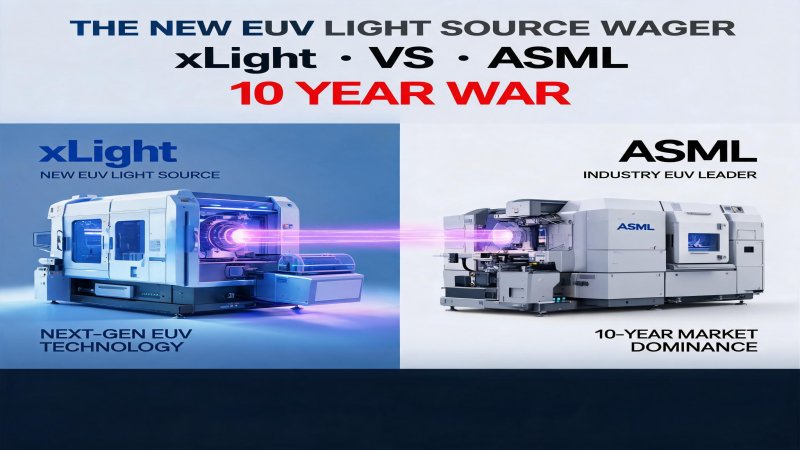
The "Ten-Year War" Timeline: Lithography technology R&D cycles are extremely long. ASML took approximately 20 years from initiating EUV feasibility research in the 1990s to achieving commercialization in the 2010s. If xLight is to make FEL technology commercially viable, it will likely take until around 2030. This means the competition between xLight and ASML will be a decade-long marathon, not a short-term sprint.
Multidimensional Assessment of ASML's Moat:
- Technology Moat: ASML holds over 10,000 patents in EUV lithography, covering the entire technology stack: light source, optical systems, masks, and photoresists. Even if xLight's FEL technology succeeds at the light source level, it still needs to solve integration issues with other subsystems of existing lithography tools.
- Ecosystem Moat: ASML's EUV lithography tools have established deep ecosystem binding with global chip manufacturers (TSMC, Samsung, Intel, TSMC, etc.). Even a performance-superior alternative technology would take years to complete verification and adoption.
- Supply Chain Moat: ASML's EUV lithography tools contain over 100,000 components from thousands of suppliers globally. If xLight's FEL solution is to be commercialized, it needs to rebuild an entirely new supply chain system.
V. Challenges and Risks
While xLight's FEL technology roadmap has disruptive potential, the challenges it faces are equally enormous. These challenges determine the answer to the question "Is ASML's moat secure?"
Technology Feasibility Risk: FEL technology currently has applications in synchrotron radiation facilities, but those facilities are designed for scientific research, not 24/7 uninterrupted chip manufacturing environments. Adapting FEL technology from scientific instruments to industrial-scale production equipment requires solving extremely complex engineering problems—including electron beam stability, thermal management, and radiation shielding. xLight needs to demonstrate in its 2028 prototype verification that all these engineering challenges are solvable.
Commercialization Gap: Even if xLight successfully verifies its FEL prototype's technical feasibility in 2028, there is still a massive gap from prototype to volume production. ASML's EUV lithography tools experienced a yield ramp-up and customer verification cycle lasting years or even a decade during commercialization. Whether xLight, as a startup, has sufficient funding and customer relationships to bridge this gap is highly questionable.
Patent and Technology Blockade Risk: ASML holds an extremely dense patent portfolio in EUV lithography. Even if xLight's FEL technology roadmap adopts a completely different physical principle, it may still touch ASML's patent blockades (for example, many foundational patents on applying EUV light to lithography processes are held by ASML). xLight needs to demonstrate that its FEL solution is also safe at the patent level, or be prepared to respond to ASML's patent litigation.
CHIPS Act Funding Political Risk: The $150 million in funding comes from the CHIPS and Science Act, whose political support within the U.S. is not entirely consistent. If major political landscape changes occur in the U.S. in 2027-2028, subsequent funding may face uncertainty. Startup technology development requires continuous funding; any funding interruption could cause project failure.
VI. Conclusion
xLight securing $150 million in CHIPS Act funding, led by Pat Gelsinger to challenge ASML's EUV light source monopoly, is a significant signal that the global semiconductor equipment industry landscape is undergoing profound restructuring.
For ASML, xLight's challenge is currently insufficient to shake its moat. ASML's technology depth, ecosystem binding, and supply chain control in EUV lithography constitute multi-layered, three-dimensional competitive barriers. Even under the most optimistic scenario, xLight's FEL technology will take until around 2030 to achieve commercialization. During this period, ASML has ample capability to consolidate its leading position through technology upgrades and patent布局.
For the global semiconductor industry, xLight's challenge has important "deterrence value"—it demonstrates to the market that ASML's EUV monopoly is not unchalengeable, which may prompt ASML to exercise greater restraint in pricing and technology openness. Simultaneously, it promotes diversification exploration of EUV light source technology roadmaps, which is beneficial for reducing single-point technology risk in global chip manufacturing in the long run.
The independent judgment on the industry competitive landscape is: ASML's moat will remain secure in the short-to-medium term (3-5 years); whether xLight's challenge can succeed depends on its technical performance in the 2028 prototype verification, and whether it can secure a volume production verification commitment from at least one top-tier chip manufacturer (e.g., Intel, TSMC, or Samsung) before 2030. This "ten-year war" has only just begun.
Why it Matters
DECISION
PREDICT
Get 3-5 key AI infrastructure signals weekly →
💬 Comments (0)