
I. Event Recap
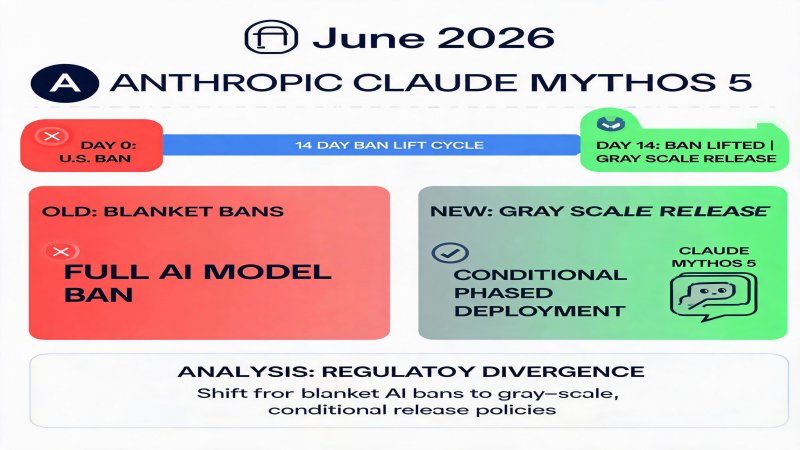
On June 12, 2026, the Trump administration abruptly suspended access to Anthropic's Claude Mythos 5 and Claude Fable 5 frontier models, requiring export control review. The ban lasted only 14 days—on June 26, the U.S. Department of Commerce formally approved restoring access for over 100 approved U.S. organizations, marking the most significant "ban-lift" event in AI model regulation in recent years.
The lifting of the ban adopted a tiered mechanism: the approximately 100 approved institutions (including Fortune 500 companies, government agencies, research institutions, and critical infrastructure operators) can freely use Mythos 5; their non-U.S. citizen employees also no longer need export licenses. However, license restrictions for all other organizations remain in effect. This "precision unbanning" model signals that AI model regulation has formally entered the "gray-scale release" phase, moving beyond "blanket bans."
The first 20 institutions to gain access were primarily cybersecurity partners participating in Anthropic's "Project Glasswing," an initiative designed to help trusted organizations identify and remediate vulnerabilities in critical software and infrastructure before malicious actors can exploit them. Anthropic reports that Mythos 5 discovered vulnerabilities in classified government systems within hours during U.S. intelligence agency testing; NSA Director and Cyber Command Commander General Joshua Rudd has publicly confirmed this capability.
The Q3 rollout countdown has begun: according to multiple sources, Anthropic plans to complete the Phase 2 expansion of Claude Mythos 5 to a broader set of enterprise customers in Q3 2026, a milestone widely seen as a critical commercialization step ahead of its potential IPO.
II. Technical Deep Dive
Mythos 5 is a frontier model built by Anthropic specifically for cybersecurity scenarios. It shares its underlying architecture with the simultaneously released Claude Fable 5 and features a 1-million-token context window, but its most critical technical characteristic is the absence of built-in safety classifiers—meaning the model has greater "operational freedom" for high-risk tasks such as vulnerability discovery and reverse engineering.
This design choice directly triggered regulatory intervention: the U.S. government feared that frontier models without safety classifiers could be used by adversary nations (particularly China and Russia) for offensive cyber operations. Anthropic's solution is "controlled distribution"—limiting model access to institutions that have passed security reviews through Project Glasswing, rather than performing dimensionality reduction on the model itself.
Technically, Mythos 5 represents the cutting edge of "vertical scenario specialization": rather than building a general-purpose model and then fine-tuning, the model is optimized for cybersecurity tasks from the pre-training stage onward. This aligns with Anthropic's overarching strategy—CEO Dario Amodei has repeatedly emphasized that "our alignment research aims for verifiable safety, not vague ethical guidelines."
Notably, Mythos 5's architecture allows for "offline deployment" within trusted organizations' intranet environments, further reducing data exfiltration risks but also increasing the enforcement difficulty of export controls.
III. Financial Logic
The "ban-lift" event has multiple financial implications for Anthropic's commercial prospects. In the short term, the June 12–26 ban caused some enterprise customers to pause their Mythos 5 procurement processes, but the impact was limited—the model was only ever available to trusted institutions, not the mass market.
A deeper impact is that "trust qualification" is becoming a commercial moat for Anthropic. As the U.S. government increasingly treats frontier AI models as strategic assets, AI companies that can establish compliant trust relationships with the federal government gain a market access advantage that competitors cannot easily replicate. OpenAI's decision to delay the public release of GPT-5.6 to cooperate with federal review confirms this dynamic from another angle.
Anthropic's revenue structure is also shifting toward a "government + large enterprise" dual-engine model. According to CNBC, Anthropic's government contract revenue in the first half of 2026 grew by over 200% year-over-year, with cybersecurity contracts related to Project Glasswing accounting for a significant portion. While this revenue structure reduces exposure to consumer market volatility, it also makes the company more vulnerable to regulatory policy shifts.
If the Q3 "Phase 2 expansion" lands as scheduled, it is expected to bring Anthropic an additional $300–500 million in annual enterprise subscription revenue, providing critical support for its IPO valuation.
IV. Strategic Context
The most profound significance of this event is that it reveals a fundamental divergence in the government relations strategies of the three global AI giants.
Anthropic: Proactive Compliance. Anthropic embedded "government collaboration" into its DNA from day one. Dario Amodei previously worked at OpenAI and left due to disagreements over safety strategy; his core philosophy is that "frontier AI model safety review should be a prerequisite, not an afterthought." The "ban-lift" cycle of Mythos 5 actually helped Anthropic demonstrate to the government its capacity and willingness to cooperate with regulation, reinforcing its long-term collaborative relationship with the state.
OpenAI: Reactive Adaptation. Sam Altman's strategy is to seek balance between commercialization speed and safety review, but the delay of GPT-5.6's public release due to government review exposes OpenAI's passive position in government relations. Altman publicly stated that he "recognizes the need for safety testing but opposes the government deciding which customers can access advanced AI models"—a stance that sparked controversy in Washington and was interpreted as OpenAI's attempt to preserve commercial autonomy under government pressure.
Google/DeepMind: Low-Profile Integration. Google's strategy is to gradually integrate frontier AI capabilities into existing enterprise products (Google Cloud, Workspace), avoiding the regulatory spotlight. This "de-fronting" strategy has helped Google avoid multiple regulatory storms over the past 12 months but has also limited its voice in the frontier model race.
From a macro perspective, the rise of the "gray-scale release" regulatory model will accelerate the regional fragmentation of the global AI supply chain: the U.S. market will develop a "government-certified AI vendor" system, Europe is building a similar mechanism through the EU AI Act, and China has constructed another framework through its algorithm filing and safety evaluation systems. In the future, cross-border AI model flows will resemble export controls on military technology—with "trust qualification" as the core threshold.
V. Challenges and Risks
While the "gray-scale release" regulatory model balances the tension between security and innovation to some extent, its inherent flaws cannot be ignored.
First is the fairness question of selective access. The first 20 institutions received Mythos 5 access, but the selection criteria are not transparent. FIRE legislative counsel John Coleman has publicly questioned the lack of transparency in this process. If frontier AI model access is subject to government discretion, small and medium enterprises, academic institutions, and non-profit organizations will be systematically disadvantaged in accessing AI capabilities.
Second is the technical barrier of compliance costs. To meet government export control and safety review requirements, AI companies need to build complete model access tracking, user identity verification, and usage log systems. The construction and maintenance costs of this compliance infrastructure are manageable for leading companies like Anthropic but may be insurmountable for smaller AI labs. Over time, frontier AI R&D will further concentrate among a few giants with government relationships.
Third is the regulatory arbitrage risk. The current U.S. "gray-scale release" control only covers "Covered Advanced AI Models," but the definition criteria are still unclear. Model vendors may avoid regulation by releasing "dimensionally reduced" versions (slightly less capable but not subject to review), potentially flooding the market with "regulatory arbitrage" versions of frontier models and actually reducing overall safety.
Finally, there is the geopolitical spillover effect. U.S. export controls on Mythos 5 are driving China to accelerate independent AI model R&D and are also prompting the EU to consider similar "strategic AI technology export review" mechanisms. The fragmentation trend of the global AI ecosystem will therefore further intensify.
VI. Conclusion
The "ban-lift" event of Anthropic's Mythos 5 is a watershed moment in global AI governance history. It marks that the release of frontier AI models has shifted from a purely technical and commercial decision to a "quasi-administrative licensing" matter requiring government approval.
For AI companies, "trust qualification" is becoming the fourth competitive dimension, after compute, data, and talent. Companies that can establish government trust relationships first will take the initiative in the future "gray-scale release" system. Anthropic's experience this time is a short-term setback but a long-term asset.
For regulators, the "gray-scale release" model provides a middle path that balances security and innovation, but its execution transparency, access criteria, and appeal mechanisms still need improvement. Otherwise, AI regulation will become a regulatory capture tool that protects incumbent giants.
For the global AI industry, regional supply chain fragmentation is already inevitable. In the next 3–5 years, we may witness the formation of three parallel supply chains: "U.S.-certified AI," "EU-compliant AI," and "China-independent AI." Under this new structure, cross-border AI model flows will face unprecedented restrictions, and "trust qualification" will become the core passport determining whether an AI company can participate in global competition.
Why it Matters
DECISION
PREDICT
Get 3-5 key AI infrastructure signals weekly →
💬 Comments (0)