
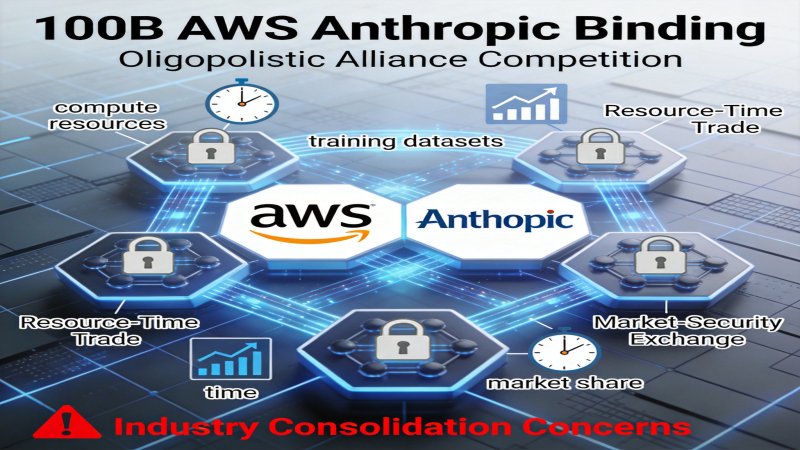
Background and Core Contradictions
In April 2026, AWS and Anthropic officially announced a 10-year, $100 billion cloud spending binding partnership, marking the entry of the AI large model industry's resource competition into a phase of strategic lock-in. The core industry contradictions are stratified by company size:- Leading Startups (e.g., Anthropic, OpenAI): The contradiction lies in trading partial strategic autonomy for guaranteed computing power, funding, and channel resources versus maintaining independent development and preserving multi-cloud flexibility.
- Small and Medium-sized Independent Startups: The contradiction is the survival choice between accepting a vassal position to cloud providers for essential computing power and financing support versus facing complete marginalization and market exit after refusing binding.
Key Events and Driving Factors
Core Event Summary
- Official Announcement of AWS and Anthropic's $100 Billion Binding (April 20, 2026) Core Facts: 10-year partnership, total value exceeding $100 billion in AWS technical spending; Anthropic commits to prioritizing AWS Trainium and other self-developed chips, while AWS provides up to 5GW of computing power support; AWS gains priority distribution rights for Claude cloud services. AWS invested $5 billion initially, with subsequent $20 billion tied to commercial milestones, totaling a maximum commitment of $25 billion (in addition to the $8 billion already invested). Driving Factors: AWS needs to bind top-tier third-party models to compensate for its own foundational model weaknesses, countering Azure+OpenAI's leading advantage; Anthropic needs to lock in long-term, stable, and cost-competitive computing power supply to support model iteration and scaled commercialization. Source: Amazon official announcement, AWS official announcement
- Google Announces Up to $40 Billion Investment in Anthropic (April 24, 2026) Core Facts: Google invested $10 billion initially, with subsequent $30 billion tied to performance targets, totaling a maximum commitment of $40 billion; simultaneously providing 5GW of TPU computing power (deployment starting from 2027); valuation approximately $350 billion. Google had previously accumulated over $30 billion in investments, holding approximately 14% stake (15% contract cap, no voting rights). Driving Factors: Google was surpassed by Claude Code in the AI programming market, using investment to hedge competitive risks; ensuring Anthropic continues using TPUs as core training infrastructure; Anthropic is already one of Google's largest TPU customers. Source: Google/Alphabet official announcement, Bloomberg reports
- Anthropic's Annualized Revenue Exceeds 300 Billion (March 2026) ⚠️Media reports/analyst estimates, not officially confirmed Core Facts: According to multiple analysis sources, Anthropic's annualized revenue run rate (ARR) reached approximately $30 billion in March 2026, growing more than twofold from approximately 90 billion at the end of 2025 within a few months; Claude Code became the core growth driver, with ARR exceeding $25 billion; over 500 customers spending more than $1 million annually, with eight Fortune 10 companies already as Claude customers. Driving Factors: Validating the preliminary commercialization results of the cloud provider binding model, providing revenue support for hundred-billion-dollar spending commitments, and strengthening capital market confidence. Source: The AI Corner analysis, Bloomberg reports, Sacra estimates (original note: ⚠️Media reports/analyst estimates, not officially confirmed)
Key Industry Data
| Metric | Value | Source | Core Significance |
|---|---|---|---|
| Anthropic March 2026 Annualized Revenue Run Rate | Approximately 300 billion | ⚠️Media reports/analyst estimates, multiple sources | Its commercialization scale rivals top technology companies; enterprise API has become the core revenue pillar, validating the scaled potential of the B2B large model market |
| 2026 Q1 Cloud-Hosted Large Model Market Share | ⚠️Third-party analysis, not independently verified | ⚠️Third-party analyst estimates | Azure+OpenAI combination temporarily leads, but Claude is growing rapidly |
| Anthropic Enterprise Customer Scale | Over 100,000 organizations using Claude via AWS | AWS official announcement | Validates Claude's widespread penetration in the enterprise market |
| Google's Total Investment Commitment to Anthropic | Up to $40 billion | Alphabet/Google official announcement | Sets a new record for single AI investment |
| AWS's Total Investment Commitment to Anthropic | Up to $25 billion | Amazon official announcement | In addition to $8 billion previously invested |
Evolution and Trends
Past (2023 and Before)
AI large model startups primarily obtained computing resources through venture capital and limited investments from cloud providers, generally maintaining relatively independent operational strategies, adopting multi-cloud deployment models to optimize costs while avoiding lock-in to a single cloud provider.Present (2024-2026)
The cooperation between leading startups and cloud giants has upgraded from pure capital investment to deep strategic binding: OpenAI with Microsoft, Anthropic with AWS+Google have all formed exclusive or deep priority alliances combining models with infrastructure, with cooperation covering huge long-term spending commitments, deep technology stack binding, joint sales, and multiple dimensions, marking the industry's entry into alliance-based competition. Anthropic received a combined maximum $65 billion investment commitment from Amazon and Google within a single week in April 2026, while committing to spending over $100 billion on AWS within 10 years, marking the industry's resources highly concentrating toward top alliances.Future (2027 and Beyond)
The coupling between AI infrastructure and model layers will further deepen; the market will concentrate toward a few super alliances; independent mid-sized model vendors face clear pressure to choose sides, and vendors not joining top alliances will see their survival space continuously shrink. While enterprise customers enjoy the convenience of integrated solutions, they will more cautiously evaluate lock-in risks. Hybrid deployment (diversifying core capabilities while binding non-core capabilities to a single vendor) may become an important strategy for enterprise customers to manage vendor lock-in risks. Whether this becomes mainstream remains to be seen:- Core AI Capabilities: Refers to model fine-tuning and inference deployment scenarios involving core business logic and sensitive customer data, such as financial institutions' risk control models and manufacturing defect detection models. Such scenarios require avoiding single-vendor lock-in, typically adopting multi-cloud deployment or self-owned computing power.
- Non-Core AI Capabilities: Refers to standardized interface services like general text generation, code assistance, and content moderation that don't involve core data assets. Such scenarios can bind to a single vendor for lower costs and smoother integration experience.
Key Players and Games
Core Players' Positions and Interests
- AWS Position: Both offensive and defensive. Using huge investments and long-term contracts to lock in the currently leading third-party model Claude, compensating for its own foundational model R&D weaknesses, and building a complete AI stack to counter Azure+OpenAI. Core Interests: Increasing AI cloud service market share, driving cloud infrastructure and self-developed Trainium/Inferentica chip consumption, and consolidating its leading position in enterprise cloud platforms; Trainium chip business annualized revenue has exceeded $200 billion with triple-digit growth.
- Anthropic Position: Trading strategic dependency for development resources. Exchanging 10-year long-term spending commitments and partial multi-cloud autonomy for hundred-billion-dollar level stable computing power guarantee, funding support, and AWS's global enterprise sales channels. Core Interests: Ensuring competitiveness in the high-investment model arms race, rapidly achieving scaled commercialization, with the goal of becoming a core AI-era infrastructure provider.
- Microsoft (Azure) Position: Leading defender. Its investment plus exclusive cloud service binding to OpenAI is an industry precedent, currently leading in market share, needing to counter AWS+Claude's direct challenge while continuing to deepen technical and product integration with OpenAI. Core Interests: Maintaining leadership in the enterprise AI market, deeply integrating AI capabilities into Microsoft 365, Dynamics, Azure and other product lines, maximizing synergistic effects.
- Enterprise Customers Position: Balancing demand and risk. Eagerly seeking industry-leading AI capabilities to support business transformation while worrying about losing bargaining power due to single-vendor lock-in. Core demands are finding optimal balance among performance, cost, security, and flexibility. Core Interests: Obtaining stable, efficient, and compliant AI services while preserving technical architecture flexibility and controlling vendor switching costs.
Competitive Landscape Dynamics
Current industry competition has upgraded from single model capability or cloud service capability comparison to systematic confrontation of "model + cloud + ecosystem": AWS+Claude and Azure+OpenAI form a two-strong domination pattern; Google attempts to maintain competitiveness through dual investments (Anthropic + self-developed Gemini) but faces internal strategic conflicts. Market resources (customers, talent, capital) further tilt toward the two major alliances.Impact and Signals
Impact on Industry Vendors
- Cloud Vendors: AI has become the core battlefield of cloud service market competition, binding top large models has become a standard strategy for cloud vendors, and cloud vendors without top model bindings will gradually lose competitiveness in the enterprise AI market.
- Independent Large Model Vendors: Financing and development paths are clearly divided—either becoming top-tier leading players like OpenAI/Anthropic courted by cloud vendors, or accepting the position of a cloud vendor ecosystem vassal. The window for small and medium startups to independently grow into full-stack giants has basically closed.
Impact on Enterprise Customers
- Positive Aspects: Can obtain more deeply integrated, performance and cost-optimized end-to-end AI solutions, reducing upfront technical integration costs and accelerating AI application deployment speed.
- Risk Aspects: Significantly increased multi-cloud deployment and management costs, decreased technical architecture flexibility, dramatically raised barriers to switching vendors, requiring reassessment of vendor risk management systems in AI strategies.
Impact on Investors
The investment logic for the AI track has fundamentally changed: focus has expanded from pure model technology metrics to model companies' cloud binding relationships, long-term cost structures, and ability to fulfill huge cloud spending commitments; valuation bubbles from circular financing models have become a core risk consideration, and revenue水分 from cloud service credits need to be thoroughly examined. The specific path of how circular financing distorts financial metrics is as follows: Among investments from cloud vendors to large model startups, some are distributed in the form of cloud service credits rather than cash. Startups count these credits as financing cash inflows while recording usage of cloud services at market prices as costs; additionally, if cloud vendors bring customers to startups through their own channels, that portion of revenue may also be settled in the form of cloud service credits. Taking Anthropic as an example, some revenue from AWS channels is settled through cloud service credits. Investors need to penetrate cloud credit terms to examine true cash flow and unit economics, removing revenue水分 from related-party transactions. Under this model, startups' true profitability and cash burn rates are significantly obscured. Once market growth falls short of expectations, startups unable to cover cloud spending commitments with true revenue will directly trigger default risks.Key Judgments
| Judgment Content | Importance Explanation | Action Recommendations | Confidence Level |
|---|---|---|---|
| The essence of the $100 billion binding is a trade of resources for time and market for security, which will accelerate the consolidation of the AI industry structure | Marking the AI industry's entry from a百花齐放 exploration period into an oligarchic alliance competition defined by capital and infrastructure, with the window for startups to independently grow into giants closing | 1. Latecomers in the large model track need to re-examine their business plans, either finding differentiated niche markets or being prepared to accept ecosystem binding terms; 2. Enterprise customers should initiate pressure tests on AI vendor lock-in, evaluating extreme-case switching costs | High |
| The circular financing model, while promoting rapid industrial development, plants major hidden dangers of valuation bubbles and financial sustainability | When most investments from cloud vendors flow back through their own service credits, startups' true cash consumption and independent profitability are obscured; once market growth slows or technology iteration falls short of expectations, startups will face default risks from inability to fulfill spending commitments, triggering industry chain chain reactions | 1. Investors need to penetrate cloud credit terms to examine true cash flow and unit economics, removing revenue水分 from related-party transactions; 2. Regulators need to pay attention to the market fairness impact of such related-party transactions, introducing special disclosure requirements in a timely manner | Medium |
| Google's $40 billion investment is a strategic defensive behavior, providing positive benefits to Anthropic but deepening the industry's alliance-ization trend | Google's dual role as both Anthropic investor and Gemini competitor reflects the complex ecosystem of AI industry coopetition; regardless of Gemini's success or failure, Google can profit through investment and computing power sales; this transaction further strengthens top alliances' monopoly on industry resources | 1. Enterprise customers should pay attention to potential impacts of cloud vendor coopetition on service continuity; 2. Independent AI companies need to assess whether they possess strategic value for simultaneous investment from multiple giants, or choose differentiated deep-cultivation paths | High |
Issues to Watch
- After 2027, will Anthropic enterprise customers' actual churn rate increase due to rising lock-in risks? Which industry customers are most sensitive to lock-in risks?
- How significant are AWS self-developed Trainium/Inferentia chips' performance and cost advantages compared to NVIDIA solutions in supporting Claude's future iterations?
- Will the Microsoft-OpenAI model adopt more aggressive strategies in investment scale or technical integration in response to competition?
- As Google's largest Anthropic investor while continuing to promote Gemini, how will it balance internal competition and investment returns?
- Will regulators introduce stricter financial disclosure requirements for circular financing and related-party transactions in the AI sector?
Why it Matters
The $100B AWS-Anthropic binding marks a watershed moment in AI industry restructuring, signaling a shift from technology race to comprehensive competition across capital plus infrastructure plus ecosystem. Google's simultaneous $40B investment demonstrates that hyperscalers' battle for top AI models has escalated to a strategic level of cannot afford to lose.
For the industry, this binding accelerates the picking sides process for independent AI startups, further compressing survival space for smaller players. For enterprise clients, the convenience of deep integration coexists with vendor lock-in risks, requiring reassessment of multi-cloud strategies. For investors, valuation bubbles and related-party transaction concerns under the circular financing model require deeper scrutiny.
DECISION
For Cloud Vendors
- Accelerate building deep binding relationships with top AI models, integrating investment plus cloud services plus joint sales as standard competitive weapons
- Invest in proprietary AI chips to reduce NVIDIA dependency while strengthening customer stickiness through custom silicon (e.g., AWS Trainium, Google TPUs)
For Enterprise
- Immediately initiate AI vendor lock-in risk assessment, conducting stress tests for multi-cloud or hybrid deployment of core business AI capabilities to quantify switching costs
- Explicitly require service providers to guarantee model and data portability in procurement contracts, and establish dedicated budgets and teams for AI vendor risk management
For Investor
- Conduct deep-dive analysis of AI model startup financials, scrutinizing the revenue proportion settled via cloud service credits to assess true cash flow and unit economics
- Shift investment focus to technology providers serving hybrid multi-cloud deployment needs (e.g., model orchestration, cost optimization tools) or niche AI companies deeply embedded in vertical industries, less replaceable by general models
Key Risk: The circular financing model obscures true profitability; slowing market growth could trigger a chain reaction of defaults as startups fail to meet massive cloud spending commitments.
PREDICT
1 year (High confidence)
Anthropic's annualized revenue run rate will exceed $50 billion, further solidifying its enterprise market leadership; AWS and Google's combined $65+ billion investment commitments will accelerate compute infrastructure construction.
2 years (Medium confidence)
Over 30% of Fortune 500 companies will formally adopt a hybrid deployment strategy, decoupling core AI capabilities from general AI services to manage vendor lock-in risk.
3 years+ (Medium confidence)
Regulators will introduce stricter financial disclosure requirements targeting circular financing and related-party transactions in the AI sector to increase market transparency.
Get 3-5 key AI infrastructure signals weekly →
💬 Comments (0)