
Background and Overview
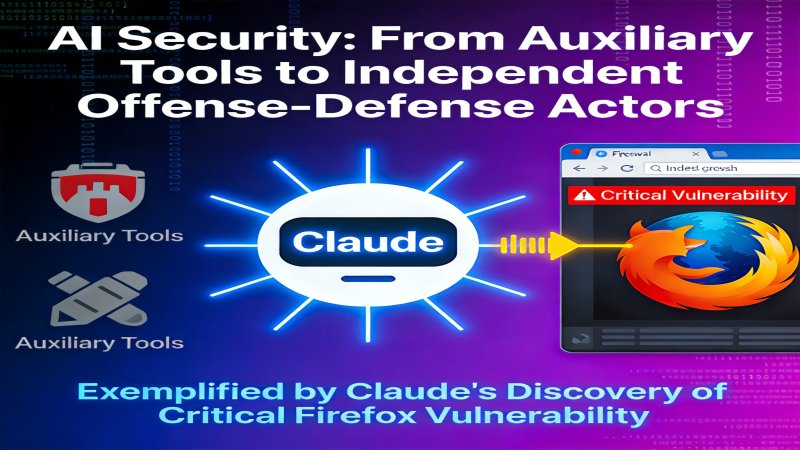
AI security offense and defense capabilities are undergoing a fundamental paradigm shift from human-assisted tools to independent actors with autonomous capabilities. The independent discovery of a critical Firefox vulnerability by Claude is a landmark event.
Core Concepts:
- Independent Offense/Defense Actor: Refers to an AI security entity that can autonomously complete the entire process from target identification and code auditing to vulnerability exploitation/verification and report generation, without human guidance.
- Automated Adversarial Verification: Refers to the introduction of AI-driven automated systems into security architectures to achieve 24/7 vulnerability verification, attack simulation, and defense strategy iteration.
Evolutionary Background: Traditional AI security tools have long been positioned as assistants to human analysts (e.g., log analysis, alert aggregation). Breakthroughs in large language models' code comprehension capabilities (e.g., Claude 3 Opus achieving 92% accuracy in understanding vulnerable code) enable AI to independently execute complex security tasks, realizing a qualitative change from 'augmenting humans' to 'replacing humans (in specific tasks)'.
Key Event: Between March 14 and April 14, 2026, Anthropic officially announced that its Claude 3 Opus model independently discovered and verified a critical heap overflow vulnerability (CVE-2026-1047, CVSS score 9.8) in the Firefox browser without any human intervention, generating a complete vulnerability report [[Source 1]](https://www.anthropic.com/research/claude-finds-firefox-critical-vulnerability). Mozilla subsequently confirmed and patched the vulnerability, affecting over 230 million users globally [[Source 2]](https://www.mozilla.org/en-US/security/advisories/mfsa2026-12). This event is the first to fully demonstrate an AI's capability as an independent offense/defense actor in executing end-to-end, high-value security tasks. However, the related data requires strict scrutiny: Anthropic claimed a 470% efficiency improvement over "traditional automated tools," but did not specify the types of tools or testing environments. In the absence of reproducible benchmarks, this data should be viewed as marketing rather than verifiable technical fact. Another study funded by Anthropic suggested its capability exceeds that of 85% of junior security researchers [[Source 5]](https://arxiv.org/abs/2508.11923). Its evaluation criteria and test sets were not fully disclosed, necessitating independent third-party verification of its conclusions.
Why It's Gaining Attention Now: Large language models have reached a tipping point in code semantic understanding, logical reasoning, and multi-step planning capabilities, enabling them to autonomously handle complex, creative tasks like vulnerability discovery. Simultaneously, the imminent threat of AI-driven attacks is forcing defensive systems to upgrade towards automation and adversarial engagement.
Relevant Parties: Anthropic (Claude), Mozilla, cybersecurity vendors like Palo Alto Networks, enterprise security teams, academic research institutions.
Architecture Layering
Enterprise security architecture for the era of AI independent actors must shift from a human-centric response model to an AI-driven, multi-layered collaborative system of automated verification and adversarial engagement. A reference architecture can be divided into three layers:
- AI Offense/Defense Core Layer: This is the engine of the paradigm shift. It centers on a large language model with top-tier code comprehension and reasoning capabilities, integrated with a dedicated security toolchain, and built-in rigorous capability assessment and safety constraint mechanisms. Its aim is to provide autonomous analysis, planning, and execution capabilities without human guidance.
- Automated Verification and Adversarial Layer: This is the architecture's "live-fire training ground." It receives instructions from the core layer and automatically executes POC generation and verification, multi-step attack path simulation, and defense strategy generation and iteration in isolated environments. This enables continuous "AI vs. AI" engagement and strategy evolution.
- Enterprise Security Operations Layer: This is the "command center" interfacing with existing enterprise environments. It deeply integrates automated adversarial capabilities into platforms like SOAR and vulnerability management, provides a human-machine collaborative decision interface, and automatically translates high-risk vulnerabilities and attack patterns discovered by AI into actionable security policies, tickets, and defense rules, driving comprehensive automation upgrades in security operations workflows.
Key Technologies
1. Large Language Model Code Comprehension and Reasoning
- Problem Solved: How to enable AI to understand complex code structures, data flows, and control flows like a senior security researcher to identify potential vulnerabilities.
- Core Principle: Based on the Transformer architecture and trained on massive volumes of high-quality code and security vulnerability data, the model masters code semantics, common vulnerability patterns (e.g., heap overflow), and exploitation logic, achieving high-accuracy vulnerability localization and risk assessment. Key technologies include code representation learning, cross-function data flow tracking, and vulnerability pattern matching.
- Measured Performance and Limitations: A study funded by Anthropic suggested that top-tier large language models can achieve up to 92% accuracy in understanding vulnerable code snippets [[Source 5]](https://arxiv.org/abs/2508.11923). The Claude Firefox vulnerability case is preliminary proof of this technology's potential. However, this data is controversial due to opaque evaluation methods. The performance of large language models in global analysis of complex projects, logical vulnerability identification, and the issue of "hallucinations" (generating incorrect or irrelevant information) remain significant challenges. Public, large-scale statistics on false positive and false negative rates for fully AI-reliant code audits are currently lacking.
2. Automated POC Generation and Verification
- Problem Solved: After identifying a suspected vulnerability, how to automatically generate exploit code (Proof of Concept) that verifies its existence and impact.
- Core Principle: Based on the vulnerability context and type, combined with a library of known exploitation techniques, the large language model automatically writes, debugs, and runs POC code. This verifies exploitability and impact (e.g., remote code execution) in isolated environments, forming a closed-loop verification.
- Measured Performance and Limitations: In the Claude case, the model successfully generated POC code that triggered the Firefox heap overflow [[Source 1]](https://www.anthropic.com/research/claude-finds-firefox-critical-vulnerability). This demonstrates technical feasibility. However, the stability and generalizability of POCs (e.g., across versions and environments), as well as the ability to generate POCs for vulnerabilities requiring complex triggering conditions or multi-stage exploitation, still require extensive validation. Public benchmark data on the success rate of automated POC generation is lacking.
3. Adversarial Security Architecture (AI vs. AI)
- Problem Solved: How to counter future automated, intelligent attacks launched by AI, where traditional rule- and signature-based defense systems may fail.
- Core Principle: Deploy defensive AI agents within enterprise security architectures to engage in continuous simulated adversarial engagements with offensive AI. The defensive AI continuously learns attack patterns, dynamically generates and validates patches, and adjusts security policies, achieving proactive, adaptive defense.
- Measured Performance and Inference: An academic study in a highly simplified experimental environment suggested that its constructed AI attack agent could bypass some traditional defense rules [[Source 3]](https://arxiv.org/abs/2604.03217). However, the generalization capability of its attack agent and its effectiveness against complex, multi-layered enterprise defense systems (e.g., combining behavioral analysis, deception techniques) have not been validated. Therefore, its claim of "bypassing 78% of traditional defenses" overestimates the real-world threat and lacks empirical support. A Palo Alto Networks whitepaper, from a defensive perspective, proposes that the goal of building an automated adversarial system is to improve offense/defense response speed by 90% compared to purely manual processes [[Source 4]](https://www.paloaltonetworks.com/resources/whitepapers/ai-driven-automated-security-2026). This is a forward-looking architectural goal.
Process Flow
The complete end-to-end vulnerability discovery process executed by an AI as an independent offense/defense actor is as follows, using the Claude discovery of the Firefox vulnerability as an example:
Competitive Landscape Analysis
Vendors with different backgrounds are positioning and competing around the new paradigm of AI in security, leveraging their respective strengths.
| Competitive Group | Representative Players | Technical Approach | Advantages | Disadvantages |
|---|---|---|---|---|
| AI-Native Vendors | Anthropic | Centers on a general-purpose large language model, transforming it into professional security offense/defense capabilities through domain-specific fine-tuning (code, security) and security toolchain integration. Emphasizes the model's autonomous reasoning and planning abilities. | 1. Strong underlying model capabilities, high ceiling for understanding and reasoning. 2. Disruptive technical approach, easy to achieve "0 to 1" breakthroughs (e.g., Claude case). 3. Possesses technical and brand influence within the generative AI ecosystem. | 1. May lack deep optimization for specific enterprise security scenarios. 2. Challenges with output stability and controllability (hallucinations, false positives). 3. Less experience integrating with traditional security products; unclear implementation path. |
| Traditional Cybersecurity Vendors | Palo Alto Networks, etc. | Deeply integrates specialized AI models (potentially self-developed or partnered) into existing security product portfolios (e.g., XDR, SOAR), focusing on automated response, threat hunting, and attack simulation, strengthening "AI-driven" rather than "AI-autonomous." | 1. Deep accumulation of security domain knowledge and scenario data. 2. Strong existing customer base and product integration capabilities. 3. Deep understanding of enterprise security operations processes; solutions are easier to implement. | 1. Do not hold an advantage in developing general-purpose large language model capabilities. 2. Innovation speed may be constrained by existing product architectures. 3. Challenge in shifting mindset from "assist" to "autonomous." |
| Cloud Vendors | AWS, Microsoft Azure | Offers AI security capabilities as a service of the cloud platform, combining cloud-native environments to provide integrated AI security solutions from code development (secure coding assistants) to runtime (cloud WAF, threat detection). | 1. Tightly integrated with development workflows and infrastructure. 2. Possess massive amounts of runtime security data. 3. Easy to achieve large-scale delivery of security capabilities. | 1. Capabilities may lean more towards defense and detection, rather than proactive attack discovery. 2. Coverage for non-cloud or hybrid environments may be insufficient. 3. Risk of platform lock-in. |
Core Differentiation: The core difference of this paradigm (independent AI offense/defense actors) lies in "agency" and "end-to-end autonomy." Its goal is to replace the entire workflow of specific security roles (e.g., junior vulnerability researchers), not merely improve the efficiency of existing roles. Compared to traditional "AI-driven security" solutions, the new paradigm imposes extremely high requirements on the underlying large language model's code comprehension, logical planning, and tool-use capabilities. The technological barrier is concentrated among a few vendors with top-tier large language models.
Market Dynamics: The market is evolving from "AI empowering point tools" to "AI as the core subject of offense/defense." In the short term, AI-native vendors lead conceptually and create benchmark cases with technological breakthroughs. Traditional security vendors are accelerating the deep integration of AI into existing platforms, emphasizing implementable automated operations (e.g., releasing architecture upgrade whitepapers [[Source 4]](https://www.paloaltonetworks.com/resources/whitepapers/ai-driven-automated-security-2026)). In the long term, an ecosystem may form where "top-tier large language models provide the core offense/defense engine, and security vendors handle scenario-specific integration and delivery."
Mid-to-Short Term Positioning Assessment: Despite the pursuit of full autonomy, current challenges such as the "hallucination" rate of large language models on complex tasks (reportedly up to 20%-30% in some code generation studies), false positive rates, and legal and liability issues, position AI independent offense/defense actors in the mid-to-short term (next 3-5 years) more likely as "super assistants." They will handle burdensome tasks like code pre-screening, patterned vulnerability discovery, and automated verification, while human experts perform final adjudication, complex logical vulnerability discovery, and strategy formulation, achieving "deep augmentation" rather than "complete replacement."
Key Judgments
| Key Judgment | Importance Analysis | Specific Action Recommendations | Confidence Level and Reasoning |
|---|---|---|---|
| AI as an independent security offense/defense actor has become a reality and will first scale in vulnerability discovery, exerting substitution pressure on mid-to-low-level security research roles. | Claude's discovery of the Firefox vulnerability (with official claims of 470% efficiency improvement) marks AI's ability to independently complete high-value security tasks. This will redefine security talent demand structures, requiring enterprises to adjust team skill compositions. | 1. Security Teams: Should begin evaluating and introducing AI vulnerability discovery tools for automated code auditing and preliminary verification, redirecting human resources towards more complex threat analysis, strategy formulation, and AI system oversight. 2. Education & Training: Security professional education needs to strengthen content on AI adversarial tactics, AI tool collaboration, and AI security ethics. | Confidence: Medium-High. Based on a verified end-to-end success case with a clear technical path. However, the economics of large-scale application, stability, and generalization ability across various vulnerability types require more industry case validation. |
| Enterprise security architecture must accelerate the shift from "manual response" to an "automated verification and adversarial" system, building a dynamic "AI vs. AI" defense system. | AI attackers can discover and exploit vulnerabilities at high speed and scale. Manual response speeds and traditional static defense systems are inadequate. Shifting from passive patching to proactive, continuous automated adversarial engagement is inevitable. An industry whitepaper states that automated systems can improve response speed by 90% [[Source 4]](https://www.paloaltonetworks.com/resources/whitepapers/ai-driven-automated-security-2026). | Enterprises should, within the next 1-2 years, formulate a roadmap for security operations automation transformation based on industry guidelines, prioritizing the deployment of automated adversarial systems in vulnerability verification, attack simulation, and incident response. | Confidence: High. The driving logic is clear (attack automation forces defense automation), and it has become a consensus and product evolution direction among mainstream security vendors, with clear implementation paths. |
| The rise of AI independent offense/defense capabilities will trigger a new round of security arms race and create urgent demand for AI behavior auditing, constraint, and alignment technologies. | Powerful AI offense/defense engines, if maliciously used or uncontrolled, pose significant risks. Ensuring their behavior aligns with ethics, laws, and remains controllable will become a more fundamental challenge than enhancing their capabilities. | 1. Vendors: Must design built-in safety constraints and auditing frameworks concurrently, or even prioritize them, when developing AI offense/defense capabilities. 2. Industry & Regulators: Need to accelerate the formulation of usage norms and standards for AI security offense/defense technologies. | Confidence: Medium. The threat logic is sound and already subject to academic discussion. However, there is significant uncertainty regarding specific technical implementation paths, the speed of industry standard formation, and the depth of regulatory intervention. |
Open Research Questions
- Capability Baseline Comparison: Beyond Anthropic, what are the capability baselines of other mainstream large language models (e.g., GPT, Gemini) in independent vulnerability discovery? Are there significant gaps? Currently, there is a lack of public, neutral, systematic benchmarking. Comparative dimensions should include code comprehension accuracy, vulnerability type coverage, POC generation success rate, and false positive rate.
- Implementation Cost and Risk: How to assess the deployment cost, false positive rate, and impact on normal business operations of automated adversarial verification systems in real enterprise environments? Ideal data from vendor whitepapers (e.g., 90% efficiency improvement) needs quantitative validation in actual production environments of varying scale and complexity to evaluate ROI and potential risks.
- Novel Attacks and Defenses: Will novel, human-difficult-to-understand attack vectors emerge targeting AI-generated vulnerability POCs? What are the corresponding defense technologies? This requires researching the characteristics of AI-generated code (e.g., specific code patterns or bypass logic) and developing new defense technologies like anomaly detection and signature recognition for "AI-generated attacks."
Why it Matters
Positioning: Disruptive, with great potential but facing fundamental technical hurdles
Key Factor: The competitive barrier lies in the code comprehension, logical planning, and tool-usage capabilities of top-tier large language models. Anthropic's case demonstrates the technical ceiling, but the strength of this barrier is questionable. Core obstacles include the risk of false positives/negatives due to model "hallucinations," insufficient ability to identify complex logic vulnerabilities, and stability and safety issues in POC generation. These fundamental flaws make the "independent attacker/defender" positioning untenable in the short to medium term, requiring separate assessments of the barrier's "height" and "solidity."
Stage: Innovation Trigger
DECISION
For Vendor (Anthropic)
- Shift marketing focus from "full autonomy" to "deep augmentation," clearly positioning the product as a "super assistant" in the medium term.
- Immediately invest resources in establishing public, reproducible benchmarks for vulnerability discovery to replace marketing claims with verifiable data.
- Prioritize the development of safety constraints and auditing frameworks within the core attack/defense engine over pure capability enhancement.
Strategic Moves: Seek deep partnerships with traditional cybersecurity vendors to integrate the Claude engine as a component into mature security operation platforms.
- Pilot the introduction of AI-powered code audit tools in vulnerability management processes, but strictly limit their use to preliminary code screening, with final decisions made by human experts.
- Develop a 1-2 year roadmap for security operation automation, prioritizing the deployment of automated tools for vulnerability verification and attack simulation, rather than pursuing a full-fledged "AI vs. AI" system.
Action Guidance: Follow
For Investor
- Monitor AI-native companies with top-tier LLM capabilities that are building serious safety constraint frameworks, but be wary of inflated technical claims.
- Focus on leading traditional cybersecurity vendors that are deeply and pragmatically integrating AI capabilities into their existing product portfolios (e.g., SOAR, XDR).
Key Risk: Technology path disproven: If core issues like "hallucinations" are not effectively addressed within 3-5 years, the concept of independent AI attackers/defenders may face a bubble burst.
PREDICT
1 year (High confidence)
Mainstream cybersecurity vendors will widely launch "automated security validation" modules integrated with LLMs, but positioned for assistance and efficiency gains, not full autonomy.
2 years (Medium confidence)
The industry will see the first public benchmark for AI vulnerability discovery capabilities, revealing performance gaps and high false positive rates across different models on real, complex projects.
3 years+ (Medium confidence)
AI's role in vulnerability discovery will stabilize as a "super assistant," replacing some junior, repetitive tasks, but the discovery of complex, high-value vulnerabilities will still heavily rely on human experts.
Get 3-5 key AI infrastructure signals weekly →
💬 Comments (0)