
Palo Alto Acquires Portkey: AI Gateway Becomes the 'Core Control Layer' for Enterprise AI Security
Why Now: The Security Crisis in the AI Agent Era
In 2026, AI Agents are evolving from "intelligent assistants" to "autonomous executors." According to Palo Alto Networks data, 81% of enterprises are currently piloting or fully deploying AI Agent solutions. These agents are no longer passive tools responding to queries—they have become "highly privileged insiders" capable of calling APIs, operating MCP servers, accessing sensitive data, and making real-time business decisions.
This brings unprecedented security challenges.
Rapidly Expanding Attack Surface: AI Agent autonomy means they can execute operations spanning multiple systems—reading internal databases, calling payment APIs, modifying business records. This "capability equals risk" characteristic renders traditional perimeter-based and identity-based security models inadequate.
Severe Visibility Deficit: Most enterprises have AI traffic scattered across hundreds of applications and teams, lacking unified visibility and governance layers. Security teams cannot answer a fundamental question: "What data is our AI system accessing? What decisions is it making?"
Compliance Risks Emerging: As regulatory frameworks like GDPR and China's "Interim Measures for the Management of Generative AI Services" take effect, enterprises need to account for AI system data processing and decision-making processes. Without unified audit logs and governance mechanisms, significant compliance exposure exists.
Palo Alto Networks Chairman and CEO Nikesh Arora stated bluntly in a LinkedIn post: "AI agents have become privileged insiders, reasoning and executing on behalf of users and companies. With that power comes a new category of risk. You cannot build an agentic enterprise without a centralized control plane to secure it."
This is precisely Palo Alto's strategic logic for acquiring Portkey—placing security controls at the infrastructure layer before AI Agents are deployed at scale.
Portkey Technical Architecture Analysis: What is an AI Gateway
Founded in 2023 by BITS Pilani alumnus Rohit Agarwal and SRM Chennai alumnus Ayush Garg, Portkey has received investment from Elevation Capital and Lightspeed, completing a $15 million funding round in February 2026.
Portkey's product is called an "AI Gateway"—a middleware layer positioned between the application layer and large language models, integrable in three lines of code, providing enterprises with observability, reliability, and cost management capabilities for AI applications.
Core Architecture Components:
1. Unified API Layer: Portkey provides OpenAI-compatible unified API interfaces, supporting 250+ AI models (officially claiming 3000+ LLMs and MCP servers). Developers can switch model providers or implement multi-model load balancing without modifying application code—simply by changing the base URL. This architectural design significantly reduces "vendor lock-in" risk while providing enterprises with flexible model selection rights.
2. Observability Engine: Portkey captures input, output, latency, token consumption, and cost data for every LLM call in real-time, generating detailed audit logs. Processing over 25 million requests daily with 99.99% availability SLA. Edge nodes are globally distributed, adding only 20-40ms end-to-end latency.
3. Semantic Routing: Based on semantic understanding, Portkey can route requests to the most suitable model—simple queries to low-cost models, complex reasoning to high-performance models. Combined with automated failover, this capability ensures 99.99% availability for critical business.
4. Caching Layer: For repeated or similar queries, Portkey returns cached results instead of re-invoking the model. Customer data shows this capability helped save "thousands of dollars" in API call costs.
5. Agent Registry & Management: Portkey provides unified registration and management for AI Agents, recording each agent's identity, permissions, and operation history. This provides infrastructure-level support for "AI Identity Security."
Portkey's CPO once summarized the product's value proposition: "It allows developers to focus on innovation rather than operational complexity." Now, Palo Alto aims to layer security capabilities on top.
Palo Alto's Integration Strategy: Prisma AIRS + Portkey = AI Security Platform
Palo Alto Networks launched Prisma AIRS (AI Runtime Security) in 2025, positioning it as "the industry's first platform securing the entire Agentic AI lifecycle." Following the Portkey acquisition, Prisma AIRS capabilities will achieve qualitative advancement.
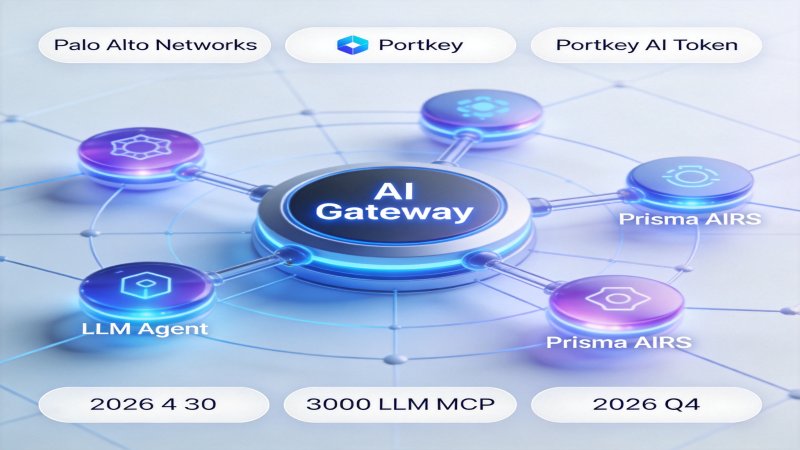
Integration Architecture: Portkey's AI Gateway will become the "central nervous system" of Prisma AIRS, monitoring, routing, and securing every AI transaction across the enterprise.
Three Major Security Capability Upgrades:
1. AI Traffic Inspection & Runtime Protection: Through Portkey's AI Gateway, all AI traffic undergoes Prisma AIRS security inspection—identifying threats, preventing data leakage, and blocking malicious prompt injections. This is not a simple overlay of traditional firewall capabilities but deep security analysis tailored to AI interaction characteristics.
2. AI Identity Security: Through partnership with CyberArk, Prisma AIRS will enforce strict least-privilege controls on every Agent interaction, ensuring all AI workloads remain secure and compliant. This addresses the identity security challenges posed by "AI Agents as privileged users."
3. Agent Artifact Scanning & Automated Red Teaming: Security scanning of Prompt templates, tool definitions, and output results for AI Agents; continuous security assessment of Agent behavior through automated red team testing.
Palo Alto Networks Chief Product & Technology Officer Lee Klarich stated: "As autonomous agents join the enterprise workforce, they also become a new, unmanaged attack surface. By integrating Portkey into Prisma AIRS, organizations will be able to confidently deploy and govern AI agents. With Portkey, we are providing enterprises with visibility into all their agentic traffic, and enabling them to control and protect against agentic threats."
This reveals Palo Alto's strategic intent: occupying the commanding heights of the security control layer before AI Agents become mainstream. This is not passive defense but proactive market shaping.
AI Gateway Track Landscape: Evolution from Tool to Platform
Portkey is one of the most well-known AI Gateway providers but not the only choice. Competition in this track is rapidly taking shape.
Key Players:
Portkey: Open-source AI Gateway with 10,400+ GitHub stars, supporting 1600+ LLMs, enterprise features including SSO, role-based access control, data isolation, and compliance logs. Multiple Fortune 500 customers.
MLflow (Databricks): Provides AI model serving and observability capabilities, but less focused on LLM Gateway functionality.
Weights & Biases: Focused on MLOps and experiment tracking, limited AI Gateway functionality.
Cloudflare AI Gateway: Launched in 2024, offering edge deployment and globally distributed AI traffic management capabilities.
AWS API Gateway + Bedrock: AWS's native solution offering model hosting and API management, but less capable in cross-model unified management compared to specialized Gateways.
Palo Alto's acquisition of Portkey will have profound impact on this landscape:
1. Security Capabilities Become Core Differentiation: Portkey's original capabilities focused on observability and cost management; Prisma AIRS integration will inject industry-leading security capabilities, forming a unique value proposition of "operations + security." This will force other AI Gateway players to accelerate security capability development.
2. Enterprise Procurement Shifts Toward "Platform": Large enterprises increasingly prefer "one-stop" platforms over point solutions in AI procurement. Palo Alto's global sales channels and brand trust will help Portkey enter more large enterprises.
3. Independent AI Gateway Vendors Face Increased Consolidation Pressure: Following Portkey's acquisition, independent AI Gateway vendors may face capital pressure. Companies like Databricks and Cloudflare may acquire or self-develop capabilities to fill this gap.
Impact on Enterprise AI Security Deployment: From "Firefighting" to "Prevention"
This acquisition has landmark significance for enterprise AI security strategy—it marks AI security's paradigm shift from "passive response" to "proactive design."
Traditional Model's Dilemma: In traditional models, enterprises discover security risks only after AI applications go live, then hastily apply patches. This "firefighting" approach is not only inefficient but also struggles to address the complexity and dynamism of AI systems.
New Paradigm's Advantages: By embedding security controls at the AI Gateway layer, enterprises can incorporate security into design considerations from the outset of AI application development. Portkey's "three lines of code integration" means security is not an afterthought but built into the architecture from day one.
Key Capability Improvements:
- Prompt Injection Protection: Prisma AIRS can detect and block malicious prompt injections—a unique attack vector specific to AI systems.
- Data Leakage Prevention: Prevent AI models from leaking PII, trade secrets, or other sensitive information in responses.
- Output Security Checks: Block models from generating outputs containing malware, phishing links, or harmful content.
- Consumption Attack Protection: Prevent attackers from exhausting AI resources through massive requests.
- Hallucination Detection: Check LLM response context consistency to reduce misinformation and hallucinated outputs.
Portkey CEO Rohit Agarwal stated: "Scaling AI in production requires a delicate balance between total flexibility for developers and absolute control for security teams. By joining Palo Alto Networks, we will establish the AI Gateway as the foundational layer of the secure AI enterprise."
The transaction is expected to close in Palo Alto Networks' Q4 fiscal 2026; specific financial terms were not disclosed. For enterprises planning AI Agent deployments, this provides a clear signal: the best time to invest in AI security infrastructure is now, not after an Agent security incident.
Why it Matters
In 2026, AI Agents are evolving from 'intelligent assistants' to 'autonomous executors'. Palo Alto's acquisition of Portkey marks a strategic turning point in AI security—security controls are shifting from the application layer to the infrastructure layer, with the AI Gateway becoming the 'core control layer' for enterprise AI security. This transaction will profoundly impact the AI infrastructure market landscape and reshape the deployment paradigm of enterprise AI security.
DECISION
Decision Recommendations
For Vendor(Security Vendors & AI Infrastructure Vendors)
- Palo Alto Networks: Accelerate deep integration of Portkey with Prisma AIRS, prioritize technical alignment; leverage Portkey's developer community and open-source advantages to expand ecosystem
- Databricks/Cloudflare: Evaluate necessity of building or acquiring AI Gateway capabilities, prevent customer churn
- Other AI Gateway vendors: Accelerate security capability development, find differentiated positioning; the choice between independent financing or acquisition comes earlier
For Enterprise(Enterprise Security & AI Leaders)
- High Priority: Evaluate existing AI application traffic governance capabilities, identify security blind spots; AI Gateway should become a mandatory component in AI security architecture
- Monitor official release timing of Portkey and Prisma AIRS integrated products, plan procurement in advance
- Establish AI Agent security governance framework, including identity authentication, least privilege, and audit logging capabilities
For Investor(Investors)
- Palo Alto Networks: Short-term integration costs manageable, long-term AI security platform strategic value significant; monitor Prisma AIRS ARR growth as key indicator
- AI Gateway track: Multi-cloud trends and enterprise AI security demand drive clear market space; focus on related M&A opportunities
- Monitor other AI security targets that could be acquired
PREDICT
6 months(High confidence)
Palo Alto completes Portkey technical integration planning; Prisma AIRS AI Gateway beta released. Enterprise AI Agent security demand further explodes.
1 year(High confidence)
Portkey officially becomes Prisma AIRS AI Gateway, GA version released. More M&A or financing events in AI Gateway track.
2 years(Medium confidence)
AI Gateway becomes standard enterprise AI infrastructure, over 50% of Fortune 500 deploying some form of AI Gateway. AI security market exceeds $5 billion.
3 years+(Medium confidence)
"AI Agent Security" becomes an independent security category, alongside traditional Application Security and Data Security. Palo Alto's leading position in AI security track established.
Get 3-5 key AI infrastructure signals weekly →
💬 Comments (0)