
I. Event Recap
In Q2 2026, NVIDIA's revenue data in the data center Ethernet switching market sent shockwaves through the industry. According to Crehan Research's Q1 2026 market report, NVIDIA took the top spot in the global data center Ethernet switching market with $2.1 billion in quarterly revenue, capturing a 21.5% market share—surpassing long-time leaders Arista (20.7%) and Cisco (17.8%).
Behind this breakthrough is the large-scale commercial deployment of NVIDIA's Spectrum-X Ethernet networking platform. Compared to NVIDIA's less than 4% market share two years ago, this growth trajectory is dramatic—a 192.7% year-over-year growth rate far exceeding any competitor (Arista: 37.3%, Cisco: 16.9%).
Particularly noteworthy is the 800G Ethernet port mix: among NVIDIA's data center networking shipments, 800G ports already account for 35.8%, with an even higher proportion in high-performance AI clusters. NVIDIA, through Spectrum-X's full-stack integration advantage, captured the largest share of the AI factory network reconfiguration opportunity during the 800G upgrade cycle.
II. Technical Deep Dive
NVIDIA's comeback in data center networking centers on its "AI Factory Full-Stack Architecture" approach—no longer selling switches as standalone products, but rather integrating Spectrum Ethernet switches, BlueField-3 DPUs, and LinkX high-speed cabling into a complete "AI Factory Network Platform" (Spectrum-X).
The traditional cloud procurement logic was "pick the best switch"; in the AI factory era, the logic has shifted to "pick the overall solution that maximizes GPU utilization." Spectrum-X's key technical value propositions include:
End-to-End Congestion Control: Through coordination between BlueField-3 DPUs and Spectrum switches, dynamic adjustments based on telemetry reduce Head-of-Line Blocking in AI distributed training to near zero. Standard Ethernet achieves less than 50% bandwidth utilization in large-scale GPU clusters due to head-of-line blocking, while Spectrum-X claims to maintain utilization above 90%.
Adaptive Routing: Spectrum-X supports dynamic path selection based on real-time network conditions, rather than relying on traditional Ethernet's static ECMP (Equal-Cost Multi-Path). In 10,000-GPU clusters, this technology reduces communication tail latency by 30-40%.
800G First-Mover Advantage: NVIDIA is the first vendor to achieve commercial end-to-end 800G Ethernet. The Spectrum-4 switch (based on Broadcom's Tomahawk-5 chip) combined with BlueField-3 DPU's 800G interfaces constitutes the most complete 800G networking solution for AI factories today.
III. Financial Logic
NVIDIA's $2.1 billion quarterly revenue in data center networking, while still modest compared to its core GPU business (tens of billions per quarter), carries strategic significance far beyond the numbers themselves.
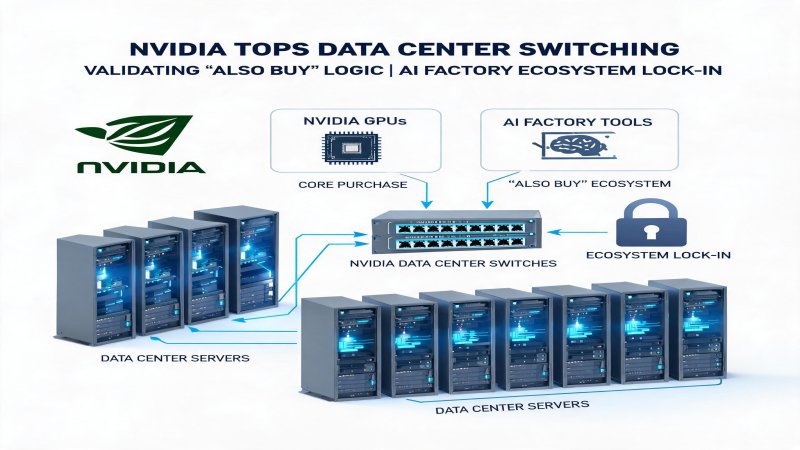
Ecosystem Lock-in Effect: Spectrum-X is not sold as a standalone product, but rather as part of the "AI Factory Package" bundled with NVIDIA GPUs. When customers choose NVIDIA H100/H200/Blackwell GPUs for AI cluster construction, "also-buying" Spectrum-X networking becomes the most natural choice to reduce system integration risk. This "buy GPU, also-buy network" logic is the fundamental driver of NVIDIA's networking business growth.
Gross Margin Advantage: Spectrum-X, as a highly integrated platform solution, commands significantly higher gross margins than traditional switch vendors. Industry estimates suggest NVIDIA's networking business enjoys gross margins above 70%—lower than the GPU business's 90%+, but substantially higher than Arista's ~60% and Cisco's ~65%.
Market Ceiling Rising Rapidly: The data center Ethernet switching market reached $10 billion in Q1 2026 (61% YoY growth). As the AI factory construction wave spreads from hyperscale cloud providers to enterprises, governments, and telecom carriers, the compound growth rate for this market is projected to exceed 40% over the next three years.
IV. Strategic Context
NVIDIA's ascent to the top of the data center switching market marks a key milestone in its "AI Factory Full-Stack Supplier" strategy. This achievement effectively validates two distinct competitive logics:
"Buy GPU, Also-Buy Network" vs. "Buy Network, Also-Buy NVIDIA GPU"
The current market landscape is primarily driven by the former: customers purchase Spectrum-X networking as an add-on when procuring NVIDIA GPUs. But NVIDIA's long-term goal is to make "buy network, also-buy NVIDIA GPU" a viable path as well—i.e., customers prioritize NVIDIA's full-stack AI factory solution because they recognize Spectrum-X's networking performance.
The core of this strategy is: the network layer—not the GPU itself—is the performance bottleneck in AI clusters. Once customers deeply experience the massive difference Spectrum-X makes in AI training efficiency compared to traditional Ethernet solutions, networking becomes the new entry point for NVIDIA's ecosystem.
Competitor Responses:
- Broadcom: As the supplier of Tomahawk-5 switch chips, Broadcom actually plays a "key component supplier" role in NVIDIA Spectrum-X. But Broadcom is not content with merely providing chips—its advancing "switching + compute" integrated solution (based on custom ASICs) attempts to directly compete with NVIDIA among hyperscale customers.
- Cisco: Still strong in the traditional enterprise data center market, but visibly lagging in the high-growth AI factory segment. Cisco's recent announcement of deepening collaboration with NVIDIA (integrating BlueField DPUs into Nexus switches) is effectively an admission of technical disadvantage in AI-optimized networking.
- Arista: Still NVIDIA's most directly comparable competitor; its EOS network operating system maintains advantages in large-scale deployment stability. But Arista lacks DPU/smart NIC products for deep co-optimization with GPU clusters, creating a natural shortcoming in full-stack integration.
V. Challenges and Risks
NVIDIA's success in the networking market heavily depends on its monopolistic position in the AI GPU market. This dependency also constitutes its greatest strategic vulnerability.
Regulatory Risk: NVIDIA's dominant position in the AI chip market has already attracted attention from global regulatory agencies. If GPU market share declines due to antitrust enforcement or competitor emergence, the "also-buy" logic for Spectrum-X will simultaneously weaken. Particularly, the U.S. Department of Justice's antitrust investigation into NVIDIA is still ongoing; while unlikely to cause substantial short-term impact on its GPU business, long-term risks cannot be ignored.
Rise of Customer-Built Networks: A few hyperscale cloud providers (e.g., Google, Meta) are already advancing self-developed network chips and switches to reduce dependence on NVIDIA Spectrum-X. Google's Falcon transport protocol and Meta's Minipack2 switch design represent top-tier customers' "de-NVIDIA-ization" technology roadmap. While these self-developed solutions are unlikely to match Spectrum-X's complete ecosystem in the short term, they will divert some market demand in the medium to long term.
800G-to-1.6T Transition Risk: Spectrum-X's current advantage is partly built on 800G first-mover status. But as the 1.6T Ethernet standard lands in 2027-2028, Broadcom, Cisco, and Arista all have the potential to regain technical leadership through more aggressive chip solutions. Whether NVIDIA can maintain the same ecosystem integration advantage in the 1.6T era remains questionable.
VI. Conclusion
NVIDIA's ascent to the top of the data center Ethernet switching market with 192.7% YoY growth and 21.5% market share is not a simple reshuffling of market map—it is a concentrated manifestation of the "compute-networking-storage" full-stack integration trend in the AI era.
For NVIDIA, the strategic value of its networking business lies not only in creating new revenue growth points, but more importantly in building "GPU + network" dual ecosystem lock-in—when customers adopt both NVIDIA GPUs and networking, the cost of single-point replacement with competitors increases exponentially.
For the industry competitive landscape, Spectrum-X's success is redefining the competitive factors for "network equipment vendors": pure switching capacity and port density are no longer sufficient to win; deep co-optimization capability with the compute side is the core of networking competition in the AI era.
In the next 12-18 months, the focus will be on whether NVIDIA can stabilize its networking market share above 25%, and whether Broadcom and Arista's counterattack solutions can turn the tide in the 1.6T era. The battle for control of the AI factory's "full-stack ecosystem" is only just beginning.
Why it Matters
DECISION
PREDICT
Get 3-5 key AI infrastructure signals weekly →
💬 Comments (0)