
<h2>I. Event Recap: The Birth of the Industry's First Commercial AI-RAN Platform</h2>
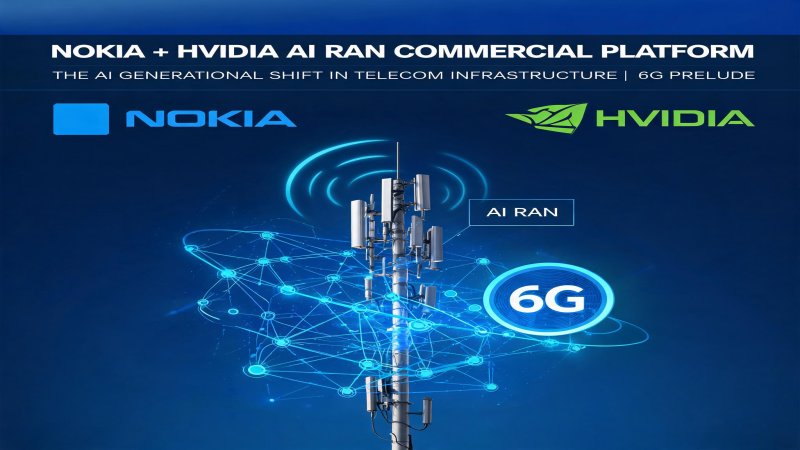
<p>On July 15, 2026, Nokia officially announced the launch of the industry's first commercial AI-RAN (Artificial Intelligence Radio Access Network) platform in partnership with NVIDIA. This release marks the historic transformation of mobile communication networks from "dedicated hardware-driven" to "general-purpose AI compute-driven" architectures.</p>
<p>The AI-RAN Alliance was established in February 2024 at MWC Barcelona, with founding members including AWS, Arm, Ericsson, Microsoft, Nokia, NVIDIA, Samsung Electronics, SoftBank, T-Mobile, and others. After more than a year of technical validation and joint development, Nokia and NVIDIA were the first to convert the concept into a commercial product. Notably, NVIDIA had previously invested $1 billion in Nokia, and their strategic partnership was formed less than ten months ago.</p>
<p>The platform's core technical architecture comprises two layers: Nokia's AI-native anyRAN software layer and the NVIDIA Aerial AI-RAN platform hardware acceleration layer. anyRAN is Nokia's software-defined RAN solution launched in 2024, supporting baseband processing on any hardware; Aerial is NVIDIA's GPU acceleration platform designed specifically for telecom networks, bringing CUDA and AI into baseband systems.</p>
<p>According to official data, the platform has already achieved over 20% spectrum efficiency improvement through AI-driven radio innovation, with potential to reach 50% by 2027 and over 100% by 2028. Pilot deployments will begin at the end of this year, with full commercial availability in 2027. Nokia will also introduce a software subscription model, allowing customers to subscribe to AI-RAN capabilities on demand in addition to purchasing pre-installed hardware.</p>
<h2>II. Technical Deep Dive: How AI-RAN Reconstructs Wireless Network Fundamentals</h2>
<p>Traditional RAN architectures rely heavily on dedicated hardware—baseband processing units (BBUs) and remote radio heads (RRHs) are typically provided as integrated solutions by equipment vendors, leaving operators with limited ability to flexibly replace or upgrade individual components. This "black box" approach results in high upgrade costs, long cycles, and inability to dynamically allocate resources based on real-time traffic demands.</p>
<p>The core transformation of AI-RAN lies in replacing dedicated communication chips (such as FPGAs and ASICs) with general-purpose GPU compute, software-izing baseband processing, signal modulation, and resource scheduling functions to run on standardized GPU clusters. The NVIDIA Aerial platform leverages GPU parallel computing capabilities to simultaneously process signal processing tasks across numerous wireless channels, while using AI algorithms to optimize spectrum allocation, power control, and interference management in real time.</p>
<p>Specifically, AI-RAN's technical advantages manifest in three dimensions:</p>
<p><strong>First, spectrum efficiency leaps.</strong> Through deep learning models predicting user distribution and traffic patterns, AI-RAN can dynamically adjust antenna beam shapes (Beamforming) and resource block allocation on millisecond-level timescales. Nokia and SoftBank's early demonstrations showed AI-RAN improved spectrum efficiency by over 30% in dense urban scenarios.</p>
<p><strong>Second, enhanced network elasticity.</strong> Because baseband functions run on general-purpose GPUs, operators can dynamically scale capacity based on business load. For example, temporarily increasing baseband compute during sporting events or concerts, then releasing resources for other uses afterward. A more radical application is "base station compute sharing"—in Nokia and SoftBank's demonstration, base stations handled communications during the day and automatically switched to AI compute providers at night, training machine learning models for third parties.</p>
<p><strong>Third, seamless evolution toward 6G.</strong> AI-RAN's software-defined architecture naturally supports smooth upgrades to 6G New Radio. Nokia CEO Justin Hotard stated, "AI-RAN makes networks intelligent, extends AI into the physical world, and enables telecom operators to fully utilize existing infrastructure, including software upgrades toward 6G."</p>
| Dimension | Nokia+NVIDIA AI-RAN | Ericsson Cloud-Native RAN | Traditional Dedicated RAN |
|---|---|---|---|
| Baseband Architecture | General GPU (NVIDIA Aerial) | Dedicated+Cloud Hybrid | Proprietary ASIC/FPGA |
| AI-Native Capability | Built-in AI Inference Acceleration | AI Add-on Modules | No Native AI |
| Spectrum Efficiency Gain | 20%→50%→100% | ~10-15% | Fixed Optimization |
| Hardware Flexibility | Software-defined, Any Hardware | Partially Softwarized | Vendor Lock-in |
| Compute Sharing/Edge AI | Supported (Demonstrated) | Limited Support | Not Supported |
| 6G Evolution Path | Software Upgrade | Hardware+Software Upgrade | Large-scale Replacement |
| Business Model | Hardware+Software Subscription | Traditional Equipment Sales | Traditional Equipment Sales |
| Commercial Maturity | Commercial Launch 2027 | Partial Deployments | Fully Mature |
| Typical Customers | SoftBank, T-Mobile, etc. | AT&T, Verizon, etc. | Global Mainstream Operators |
<h2>III. Financial Logic: Nokia's Software Transformation and NVIDIA's Base Station Chip New Market</h2>
<p>For Nokia, AI-RAN is the core lever for transforming from a "hardware equipment vendor" to a "software platform provider." The traditional telecom equipment market has hit a growth ceiling: global 5G construction is entering its mid-to-late stage, operator capex is stabilizing, and equipment prices face continued pressure. Nokia's 2025 network infrastructure revenue was approximately €18 billion, up only 3% year-over-year, with gross margins hovering in the 35%-38% range.</p>
<p>The software subscription model is Nokia's key to breaking through growth bottlenecks. With AI-RAN, operators pay not only for hardware upfront but also annual software licensing fees (likely based on base station count or capacity). This model converts one-time transactions into recurring revenue, significantly improving customer lifetime value (LTV) and revenue predictability. Drawing from Cisco, VMware, and others' experience, every 10-percentage-point increase in software subscription revenue share typically boosts valuation multiples (EV/Revenue) by 1-2x.</p>
<p>For NVIDIA, AI-RAN opens another large-scale GPU application scenario beyond data centers. There are approximately 7 million mobile communication base stations worldwide. If 20% upgrade to AI-RAN architecture within the next five years, with each station averaging 4-8 GPU accelerator cards, this would create 5.6-11.2 million units of new GPU demand. Even at $5,000 per GPU, this represents a $28-56 billion potential market.</p>
<p>NVIDIA CEO Jensen Huang stated in the press release: "We are working with Nokia to bring CUDA and AI into baseband systems, transforming the RAN into a global-scale AI computing platform." This is not merely a technical vision but a market-size commitment to investors. Currently, NVIDIA's data center business accounts for approximately 85% of total revenue; AI-RAN could diversify its revenue sources and reduce dependence on hyperscaler cloud customers.</p>
<h2>IV. Strategic Depth: Power Restructuring and Ecosystem Games in the Telecom Equipment Market</h2>
<p>AI-RAN is shaking the traditional power structure of the telecom equipment market. For a long time, Huawei, Ericsson, and Nokia have dominated the global RAN market, with competitive moats built on dedicated hardware integration capabilities and long-standing operator relationships. AI-RAN breaks this pattern—the introduction of general-purpose GPUs means NVIDIA, AMD, and even cloud hyperscalers could become new participants.</p>
<p>Ericsson is Nokia's most direct competitor in the AI-RAN space. Ericsson is also upgrading its network equipment to support more AI terminals, but its strategy differs fundamentally from Nokia's: Ericsson has chosen not to enter the data center market, continuing to focus on mobile network equipment for telecom operators while adhering to a "dedicated hardware + cloud-native software" hybrid approach. Ericsson believes dedicated hardware remains irreplaceable in power consumption and real-time performance, especially in large-scale macro base station scenarios.</p>
<p>Huawei is another key variable. Due to US sanctions, Huawei cannot access advanced GPUs from American companies like NVIDIA, so its AI-RAN technical path inevitably moves toward self-reliance—building a closed ecosystem based on self-developed Ascend AI chips and the HarmonyOS. At WAIC 2026, Huawei will showcase the Atlas 950 SuperPoD AI computing system, likely the infrastructure foundation for its AI-RAN strategy. In China's domestic market, Huawei, leveraging deep ties with the three major operators, may still dominate localized AI-RAN deployment.</p>
<p>From an ecosystem perspective, the real winner of AI-RAN may be the software platform layer. Regardless of whether base station hardware comes from Nokia, Ericsson, or Huawei, AI-RAN software stacks (such as NVIDIA Aerial and Nokia anyRAN) could become de facto standards, similar to Android's position in the smartphone market. This means competition among telecom equipment vendors will shift from "hardware performance" to "software ecosystem" and "developer community."</p>
<h2>V. Challenges and Concerns: Practical Barriers to AI-RAN Scale Deployment</h2>
<p>Despite AI-RAN's bright prospects, multiple challenges remain before it moves from pilot to large-scale commercial deployment. First is power consumption and heat dissipation. General-purpose GPUs consume significantly more power than dedicated ASICs; deploying GPU accelerator cards at base station sites will impose higher requirements on site power supply and cooling systems. For remote base stations in developing markets, power infrastructure may be insufficient to support AI-RAN equipment operation.</p>
<p>Second is cost economics. Although AI-RAN can generate recurring revenue through software subscriptions, upfront hardware investments (GPUs, liquid cooling systems, high-speed interconnects) may exceed traditional RAN solutions. Operators need to see clear ROI models before large-scale procurement. Whether Nokia's promised "20% spectrum efficiency improvement" can translate into equivalent "cost per bit reduction" awaits real-world network validation.</p>
<p>Third is interoperability and standardization. AI-RAN relies on O-RAN (Open Radio Access Network) standards, but O-RAN maturity remains controversial. Interoperability testing between different vendors' hardware and software is complex and time-consuming; operators worry about falling into "multi-vendor integration quagmires." Furthermore, 3GPP's 6G standardization is still in early stages, and some AI-RAN technical paths may face standard compatibility risks.</p>
<p>Finally, security and regulation. Software-izing baseband processing functions to run on general-purpose GPUs significantly expands the attack surface. New risks such as software vulnerabilities, AI model poisoning, and supply chain attacks require entirely new security frameworks. For government and security-sensitive industry customers, AI-RAN security certification and compliance review will be lengthy and rigorous processes.</p>
<h2>VI. Conclusion: Is AI-RAN the iPhone Moment for the Telecom Industry?</h2>
<p>The industry's first commercial AI-RAN platform from Nokia and NVIDIA could become the "iPhone moment" for communications infrastructure—just as the 2007 iPhone redefined mobile phones, AI-RAN is redefining the underlying architecture of base stations and wireless networks. General-purpose GPUs replacing dedicated chips, software subscriptions replacing hardware sales, and AI-native replacing rule-based optimization: these three shifts will profoundly reshape the telecom equipment market landscape over the next decade.</p>
<p><strong>For telecom operators:</strong> Leading operators are recommended to launch AI-RAN technical validation and small-scale pilots in H2 2026, prioritizing high-traffic, high-interference dense urban scenarios. During pilots, focus on three metrics: actual spectrum efficiency improvement, base station energy consumption changes, and TCO comparison of software subscription models. For capex-constrained small and medium operators, waiting until 2027-2028 for technology maturation before following may be prudent.</p>
<p><strong>For investors:</strong> AI-RAN is a win-win story for Nokia's software transformation and NVIDIA's base station chip market expansion. Nokia's software subscription revenue share increase will improve its valuation multiples; monitor AI-RAN-related revenue realization in 2027. NVIDIA's AI-RAN GPU demand will provide incremental market opportunity beyond data centers, but near-term contribution remains limited—avoid excessive optimism. Ericsson may temporarily lag in the AI-RAN wave due to its traditional approach, but its deep expertise in dedicated hardware retains defensive value.</p>
<p><strong>For industry observers:</strong> AI-RAN will not replace traditional RAN overnight but will gradually become mainstream between 2027-2030. By the 6G era (expected commercialization around 2030), AI-RAN could become the default architecture. At that point, network competition will shift from "who has more base stations" to "who has smarter AI," and NVIDIA and Nokia are standing at the forefront of this transformation.</p>
Why it Matters
AI-RAN will fundamentally restructure the underlying architecture of approximately 7 million mobile communication base stations globally. For Nokia, this is the key lever for transforming from hardware vendor to software platform provider, with subscription models potentially breaking growth bottlenecks. For NVIDIA, AI-RAN opens another large-scale GPU market beyond data centers, with potential size of $28-56 billion. For operators, AI-RAN can improve spectrum efficiency by 20%-100% without adding infrastructure—a critical cost-efficiency tool amid weak 5G ROI.
DECISION
<ul><li><strong>Telecom Operators:</strong> Leading operators should initiate AI-RAN pilots in H2 2026, prioritizing dense urban scenarios while focusing on spectrum efficiency, energy consumption, and TCO metrics.</li><li><strong>Investors:</strong> Monitor Nokia's software subscription revenue share improvement on valuation multiples; NVIDIA's AI-RAN GPU demand provides incremental opportunity but limited near-term contribution.</li><li><strong>Equipment Procurement:</strong> In RAN tenders, AI-RAN capabilities can be weighted heavily in technical scoring, but O-RAN interoperability risks require attention.</li></ul>
PREDICT
<ul><li><strong>H2 2026:</strong> Leading operators like SoftBank and T-Mobile will initiate small-scale AI-RAN pilots, with first performance data expected in early 2027.</li><li><strong>2027:</strong> AI-RAN platform commercially launched, with initial deployments expected at tens of thousands of sites, concentrated in Japan, the US, and Europe.</li><li><strong>2028:</strong> If spectrum efficiency improvement reaches the 50% target, over half of the world's top 20 operators will initiate scaled AI-RAN deployment.</li><li><strong>2030 (pre-6G commercialization):</strong> AI-RAN could become the mainstream architecture for new base stations globally, with NVIDIA capturing over 60% of the base station GPU market and Nokia's software subscription revenue share exceeding 30%.</li></ul>
Get 3-5 key AI infrastructure signals weekly →
💬 Comments (0)