
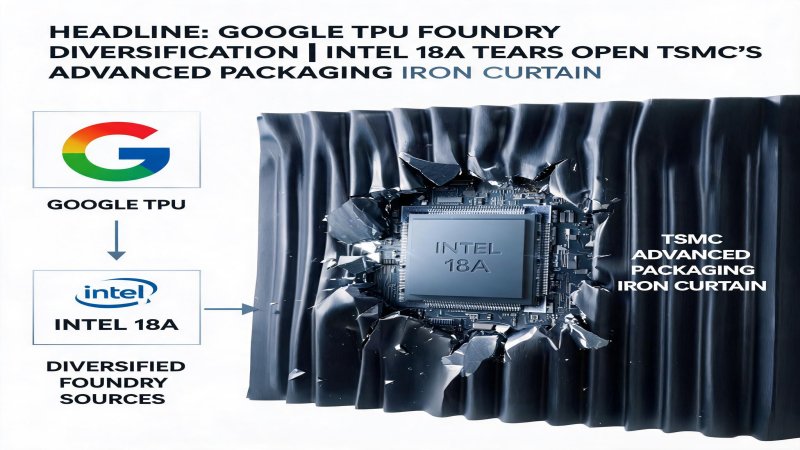
I. Event Recap
On June 8, 2026, The Information disclosed a piece of news that sent shockwaves through the global semiconductor supply chain: Google has formally placed an order with Intel's foundry division to manufacture over 3 million units of its self-developed Tensor Processing Units (TPUs) via Intel's production lines in 2028. According to Morgan Stanley estimates, this order accounts for approximately 50% of Google's total TPU production in 2027-2028, marking the largest single order Intel Foundry has ever received.
The significance of this event extends far beyond the commercial contract itself. It means one of the world's largest AI chip buyers (Google) has formally launched its "de-TSMC-ization" strategy—partially transferring the production of its most advanced AI accelerator chips from TSMC-dominated Taiwan supply chain to Intel's 18A process and advanced packaging lines in the United States.
Particularly noteworthy: Intel Foundry had struggled for years without securing volume production orders from top-tier customers. This 3-million-TPU order from Google not only provides a critical volume validation opportunity for Intel 18A process, but also provides decisive momentum for the commercial deployment of its advanced packaging technologies (EMIB + Foveros) in the AI chip domain.
II. Technical Deep Dive
The core technical highlight of Google's TPU shift to Intel Foundry lies in the head-on competition between Intel's advanced packaging technology roadmap and TSMC's CoWoS solution.
Intel EMIB + Foveros Dual Technology Stack: EMIB (Embedded Multi-die Interconnect Bridge) enables high-density inter-chip signal transmission by embedding tiny silicon bridges in the packaging substrate, achieving high-bandwidth inter-chip interconnect without requiring a large-area silicon interposer. Foveros is Intel's 3D stacking packaging technology, allowing vertical stacking of chiplets manufactured on different process nodes. Combined, they enable Intel to provide a complete advanced packaging solution for AI chips: "compute chiplet + HBM + I/O chiplet." According to JPMorgan analyst reports, EMIB yield has approached 90%.
TSMC CoWoS Capacity Bottleneck: CoWoS (Chip-on-Wafer-on-Substrate) is TSMC's 2.5D advanced packaging technology, currently providing packaging services for virtually all advanced AI chips globally (including NVIDIA H100/H200, Google TPU v5/v6). However, severe CoWoS capacity shortage has become a critical bottleneck in the AI chip supply chain—TSMC management has publicly warned that AI chip shortages will persist for several years, and has been raising prices on the most advanced nodes.
Technology Roadmap Comparison:
| Dimension | Intel EMIB + Foveros | TSMC CoWoS |
|---|---|---|
| Interconnect | 2.5D + 3D hybrid | 2.5D (CoWoS-R/CoWoS-L) |
| Yield | EMIB ~90% | CoWoS ~85-90% |
| Production Location | U.S. (primarily) | Taiwan (single region) |
| Geopolitical Risk | Low | High |
| Ecosystem Maturity | Being established | Highly mature |
III. Financial Logic
For Intel, Google's 3-million-TPU order is the critical turning point for its foundry business to reverse losses into profits. Intel Foundry posted losses exceeding $7 billion in 2025. Securing a volume production order from a top-tier customer like Google not only fills capacity for the 18A process, but more importantly provides market credibility for Intel Foundry—"If Google trusts Intel's process, other customers can consider it too."
For Google, the financial logic of supply chain diversification is equally clear: TSMC's AI chip packaging capacity shortage has already caused extended TPU delivery cycles, affecting Google Cloud's AI compute supply capacity. By introducing Intel as a second supplier, Google can effectively reduce supply chain disruption risk and gain greater bargaining leverage in commercial negotiations with TSMC.
Order Value Estimate: At an estimated average TPU selling price of $400-600, the 3-million-TPU order represents a total value of approximately $12-18 billion. This scale is sufficient to cover a significant portion of Intel 18A production line's capacity investment over the next 3 years.
Intel's Financial Risk: If 18A process yield in volume production fails to meet expectations (target should be above 80%), Intel Foundry may face further massive losses. This is precisely the core reason Intel failed to secure volume orders from top-tier customers in the past—customers were concerned about yield and delivery reliability.
IV. Strategic Context
Google's TPU order to Intel appears to be a commercial procurement decision on the surface, but essentially reflects the historic restructuring the global technology industry chain is undergoing—from an "efficiency-first" globalized supply chain to a "security-first" regionalized supply chain.
The Supply Chain Security Narrative: For the past 40 years, the global semiconductor industry followed the comparative advantage logic of "produce where it's cheapest." But in recent years, as geopolitical tensions escalate (particularly cross-strait tensions), this logic is being replaced by "produce where it's safest." Google's TPU order is the most标志性 implementation case of this narrative in the AI chip domain.
Feasibility and Cost of "De-TSMC-ization": Google's "de-TSMC-ization" strategy is not about completely removing TSMC, but rather establishing a "TSMC + Intel" dual-supplier system. The costs of this strategy include: (1) needing to design two process adaptation solutions for the same TPU (TSMC N3/N2 + Intel 18A); (2) increased supply chain complexity from dual suppliers; (3) whether Intel 18A's energy efficiency can match TSMC's most advanced processes remains to be validated in volume production.
NVIDIA's Synchronous Layout: According to reports, NVIDIA is also evaluating Intel 18A process for its next-generation multi-chiplet GPU design (Feynman architecture, expected around 2028). While NVIDIA has not yet placed a volume order, it is already conducting Multi-Project Wafer (MPW) testing. If NVIDIA also joins Intel Foundry's customer roster, it would have a disruptive impact on the global AI chip foundry landscape.
V. Challenges and Risks
Even after securing Google's order, Intel Foundry still faces multiple challenges that will determine whether the "de-TSMC-ization" strategy can truly land.
18A Process Yield Risk: While Intel 18A has shipped in volume in its own Xeon 6 server chips (Clearwater Forest), those are Intel's own products with greater yield control latitude. When manufacturing for external customers (like Google), yield requirements are more stringent—any failure to meet yield targets could trigger massive penalty clauses. Industry analysts point out that Intel 18A's yield and supply capability under large-scale external orders remain to be validated.
TSMC's Counterattack: TSMC will not sit idly by as its market share gets eroded. It is accelerating the construction of advanced packaging capacity in Arizona, USA (CoWoS-US), expected to commence production in 2027-2028. Once TSMC's U.S. packaging lines land, Intel's differentiation advantage in "geographic security" will be weakened. Additionally, TSMC is also advancing CoWoS capacity expansion plans, targeting monthly CoWoS capacity above 40,000 wafers by late 2027.
Intel's Own "Coopetition" Contradiction: Notably, Intel's upcoming Nova Lake processor reportedly outsources its compute chiplets to TSMC's 2nm process. That is to say, Intel is both TSMC's competitor (in foundry business) and TSMC's customer (CPU chiplet outsourcing). This "coopetition" relationship complicates Intel's role in the "de-TSMC-ization" narrative—it itself has not yet fully escaped dependence on TSMC.
Geopolitical Risk Transfer, Not Elimination: Relocating AI chip production from Taiwan to the U.S. indeed reduces the supply chain disruption risk from cross-strait conflict. But new risks follow: U.S. political uncertainty (trade policy, industrial policy continuity), and Intel Foundry's own technical execution risk. Supply chain security is a dynamic balance, not a one-time solution.
VI. Conclusion
Google's 3-million-TPU order to Intel is a watershed event for the AI chip supply chain transitioning from "efficiency-first" to "security-first." It marks Intel 18A process and advanced packaging technologies (EMIB + Foveros) formally entering the global top-tier AI chip supply chain system, and also marks TSMC's exclusive monopoly in advanced AI chip manufacturing facing its first substantive challenge.
From a more macro perspective, this event reveals that "foundry capacity outside Taiwan, China" is transitioning from concept to reality. As leading AI chip buyers like Google, and potentially NVIDIA, continue advancing supplier diversification, global semiconductor manufacturing capacity will be redistributed along geopolitical axes. The United States, Japan, and Germany are becoming new chip manufacturing clusters, and the single-region supply chain risk of Taiwan, China will thus be gradually diluted—but this process will take at least 5-10 years to complete.
For the industry competitive landscape, the revival of Intel Foundry will reshape the competitive factors of global semiconductor foundry: pure process leadership (like TSMC's N3/N2) is no longer sufficient to win; packaging co-optimization capability, geographic security attributes, and supply chain resilience will become new competitive dimensions. TSMC needs to find a new positioning in this new era, while Intel stands at the most critical turning point in its foundry business history.
Why it Matters
DECISION
PREDICT
Get 3-5 key AI infrastructure signals weekly →
💬 Comments (0)