
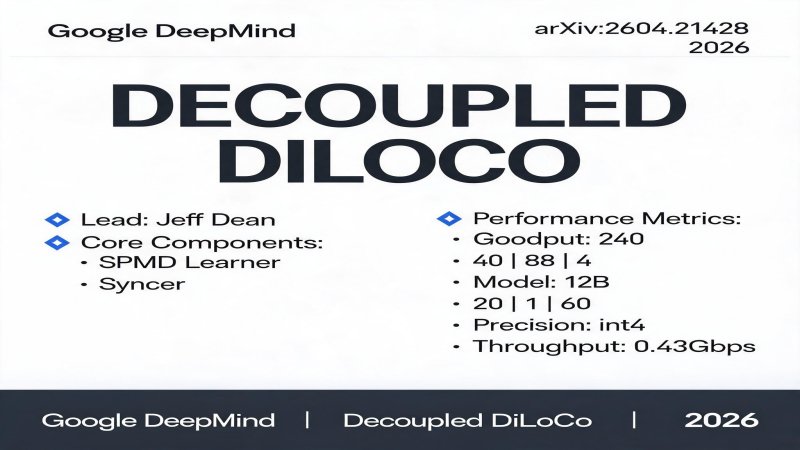
1. Problem: The Scaling Dilemma of SPMD Paradigm
Modern large-scale language model training relies on SPMD (Single Program Multiple Data) paradigm. This architecture requires all accelerators to maintain strict synchronization at every step—a single chip failure or communication delay stalls the entire cluster.
With 2.4 million chips and MTBI=1 year per chip, the cluster mean time between failures drops below 1 minute. Hardware failures are no longer exceptional events but routine occurrences. Even with elastic training, Goodput only reaches 40%—60% of compute wasted on waiting and reconfiguration.
2. Architecture: Core Design of Asynchronous Decoupling
Decoupled DiLoCo's core idea is to completely abandon global strong consistency, trading it for high availability through asynchrony.
Learner: Partition the cluster into independently operating learners, each with its own model replica and data shard, executing local inner optimization steps without waiting for peers. When one learner fails, others continue unaffected—like splitting a large exam hall into independent rooms.
Syncer: A lightweight central synchronizer runs on stable CPU resources, periodically collecting parameter update fragments from learners, performing outer optimization, and asynchronously pushing back. Key: the syncer uses Minimum Quorum—merging once the minimum required learners have reported.
3. Key Mechanisms: Four Core Innovations
3.1 Minimum Quorum
The syncer sets minimum learner count K (K≤M). As long as K learners successfully report, parameter merging proceeds. Stragglers are skipped and catch up via normal fragment sync on recovery.
3.2 Adaptive Grace Window
After reaching minimum quorum, the syncer waits a moment (grace window) to let more learners catch up. Wait time is dynamically calculated via ξ_slack = τ × ξ_step − (ξ_quorum + ξ_sync), improving sample efficiency without blocking.
3.3 Dynamic Token-Weighted Merging
Prevents fast learners from dominating by weighting contributions based on token processing volume:
Weight = tokens_processed × (tokens_processed / steps_taken)
Each learner's contribution = quantity × quality (sparser data = higher quality), ensuring fair representation in merged results.
3.4 Balanced Tensor Fragmentation
Model parameters are split into P similarly-sized fragments, synchronized one at a time per step. Offset scheduling overlaps communication with computation, avoiding bursty bandwidth usage.
4. Performance Verification
| Metric | Data | Source |
|---|---|---|
| 2.4M chips Goodput | 88% vs 40% (traditional elastic) | ✅ Paper Table 1a |
| 5B/12B model downstream eval | Comparable to synchronous training | ✅ Paper Table 14 |
| Bandwidth (90% utilization) | 1.7Gbps vs 104Gbps (int4: 0.43Gbps) | ✅ Paper Table 13a |
| 12B model across 4 US regions | 20x faster than sync methods | ✅ Google Blog |
| Mixed TPUv5p+v6e | No performance loss with 20% slowest | ✅ Paper |
| System availability | 100% uptime (8 learners) | ✅ Paper Table 1b |
Simulation (Table 1a) under 2.4M chips, MTBI=1 year/chip:
- No-elastic DP: Goodput 18%
- Elastic DP (current best): Goodput 40%
- DiLoCo M=8: Goodput 80%
Real model validation (Table 14) on 2B/5B/9B Gemma models shows Decoupled DiLoCo (M=8) performs comparably to Data-Parallel on text and vision benchmarks, with some metrics slightly better.
5. Vulnerability Analysis: Three-Factor Assessment
| Vulnerability | Traditional Problem | AI Attack Vector | Defense Direction |
|---|---|---|---|
| Syncer single point | Centralized coordinator bottleneck | Syncer attack affects global convergence | Lightweight design (CPU), Chandy-Lamport snapshots, decentralized learner recovery |
| Async consistency | Uncertain update order affects convergence | Malicious learner sends incorrect gradients | Minimum Quorum validation, token weighting, outer optimizer fault tolerance |
| Bandwidth dependency | Unstable cross-region bandwidth | Network attacks cause selective packet loss | Adaptive Grace Window, int4 compression, communication-computation overlap |
Key Metrics Summary
| Category | Metric | Value | Note |
|---|---|---|---|
| Scale | Simulated chips | 2.4M | Goodput 88% |
| Goodput | 2.4M chips | 88% vs 40% | vs traditional elastic |
| Bandwidth | 90% utilization | 1.7Gbps (bf16) / 0.43Gbps (int4) | vs 104Gbps traditional |
| Speedup | Cross-region | 20x | 4 US regions, 12B model |
| Quality | 5B model | On par with sync | Text/vision benchmarks |
| Heterogeneous | Cross-gen speed diff | 20% slower acceptable | TPUv5p + v6e mix |
| Availability | 8 learners | 100% uptime | Chaos engineering verified |
| Bandwidth savings | vs traditional | ~60x | With int4 compression |
References: arXiv:2604.21428v1 (2026.04.23), Google Blog, Jeff Dean co-author
Analysis by VendorDeep. Legend: ✅ Verified=paper/official data, ⚠️ High Confidence=multi-source inference, ⚠️ Vendor Claim=single source only
Why it Matters
Breaking geographic constraints: Bandwidth requirements drop from 104Gbps to 1.7Gbps, enabling training on scattered global compute—even across time zones and hardware generations.
Redefining elasticity: Traditional elastic solutions “cut losses” after failures; Decoupled DiLoCo makes failures “invisible”—local failures do not affect global training, achieving 100% system availability.
Extending hardware lifecycle: Mixed-generation TPU training means decommissioned hardware can still contribute, converting old resources into new capacity.
Engineering validation: Jeff Dean's 14-year-old vision now has engineering conditions—not just a technical breakthrough, but a milestone in AI infrastructure evolution.
DECISION
| Role | Recommendation |
|---|---|
| CTO/Infrastructure Leads | Monitor bandwidth savings (~60x)—existing cross-region capacity can support larger-scale training or significantly reduce network costs. |
| Architects | Evaluate how the async-first design philosophy fits existing systems. Traditional strong consistency needs rethinking, but the payoff is clear (2x Goodput). |
| Investors | Low bandwidth requirements may change data center geographic distribution logic; compute scavenging may become a new business opportunity. |
| AI Lab Researchers | Open-source DiLoCo implementations are worth monitoring—the finding that model quality matches synchronous training opens new academic doors. |
PREDICT
| Timeframe | Prediction |
|---|---|
| Short-term (1-2 years) | Google expands internal deployment, Gemma 4+ models trained with Decoupled DiLoCo; other frontier labs (Meta, xAI) follow with similar approaches. |
| Mid-term (2-3 years) | Open-source implementations emerge (e.g., JAX/Pathways-based DiLoCo library); smaller organizations begin compute scavenging using low-cost cross-region bandwidth. |
| Long-term (3-5 years) | Availability-first becomes the de facto standard for cross-region training; dedicated compute matchmaking platforms may emerge; traditional SPMD synchronous training mainly retained for single-datacenter deployments. |
Get 3-5 key AI infrastructure signals weekly →
💬 Comments (0)