
Why it Matters
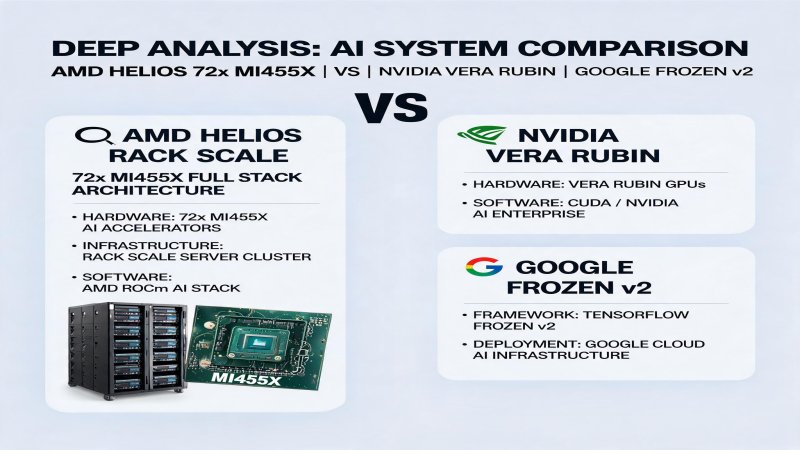
Helios launch marks the escalation of AI infrastructure competition from GPU/server level to rack-scale systems. AMD achieves full in-house design across GPU+CPU+network for the first time, creating an open-standards vs proprietary battle with NVIDIA's NVLink ecosystem. Microsoft Azure's adoption validates Helios commercially, signaling NVIDIA's monopoly in AI training/inference accelerators is being materially eroded.
DECISION
Cloud providers and large-scale AI training users should evaluate Helios POC in H2 2026, focusing on ROCm 7.14 compatibility and performance with real workloads (PyTorch/JAX/vLLM). For existing NVIDIA Vera Rubin customers, Helios offers a more cost-effective inference alternative (432GB vs 288GB HBM4) reducing cross-node communication overhead.
PREDICT
AMD Helios is expected to begin shipping in H2 2026, with initial deployments to Azure, OpenAI, and Meta. By mid-2027, Helios could capture 10-15% of AI inference infrastructure market. Google Frozen v2's model-specific hardware approach could trigger a paradigm shift in AI chip design.
Get 3-5 key AI infrastructure signals weekly →
💬 Comments (0)