
Background and Overview
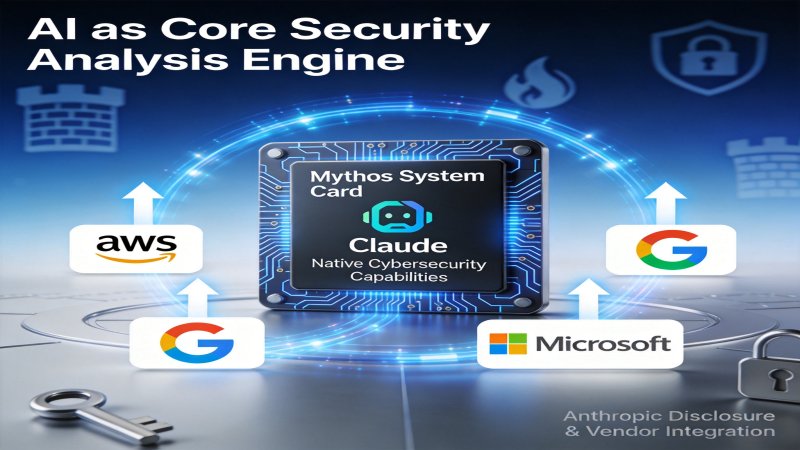
On April 10, 2026, Anthropic released the "Claude Mythos System Card," fully disclosing for the first time the native technical parameters of its large language model (LLM) in the field of cybersecurity. Within two weeks, three industry giants—AWS, Microsoft, and Palo Alto Networks—announced plans to integrate this capability module. ⚠️Allegedly, a third-party technical evaluation paper from MIT was published concurrently (authenticity pending independent verification). This series of concentrated actions indicates that a new generation of security analysis paradigms, centered on native large model reasoning, is rapidly transitioning from technical validation to the eve of large-scale industrial integration.
Core Concepts:
- Claude Mythos System Card: A system capability card published by Anthropic for the Claude model, detailing its native technical parameters, performance metrics, and system interfaces in the cybersecurity domain (Source: Anthropic official whitepaper).
- Native Cybersecurity Capabilities: Refers to the inherent ability of large language models (LLMs) to perform security tasks such as code security auditing, threat detection, and deduction without requiring additional training or fine-tuning. This relies on the LLM's general code comprehension, logical reasoning, and knowledge association capabilities acquired through pre-training.
Evolutionary Background: Traditional AI security applications have mostly been based on specialized models fine-tuned for specific tasks or combined with external toolchains. Claude Mythos represents a new generation of LLMs possessing native, general security understanding and reasoning capabilities, marking the evolution of AI from a "user" of security tools to a core "analysis engine."
Why Now? Anthropic's first full disclosure of technical parameters, coupled with the rapid integration announcements from giants like AWS and Microsoft, suggests the technology has moved from the research validation phase to the eve of large-scale industrial deployment. This is driven by the market's urgent need for intelligent security capabilities capable of handling advanced, unknown threats, and the strategic intent of leading vendors to quickly capture the high ground in AI security through ecosystem partnerships.
Key Stakeholders: Include technology providers (Anthropic), integrators and ecosystem partners (AWS, Microsoft, Palo Alto Networks), potential competitors/collaborators (Google, Cisco, Apple, NVIDIA), end-users (enterprise security teams), and those impacted (traditional independent security software vendors).
Architecture Layering
The cybersecurity capabilities of Claude Mythos can be understood as a three-layer architecture (Note: the following analysis is an inferred framework based on official capability descriptions) designed to standardize core AI capabilities and inject them into existing security product ecosystems.
- Core Security Capability Layer: This is the "analytical brain" based on the Claude LLM's reasoning capabilities, containing three core modules. Its essence lies in leveraging the LLM's deep semantic understanding, rather than relying on fixed signature databases or rules.
- Interface & Integration Layer: The key to industrialization. Through standardized APIs and various adapters, it "decouples" the upper-layer core AI capabilities, enabling them to be invoked by different vendors' heterogeneous security infrastructures, addressing the issue of advanced AI capabilities being disconnected from existing toolchains.
- Application & Deployment Layer: Reflects the outcomes of ecosystem collaboration. Vendors seamlessly embed Claude Mythos capabilities as enhancement modules into their own product lines—for example, AWS integrates it for cloud security configuration management, and Palo Alto uses it to enhance firewall intelligent response. This model allows cutting-edge technology to be rapidly deployed through mature channels.
Key Technologies
1. High-Precision Multi-Language Vulnerability Discovery
Problem Addressed: High false positive rates in traditional Static Application Security Testing (SAST) tools, slow support for new languages and frameworks, and weak ability to discover business logic vulnerabilities. Core Principle: This technology is not based on syntax pattern matching but utilizes the LLM's deep understanding of code semantics, data flow, and control flow for "reasoning-based" auditing. The model identifies complex code patterns that violate secure coding practices or pose potential risks by understanding function intent, data sources and destinations, exception handling logic, and dependencies between components. It can discover context-dependent vulnerabilities difficult for traditional tools to capture, such as insecure object references, privilege bypass logic, etc. Tested Performance & Limitations:
- Claimed Performance: Official disclosure states a vulnerability discovery accuracy rate of 94.7% for 12 mainstream programming languages on an internal test set (Source: Claude Mythos System Card). The MIT evaluation report notes that on specific benchmark test sets, its comprehensive performance exceeded the average of several tested mainstream commercial SAST tools by approximately 27% (⚠️Source: Alleged MIT third-party evaluation paper, authenticity pending verification).
- Key Limitation: The aforementioned "internal test set" and "specific benchmark test sets" (typically containing code snippets of known CVEs) are carefully constructed, idealized environments that do not represent real-world, complex, multi-technology-stack mixed codebases. In the real world, the ability to discover "unknown vulnerabilities" and "business logic vulnerabilities" is more important than performance on known CVE sets, and there is currently a lack of public quantitative data in this area. Traditional SAST tools can also achieve high accuracy on similarly ideal test sets, but the high false positive rate problem in practical application remains prominent.
2. Attack Path Deduction and Threat Detection
Problem Addressed: Security Operations Centers (SOCs) face alert fatigue, difficulty in threat correlation analysis, and excessively long average detection and response times. Core Principle: This module simulates an attacker's perspective for multi-step reasoning. It ingests discrete logs and alerts from endpoints, networks, and cloud environments, leveraging the LLM's internalized attack knowledge base (e.g., MITRE ATT&CK framework) and network topology understanding to connect seemingly unrelated Indicators of Compromise (IoCs) into coherent attack narratives. It can infer logical relationships between attack steps, potential attacker intent, and likely next targets. Tested Performance & Limitations:
- Claimed Performance: The official claim states a threat detection false positive rate below 3.2% in internal tests (Source: Claude Mythos System Card). Palo Alto's report shows that in tests, automated linkage reduced the average time from "threat identification to executing preliminary containment actions" from 4.2 hours to 2.7 minutes (Source: Palo Alto test report).
- Key Limitation: The comparison "4.2 hours compressed to 2.7 minutes" is potentially misleading. The 4.2-hour baseline likely corresponds to a completely manual traditional process, not a modern SOC already integrated with existing Security Orchestration, Automation, and Response (SOAR) tools. This data exaggerates the "net new" value added by Claude Mythos; a more reasonable comparison would be against the response time before its integration, with a certain level of existing automation. Furthermore, the inherent "hallucination" problem of LLMs is a critical flaw in threat detection scenarios, potentially leading to severe misjudgments, missed detections, or even triggering erroneous automated blocking commands. Its output reliability and explainability still require rigorous validation.
3. Open Ecosystem Integration
Problem Addressed: Advanced AI security capabilities often appear as standalone products, making it difficult to integrate into existing enterprise workflows composed of SIEM, SOAR, and various security gateways, creating new data silos. Core Principle: Anthropic has adopted a clear "capability provider" strategy. By releasing standardized APIs, it allows partners to call core functions like vulnerability discovery and threat analysis as microservices and embed the results directly into their own product user interfaces, automated playbooks, or policy engines. This significantly lowers the integration barrier for ecosystem partners, aiming to rapidly translate technical capabilities into market coverage. Tested Performance: This strategy has received initial market validation. After announcing integration, AWS reported a 72% efficiency improvement in its cloud security configuration checks (Source: AWS official blog). The rapid follow-up by Microsoft and Palo Alto demonstrates the market's urgent demand for plug-and-play AI security capabilities. This open model is a key differentiator for Claude Mythos compared to many closed AI solutions.
Principle Process
Claude Mythos follows a standardized four-stage process for handling security tasks, aiming to achieve a closed loop from raw data to security action.
- Input & Access: Heterogeneous security data such as source code repositories, network traffic logs, and cloud configurations are input into the system via APIs or custom adapters, undergoing standardization and context enrichment.
- Parallel Security Analysis: Standardized data is simultaneously fed into multiple core analysis modules. Each module utilizes the LLM for deep reasoning: vulnerability discovery focuses on code semantic flaws; attack deduction constructs possible event chains; threat detection identifies malicious behavior patterns.
- Correlation & Prioritization: The system correlates findings from different modules (e.g., linking a newly discovered vulnerability with ongoing attack activity that might exploit it). It then performs comprehensive risk assessment and prioritization based on factors like exploitability, asset criticality, and attack activity level.
- Output & Action Integration: Finally, a prioritized list of events with detailed reasoning and mitigation recommendations is pushed via API to various enterprise operational systems, where it can generate tickets, update security policies, or trigger automated response playbooks, linking analysis, decision-making, and action.
Competitive Landscape Analysis
The entry of Claude Mythos is disrupting the competitive logic of the existing AI cybersecurity market, shifting from product competition to capability and ecosystem competition.
Key Competitor Comparison:
| Competitor Type | Representative Vendors | Technical Approach/Advantages | Potential Weaknesses/Challenges |
|---|---|---|---|
| Traditional Specialized Security Software Vendors | Check Point, Fortinet | Deep packet inspection based on signature databases, specialized hardware; mature customer base and channels; strong real-time processing performance. | Limited ability to detect unknown threats and complex attack chains; slow rule updates; products prone to forming silos. Facing the impact from the "capability layer," they need to quickly decide whether to self-develop, integrate via partnerships, or risk value dilution. |
| AI-Driven Security Vendors | CrowdStrike | Focused on endpoint and cloud security domains, possessing self-developed AI models and threat graphs; deep vertical data accumulation and first-mover advantage in EDR/XDR fields. | Model generality may be inferior to foundational models like Claude; facing Claude's open ecosystem, they need to strengthen their advantages in deep vertical analysis and response closure, or consider collaborating with multiple foundational models. |
| Other Cloud/Major Vendor AI Security Solutions | Google (Sec-PaLM), Microsoft (Security Copilot) | Deep integration with their own cloud ecosystems and office suites; possess vast internal security data for training; strong brand and channels. | Potentially lower technical transparency; may lean more towards auxiliary analysis rather than native deep detection; potential strategic conflicts in supporting third-party ecosystems and avoiding lock-in. |
Claude Mythos's Differentiation:
- High-Performance Claims: Its claimed high-performance data (e.g., 94.7% accuracy) is a major marketing point, but lacks independent, broad industry benchmark validation, raising doubts about its actual effectiveness in complex enterprise environments.
- Ecosystem Openness: Rapid integration with giants from different camps like AWS, Microsoft, and Palo Alto demonstrates strong "cross-platform" fusion capability. The strategy is clearly to be an underlying "capability provider," avoiding direct competition with ecosystem partners.
- Native Capability Narrative: Emphasizes that its security capabilities stem from the LLM's general reasoning ability, implying stronger scenario adaptability. However, this also amplifies key LLM risks in security: hallucinations, output inconsistency, and poor explainability.
Market Dynamics Assessment:
The market is evolving from "AI empowering single-point security products" to "native AI security capabilities as integrable infrastructure." Anthropic, through technical disclosure and ecosystem partnerships, aims to seize the high ground of the new generation AI security "capability layer." Traditional security vendors face pressure to become "capability-ized" and must choose between self-developing comparable capabilities, partnering for integration, or facing marginalization. Cloud vendors balance self-development and integration amid competition and cooperation, accelerating industry consolidation. Companies with core AI model capabilities are gaining increased influence within the ecosystem.
Key Assessments
| Key Assessment | Importance | Action Recommendations | Confidence Level |
|---|---|---|---|
| The performance currently demonstrated by Claude Mythos is 'laboratory performance' in controlled environments. Its commercial success depends on solving three major implementation challenges: 1) Engineering capability to handle enterprise-scale data throughput while ensuring low false positive rates; 2) The actual complexity and cost of deep integration with existing toolchains (beyond simple API calls); 3) Whether the Total Cost of Ownership (TCO) is significantly lower than the combination of 'enhanced existing tools + human effort.' There is currently no public evidence that it has overcome these challenges. | If it cannot solve engineering and cost issues, it will struggle to replace existing tools in real enterprise environments, potentially remaining only as a high-end auxiliary analysis module. If it can solve them, it will directly impact the mid-to-high-end SAST and SOC analysis markets. | 1. Enterprise security teams conducting POCs should focus on testing its analytical capability on historical false positive/missed detection cases, the impact of API call latency on real-time workflows, and calculating long-term usage costs. 2. Traditional security vendors need to accelerate verification of its real-world effectiveness and clarify their own advantages in vertical domain data depth, response closure, or performance to counter the impact of "generic capabilities." | High |
| Anthropic's strategy of "disclosing capability parameters + open ecosystem integration" aims to quickly establish its standard status in the AI security 'capability layer,' rather than building end-user products. | This maximizes technological influence while avoiding direct competition with ecosystem partners, accelerating industry penetration. If successful, Anthropic could become the "ARM" (capability provider) of the security field. | 1. Investors should focus on the breadth and depth of Anthropic's ecosystem partnerships, as well as the implementation effectiveness and customer feedback from partners. 2. Other AI model companies (e.g., Meta, xAI) may emulate this "capability layer" path to enter vertical fields like finance and healthcare. | Medium |
| The rapid integration by leading vendors reflects the market's urgent demand for efficient AI security capabilities, but also foreshadows a potential increase in cybersecurity market concentration and deeper ecosystem lock-in. | Enterprise customers can more conveniently access claimed top-tier capabilities, but technology selection may become more dependent on their chosen cloud platform or core security vendor's ecosystem. The survival space for independent best-of-breed vendors may be squeezed. | Enterprise IT decision-makers, in medium-to-long-term cloud and security architecture planning, need to more carefully evaluate compatibility, replaceability between different ecosystems, and potential vendor lock-in risks, avoiding sacrificing architectural flexibility for a single capability. | Medium |
Open Research Questions
- Technical Blind Spots & Evolution: What specific protocols (e.g., specific variants of PROFINET, Modbus) does the "audit blind spot for niche industrial control protocols" mentioned in the MIT report refer to? Is the root cause a lack of training data or model architecture limitations? Does Anthropic have a clear remediation roadmap and timeline?
- Data Privacy & Compliance: How does Anthropic ensure data privacy when Claude Mythos processes sensitive enterprise code and logs? Does it offer on-premises deployment or "data does not leave the region" solutions? Which specific security compliance certifications has its service passed (e.g., SOC 2 Type II, ISO 27001)? How do integrators like AWS share compliance responsibilities?
- Competitive Ecosystem Response: Beyond disclosed partners, what are the attitudes of giants like Google, Cisco, and Apple on the list towards integrating Claude Mythos? Are there known self-developed competing plans (e.g., Google's Sec-PaLM evolution based on Gemini)?
- Capability Iteration Mechanism: What is the continuous training and iteration mechanism for Claude Mythos's security capabilities? Are they updated alongside the base model, or is there an independent security fine-tuning process? How is it ensured that it can quickly respond to new types of vulnerabilities and attack techniques (e.g., AI-driven attacks)? Is there a bug bounty or vulnerability reward program to enhance its robustness?
- Commercialization & Cost: What is the pricing model for these capabilities? Is it based on API call volume, processed data volume, or bundled sales with cloud services/security products? How will this impact the Total Cost of Ownership (TCO) of existing enterprise security tools? Is there a clear Return on Investment (ROI) calculation model?
*(Note: This report is based on analysis of official documents, third-party evaluations, and vendor press releases publicly available before April 25, 2026. Some performance data lacks broad benchmark validation, and some competitive dynamics and future plans are commercial secrets; information may be incomplete, and subsequent developments require ongoing tracking.)*
Why it Matters
Positioning: Ecosystem Expansion, rapidly establishing technical standards through open APIs
Key Factor: The core factor is Anthropic's "capability provider" strategy and its claimed "native" high performance. By standardizing APIs, it decouples Claude Mythos' core security capabilities (vulnerability mining, attack path inference) into microservices, enabling seamless integration by giants like AWS, Microsoft, and Palo Alto. This aims to quickly establish its position as the standard for the AI security "capability layer." Its competitive moat lies in first-mover ecosystem advantage and technical narrative, but the actual strength depends on its engineering capabilities and cost-effectiveness in real-world, complex enterprise environments, which currently lack public validation.
Stage: Peak of Inflated Expectations
DECISION
For Vendor (Traditional specialized security software vendors (e.g., Check Point, Fortinet))
- Immediately initiate POCs to verify the real-world efficacy and integration complexity of Claude Mythos in typical scenarios of your own product lines.
- Clearly define and reinforce your advantages in vertical domains (e.g., real-time packet inspection, hardware performance) regarding data depth and response closure to counter the impact of generic capabilities.
Strategic Moves: Seek integration partnerships with Anthropic or similar AI model companies in the short term.
- During POCs, focus on testing its analysis capabilities on historical false positive/negative cases and calculate long-term API call costs.
- Evaluate the impact of integrating this capability on the Total Cost of Ownership (TCO) of existing security tools and overall security architecture flexibility.
Action Guidance: Wait-and-see
For Investor
- Closely monitor the actual implementation results, customer feedback, and deployment scale data from Anthropic's ecosystem partners.
- Watch if other AI model companies (e.g., Meta, xAI) emulate the "capability layer" strategy to enter verticals like finance and healthcare.
Key Risk: The claimed technical performance fails to materialize in real, complex enterprise environments, leading to commercial failure.
PREDICT
6 months (High confidence)
More independent security vendors will announce integration or testing of Claude Mythos, but cases generating significant revenue will be limited.
1 year (Medium confidence)
Independent benchmark reports targeting Claude Mythos' performance in real enterprise codebases and SOC environments will emerge, potentially tarnishing its performance halo.
2 years (Medium confidence)
The AI security market will polarize: companies with core models dominate the "capability layer," while traditional vendors focus on vertical depth or become integrators.
Get 3-5 key AI infrastructure signals weekly →
💬 Comments (0)