
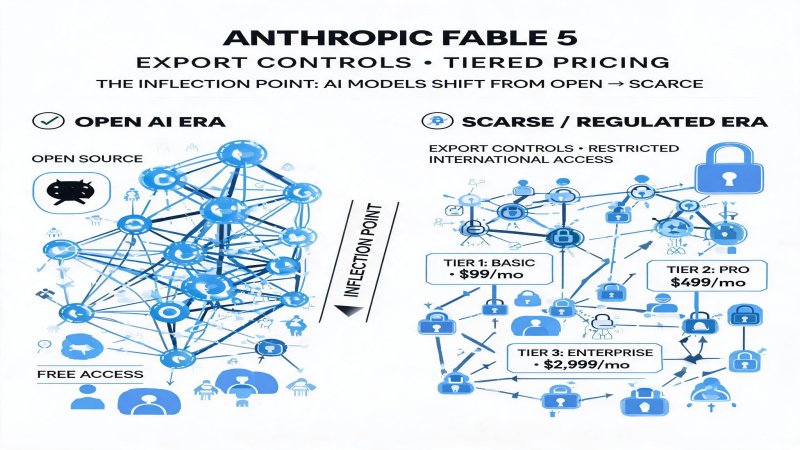
Anthropic Fable 5 Export Controls and Tiered Pricing: The Inflection Point Where AI Models Shift from Open to Scarce
1. Event Recap
On June 12, 2026, the US government imposed export controls on Anthropic's frontier AI models Fable 5 and Mythos 5 for national security reasons. Anthropic responded by suspending global access to both models — including US domestic users — stating it had no reliable way to verify user nationality in real time. This affected all subscription tiers, from free users to Enterprise customers.
Three weeks later in early July, Anthropic restored access while fundamentally restructuring its product distribution. Core changes included:
Four-Tier Model Classification:
| Tier | Model | Input Price (per million tokens) | Output Price (per million tokens) |
|---|---|---|---|
| Mythos Tier | Fable 5 | $10 | $50 |
| Standard Tier | Opus 4.8 | $5 | $25 |
| Value Tier | Sonnet 5 | $2 (promotional) | $10 (promotional) |
| Budget Tier | Haiku 4.5 | $1 | $5 |
From July 20, Fable 5 officially transitioned from bundled subscription access to metered billing. During the transition, Anthropic made two free extensions (original July 7 deadline → July 12 → July 19), exposing persistent compute supply constraints.
Simultaneously, OpenAI accelerated its compute infrastructure buildout. In mid-July, OpenAI elevated former xAI infrastructure lead Uday Ruddarraju to the newly created CTO of Compute role, dedicated to expanding global compute capacity. Ruddarraju stated his team completed "deep systems engineering across compute, networking, and storage required for training frontier models like GPT-5.6" and teased "very exciting compute expansion plans and roadmaps."
Meta was also reported to be negotiating a potential $10B, two-year compute leasing deal with Anthropic — marking Meta's potential entry as a cloud computing provider. Meta pursued a dual AI strategy: releasing Muse Spark 1.1 (1M token context window, 50%+ cheaper than Anthropic/OpenAI), while developing custom Iris AI chips (production starting September 2026, Broadcom design, TSMC fabrication).
2. Technical Deep Dive
Fable 5's Technical Positioning
Fable 5 is Anthropic's flagship frontier model, targeting multimodal long-chain reasoning, code generation, and agent tasks. Its "Mythos Tier" classification suggests capabilities that may approach or exceed thresholds defined by AI safety research as "high-risk" — the technical basis for government export controls.
In competition with OpenAI's GPT-5.6 Sol and xAI's Grok 4.5, Fable 5 differentiates through Anthropic's "Constitutional AI" safety alignment approach. Ironically, it's this very capability that made it a target for government regulation.
Root Cause of Anthropic's Compute Constraints
Anthropic's repeated deadline extensions stem from the physical limits of inference compute. Each frontier model inference call consumes massive GPU compute. At Fable 5's estimated scale, if each Pro subscriber ($20/month) processes just 10 medium-complexity tasks daily, inference costs alone could exceed subscription revenue.
Strategic Significance of Meta Iris
Meta's custom Iris chip aims not to replace NVIDIA GPUs but to reduce marginal compute costs for its own AI services. By co-designing with Broadcom and fabricating at TSMC, Meta can achieve superior cost-efficiency for specific workloads (inference-heavy, training-light). This mirrors Google TPU and Amazon Trainium/Inferentia strategies.
3. Financial Logic
Anthropic's Compute Cost Structure
Anthropic's 2026 compute sources include:
- AWS (primary partner): Usage-based billing, costs scale linearly with model invocation volume
- SpaceX Colossus 1: Signed May 2026, ~$1.25B/month, 300MW capacity (220K+ NVIDIA processors)
- Potential Meta compute: Up to $10B/two years, ~$420M/month
At Fable 5's metered rates ($10/$50 per million tokens), Anthropic needs very high inference utilization to cover SpaceX's $1.25B/month fixed compute commitment.
OpenAI's Compute Investment
OpenAI's CTO of Compute appointment elevates compute from an operational issue to a strategic one. Ruddarraju's mandate to "build the world's largest compute footprint" encompasses distributed systems, hardware, manufacturing, and data center construction.
Meta's Dual Investment
Meta's 2026 capex guidance of $125-145B (nearly double 2025's $72.2B) funds Iris chip R&D, Muse Spark 1.1 infrastructure, and potentially compute leasing revenue from Anthropic.
| Company | 2026 AI Capex | Compute Strategy | Model Pricing |
|---|---|---|---|
| Anthropic | ~$5-10B (est.) | Outsourced (AWS+SpaceX+Meta) | 4-tier, Fable 5 metered |
| OpenAI | ~$10-15B (est.) | Self-built + custom chips | GPT-5.6 unified pricing |
| Meta | $125-145B | Custom Iris + leasing idle compute | Muse Spark 1.1 at 50%+ below competitors |
4. Strategic Depth
Anthropic vs OpenAI vs Meta Comparison Matrix
| Dimension | Anthropic | OpenAI | Meta |
|---|---|---|---|
| Frontier Model | Claude Fable 5 / Mythos 5 | GPT-5.6 Sol | Muse Spark 1.1 |
| Model Positioning | Safety-aligned first | Performance leader | Cost killer |
| Pricing Strategy | Tiered rationing ($1-$50/M tokens) | Unified pricing | 50%+ below competitors |
| Compute Source | AWS+SpaceX+Meta (outsourced) | Self-built + custom chips | Custom Iris + leasing |
| Gov Relations | Export-controlled then restored | Pentagon criticism + potential contracts | Relatively neutral |
| Business Model | API subscription + metered | ChatGPT subscription + API + enterprise | Ad revenue subsidizes AI |
| Closeness | High (Fable 5 restricted) | Medium-high | Medium (Muse Spark open) |
| MAU | ~100M (est.) | ~300M (ChatGPT) | ~4B (Meta AI) |
| Developer Ecosystem | Claude Code + MCP | ChatGPT Plugins + API | Open-source focused |
From Open to Scarce: Strategic Implications
Anthropic's four-tier system is essentially a capability rationing regime:
- Cost recovery: Fable 5 inference costs far exceed mid-range models; 10-50x price differential passes costs to willing deep users
- Demand signaling: Who pays $50/M output tokens reveals the most demanding customer segment
- Supply management: In compute scarcity, pricing is more efficient than queuing
OpenAI contrasts by using scale economics (self-built infrastructure) to reduce unit costs and maintain relatively uniform pricing. Anthropic chose to "acknowledge scarcity, manage demand through price."
Meta as Compute Lessor: A Disruptive Force
If Meta's $10B Anthropic deal materializes:
- "Meta Effect" on AI infra pricing: $125-145B annual capex means even a fraction of idle compute can shift market dynamics
- Compute diversification value: Anthropic moves from single-vendor (AWS) dependency to multi-cloud + third-party compute
- Meta's evolution from user to platform: Meta Compute could become the fourth major AI compute provider after AWS, Azure, GCP
5. Challenges and Risks
1. Unpredictability of Government Controls
The June 12 export controls were implemented without prior notice, causing three weeks of global service disruption. This unpredictability creates systemic risk for enterprise AI planning. If controls expand to more models or jurisdictions, enterprises may need "geographic model redundancy."
2. Financial Sustainability of the Compute Arms Race
Anthropic (~$1.25B/month SpaceX + potential $420M/month Meta), OpenAI ("world's largest compute footprint"), Meta ($125-145B annual capex) — three companies pouring unprecedented resources into compute. Anthropic relies on external funding; sustained cost growth accelerates cash burn.
3. Model Degradation UX Risk
For developers who integrated Fable 5 into production, Anthropic's three billing deadline changes created "runtime dependency" issues. When applications perform well on Fable 5 but degrade significantly on Opus 4.8, developer maintenance costs spike.
4. Apple Lawsuit's Indirect Impact on OpenAI
OpenAI faces Apple's trade secret lawsuit (alleging io Products stole iPhone manufacturing secrets), potentially diverting attention and resources from compute expansion. If hardware plans (screenless AI smartphone) are blocked, OpenAI's edge AI strategy requires adjustment.
6. Conclusion
July 2026 marks the transition from the "open access" era to the "controlled scarcity" era in AI. Anthropic Fable 5's export controls and restoration, the four-tier pricing system, OpenAI's CTO of Compute appointment, and Meta's entry into compute leasing — together these point to one conclusion: AI capability is shifting from public infrastructure to strategic resource constrained by politics, physics, and economics.
For enterprises, AI procurement decisions must upgrade from "which model is best" to "which model remains available in the worst case." Model redundancy, cross-vendor API integration, and compliance auditing become foundational AI infrastructure.
For AI vendors, compute is no longer a growth enabler but a growth bottleneck. Anthropic's tiered pricing acknowledges this reality; OpenAI's CTO of Compute tries to break it with organizational force; Meta's compute leasing attempts to turn the bottleneck itself into a business.
Ultimately, this inflection point's outcome hinges not on whose model is smarter, but on who can deliver compute more reliably, who can navigate regulation more flexibly, and who can operate with a more sustainable cost structure. On these three dimensions, Anthropic's classification system is a pragmatic response — but also a forced compromise that admits: in the age of compute scarcity, "making the best AI available to everyone" is no longer a viable business strategy.
Why it Matters
Anthropic's model classification marks a structural shift in the AI industry:
- First government export controls on commercial AI models: The June 12 controls on Fable 5/Mythos 5 for national security created a precedent
- Model capability becoming "controlled material": From open API to tiered pricing to political approval, accessing AI capability increasingly resembles obtaining encryption technology or military-grade materials
- Compute as the ultimate bottleneck: Anthropic changed Fable 5 billing deadlines three times in two weeks, exposing physical constraints of frontier model operations; OpenAI created a dedicated CTO of Compute role; Meta proposed leasing compute to Anthropic
Enterprises can no longer treat "choosing the best AI model" as purely a technical and cost decision — political risk, compute supply security, and compliance are becoming equally critical dimensions.
DECISION
Enterprise AI Procurement Decisions
- AI application developers: Do not bind core workflows to a single frontier model. Anthropic's 3-week Fable 5 suspension proved government orders can interrupt access. Adopt "model redundancy" — maintain API integrations with both Anthropic and OpenAI
- Compute buyers: Anthropic's shift from flat-rate to metered billing ($10/$50 per million tokens) means API costs could rise 5-10x — reassess AI application ROI models
- Compliance teams: US export controls now apply to AI models. Enterprises using Fable 5/Mythos 5 must evaluate controlled user exposure and establish model access auditing
Investment Decisions
- Short-term: Anthropic's tiered pricing will boost per-token revenue, but compute costs rise in parallel (SpaceX Colossus 1 at $1.25B/month + potential Meta $10B deal). Short-term profitability depends on compute cost control
- Mid-term: OpenAI's new CTO of Compute and Meta's entry into compute leasing will intensify AI infrastructure price competition, benefiting AI application cost structures
- Long-term: AI model export controls may spread globally (EU, APAC), accelerating "regional AI" landscape formation
PREDICT
- 2026 Q3: Anthropic Fable 5 may re-enter some subscription plans after compute expansion, but free quotas will shrink dramatically. Metered billing becomes the norm
- 2026 H2: OpenAI GPT-5.6 full release will trigger direct pricing competition with Anthropic Claude Fable 5. Model API price wars could reduce per-million-token costs by 20-30%
- 2027: Meta Iris custom AI chip production will lower compute costs. Meta Compute cloud platform may officially launch, competing with AWS/Azure for AI compute market share
- 2027-2028: US export control framework may expand to more AI models and broader geographies. "AI model licensing" could become the new normal in global tech regulation
Get 3-5 key AI infrastructure signals weekly →
💬 Comments (0)