
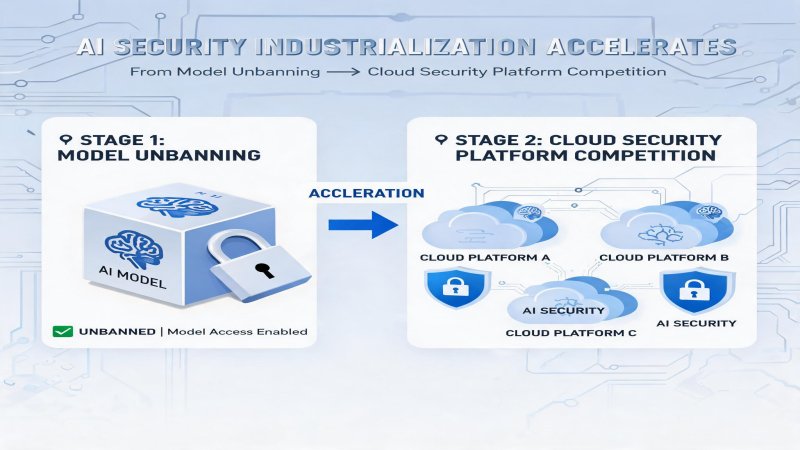
I. Event Recap: The Critical Intersection of Model Unbanning and Security Earnings Season
In mid-June 2026, Anthropic's most capable models, Fable and Mythos, were unexpectedly unbanned by the U.S. government less than three weeks after their initial prohibition, marking one of the most symbolic events in AI safety to date. The unbanning came with stringent conditions: Anthropic must commit to enhanced safety guardrails, increased red-teaming frequency, and granting regulators access to model weight audit trails. This episode signals a fundamental shift in American AI regulation from "freezing control" to "conditional release," reflecting the strategic disadvantage of suppressing domestic frontier models amid an intensifying global generative AI arms race. Almost simultaneously, Anthropic launched Claude Sonnet 5 at a price point of $2-3 per million input tokens, directly undercutting OpenAI's GPT-5 series and signaling that the large model API market has entered a brutal price war phase.
Against this regulatory backdrop, global cybersecurity giants released their fiscal Q1 2026 earnings, painting a clear picture of AI security industrialization. CrowdStrike delivered a standout performance with Q1 total revenue of $1.386 billion, up 26% year-over-year, and annual recurring revenue (ARR) reaching $5.51 billion. More significantly, CrowdStrike introduced three major AI-driven product lines: Charlotte AI AgentWorks, Agentic MDR, and Falcon Data Security, explicitly extending its capabilities from endpoint protection into AI risk remediation. Fortinet also posted strong results, reporting Q1 revenue of $1.85 billion, a 20% YoY increase, and unveiled FortiSOC, a unified cloud-delivered security operations platform featuring built-in AI agents for automated alert triage. Confident in its trajectory, Fortinet raised its full-year revenue guidance to 15% YoY growth.
However, not all players are sharing in the prosperity. Zscaler's FY2026 Q3 earnings, coupled with a weaker-than-expected Q4 revenue outlook, triggered a catastrophic single-day stock plunge of over 30%—the largest in its history. Year-to-date, Zscaler has declined approximately 38.8%, with its price-to-sales ratio collapsing to just 7.0x, a stark contrast to CrowdStrike's 37.1x. This violent divergence reflects not only investor recalibration of Zero Trust architecture commercialization timelines but also a deeper restructuring of valuation frameworks across the cloud security landscape. Beyond these macro events, Meta's introduction of Instagram Stories features for AI smart glasses—including rotating views and multi-camera synchronization—further confirms the trend of AI capabilities permeating edge devices, presenting security vendors with new challenges in endpoint-cloud synergy.
II. Technical Depth: AI Security Architecture and Platform Capability Comparison
The definition of AI security is expanding from traditional "defense against known threats" to "defense against unknown risks introduced by AI itself." Contemporary AI security architectures can be broadly divided into three layers. The bottom layer is model security, concerned with training data poisoning, model exfiltration, and adversarial sample attacks. The middle layer is AI application security, focusing on prompt injection, hallucination abuse, and privilege escalation. The top layer is security-AI integration, leveraging AI capabilities to enhance traditional security operations efficiency. These three layers are deeply intertwined, forming the technical foundation of AI security industrialization.
At the model security layer, the Anthropic Fable/Mythos unbanning case reveals the tension between national regulation and model capability. Enhanced safety mechanisms require not only technical improvements but also supply chain transparency and compliance process overhaul. For enterprise buyers, selecting model vendors with complete security audit trails will become a critical procurement criterion. At the application security layer, CrowdStrike's Falcon Data Security directly targets AI data leakage risks by monitoring interactions between large models and enterprise data in real time, identifying anomalous access patterns. Fortinet's FortiSOC embeds AI agents within the Security Operations Center (SOC), enabling automated alert classification and preliminary triage, significantly reducing analyst fatigue.
From a platform capability perspective, the competitive landscape among the four major vendors exhibits distinct differentiation. The following matrix systematically compares them across six dimensions: AI-native capability, platform coverage, cloud delivery model, data security, agent ecosystem, and valuation level.
| Vendor | AI-Native Capability | Platform Coverage | Cloud Delivery | Data Security | Agent Ecosystem | Valuation (P/S) |
|---|---|---|---|---|---|---|
| CrowdStrike | Deep Charlotte AI integration; AgentWorks supports autonomous orchestration | Endpoint + Cloud Workload + Identity + Data | Native SaaS with modular subscriptions | Falcon Data Security focused on AI data protection | Agentic MDR commercially available | 37.1x |
| Fortinet | FortiAI embedded in FortiSOC; automated alert triage | Network Firewall + SOC + SD-WAN + Cloud Security | Unified cloud delivery; strong hybrid deployment | FortiDLP covers data loss prevention | AI agents limited to SOC scenarios | ~12-14x |
| Zscaler | Zscaler AI for threat detection and policy optimization | Zero Trust Network Access + Cloud Firewall + DLP | Pure cloud proxy architecture; no on-premise | Cloud-native DLP integrated with CASB | Agent capabilities still early-stage | 7.0x |
| Palo Alto Networks | Cortex XSIAM platform integrates AI analytics | Network + Cloud + Endpoint + SOC full coverage | Hybrid cloud and on-premise delivery | Prisma Cloud focused on cloud data security | XSIAM Agents gradually expanding | ~15-18x |
The comparison reveals CrowdStrike's leadership in AI-native capabilities and agent ecosystems, with its valuation premium reflecting market confidence in its platformization vision. Fortinet leverages deep network security expertise and unified cloud delivery to carve out unique advantages in enterprise hybrid cloud environments. Zscaler's pure cloud proxy architecture delivers excellent performance and scalability, but its absence of a mature agent ecosystem leaves it passive in the AI-driven proactive defense race. Palo Alto Networks' Cortex XSIAM platform demonstrates formidable integration ambition, though its product complexity demands greater customer implementation maturity.
A critical technological trend is the shift from "rule-driven" to "agent-driven" security platforms. Traditional SOCs rely on static rules and signature-based detection, whereas Agentic MDR leverages large models to understand threat context and autonomously execute isolation, forensics, and remediation actions. This transformation not only improves response speed but fundamentally redefines human-machine collaboration in security operations. Over the next two years, vendors with mature agent ecosystems will gain disproportionate advantages in RFP processes.
III. Financial Logic: ARR Quality, Cash Flow Health, and Valuation Divergence
The financial validation of AI security industrialization is entering a critical phase. Annual Recurring Revenue (ARR), the core metric for SaaS enterprises, together with its growth rate and quality, directly determines capital market pricing logic. CrowdStrike's ARR has reached $5.51 billion, growing 26% year-over-year, with over 70% of new ARR coming from non-endpoint security modules. This demonstrates that its platform expansion strategy is generating substantive cross-selling effects. The modular subscription model allows customers to enter from a single point and gradually expand into identity protection, cloud security, and data security—a "land-and-expand" approach that significantly boosts customer lifetime value (LTV).
Fortinet's financial structure presents different characteristics. Of its Q1 revenue of $1.85 billion, product and service revenues are roughly split, with service revenue growth (20%+) consistently outpacing product revenue. Fortinet's FortiSOC unified cloud delivery platform adopts a subscription model, enhancing revenue predictability. However, its traditional hardware firewall business still constitutes a significant portion, resulting in lower ARR transparency compared to pure-play SaaS vendors. Nevertheless, Fortinet's cash flow performance is remarkably robust, with operating cash flow margins consistently above 30%, providing a solid foundation for sustained AI R&D investment.
Zscaler's financial predicament has become the focal point of this valuation divergence. Although FY2026 Q3 revenue still grew 16% year-over-year, the weaker Q4 guidance exposed problems of extended sales cycles and slower decision-making among large customers. With a year-to-date decline of approximately 38.8% and a P/S ratio collapsed to 7.0x, Zscaler not only trails CrowdStrike's 37.1x by a wide margin but also sits below Palo Alto Networks' 15-18x range. Market concerns center on the reality that, under macroeconomic pressure, customers increasingly prefer platform vendors capable of integrating endpoint, network, and cloud security over best-of-breed point solutions. Additionally, Zscaler's slow AI agent deployment has caused it to lose narrative initiative in the "security-AI integration" story, further compressing valuation recovery space.
From a cash flow perspective, CrowdStrike's free cash flow margin has approached 30%, placing it at the industry's pinnacle. Fortinet similarly demonstrates excellent cash generation, while Zscaler lags noticeably due to continued heavy investment in cloud infrastructure. In an environment where interest rates remain elevated, capital markets have become significantly more sensitive to cash flow, with the "growth-first" valuation logic yielding to a new paradigm of "profitability quality first." This shift means that vendors capable of simultaneously maintaining high ARR growth and strong cash flow will receive disproportionate valuation premiums going forward.
IV. Strategic Depth: Platformization vs. Point Tools and AI-Native Security
The cybersecurity industry is undergoing a profound paradigm shift from "best-of-breed point tools" to "unified platforms." This transition is driven by three forces: customer demand for budget consolidation, the complexity of AI operations, and integrated regulatory compliance requirements. For CISOs, managing security tools from a dozen different vendors is not only costly but can cause fatal fragmentation delays during incident response. Both CrowdStrike's Falcon platform and Fortinet's FortiSOC target this pain point, attempting to unify endpoint, network, cloud, and identity data within a single analytics plane through shared data lakes and AI engines.
The core of platform strategy lies in the data flywheel effect. CrowdStrike processes over 2 trillion endpoint events daily. This data serves not only threat detection but also constitutes the core fuel for training Charlotte AI. A positive feedback loop emerges between data scale and model capability: more data enables more accurate detection, more accurate detection attracts more customers, and more customers generate more data. While Fortinet's endpoint data scale does not match CrowdStrike's, its network-layer traffic data holds unique value, particularly in identifying east-west traffic anomalies and IoT device risks.
AI-native security represents another strategic dimension. Traditional security products follow an "AI-enabled" path, layering machine learning modules onto existing architectures. AI-native security, by contrast, embeds large model capabilities into core workflows from the ground up. CrowdStrike's Agentic MDR exemplifies this path: AI agents are not merely analytical assistants but are granted authority to autonomously execute response actions within predefined policy boundaries. This architectural transformation imposes entirely new requirements on product design, permission models, and audit trails. Fortinet's FortiSOC also emphasizes AI agents' proactive triage capabilities, though their autonomous execution authority remains more conservative, focusing primarily on alert noise reduction and prioritization.
Underlying these strategic choices is a trade-off between risk and efficiency. The greater the autonomy of AI agents, the faster the response—but the higher the risk of misoperation. CrowdStrike chose to first unleash agent authority in the MDR (Managed Detection and Response) scenario because human analysts serve as the ultimate backstop. As technology matures, this authority boundary is expected to gradually expand into automated threat hunting and vulnerability remediation. In contrast, Zscaler's strategic focus remains on network proxy optimization and policy automation, lacking a clear AI agent roadmap—a strategic shortcoming in platformization competition.
From an ecosystem perspective, Palo Alto Networks pursues a "full-stack integration" strategy, building moats through broad coverage across network, cloud, and endpoint. CrowdStrike focuses on depth across "endpoint-data-AI." Fortinet cultivates "network-SOC" synergy. Zscaler defends the "Zero Trust access" high ground. The key variable over the next three years will be who can most quickly fill AI agent and data security capability gaps while preserving core strengths. Historical experience suggests that winners in security platformization are often not the earliest entrants but those who fastest achieve cross-domain data fusion and AI closed loops.
V. Challenges and Concerns: Model Safety, Regulatory Uncertainty, and Execution Risk
Beneath the acceleration of AI security industrialization, three major challenges are accumulating. Foremost is model safety risk itself. While the unbanning of Anthropic's Fable/Mythos was interpreted as a regulatory loosening signal, its attached conditions actually reveal deeper governance dilemmas: when model capabilities approach or surpass human expert levels, are traditional red-teaming and content filtering sufficient to prevent systemic abuse? Opening model weight audit channels to regulators increases transparency but also introduces new supply chain attack surfaces. For security vendors, this means defending not only against external threats but also helping clients audit their AI suppliers' security posture—further blurring business boundaries.
Regulatory uncertainty constitutes the second challenge. The U.S. government's "conditional release" model may become a global template, but interpretation of specific conditions remains highly concentrated in executive agencies. Different jurisdictions define AI safety differently: the EU AI Act emphasizes high-risk system compliance, the U.S. focuses on export controls and national security, while China prioritizes algorithmic recommendation and content governance. Multinational enterprises deploying AI security solutions face a fragmented compliance map, increasing global delivery costs for platform vendors. Although CrowdStrike and Fortinet have established global compliance frameworks, AI-specific cross-border data flows and model training compliance issues still lack clear international coordination mechanisms.
The third challenge comes from execution and earnings pressure. The hype around AI security concepts is driving market expectations to elevated levels, but true commercial volume may require more time. While CrowdStrike's Charlotte AI AgentWorks and Agentic MDR have been launched, their actual penetration rates and average selling price contributions need several quarters to validate. Fortinet's FortiSOC unified platform similarly faces the chasm between "feature launch" and "scaled deployment." Zscaler's earnings miss has already proven that even with a correct technical trajectory, subtle changes in sales execution and macro environment can collapse expectations. For investors, distinguishing between "AI-driven genuine demand growth" and "AI narrative-driven valuation froth" will be the central task over the next twelve months.
Additionally, talent competition remains a hidden concern. The AI security field demands compound talent proficient in machine learning, threat intelligence, and compliance policy, while supply severely lags demand. Large vendors acquiring AI startups for their teams has become commonplace, but this not only inflates M&A valuations but also introduces cultural integration and product roadmap fusion challenges.
VI. Conclusion: Investment Perspective and Forward-Looking Assessment
AI security industrialization has transitioned from proof-of-concept to commercial volume phase, but this progression will not be linear. From large model unbanning to cloud security platformization competition, the key events of H1 2026 outline a central theme: vendors possessing data flywheels, AI agent ecosystems, and modular platform capabilities are progressively pulling away from point tool suppliers. The stark contrast between CrowdStrike and Fortinet's earnings strength and Zscaler's collapse is fundamentally a market repricing of "platformization capability."
From an investment perspective, the current valuation divergence across the cloud security sector offers structural opportunities. CrowdStrike's 37.1x price-to-sales ratio appears lofty, but if its AI agent products achieve above-expectation penetration over the next four quarters, the valuation retains support and even expansion potential. Fortinet's valuation is relatively reasonable, and its hybrid cloud delivery capabilities offer differentiated advantages in Asia-Pacific and European markets, making it suitable for balanced portfolio allocation. Zscaler's 7.0x P/S ratio has entered deep value territory, but valuation recovery hinges on management delivering a clear AI agent roadmap and demonstrating sales funnel improvement; otherwise, it risks becoming a "value trap." Palo Alto Networks, as the full-stack integrator, the growth slope of its Cortex XSIAM platform will be the key variable determining whether its valuation can break through current ranges.
Looking forward, the AI security domain will witness three critical inflection points over the next 12-18 months. First, Agentic MDR customer adoption will reach a scaled tipping point by year-end 2026, with AI agent-related ARR at leading vendors expected to exceed 15%. Second, regulators will introduce mandatory audit standards targeting AI supply chain security, driving compliance spending as a new market increment. Third, platformization consolidation will accelerate, with at least two point-tool vendors expected to be acquired by major platforms. For enterprise buyers, the present moment represents a strategic window to reassess security stack architecture and consolidate around platform vendors. For investors, identifying genuine platform winners amid valuation divergence will be the core source of alpha generation.
Why it Matters
AI security industrialization is moving from the fringe to the mainstream, with regulatory attitudes shifting from freezing to conditional release. The tug-of-war between frontier model capabilities and safety guardrails will reshape enterprise AI procurement standards. The dramatic divergence in earnings and valuations among CrowdStrike, Fortinet, and Zscaler demonstrates that platformization capability and AI agent ecosystems have become the core variables in capital market pricing. For enterprise CISOs and investors, the next twelve months represent a critical window to reassess security architecture and allocate cloud security assets.
DECISION
\n1. Enterprise CISOs: Prioritize platform vendors with unified data lakes and AI agent ecosystems (e.g., CrowdStrike, Fortinet) and consolidate point tools within a 12-month roadmap. Increase security audit weighting in AI model procurement, requiring vendors to provide model weight audit trails and red-teaming reports.\n2. Institutional Investors: CrowdStrike suits growth-oriented allocations with focus on Agentic MDR penetration; Fortinet fits balanced portfolios benefiting from hybrid cloud security demand; Zscaler requires a clear AI agent roadmap from management before considering entry.\n3. Channel Partners and Integrators: Invest heavily in implementation capabilities for Agentic MDR and FortiSOC, as platform integration projects will dominate revenue over the next 18 months.\n4. Regulators and Compliance Officers: Monitor legislative progress on AI supply chain security audit standards and proactively establish compliance evaluation frameworks for model procurement.
PREDICT
\n1. Before Q4 2026: Agentic MDR adoption at leading security vendors will reach a scaled tipping point, with AI agent-related ARR exceeding 15% of total.\n2. H2 2026: The U.S. and EU will introduce mandatory audit standards for AI supply chain security, with compliance spending becoming a new growth vector for cloud security.\n3. Within 12 months: At least two major acquisitions of point-tool vendors by large platforms will occur, accelerating platformization consolidation.\n4. Before mid-2027: The large model API price war will drive average per-million-token pricing below $1, forcing security vendors to seek new revenue through value-added services such as AI risk insurance.
Get 3-5 key AI infrastructure signals weekly →
💬 Comments (0)