
1. Background: Structural Crisis in SOC
Security Operations Centers face unprecedented structural challenges. Industry data shows enterprises process 100,000-level daily alerts, with approximately 70% uninvestigated due to resource constraints. The traditional human wave strategy has hit its ceiling—while the global cybersecurity talent gap reaches millions, attackers leverage AI to increase attack speed by 100x.
The essence of this crisis is mathematical asymmetry: data grows exponentially, attack surfaces expand globally, yet team capacity remains linear. You cannot hire your way out of this problem—this is every SOC leader's reality.
Traditional SOAR, while improving efficiency, remains fundamentally playbook-driven response. Preset workflows only handle known threat scenarios; when attackers use novel techniques, automation falls into human dependency. The dual pressure of alert overload and response delays is forcing a fundamental transformation in security operations paradigm.
2. Core Events: Four Major Players Compete
Palo Alto Networks: Cortex AgentiX
Released October 2025, Cortex AgentiX represents the next generation security automation core. As XSOAR's iterative upgrade, key breakthroughs include:
- Pre-built Agent Matrix: Threat Intelligence, Email Investigation, Endpoint Investigation, Network Security, Cloud Security, IT Agents covering full SOC scenarios
- No-code Agent Builder: GenAI-powered, non-technical users create custom agents via natural language
- Governance and Orchestration: RBAC controls, human approval options, three operation modes (autonomous/supervised/manual)
- Core Metrics: 98% MTTR reduction, 75% less manual work; trained on 1.2 billion real-world playbook executions
Alibaba Cloud: Agentic SOC
Positioned as cloud-native SIEM+SOAR platform with differentiated advantages:
- Multi-Agent Architecture: Team Leader coordinates threat detection, investigation, impact assessment, user interaction agents
- Performance Data: MTTD compressed to 5 minutes from hours; MTTA to 35 minutes from days; MTTR to 90 minutes from weeks
- Alert Convergence: 99.94% convergence rate, millions of weekly alerts converge to hundreds of security events
- Autonomous Investigation Rate: 81% of L1/L2 events independently investigated by AI Agents
Prophet Security: AI SOC Analyst
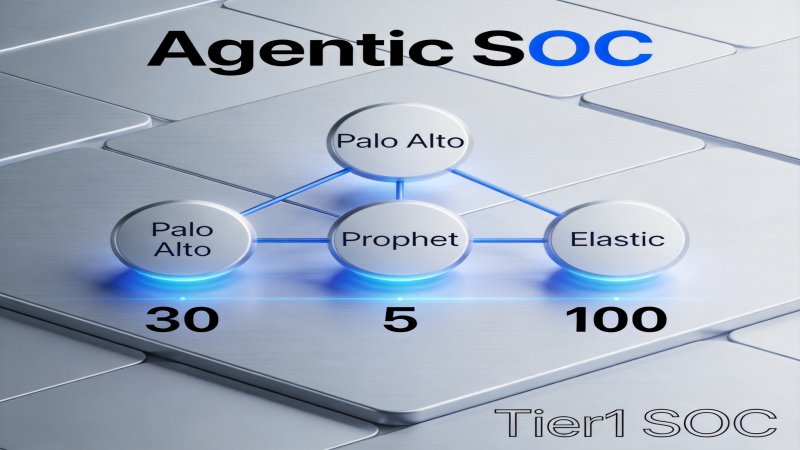
Raised $30M Series A in 2025, launching complete Agentic AI SOC Platform. Core philosophy: Use AI to mimic how human analysts investigate:
- End-to-end investigation: Agents automatically build investigation plans, collect evidence across data sources, dynamically adjust investigation paths
- Fundamental SOAR difference: SOAR answers what steps should run? Agent answers what is actually happening, and does it matter?
- Customer metrics: 10x SOC throughput; 90% MTTI/MTTR reduction; 75% faster triage and investigation; 100% alert coverage
Elastic: Agentic Security Platform
Positioned as Agentic AI SOC platform emphasizing open architecture and transparent AI:
- Attack Discovery: Correlates alerts, behaviors, attack paths with RAG context to automatically surface threats
- Agent Builder: Connects tools and data sources to build custom AI Agents
- Elastic Workflows: Deterministic orchestration engine working with Agents
Microsoft Security: Agentic SOC Vision
Published The Agentic SOC whitepaper in April 2026, proposing three-tier evolution: SOC 1-Unified platform foundation, SOC 2-Generative AI accelerates operations, SOC 3-Agentic automation.
3. Technical Analysis: Agent Cluster Collaboration and Autonomous Decision Loop
From Copilot to Agentic: Paradigm Shift
Traditional AI Copilot is reactive—analyst initiates query, AI provides answer, human always in loop. Agentic AI core features autonomy:
- Plan: Dynamically build investigation plans based on threat scenarios
- Reason: Form inferences on incomplete/noisy data, test hypotheses
- Adapt: Real-time strategy adjustment based on new evidence
- Act: Call tools, execute actions, close loop
Agent Cluster Architecture
Alibaba Cloud Agentic SOC uses Team Leader + specialized Agent team layered architecture. Team Leader Agent coordinates, with specialized threat detection, investigation, impact assessment, user interaction agents—avoiding single-agent capability ceiling.
Autonomous Decision Loop
Complete Agentic SOC loop: Perception (continuous multi-source telemetry monitoring) → Analysis (correlate alerts, reconstruct attack chain) → Decision (confidence assessment, action recommendations) → Execution (automated response, human approval) → Learning (feedback loop, model optimization).
Key is Human-in-the-Loop—AI handles high-confidence scenarios, humans retain complex decision authority.
4. Market Landscape: Titans Clash, Each with Focus
Current market presents two superpowers, multiple strong players pattern: Palo Alto Networks, Microsoft Security dominate enterprise market via existing customer base; Elastic (open transparency), Prophet Security (vertical focus), Alibaba Cloud (local cloud-native) each have differentiated positioning.
Core competition shifted from feature completeness to Agent autonomous capability—whoever builds smarter, more controllable, more explainable Agents wins the next-generation SOC market.
5. Prediction: Agentic SOC Becomes Standard, Tier1 Transformation Inevitable
2026-2027: Mass Deployment
Agentic SOC transitions from early adopter to mainstream. Over 60% of SOCs expected to deploy some form of AI Agent. Basic capabilities like alert triage, incident investigation, automated response converge—core differentiation shifts to Agent reasoning depth, governance transparency, LLM controllability.
2028-2030: Tier1 Analyst Redefinition
Traditional Tier1 SOC analyst (L1 triage) faces transformation pressure. AI Agents already complete 90%+ routine classification work. Human roles shift to: AI output reviewer, Agent parameter tuner, complex threat analyst.
Long-term Trend: SOC Disappears and Evolves
Bold prediction: Traditional alert triage center SOC gradually disappears, replaced by threat decision center. When AI Agents handle virtually all routine alert classification and preliminary investigation, SOC value shifts to threat intelligence research, attack surface management, security architecture optimization.
Conclusion
Agentic SOC's emergence resembles the iPhone moment in security operations—it redefines human and machine roles: machines handle speed and scale, humans handle judgment and strategy.
For enterprise security leaders, Agentic SOC is no longer whether to adopt but when to adopt. Early movers are building advantages; those who wait need to accelerate.
Why it Matters
DECISION
PREDICT
Get 3-5 key AI infrastructure signals weekly →
💬 Comments (0)